What Content Still Earns Clicks in Zero-Click Search (2026): A “Not-Answerable” Strategy for Affiliate and Lead Gen Sites
Many publishers treat AI Overviews as a traffic problem. That is true, but only partly.
The more useful framing is this: zero-click search exposes weak business models. If a page mostly repeats an answer Google can summarize in seconds, the drop is not just an SEO problem. It is a monetization problem.
Search still sends clicks. But Google is getting better at handling the easy layer of the job: summarizing, broad comparisons, and follow-up refinement before a user ever visits a site.[^1][^2] The pages that still earn visits are the ones where the click does something the SERP cannot.
Zero-click search did not kill content. It killed easy-answer content.
Why this is really a monetization issue
For affiliate and lead-gen sites, the old model was straightforward: publish a large volume of informational content, win early clicks, and let a share of that traffic move toward commercial pages.
That model weakens when the query is satisfied before the click.
SparkToro’s clickstream analysis found that 68.01% of U.S. Google searches in the first four months of 2026 ended without a click, and AI Overviews appeared on more than 20% of searches in its dataset.[^3] Those are third-party numbers, not Google’s own reporting, so they are better treated as directional than definitive. Still, the strategic lesson is hard to ignore: if the SERP can resolve the query, low-intent pageviews become less dependable.
What AI Overviews and AI Mode changed
Google’s product updates make the direction clear. In March 2025, it expanded AI Overviews and introduced AI Mode for harder, multi-part, and multimodal questions.[^1] By May 2025, Google said users were asking longer, more complex questions, with AI Mode built for deeper follow-ups and links to the web.[^2] In May 2026, Google said AI Mode had passed 1 billion monthly active users globally.[^4]
Search is no longer just ranking pages. It is trying to complete the first layer of the task.
The core idea
This is the line that matters:
- AI-answerable content gives the user a summary.
- Not-answerable content helps the user decide, calculate, configure, validate, or act.
If your page can be replaced by a competent answer box, it will struggle. If it depends on interaction, context, trust, or workflow support, it still has a reason to earn the click.
The “AI-answerable vs. not-answerable” test
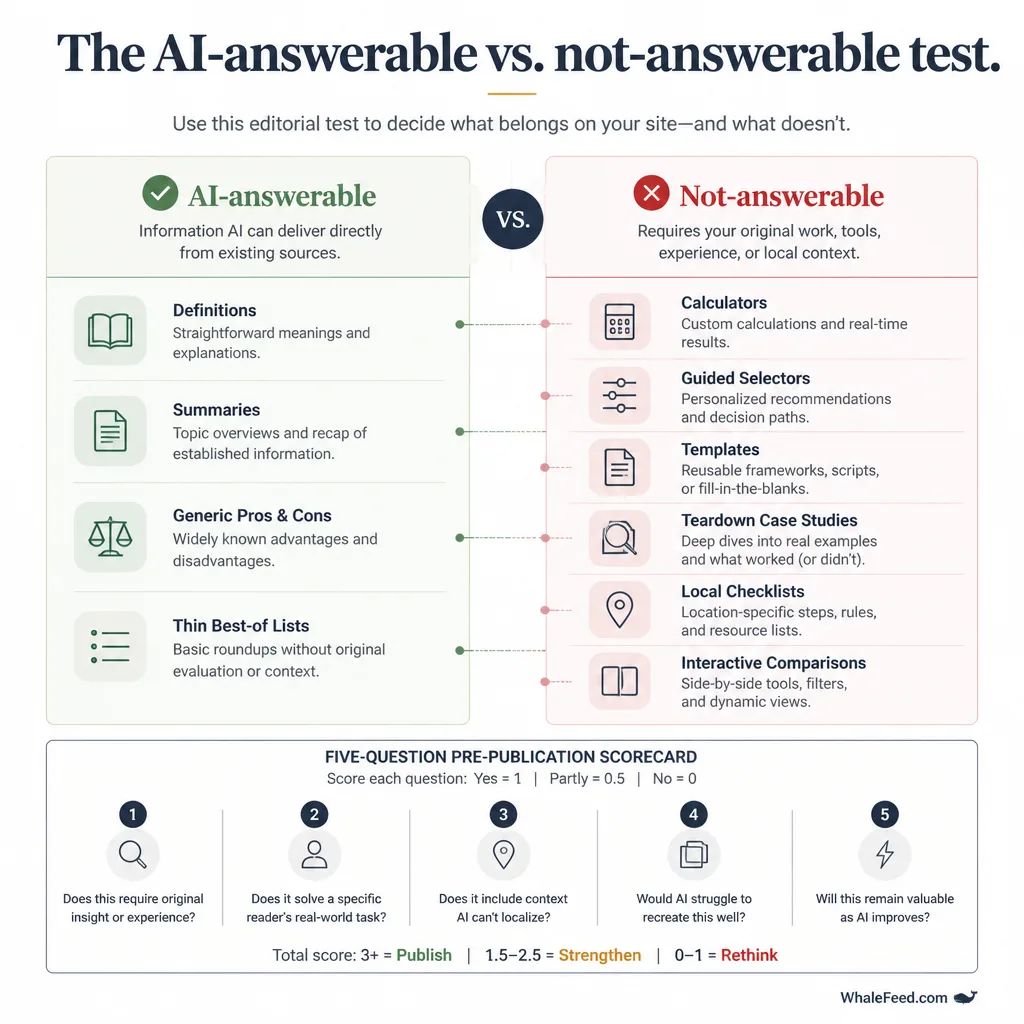
AI-answerable: facts, summaries, definitions, and generic recommendations
These formats are most exposed to zero-click behavior:
| Vulnerable format | Why it is exposed |
|---|---|
| “What is X?” pages | Easy to summarize in the SERP |
| Generic pros-and-cons articles | Can be compressed into a short answer |
| Thin “best tools” roundups | Often reduced to broad recommendation lists |
| Surface-level comparisons | Usually lack real decision logic |
That does not mean they have no value. It means they should not be your main growth engine unless they support something stronger.
Not-answerable: pages that require context, trust, or action
The more resilient pages usually do at least one of these things:
- ask for user inputs
- adapt recommendations to a specific scenario
- reduce decision risk
- provide firsthand proof
- help the user complete a task
A mortgage calculator is harder to replace than a mortgage explainer. A CRM selector is harder to replace than a generic “best CRM” list. A teardown with real spend, screenshots, and mistakes is harder to replace than a polished summary of other people’s advice.
A five-question filter before you publish
Before publishing a page, ask:
- Can AI answer this in under 20 seconds without losing much value?
- Does the user need to enter inputs, filters, or constraints?
- Is the decision risky enough that trust or proof matters?
- Does the page help the user act, not just understand?
- Would two different users need meaningfully different answers?
If the answers point to summary, sameness, and low risk, the topic is probably too answerable. If they point to variation, context, and action, the page may still deserve to exist.
Content formats that still earn clicks in 2026
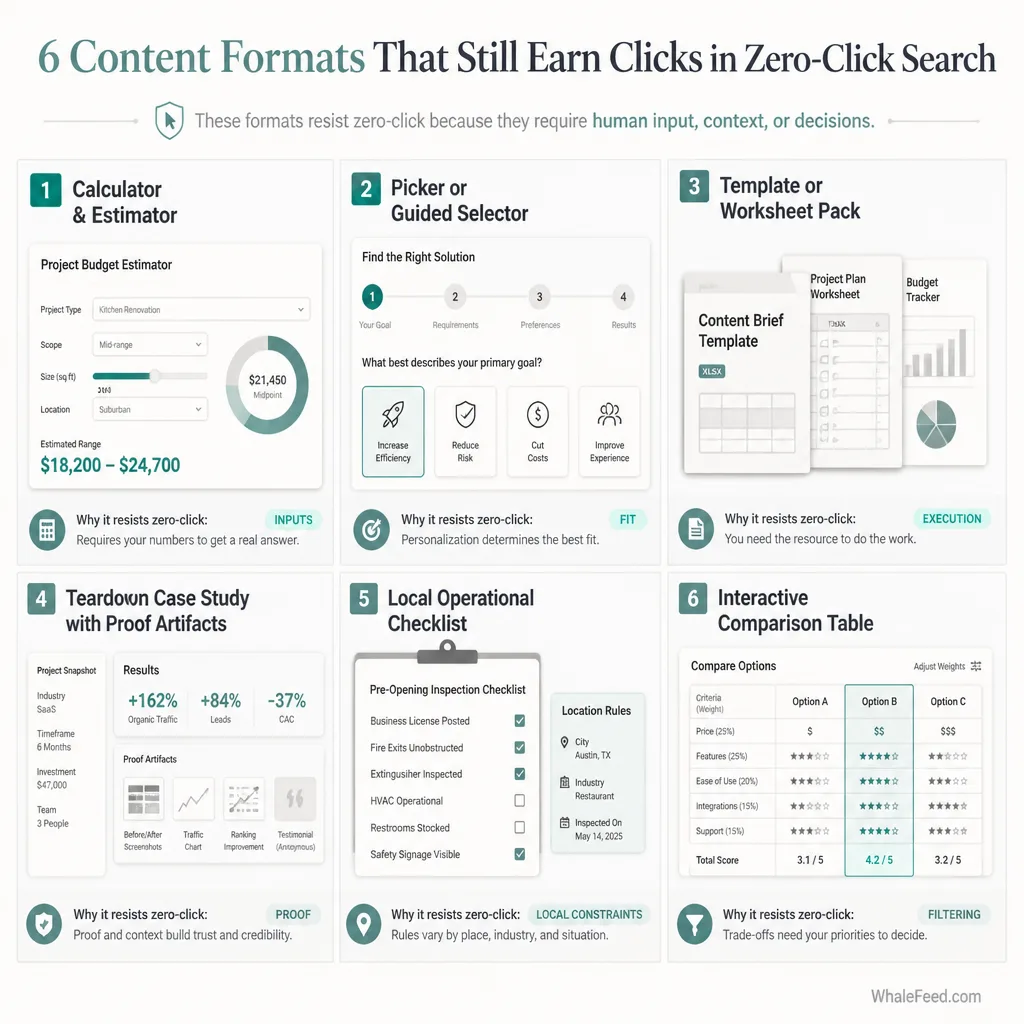
Calculators and estimators
These work because the output changes with the input.
Examples:
- affiliate commission calculators
- CAC payback estimators
- local project cost calculators
- email platform pricing estimators by subscriber count
A B2B SaaS affiliate page becomes much stronger when it lets a visitor estimate cost at 10,000 contacts, compare annual versus monthly pricing, and spot migration breakpoints.
Pickers, quizzes, and guided selectors
These work when the real problem is fit, not awareness.
A weak page says “best email marketing software.”
A stronger page asks:
- ecommerce or SaaS?
- list size?
- simple campaigns or advanced automation?
- need a built-in CRM?
- migrating from another tool?
- budget ceiling?
That is not just content. It is decision support.
Templates, worksheets, and implementation packs
Templates still earn clicks because they save execution time.
Examples:
- lead qualification worksheet
- affiliate content audit template
- campaign naming convention pack
- SOP checklist for ad account handoff
A reader may understand the concept from the SERP and still click because they want the asset that helps them do the work.
Teardown case studies with proof
This format is underrated because it transfers trust.
A real teardown might include:
- screenshots from the tool stack
- before-and-after landing page changes
- cost-per-lead movement over 60 days
- what failed before what worked
- why one tool was rejected, not just chosen
Google can summarize advice. It is much worse at reproducing firsthand evidence with operator judgment attached.
Local or operational checklists tied to real action
These work especially well for lead gen.
Examples:
- office relocation IT checklist for Chicago firms
- HOA solar permit checklist by county
- clinic website HIPAA intake checklist
- restaurant grease trap compliance checklist by city
Local constraints and operational detail create friction that a generic answer rarely resolves well.
Interactive comparisons and decision tables
Static comparison posts are fading. Interactive comparison tables still help because they let visitors narrow their options.
Useful filters include:
- starting price
- contract length
- best fit by team size
- migration difficulty
- reporting depth
- support quality
- implementation time
How to retrofit a dying “best X” page into a decision tool
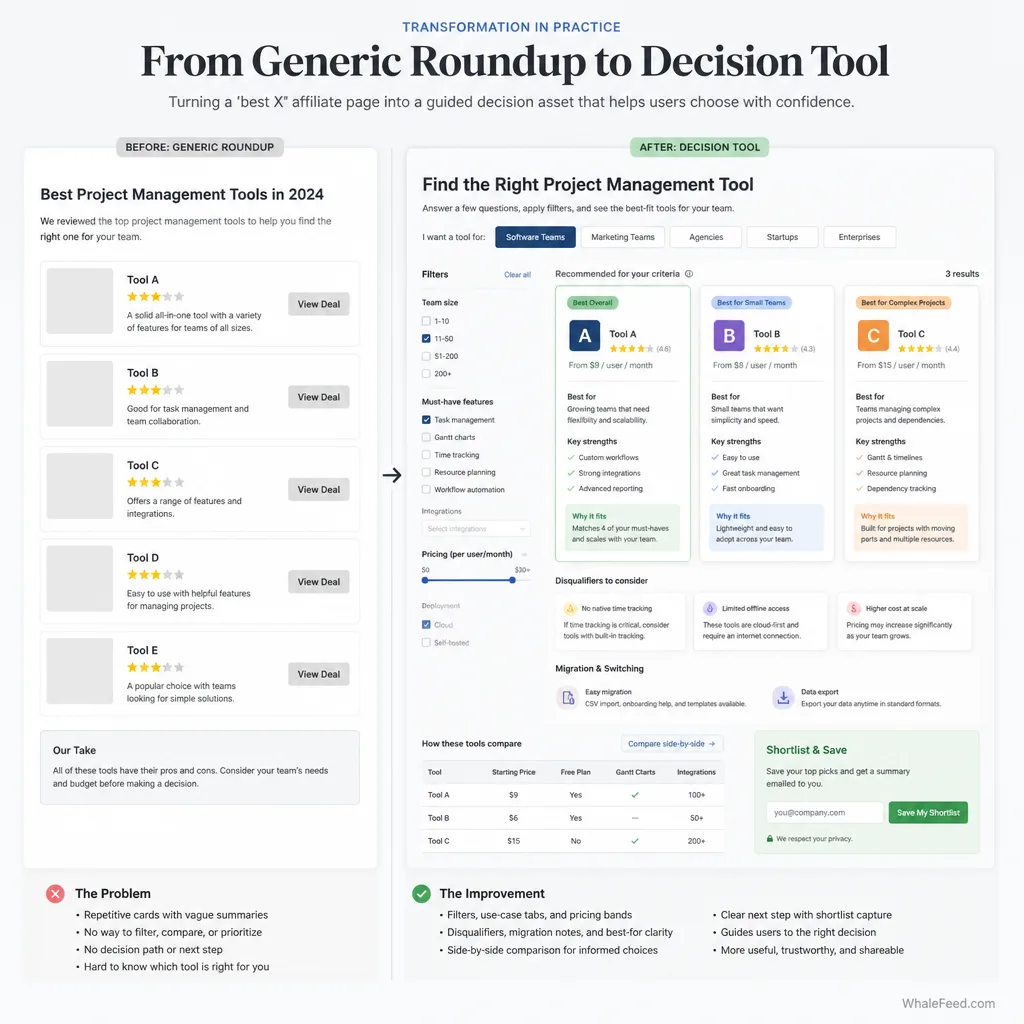
Start with the friction, not the keyword
Most old affiliate pages are not dead. They are underbuilt.
Take “best email marketing software.” The keyword is broad, but the buying friction is specific: budget, complexity, migration pain, deliverability needs, store platform, CRM requirements.
Build around that.
Add filters, scenarios, and disqualifiers
A stronger page includes:
- filters by business type and size
- “not for you if” callouts
- migration warnings
- price breakpoints
- best-for scenarios
- setup complexity notes
Disqualifiers matter. They build trust because they show judgment, not just ranking.
Replace generic reviews with “best for” paths
Instead of ten short reviews in a row, create decision paths:
- best for solo creators
- best for Shopify stores
- best for B2B sales teams
- best for advanced automation
- best low-cost option before 5,000 subscribers
That structure matches how real buyers think.
Capture intent while helping the user choose
This does not need to be aggressive.
If the page includes a selector, offer:
- a saved shortlist by email
- a recommendation summary
- a migration checklist download
- a consultation request for more complex setups
For lead gen, the asset should shape the CTA. A calculator can lead to an audit. A selector can lead to a shortlist review. A checklist can lead to implementation help.
Monetization has to match higher-intent clicks
Why recurring commissions matter more when traffic falls
When click volume drops, each click has to be worth more.
That usually favors:
- recurring SaaS commissions
- high-retention tools
- higher-AOV software
- offers with expansion revenue
- services with meaningful LTV
A one-time, low-payout offer built on casual traffic is more fragile than a recurring offer tied to a serious buying decision.
Why trials, demos, and usage-based offers fit decision-stage content
Decision-stage pages convert better when the offer matches the moment.
Examples:
- trial CTAs on software selectors
- demo bookings on comparison tools
- usage-based calculators tied to pricing pages
- “get your shortlist” flows before affiliate clicks
The closer the page is to a real decision, the less you should depend on generic display-style monetization.
How lead-gen sites should package the next step
For lead gen, this is often the cleanest shift:
- calculator → “email me the estimate”
- checklist → “book an implementation review”
- selector → “get a vendor shortlist”
- teardown → “request a custom audit”
The page should do more than attract a visit. It should create an obvious next action.
What to stop publishing, or at least stop leading with
Generic “what is” pages with no next step
If the page only explains, it is easy to displace.
Thin “best tools” roundups with no decision logic
These are especially vulnerable because AI can generate broad recommendation sets quickly.
Surface-level paraphrase content built from other rankings
This was already weak. It is weaker now.
Top-of-funnel pages with no trust, interaction, or differentiated insight
Top-of-funnel content is not useless. It just needs a job. If it does not lead into a tool, a decision page, an email capture, or a trust asset, it becomes harder to justify.
A simple 90-day migration plan
Audit existing URLs by answerability and monetization potential
Score each URL on:
- answerability
- click necessity
- commercial intent
- proof depth
- update effort
This usually reveals that some high-traffic pages are low-opportunity, while some mid-tier pages are one strong rebuild away from becoming meaningful revenue assets.
Upgrade the pages closest to decision intent first
Do not start with awareness content.
Start with pages where users are already comparing, shortlisting, pricing, or validating. These are closer to monetization and easier to turn into not-answerable assets.
Build one reusable interactive format
Do not reinvent the wheel on every page.
Pick one format:
- comparison engine
- pricing estimator
- guided selector
- checklist framework
Then reuse it across categories. That is usually a better bet than publishing twenty more generic articles.
Conclusion
The useful question in 2026 is not, “How do I get my old traffic back?”
It is, “What kind of page still deserves a click?”
That shift changes almost everything: what you publish, what you update, what you kill, and how you monetize. Pages built for summaries will keep losing ground. Pages built for decisions, inputs, proof, and action still have leverage.
Stop chasing answerable traffic. Build assets that cannot be reduced to an answer box.
FAQ
What is a zero-click affiliate strategy?
A zero-click affiliate strategy focuses on pages that still require a visit even when Google shows AI-generated answers in search. Instead of chasing easy informational clicks, it prioritizes content that helps users decide, compare, calculate, configure, or act.
What content still gets clicks in zero-click search?
The strongest formats are usually the ones AI cannot fully complete in the SERP: calculators, estimators, guided selectors, templates, teardown case studies, operational checklists, and interactive comparison tools. These earn clicks because the user needs inputs, context, proof, or workflow support.
Are AI Overviews killing all affiliate traffic?
No. The impact varies by query and intent, but informational searches are more vulnerable because Google can often summarize the answer before the click. Google has also expanded AI Overviews and AI Mode to handle more complex search behavior, which raises the bar for what deserves a visit.[^1][^2][^4]
How can I tell if a topic is too answerable by AI?
Use a simple test: can the query be satisfied by a short summary, or does it require user-specific inputs, tradeoff analysis, firsthand proof, local constraints, or decision support? If the SERP can resolve it in seconds, the page is more exposed. If the page helps the user choose, validate, or act, it is more likely to keep earning clicks.
How do I update an old best X affiliate page for 2026?
Turn it from a ranking list into a decision asset. Add filters, use-case paths, disqualifiers, pricing bands, migration concerns, and best-for scenarios. The goal is to help the visitor make a purchase decision, not just skim a generic roundup.
What should affiliate and lead-gen sites stop publishing?
They should reduce low-value formats that are easy for AI to compress: generic what-is pages, thin best-tools roundups, paraphrased informational posts, and broad top-of-funnel pages with no next step. These assets are increasingly hard to monetize when the answer appears directly in search.
Why does monetization matter more than traffic in zero-click search?
Because lower click volume changes the economics. If traffic falls, each visit has to be worth more. That is why recurring commissions, free trials, demos, usage-based software, audits, and consultation-led offers often fit better than low-payout offers that depend on large volumes of casual clicks.
Is there evidence that zero-click search is increasing?
Yes, though the exact impact depends on the source and keyword mix. Google continued expanding AI Overviews and AI Mode across 2025 and 2026,[^1][^2][^4] and SparkToro reported that 68.01% of U.S. Google searches in the first four months of 2026 ended without a click anywhere.[^3] Because that research is based on third-party clickstream analysis rather than Google’s own reporting, it is best used as directional evidence, not as a universal benchmark.