Affiliate Marketing After “Best X” Lists: Build Buyer Decision Systems AI Can Cite
Generic affiliate listicles worked when distribution did most of the work. Rank the page, earn the click, and let the merchant handle the sale.
That model is weaker now. Search is more crowded, answer engines can summarize generic comparisons, and too many affiliate pages say the same things in slightly different words. Google’s guidance has been consistent: original analysis, firsthand experience, and genuinely useful reviews matter more than thin summaries.[^1][^2]
The real shift is not “write longer reviews.” It is to change what the page does. Instead of publishing a ranked list with a vague recommendation, build a buyer decision system: a page that makes the decision easier by showing criteria, tradeoffs, pricing assumptions, scenario fit, and direct observations.
That approach is slower to produce. It is also much harder to replace.
Why “Best X” listicles are losing strategic value
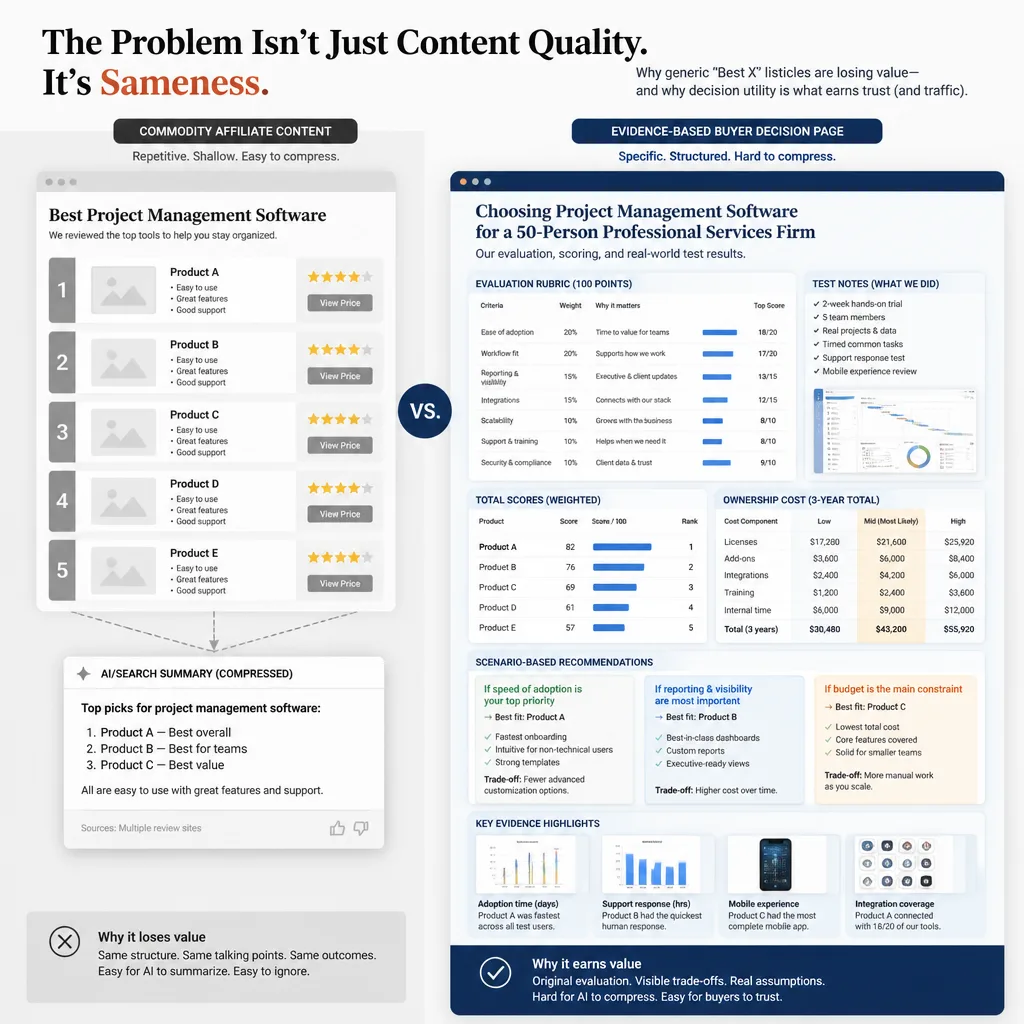
AI summaries compress generic comparison content
When ten pages make the same points, they become easy to condense. That is the bigger risk. Rankings may fluctuate, but the deeper problem is that interchangeable content can be collapsed into a short answer by search engines and AI interfaces.
There is some evidence that zero-click behavior is increasing. Bain reported in February 2025 that many users are relying more on search experiences that answer questions without a click, though that finding is best treated as directional rather than universal.[^3] The practical takeaway is simpler: if your page adds little beyond the standard consensus, it is vulnerable.
The problem is not only rankings. It is sameness.
Many affiliate publishers are solving for the wrong thing. They focus on broader coverage, cleaner formatting, or better-looking comparison tables.
But presentation is not differentiation. If your “best CRM” page is just a reshuffled version of every other “best CRM” page, it may still rank, but it offers little editorial defensibility. It gives readers a shortlist, not real help making a choice.
What still holds up: evidence, judgment, and decision support
Google’s reviews guidance is direct on this point: it aims to reward insightful analysis and original research, not thin summary pages.[^2] Its broader people-first guidance asks whether content offers original information, analysis, or firsthand expertise.[^1]
That does not guarantee any specific format will rank or get cited. But it does suggest a more durable advantage: evidence plus judgment. The goal is not to help readers browse. It is to help them decide.
The core shift: from recommendation pages to buyer decision systems
What a buyer decision system is
A buyer decision system is a commercial page built around the decision itself.
Instead of leading with a ranked list of brands, it leads with the logic behind the choice:
- what matters most in the category
- which criteria deserve the most weight
- how pricing actually works
- which product fits which situation
- what you tested directly
- what remains uncertain
The difference is simple. “Here are 12 tools” becomes “Here is how to choose the right one.”
Why decision systems are more useful and more cite-worthy
I would be cautious about claiming that AI tools directly reward rubrics or scorecards. There is no strong primary-source evidence proving that causal link.[^4] What decision systems do offer is something more grounded: they make your reasoning visible.
A clear rubric, cost model, and scenario map give readers something concrete to evaluate. Why is Tool A better for a three-person team but worse for a 20-person sales org? Why does Tool B look cheaper until you add contacts, onboarding, and migration time?
That is what real buyers need. Most are not looking for a generic winner. They want the right choice for their situation.
The thesis
Affiliates win when they reduce uncertainty, not when they add more options.
The most durable affiliate page is not the one with the longest list. It is the one that makes the decision easier than competing pages do.
The four evidence layers that replace commodity affiliate content
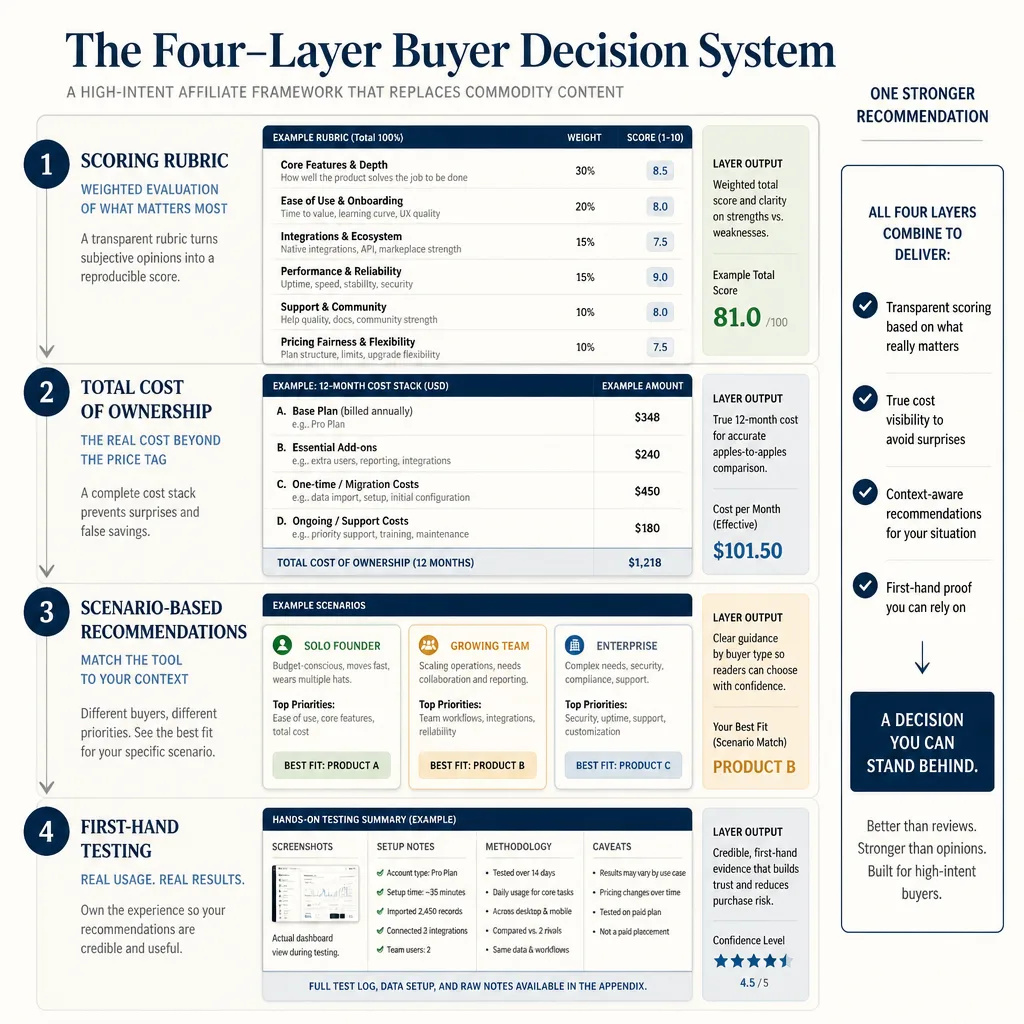
Scoring rubrics: make the evaluation logic visible
A scoring rubric is not a gimmick. It is a way to show how you are judging the category.
For a CRM comparison, the rubric might weigh:
- pricing transparency
- contact or seat scaling
- automation depth
- reporting quality
- onboarding friction
- integration flexibility
- switching cost
- support quality
The categories themselves are not the point. The point is the weighting.
A solo founder choosing for speed should not evaluate a CRM the same way a RevOps team replacing an entrenched system would. Your page should say that directly.
Total cost of ownership: go beyond list price
This is where many affiliate pages still fall short.
In software categories, the cheapest plan often tells you very little. Real costs show up in extra seats, workflow limits, API access, onboarding fees, premium support, compliance add-ons, usage overages, and migration labor.
Email platforms are a good example. A tool may look affordable at 5,000 subscribers, then become meaningfully more expensive once automation caps, sending tiers, and user permissions start to matter. The “best” option can change again if migration help or advanced segmentation becomes necessary.
A useful comparison page does not stop at sticker price. It shows likely cost under realistic conditions.
Scenario-based recommendations: best for whom?
One overall winner is often a shortcut.
A better structure is to recommend by scenario:
- best for a solo operator who needs fast setup
- best for a growing team expecting migration within 12 months
- best for compliance-sensitive buyers
- best for buyers focused on long-term cost
- best for teams that need advanced reporting
Hosting and VPNs illustrate why this matters. Performance can vary by geography, use case, traffic profile, or protocol. A recommendation that ignores those differences is usually too broad to be trusted.
Firsthand testing: show what you saw and what you could not verify
Firsthand testing matters because it produces details secondary research cannot.[^1][^2]
That does not mean every site needs lab-grade benchmarks. Usually, it means testing enough to produce original observations, such as:
- what setup actually looked like
- where onboarding caused friction
- which features were gated
- how pricing was presented in practice
- how support responded
- what broke, lagged, or felt confusing
- what kind of user would struggle most
If you tested three hosting providers, for example, you could compare onboarding flow, dashboard complexity, cache setup, support wait times, and migration friction. That is far more useful than another recycled paragraph about uptime.
A practical framework for choosing categories where evidence creates an edge
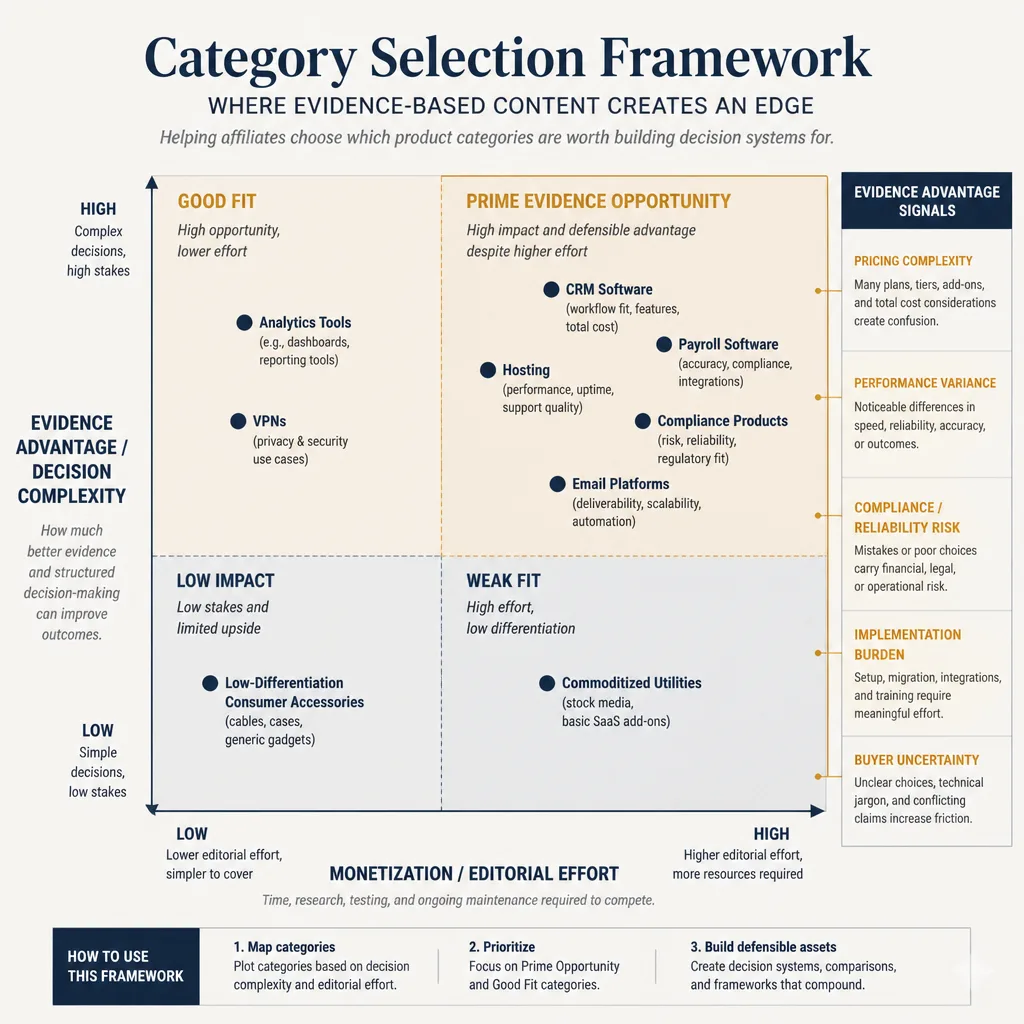
Not every affiliate category deserves this level of effort. A simple filter helps: evidence advantage vs. monetization effort.
The best categories tend to share five traits.
Signal 1: pricing complexity
The more pricing depends on seats, usage, limits, modules, or contracts, the more valuable your analysis becomes.
CRM, payroll, analytics, and email software are strong examples.
Signal 2: performance varies by use case
If product performance changes meaningfully by geography, workflow, scale, or team sophistication, shallow comparisons become less useful.
Hosting, VPNs, and analytics tools fit this pattern.
Signal 3: choosing badly creates real downside
When a bad choice creates compliance, accuracy, or reliability risk, buyers need more confidence.
That is common with privacy tools, payroll systems, tax software, and compliance platforms.
Signal 4: implementation and switching are painful
Some products are easy to buy but hard to adopt, migrate to, or unwind from.
In those categories, setup notes, migration caveats, and workflow testing become unusually valuable.
Signal 5: buyers still feel unsure despite abundant content
This is often the best opportunity: categories full of “best tools” content where buyers still lack confidence.
That usually means content volume is high, but decision support is weak.
How to build the page
Start with the decision, not the list
Open with the buyer’s real question.
Not “best project management tools.”
Better: “Which project management tool fits a 10-person agency that needs client-facing collaboration without enterprise overhead?”
That framing immediately makes the page more relevant.
Publish the rubric before the rankings
Show the criteria first, then the outcome.
This helps in two ways. It builds trust because readers can see how you are judging. And if someone disagrees with the final ranking, the logic is still visible. They may object to the weighting, but not to hidden reasoning.
Use scenario pathways instead of one winner
A strong decision page often has multiple winners because buyers have multiple constraints.
For example:
- Best for lowest operational cost: Tool A
- Best for advanced automation: Tool B
- Best for easiest migration: Tool C
- Best for regulated industries: Tool D
That is usually more honest and more persuasive than forcing a universal winner.
Show evidence inline
Do not hide the proof.
Add setup screenshots. Show the assumptions behind your cost table. Note whether support responded by live chat or email. State whether your test used a free plan, trial, or paid account.
Readers should be able to see how you know what you know.
Separate facts, judgments, and unknowns
This is one of the simplest ways to build credibility.
Use three layers:
- Facts: plan limits, pricing terms, integrations, contract details
- Judgments: who the product fits best and why
- Unknowns: what you could not verify, what may change, and where outcomes depend on context
That separation makes the page more trustworthy because it does not pretend certainty where certainty is impossible.
Why this can improve monetization even with fewer clicks
Fewer clicks can still produce stronger EPC
This is possible, not guaranteed.
If your page does a better job filtering out poor-fit buyers and sending the right ones forward, you may end up with fewer clicks but better conversion efficiency. In categories where trust and fit matter, that can improve EPC.[^3]
Specificity pre-qualifies buyers
A reader who clicks after reviewing pricing assumptions, migration concerns, and scenario fit is usually further along than a reader coming from a generic top-10 post.
That matters because merchants do not pay for curiosity. They pay for qualified intent.
Better clicks often beat more clicks
A page that sends 1,000 weak clicks is not automatically better than one that sends 250 high-conviction clicks.
That is especially true in software and service categories where the sale depends on confidence, not novelty.
Monetization systems that fit evidence-based affiliate content
Email capture with comparison-native lead magnets
Generic newsletter forms are usually weak here.
A better option is an asset that continues the decision, such as a:
- shortlist scorecard
- pricing calculator
- migration checklist
- implementation worksheet
- scenario buyer guide
The lead magnet should extend the decision process, not interrupt it.
Interactive buyer guides, calculators, and scorecards
These tools work because they turn passive reading into active evaluation.
A CRM calculator based on contacts, seats, and onboarding assumptions can outperform a static table because it personalizes the comparison.
Segmented follow-up by use case
If someone downloads a migration checklist, send migration-focused follow-ups.
If they use a pricing calculator, send plan-comparison emails and contract caveats.
This is where specificity compounds. You are not nurturing a generic subscriber. You are helping someone resolve a defined purchase decision.
Delay the affiliate click when necessary
Some categories convert better when the first visit educates and the second or third interaction monetizes.
That is not a weakness. It often means the buyer is taking the decision seriously.
Where this approach fails
Low-differentiation, low-stakes products
If buyers do not care much and products are barely distinguishable, heavy evidence work may not pay off.
Some categories still reward speed more than depth.
Categories you cannot credibly test
If you cannot access the product, validate the experience, or verify meaningful differences, your “decision system” risks becoming a polished guess.
That is not defensible.
Teams that cannot trade speed for quality
This model is slower. It requires research discipline, testing, and editorial restraint.
If your operating model depends on publishing 30 thin commercial pages a month, this is a difficult shift.
Weak affiliate economics
Some affiliate programs simply do not justify this level of editorial effort.
If commissions are thin and research costs are high, the unit economics stop working.
What affiliates should do next
Start by auditing your existing money pages for evidence depth.
Ask a simple question: does each page include original observations, explicit criteria, realistic cost assumptions, and scenario-specific judgment? Or is it mostly well-formatted consensus?
Then choose one category where buyer uncertainty is high. CRM software is a strong example because pricing, implementation burden, and switching costs vary enough to reward depth. Hosting, payroll, analytics, and compliance software can work for similar reasons.
Finally, rebuild one listicle into a decision system before scaling the model. Publish the rubric. Add cost logic. Show what you tested. Create one buyer-specific lead magnet. Then measure not just traffic, but click quality, downstream conversion behavior, and EPC.
Conclusion
The problem with old-school affiliate listicles is not only that search has changed. It is that too much commercial content became easy to replace.
The stronger model is to publish decision infrastructure: pages that reduce uncertainty through evidence, explicit judgment, realistic cost analysis, and firsthand observation. That aligns more closely with what Google says it values in helpful and review-focused content, and it gives readers something more durable than another recycled ranking.[^1][^2][^4]
Done well, this approach may produce fewer casual clicks. But it can create something more valuable: trust, defensibility, and better-qualified buyer intent.
That is a stronger business than chasing one more interchangeable “best X” post.
FAQ
Why are traditional “Best X” affiliate listicles losing value?
Because many of them are interchangeable. When pages mostly repeat the same feature summaries and rankings, they become easy for search engines and AI interfaces to compress. The stronger alternative is content built on original evidence, explicit evaluation logic, and real buyer guidance.[^1][^2][^3]
What is a buyer decision system in affiliate marketing?
A buyer decision system is a commercial content format designed to help readers make a choice, not just scan a ranked list. It usually includes a scoring rubric, total cost breakdown, scenario-based recommendations, testing notes, tradeoffs, and a clear separation between facts, judgments, and unknowns.
Will scoring rubrics make AI tools cite my content?
Not automatically. A rubric is not a citation trick. Its value is that it makes your reasoning visible and easier to inspect. Combined with firsthand testing, pricing analysis, and useful scenario guidance, it can make your content more original and more trustworthy, but that link should be treated as informed inference, not proven rule.[^4]
What should a good affiliate scoring rubric include?
It should reflect how buyers actually choose in that category. For software and services, common criteria include pricing transparency, implementation difficulty, performance, support quality, compliance or reliability risk, flexibility, switching cost, and fit for specific use cases. The key is not just the criteria, but the weighting and the explanation behind it.
How much firsthand testing is enough for affiliate content?
Enough to produce observations secondary research cannot. That might include account setup, onboarding friction, sample workflow testing, pricing verification, support interactions, migration notes, limitations, and screenshots. You do not need lab-grade testing for every category, but you do need evidence of direct experience.[^1][^2]
Which affiliate categories suit an evidence-based decision model?
Usually the best candidates are categories with pricing complexity, performance variance, implementation burden, switching costs, or compliance risk. Examples include CRM software, email platforms, hosting, VPNs, analytics tools, payroll software, and compliance products.
How does total cost of ownership improve comparison content?
It surfaces costs buyers often miss in simple reviews. In many categories, the real decision is shaped by seat limits, overages, onboarding fees, support tiers, migration effort, contract terms, and add-on modules. Explaining those costs makes the recommendation more useful and more credible.
Can fewer clicks still improve affiliate revenue?
Sometimes, yes, though not always. If your content pre-qualifies visitors more effectively, the people who do click may have stronger intent and more trust, which can improve EPC or conversion efficiency in some categories.[^3]
What lead magnets work best with evidence-based affiliate pages?
The best lead magnets continue the buying decision. Strong options include shortlist scorecards, pricing calculators, migration checklists, implementation worksheets, and scenario-based buyer guides. Generic newsletter forms are usually less effective.
Where does this model fail?
It is less effective in low-stakes, low-differentiation categories where buyers want speed and products are hard to distinguish. It also struggles when you cannot credibly test the products, when commissions do not justify the research effort, or when the site cannot support slower, evidence-heavy production.