Affiliate Sites in 2026: How to Build a “Price & Availability Truth Layer” That Keeps Content Accurate and Converts Better
Affiliate content rarely fails because the recommendation is wrong. It fails because the details drift.
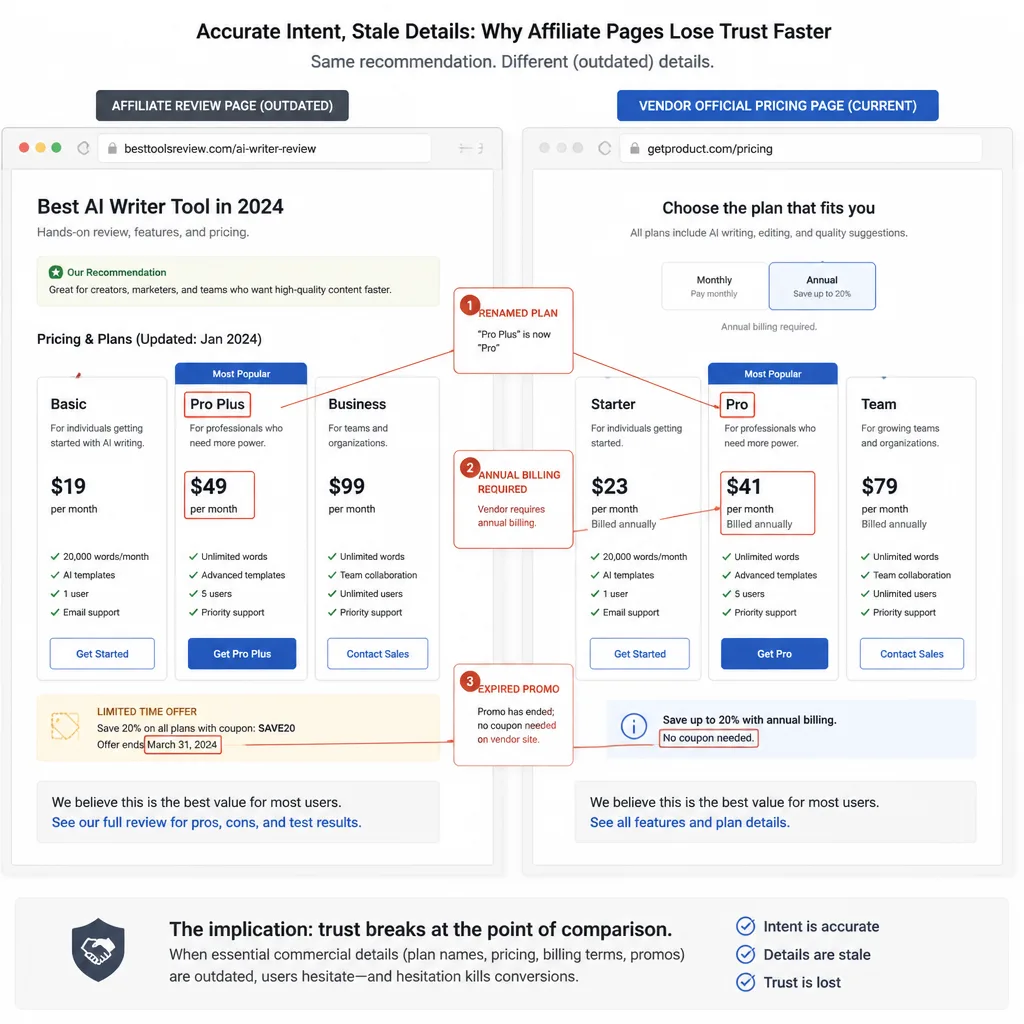
A review page says a tool starts at $29 per month. Three weeks later, the vendor has renamed the plan, changed annual billing terms, and moved the free trial behind a sales form. The recommendation may still be sound, but the page is no longer accurate. That is where trust starts to break.
In 2026, the risk is bigger because commercial content is being scanned, summarized, and repeated across more surfaces. If your page shows stale pricing, expired promos, or outdated availability, the damage is not just editorial. It is commercial. Readers bounce, hesitate before clicking, or land on a page that immediately contradicts what you wrote. Google’s guidance still emphasizes helpful, reliable, people-first content, and the FTC’s standard remains straightforward: claims should be truthful, not misleading, and supported when necessary.[^1][^2]
The answer is not endless manual edits. It is a maintainable system: one source of truth for volatile commercial facts, visible verification where it matters, a monitoring process, and a refresh cadence based on revenue risk.
Why affiliate content loses trust faster in 2026
The real failure mode: good recommendation, outdated details
Many affiliate pages are broadly right but practically wrong.
The product still fits the use case. The recommendation still makes sense. But the details that matter at the moment of purchase have changed: plan names, billing intervals, coupon rules, free trial eligibility, stock status, or geo availability.
Readers do not interpret that as an editorial systems problem. They see an outdated page.
Why AI summaries make stale details more costly
There is also a broader distribution risk. This is best treated as a practical operational concern, not a universal rule: when outdated pricing or promo language stays live on your page, it becomes easier for third-party systems, summaries, and snippets to repeat it elsewhere.
That matters because commercial details often outdate faster than opinions. A vendor might rename “Starter” to “Launch,” remove monthly billing, or end a 20% annual discount while your comparison table still shows the old offer.
This is not just a UX issue
The FTC says advertising claims must be truthful, not misleading, and that qualifying information should be clear and placed close to the claim it qualifies.[^2][^3] Google, from a search quality perspective, says it wants helpful, reliable content created for people.[^1]
Neither source says you need a timestamp on every affiliate page. But together they point to a clear operational conclusion: if your most commercial claims change often, you need a system to keep them accurate and properly qualified.
That is why stale pricing is not a housekeeping issue. It affects trust, click confidence, support friction, and likely conversion quality, even if the exact impact varies by site.
The core idea: build a price and availability truth layer
What it is, and what it is not
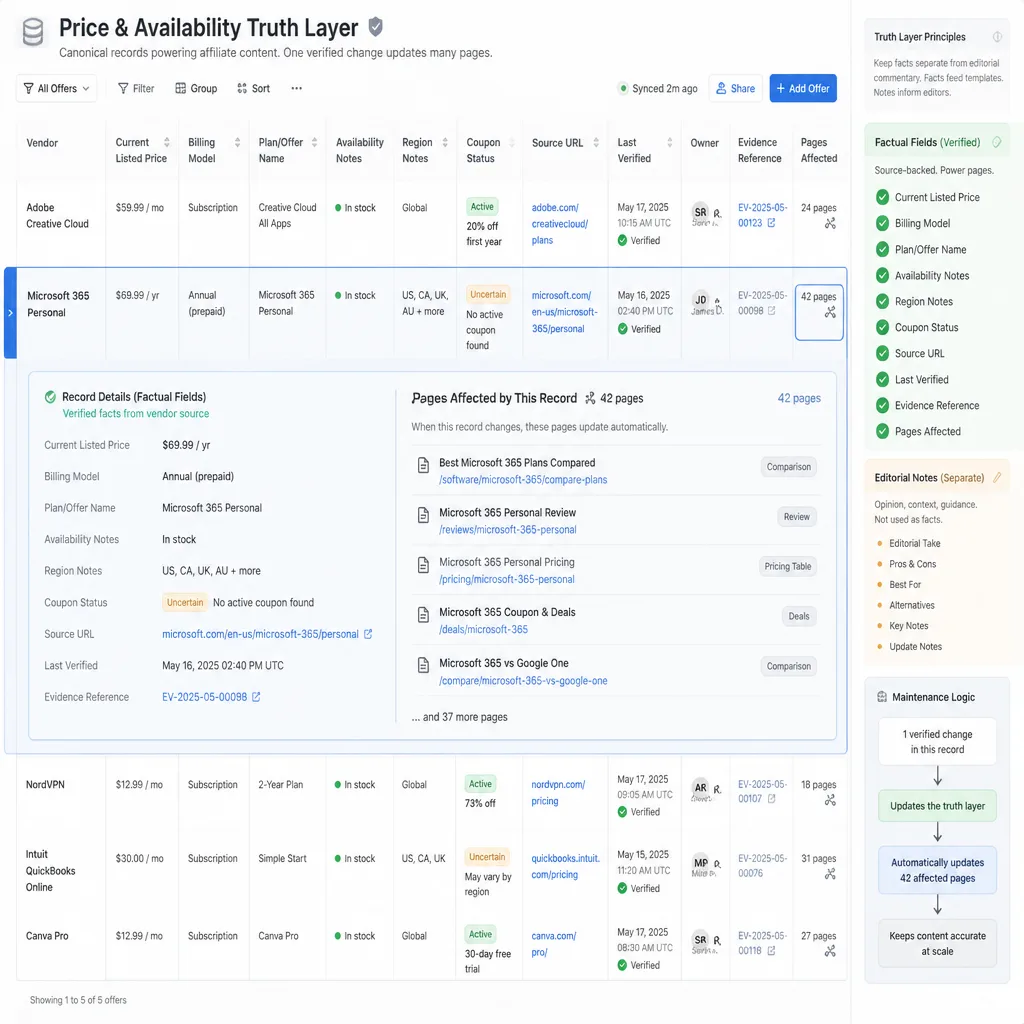
A truth layer is a central record for unstable commercial facts.
It is not your CMS. It is not your editorial opinion. It does not need to be a complex database. For most publishers, a spreadsheet, Airtable, or Notion table is enough to start.
Its job is narrow but important: maintain one canonical version of the facts most likely to go stale.
Think of the system in four parts:
- Truth layer: canonical facts
- Page rendering: how those facts appear on pages
- Monitoring: how you detect changes
- Refresh governance: who checks what, how often, and with what evidence
The minimum fields to track
Your basic schema should include:
| Field | Why it matters |
|---|---|
| Vendor / offer name | Prevents naming drift across pages |
| Current listed price | Core commercial claim |
| Billing model | Monthly, annual, one-time, or usage-based |
| Plan names | Important when vendors rename tiers |
| Availability notes | Trial status, stock status, sales-only access |
| Region notes | Currency, VAT inclusion, geo restrictions |
| Coupon / promo status | Prevents expired offer copy from lingering |
| Source URL | Canonical evidence location |
| Last verified date | Freshness signal |
| Checker / owner | Accountability |
| Evidence reference | Screenshot, saved note, archive link |
| Pages affected | Lets one change trigger multiple updates |
Why this works better than fixing pages one by one
Without a truth layer, maintenance happens page by page. That sounds manageable until a SaaS company changes three plan names and a coupon rule across your homepage comparison table, two alternatives posts, one dedicated review, and four roundup pages.
At that point, the real problem is not writing. It is synchronization.
A centralized truth layer will not eliminate work, but it does reduce contradictory updates and missed edits. That makes it less of a tactic and more of an editorial operating system.
What belongs in the truth layer
Different offer types need different fields
For SaaS, track price, billing interval, free plan or trial terms, seat limits if they materially affect the advertised rate, and whether the listed price requires annual billing.
For ecommerce offers, track current price, sale status, stock or availability notes, shipping restrictions if relevant, and whether model or color changes the displayed price.
For service offers, “price” may need to become starting at, custom quote, or contact sales. That is still useful, as long as the uncertainty is explicit.
Separate factual data from editorial opinion
Keep factual fields separate from editorial interpretation.
“Starter plan renamed to Launch on June 14, 2026” is factual.
“Best choice for freelancers” is editorial.
When those get mixed together, refreshes become messy. The person checking a pricing page should not have to re-evaluate every value judgment just to update a factual record.
Record uncertainty instead of faking precision
This is where many affiliate sites create avoidable problems. They turn ambiguity into false precision.
Instead, use controlled qualifiers such as:
- Starting at
- Annual billing required
- Pricing varies by region
- Contact sales
- Promo observed on July 8, 2026
- Free trial availability varies by plan
That language is not weaker. It is more durable.
How to show accuracy on the page without hurting conversions
Put verification near price-sensitive claims
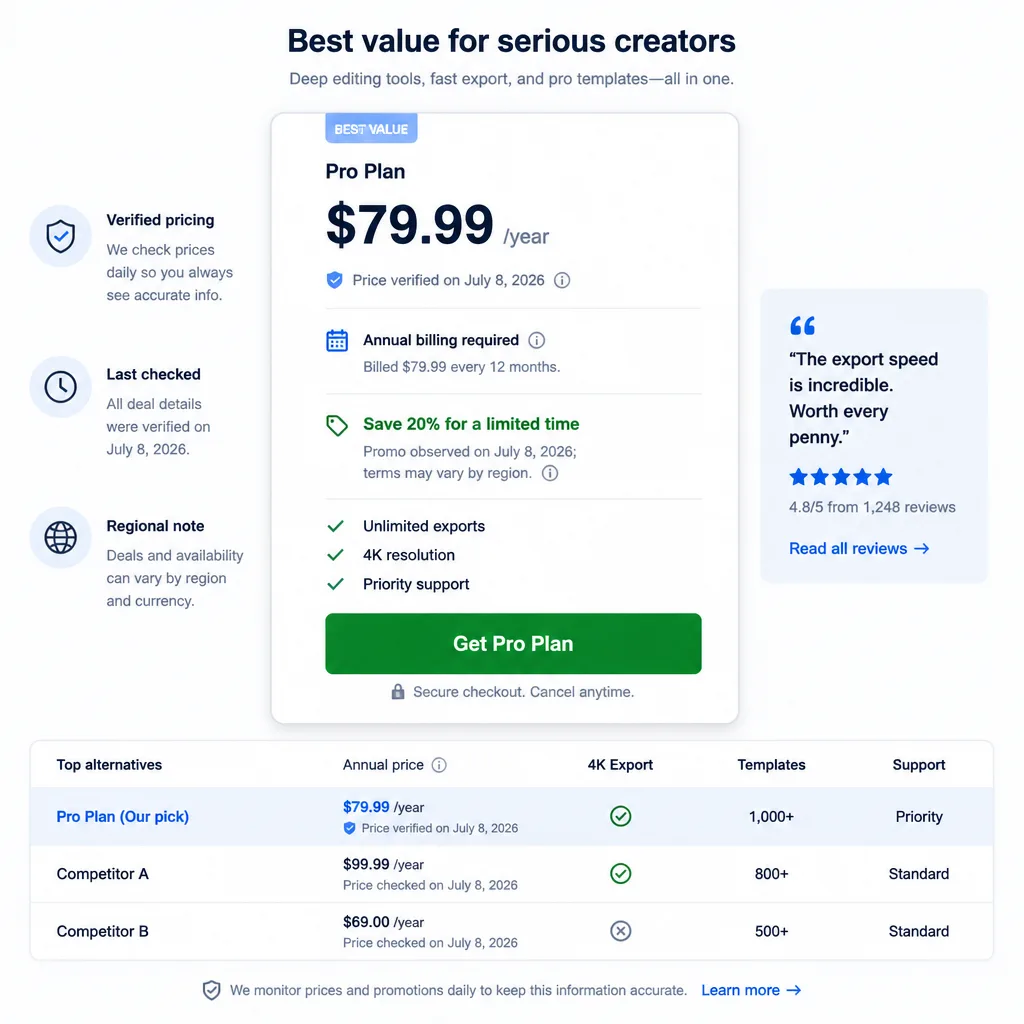
The best place for verification language is not the footer. It is next to the volatile claim itself.
Examples:
- Price verified on July 8, 2026 from the vendor pricing page
- Annual billing required for this rate
- Promo observed on July 8, 2026; terms may vary by region
This aligns with FTC guidance that qualifying information should be clear, unambiguous, and close to the claim it qualifies.[^2]
Use disclaimers selectively
Do not cover the page in defensive copy.
A comparison table, promo box, or CTA-adjacent price claim may need a short qualifier. A 2,500-word review does not need “prices may change” repeated throughout.
The rule is simple: add friction only where volatility creates real risk.
Where disclosures actually belong
The FTC is especially clear on one point: fine print cannot rescue a misleading main claim, and disclosures should not be buried or contradicted elsewhere.[^2][^3]
So if your page says “Get 40% off” and the offer expired last week, a tiny note underneath does not fix the problem. You need to update or remove the claim.
Monitor change signals before pages go stale
The highest-signal sources
The best sources are usually:
- Official pricing pages
- Plan comparison pages
- Vendor changelogs or release notes
- Official help docs
- Affiliate dashboard updates
- Vendor email announcements
These are stronger than third-party coupon sites, which can help as weak signals but should not be treated as canonical evidence.
A simple monitoring stack for solo operators
You do not need custom software.
A workable setup for one person looks like this:
- Spreadsheet or Airtable truth layer
- Saved bookmarks for pricing pages
- Email filters for vendor updates
- Calendar reminders by page tier
- One review queue sorted by next verification date
That is enough to manage dozens, and sometimes hundreds, of commercial pages if the process stays disciplined.
What should trigger an immediate review
Do not wait for the scheduled refresh if any of these happen:
- Plan rename
- Pricing restructure
- Monthly or annual billing change
- Promo expiration
- New eligibility rules
- Free trial change
- Region restriction update
- Mismatch between your page and the vendor landing page
A useful rule: if the CTA destination now contradicts your page’s commercial claim, move that page to the front of the queue immediately.
Set refresh cadence by revenue risk, not publish date
Publish date is a weak prioritization signal. A page can be new and already wrong. An older page can still be commercially accurate if the volatile claims were verified yesterday.
A better model is revenue risk plus volatility.
Tier 1: top revenue pages reviewed weekly

These are the pages that drive the most money: comparisons, alternatives posts, best-of roundups, and high-click reviews where prices or promos influence the click.
If the vendor changes offers often, weekly is a strong default.
Tier 2: mid-tier commercial pages reviewed monthly
These pages matter, but they do not justify weekly effort. Monthly review works for many stable tools, service providers, and evergreen comparisons.
Tier 3: long-tail pages reviewed quarterly
Quarterly is reasonable for lower-revenue pages or offers with relatively stable pricing.
When to break the cadence
Adjust the schedule when the market changes:
- Product launch
- New pricing architecture
- Seasonal promo period
- Checkout migration
- Currency or VAT policy shift
This is a recommendation, not a universal law. But it is much more useful than a blanket “update everything every 90 days.”
Regional pricing, coupons, and limited-time offers are where sites get sloppy
Regional pricing is where vague copy turns misleading fastest.
If a price only applies in the US, say so. If VAT is included in EU pricing but not in US pricing, that matters. If a plan is unavailable in certain countries, put that near the claim instead of burying it in a generic note.
Coupons need even tighter handling. Common failures include expired codes, non-stackable promos, annual-only discounts, and new-customer-only eligibility.
A practical standard is this: if you mention a promo, log the source page, observed date, eligibility note, and affected URLs. If the vendor later removes the offer, you should be able to trace exactly why your page said it existed.
That also makes the copy more credible. “Save 20% with annual billing as of July 8, 2026” is stronger than a vague promise like “best deal available.”
A lightweight QA workflow for solo operators and small teams
Small publishers often avoid process because they associate it with bureaucracy. That is the wrong comparison.
The real choice is between a lightweight workflow and recurring trust leaks.
The three-step workflow: verify, update, publish log
Verify: Check the source page, confirm the current facts, capture evidence.
Update: Change the truth-layer record first, then update affected pages.
Publish log: Record what changed, when, and where.
That last step matters more than it seems. An audit trail helps when a vendor changes something twice in one month or when an old screenshot shows a different offer.
Ownership still matters if you work alone
If you are solo, ownership is still necessary. It is just all yours.
The simplest approach is batching:
- Monday: verify Tier 1 pages
- Wednesday: update affected pages
- Friday: clean the log and resolve mismatches
Structure beats memory.
Keep the audit trail simple
At minimum, log:
- Date checked
- Source reviewed
- Change found or not found
- Pages updated
- Evidence saved
That is enough to create accountability without turning your content operation into compliance theater.
Templates you can copy
Pricing change log template
| Date checked | Vendor | Offer / plan | Source URL | Old detail | New detail | Region note | Promo note | Pages affected | Updated by | Evidence |
|---|
Verification checklist template
Before updating a page, verify:
- Listed price
- Billing interval
- Annual vs. monthly terms
- Plan names
- Free trial or free plan status
- Coupon or promo eligibility
- Region / currency / tax note
- Availability restrictions
- Source URL
- Date checked
- Evidence captured
- Affected pages identified
Page-level QA workflow template
| Step | Owner | Action | Output |
|---|---|---|---|
| Verify | Editor / operator | Check vendor source and capture evidence | Updated truth-layer record |
| Update | Editor / operator | Change page copy, tables, promo boxes | Revised page |
| Publish log | Editor / operator | Record change and next review date | Audit trail |
The practical takeaway
Accuracy becomes scalable when you treat it like infrastructure.
That is the real shift. Not “refresh content more often.” Not “add a disclaimer.” Build a system where volatile commercial claims have one source of truth, visible verification where it matters, a monitoring loop, and a refresh cadence tied to revenue risk.
Do not start site-wide. Start with your highest-risk pages: the ones that drive the most clicks, mention prices most aggressively, or depend on promos that change often.
That is where trust is easiest to lose. It is also where disciplined accuracy usually pays back fastest.
FAQ
What is a price and availability truth layer for affiliate content?
A truth layer is a central record for volatile commercial details such as current price, billing model, plan names, availability notes, coupon status, source URL, and last verified date. Instead of fixing the same claim across multiple pages manually, you update one canonical record and use it to guide page refreshes.
How often should affiliate pages be refreshed?
Refresh cadence should follow revenue risk and change volatility, not just the original publish date. A practical model is weekly reviews for top-revenue or highly volatile pages, monthly for mid-tier commercial pages, and quarterly for long-tail or relatively stable pages, with immediate reviews when vendors change pricing, rename plans, or end promotions.
Do last-verified timestamps hurt affiliate conversions?
Not necessarily. Overused disclaimers can add friction, but restrained verification signals near volatile claims can support trust. The key is to use them selectively around pricing tables, promo boxes, and CTA-adjacent claims instead of spreading defensive copy across the whole page.
What should be included in an affiliate pricing verification checklist?
At minimum, verify the listed price, billing interval, annual versus monthly terms, plan names, free trial or free plan status, coupon or promo eligibility, regional restrictions, source URL, date checked, and affected pages. It also helps to save evidence such as a screenshot or source note.
How should affiliate sites handle regional pricing ethically?
Use precise qualifiers when regional differences materially affect the offer. If pricing varies by country, tax treatment, currency, or availability, say so near the claim. Avoid blanket statements that imply one price applies globally when it only applies in one market.
What should trigger an immediate content review on affiliate pages?
Immediate review triggers include plan renames, pricing restructures, billing model changes, promo expirations, new eligibility rules, changes to free trial terms, regional availability updates, or mismatches between your page and the vendor landing page.
Can a solo affiliate operator manage this without complex tools?
Yes. A spreadsheet, Airtable base, or Notion table is usually enough to start. The system matters more than the software. Even solo operators can run a simple verify, update, and publish-log workflow if they consistently track sources, dates, and affected pages.
Are disclaimers enough to fix stale affiliate pricing?
No. A vague disclaimer does not fix a misleading core claim. If the visible price, plan, or promo is outdated, the real solution is to update the claim and document the latest verified source. Disclaimers should clarify uncertainty, not excuse stale information.
[^1]: Google Search Central: Creating helpful, reliable, people-first content [^2]: FTC: Advertising FAQ's: A Guide for Small Business [^3]: FTC: Truth in Advertising