AI-Powered Lead Monetization System: The “Route, Enrich, Offer” Workflow
Most lead lists do not fail because the leads are bad. They fail because nothing useful happens after capture. A form gets submitted, someone registers for a webinar, a newsletter opt-in lands in the CRM, and then the list sits there waiting for follow-up that rarely happens consistently.
That is the gap an AI-powered lead monetization system should close. Not with magic, and not with a giant stack of tools, but with a practical workflow that moves leads toward the right revenue path automatically.
In this article, you will learn a simple system: Route, Enrich, Offer. First, sort leads by intent. Then add only the data that improves decisions. Finally, match each segment to the monetization path most likely to convert: affiliate, referral, self-serve, or appointment. The goal is simple: turn existing leads into revenue with less manual effort and without relying on sales calls as the main engine.
The Route, Enrich, Offer workflow
The core idea is straightforward: not every lead should get the same follow-up, and not every lead should be monetized the same way.
A good workflow does three things:
- Route leads into useful segments
- Enrich them with context that improves decisions
- Offer-match them to the best monetization path
AI can help as a sorting and scoring layer. It can classify intent, summarize behavior, suggest fit, or trigger workflows based on patterns. But the value does not come from AI by itself. It comes from using that layer to make better routing and monetization decisions.
Key Insight: The fastest way to increase revenue from existing leads is usually not getting more leads. It is reducing the distance between lead capture and the right offer.
Why most lead lists do not produce revenue
The real problem
Many businesses already have enough leads to generate more revenue. What they lack is a repeatable system.
Without one, three things tend to happen:
- High-intent leads cool off before they see a relevant offer
- Low-intent leads get pushed into the wrong funnel
- Manual follow-up becomes the bottleneck
That is why a large database can still produce weak revenue. The issue is rarely list size alone. It is usually poor routing, weak context, and weak offer fit.
What this article will help you do
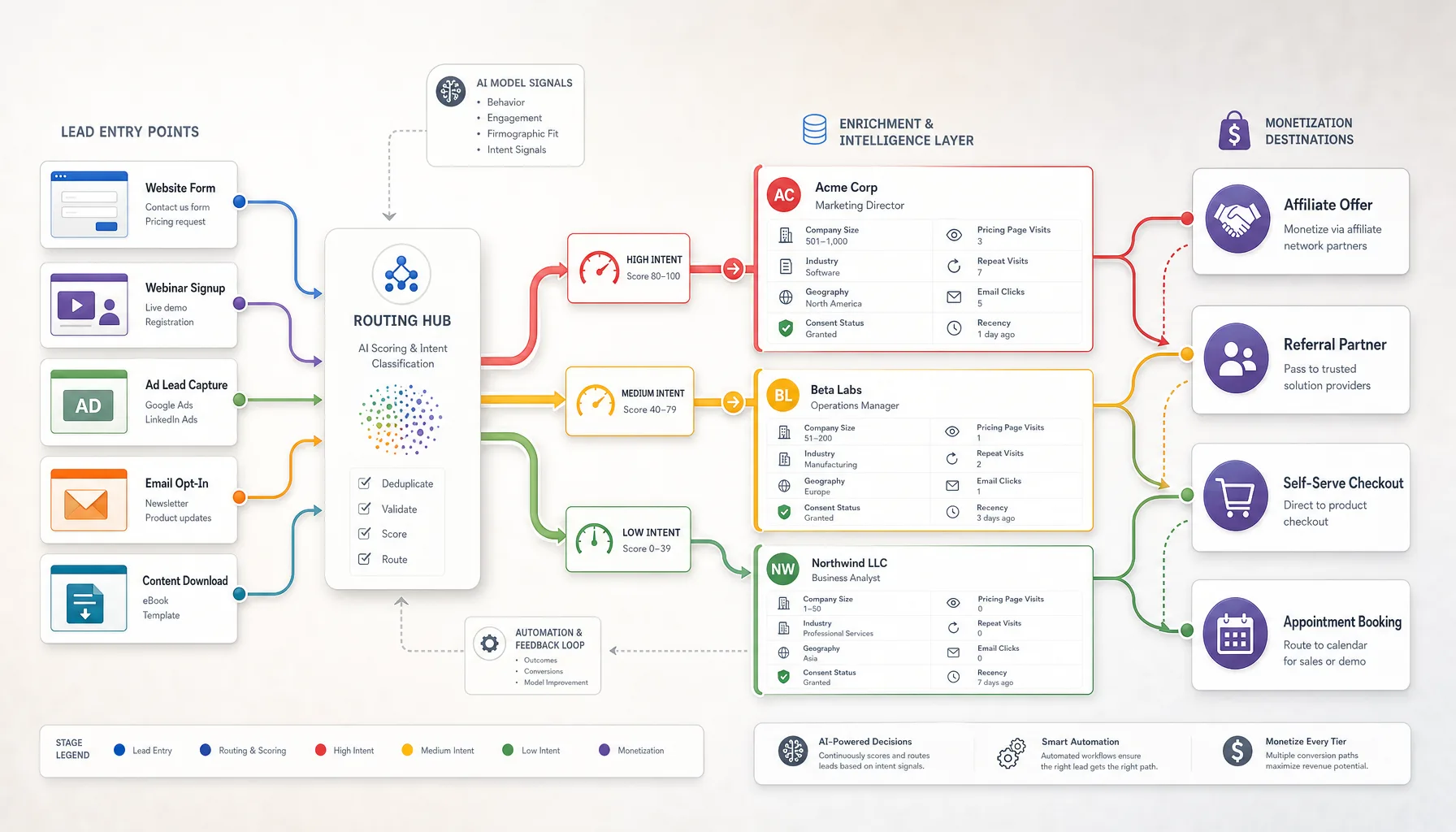
The rest of this article shows how to build a workable first version quickly:
- what data you actually need
- how to segment by intent
- what enrichment improves monetization decisions
- how to choose between affiliate, referral, self-serve, and appointment paths
- where paid traffic fits once one segment is already working
Bottom Line: Collecting leads is acquisition. Monetizing leads is a separate operating system.
What the workflow actually does
Route: sort leads by intent, source, and likely value
Routing means deciding what should happen next based on what the lead has already shown you.
The most useful routing inputs are:
- Source: where the lead came from
- Action: what they did
- Recency: how recently they did it
- Fit: whether they match your offer or a partner’s offer
A pricing-form lead from yesterday should not get the same sequence as a newsletter subscriber from three months ago.
Enrich: add context that improves decisions
Enrichment is not about collecting more data for its own sake. It is about making better decisions.
If knowing company size changes whether you send someone to a self-serve checkout or a booked appointment, that field matters. If it changes nothing, it is clutter.
Offer: match each segment to the best path
This is where revenue happens. Each segment should go to the path with the best balance of conversion probability, economics, and operational simplicity.
That could be:
- an affiliate offer
- a referral partner
- your self-serve product
- an appointment booking flow
Start with minimum viable data, not a perfect CRM
The minimum data fields you need
You do not need a perfect CRM to start. You need enough data to route intelligently.
At minimum, try to capture:
- phone number, if consented
- first name
- lead source
- acquisition date
- last activity date
- primary action taken
- campaign or content source
- geography
- company or domain, when relevant
- consent status by channel
These fields matter because they shape both relevance and compliance. Consent determines which channels you can use. Source gives context. Recency affects urgency. Action signals intent.
Which behavioral signals matter most
The strongest signals are usually the ones closest to a buying decision:
- pricing page views
- checkout starts
- booking attempts
- repeat visits
- product comparison page views
- email clicks on commercial content
- webinar registrations tied to a specific problem
- short time from first touch to action
A lead who visits your pricing page twice in 48 hours is telling you something very different from a lead who downloaded a broad industry guide six weeks ago.
What to do when your data is incomplete
Incomplete data is normal. Start anyway.
Use what you have, then improve records over time through:
- progressive profiling on forms
- domain-based enrichment for B2B leads
- behavior tracking in your site and email platform
- simple tagging rules in your CRM
Decision Rule: If a field does not change routing, offer choice, or channel selection, do not prioritize it in version one.
Step 1: Route leads into intent-based segments
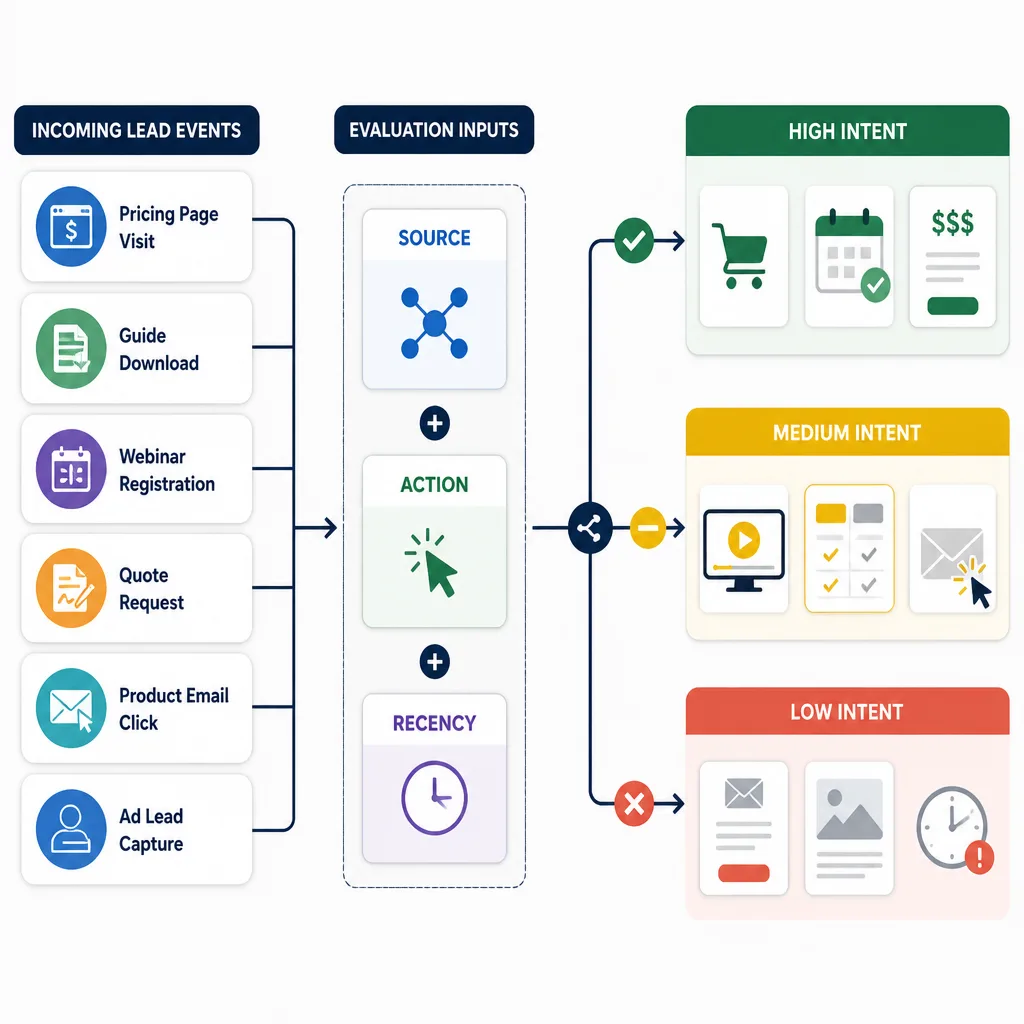
A simple intent model: high, medium, and low
Do not start with 27 lead scores. Start with three buckets:
| Intent Level | Typical Signals | Likely Next Step |
|---|---|---|
| High | Pricing views, booking attempts, checkout starts, repeated bottom-funnel visits | Self-serve or appointment |
| Medium | Webinar signup, comparison content, repeated email clicks | Education plus direct offer |
| Low | Newsletter signup, broad content download, stale ad lead | Nurture, affiliate, or referral |
This model is easier to implement, easier to debug, and easier to improve.
How source, action, and recency shape intent
A lead’s intent is not one action in isolation. It is the combination of context and timing.
For example:
- A social lead ad capture often starts as lower confidence until the lead clicks through or re-engages
- A quote request from yesterday usually deserves immediate routing to a bottom-funnel path
- A content subscriber who keeps returning to one topic may be a strong affiliate or referral candidate even without direct buying behavior
Example routing logic
Here is a practical routing approach:
Pricing or quote form submitted + revisit within 7 days
Route to self-serve checkout or appointment flowGeneral guide form + no commercial page visits
Route to nurture or a topic-based affiliate/referral sequenceClicked product email 2+ times in a week
Move to high intent and trigger direct-offer follow-upWebinar registration + comparison page visits
Move to medium intent with product education and retargetingSocial ad lead + no follow-up engagement
Keep low intent until they open, click, revisit, or complete a second action
Scenario: A SaaS founder downloads a template from your site. At first, that lead is medium or low intent. Two days later, they visit your pricing page twice and click a “compare plans” email. That lead should not stay in nurture. It should move into a self-serve or booking sequence immediately.
Common Mistake: Treating all form fills as equal. A guide download and a booking request may both be “leads,” but they should not enter the same monetization path.
Step 2: Enrich profiles so decisions improve
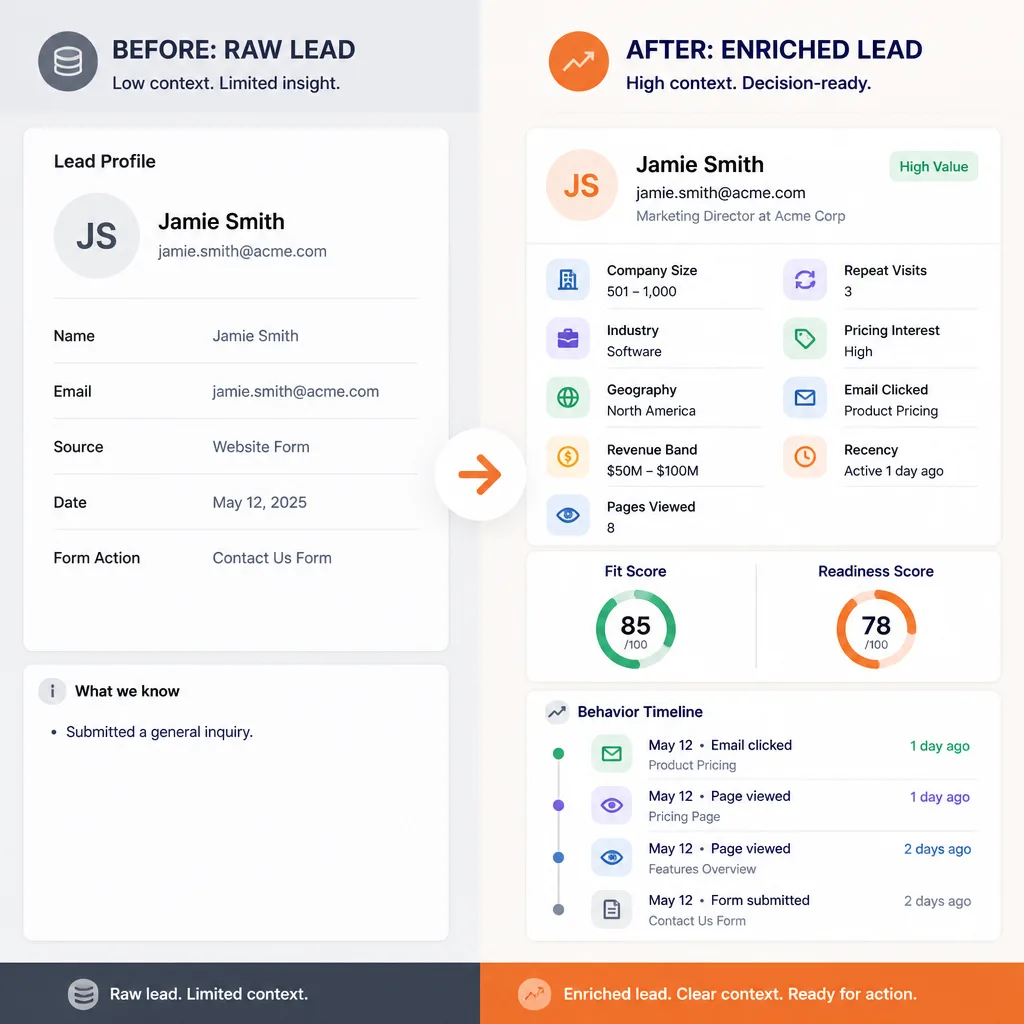
Firmographic enrichment
For B2B, firmographic enrichment often improves monetization decisions the most.
Useful fields include:
- company size
- employee count
- industry
- geography
- estimated revenue band
- domain category
- relevant tech stack, if it affects fit
This matters because a 5-person agency and a 500-person company may need completely different paths.
Behavioral enrichment
Behavioral enrichment helps you understand readiness, not just identity.
Useful signals include:
- sequence of pages viewed
- repeat visit count
- email click themes
- product category interest
- time-to-action
- ad engagement category
- previous purchases, if available
Tool options for enrichment and scoring
Depending on your setup, you might use:
- CRM-native fields and workflows in HubSpot, Pipedrive, or Salesforce
- enrichment providers such as Apollo, Clay, or similar firmographic tools
- event tracking via Google Analytics 4 or customer data tools like Segment
- workflow automation through Zapier or Make
Capabilities change, especially in enrichment products, so verify current coverage before building around a vendor’s feature set.
Before and after enrichment
Before enrichment, a lead from a generic “request info” form may look average.
After enrichment, you discover:
- the company has 120 employees
- the industry matches one of your strongest verticals
- the lead visited pricing twice
- a decision page was revisited from an email click
Now the next step changes. Instead of sending that lead to a generic nurture sequence, you route them to a premium self-serve plan or a booked consultation because both likely value and readiness are higher.
Bottom Line: Enrichment should change a decision. If it does not, it is probably unnecessary.
Step 3: Match each segment to the right monetization path
Not every lead should be pushed toward your core offer. Sometimes the highest-converting path is a partner, affiliate, or lower-friction option.
| Path | Best For | Strength | Limitation | Automation Potential |
|---|---|---|---|---|
| Affiliate offer | Problem-aware leads that are not ideal for your own offer | Fast to launch, no fulfillment burden | Lower control and variable payout quality | High |
| Referral partner | Leads needing specialized or local service | Better fit for complex or off-model demand | Partner quality and acceptance can vary | Medium to high |
| Self-serve product | Clear offer, transparent pricing, low-friction buying | Fast time-to-revenue, scalable | Requires strong UX and support design | High |
| Appointment booking | High-value or more complex leads | Can increase conversion on valuable deals | More friction, scheduling and no-show risk | Medium |
When to send leads to affiliate offers
Affiliate offers work well when:
- the lead has a clear problem
- your own product is not the best fit
- trust already exists with your audience
- payout economics justify the funnel
Example: A low-intent newsletter subscriber keeps reading content about email deliverability, but you do not sell a deliverability product. A relevant affiliate sequence may monetize better than forcing them into your unrelated core offer.
When referral partners are the better fit
Use referral partners when:
- fulfillment needs local coverage
- the service requires specialized expertise
- compliance or regulation matters
- your own operation cannot serve the lead well
Example: An agency gets inbound leads asking for local legal marketing services in regions it does not cover. A vetted referral partner is a better path than an affiliate link or a weak internal pitch.
When to push a self-serve product
Self-serve is best when:
- the offer is easy to understand
- pricing is transparent
- support needs are manageable
- the buyer does not need a long sales process
This is often the strongest path for high-intent leads.
When appointment booking still makes sense
“No sales calls required” does not mean “no human interaction ever.”
Appointment booking still makes sense when:
- lead value is high
- customization is required
- the product has real complexity
- the economics justify human time
The point is that your system should not depend entirely on manual sales calls to generate revenue. Appointments can be one branch, not the whole machine.
The REO decision framework
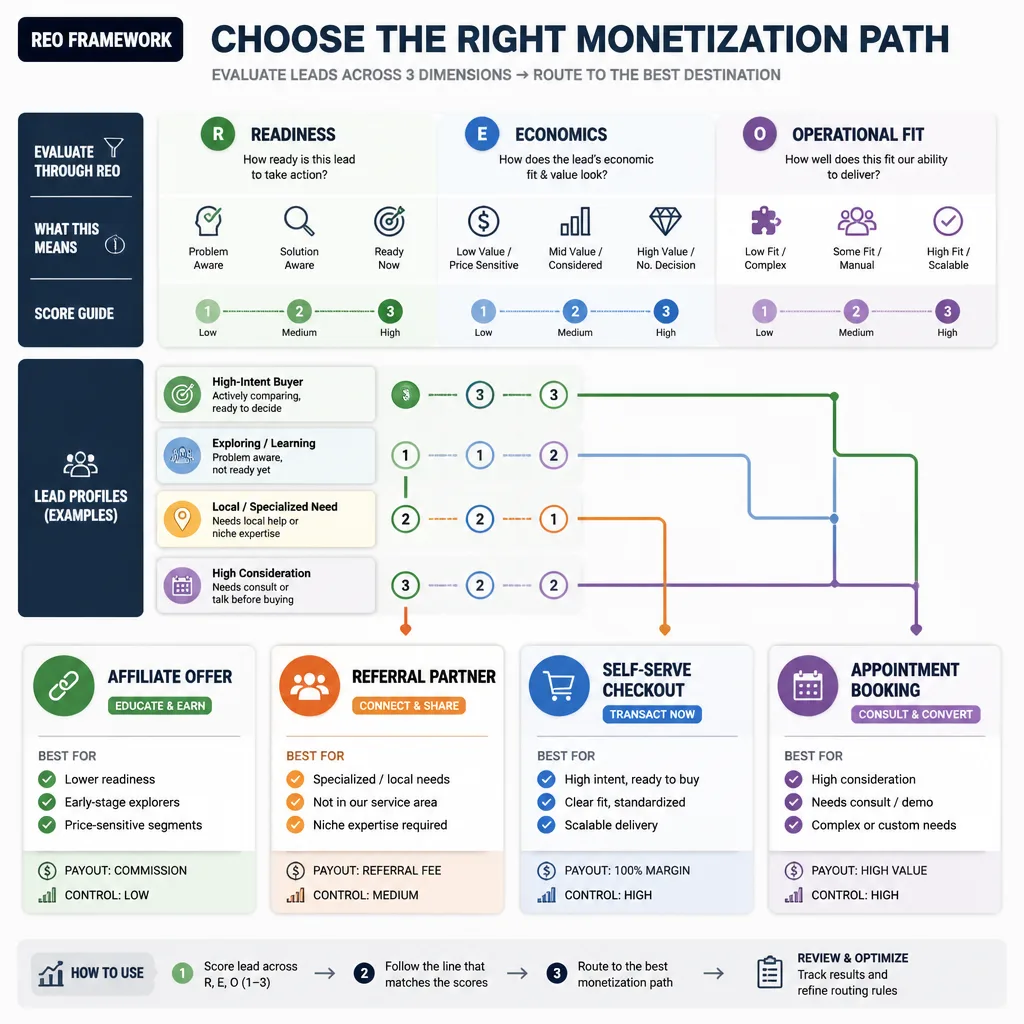
This article’s decision model is the REO Framework:
| REO Factor | Question | What to Look For |
|---|---|---|
| Readiness | How close is the lead to action? | Pricing visits, checkout starts, booking attempts, recency |
| Economics | Is the path financially worth it? | Margin, payout, revenue per lead, conversion lag, CAC tolerance |
| Operational Fit | Can you fulfill this consistently with low friction? | Automation readiness, partner reliability, support load |
Readiness
Readiness is about timing and intent. Commercial behavior matters more than vanity engagement.
Economics
The best-looking path on paper can still be bad if:
- payout arrives too slowly
- refunds are high
- partner quality is inconsistent
- conversion rates are weak
Operational fit
If the path depends on custom exceptions, heavy hand-holding, or constant manual routing, it is a poor fit for automation.
Decision Rule: Choose the path with the strongest combination of readiness and economics that your operation can fulfill consistently.
Example automations you can deploy quickly
Email sequences by intent segment
Start with one sequence per segment:
- High intent: pricing reminders, checkout recovery, booking prompts
- Medium intent: use-case education, objections, proof, comparison content
- Low intent: light nurture, topic-based affiliate or referral offers
SMS for high-intent reminders
SMS is best used sparingly and only where consent exists.
Good use cases:
- abandoned checkout reminders
- appointment confirmations
- no-show follow-up
- deadline reminders
Tools like Twilio can support this, but you still need to follow applicable consent and messaging rules.
Retargeting audiences based on behavior
Build audiences for:
- pricing-page viewers
- repeat visitors
- abandoned checkout users
- booked-but-no-show leads
- content consumers by topic category
Platforms such as Meta Ads and Google Ads make this practical when event tracking is in place.
CRM and webhook automations
Useful first automations include:
- tagging leads by source and action
- moving leads between sequences when they cross intent thresholds
- pushing leads to partner forms
- triggering direct-offer emails after commercial behavior
- updating CRM status via webhook from forms, checkout, or booking tools
Bottom Line: One automation per segment is enough for the first version. Complexity should follow proof, not come before it.
Recommended tool stacks by complexity level
| Stack Level | Typical Tools | Best For | Tradeoff |
|---|---|---|---|
| Lean | Pipedrive or HubSpot, Mailchimp or ActiveCampaign, Zapier, GA4, ad retargeting | Solo operators and small lead volumes | Limited customization |
| Growth | HubSpot, Klaviyo or ActiveCampaign, Twilio, Make, Apollo or Clay, Meta/Google audiences | Teams with multiple funnels | More moving parts |
| Advanced | Salesforce, Segment, warehouse/CDP layer, server-side tracking, advanced orchestration | Higher-volume lead monetization | Higher setup cost and complexity |
Lean stack for solo operators
A spreadsheet, a lightweight CRM, one email platform, one automation tool, and retargeting can be enough to monetize leads well.
Growth stack for teams with multiple funnels
As volume grows, you usually need stronger event tracking, custom fields, SMS, and better enrichment.
Advanced stack for higher volume
At higher scale, routing logic often expands into a dedicated data layer, deeper scoring, and more structured partner distribution.
Common Mistake: Buying an advanced stack before proving your routing logic. Tools rarely fix an unclear monetization strategy.
Where Traffics.io fits once a segment starts converting
Paid traffic should amplify proven monetization paths, not guess at them.
Once you know that a segment-path combination works — for example, medium-intent B2B leads from content downloads converting into a self-serve trial, or low-intent publisher leads monetizing through a specific affiliate sequence — scaling becomes a traffic problem.
That is where Traffics.io can fit. It becomes useful after you validate:
- which lead type converts
- which landing page works
- which offer path monetizes best
- what acceptable revenue per lead and time-to-revenue look like
Why paid traffic should amplify proven paths
If routing is weak, more traffic just creates more unmonetized leads. If offer fit is weak, paid acquisition magnifies waste.
Using paid traffic to scale the best segments
The smartest scaling move is usually to buy more of what already works:
- same segment
- same funnel entry point
- same offer path
- same follow-up logic
When to avoid scaling too early
Do not scale if you still cannot answer:
- Which segment converts best?
- What is revenue per lead by segment?
- How long does monetization take?
- Which offer path wins consistently?
Decision Rule: Add paid traffic only after a source-intent-offer combination already produces acceptable conversion rate, revenue per lead, and time-to-revenue.
Common mistakes that break automated lead monetization
Over-segmenting before you have enough data
Too many micro-segments create weak learning and brittle workflows. If each segment gets only a handful of leads, you cannot tell what is working.
Using too many tools before defining routing logic
Tool-first setups create complexity without clarity. Routing logic should come before orchestration.
Treating all leads as sales-call candidates
This is one of the most expensive defaults in lead monetization. It slows response, raises labor cost, and misses self-serve, affiliate, and referral opportunities.
Ignoring offer economics and payout timelines
A path with a high payout can still be bad if:
- conversion takes too long
- payout is delayed
- margins are thin
- partner quality is inconsistent
Cash flow matters. So does operational effort.
Implementation checklist: build your first version this week
Define segments
Start with:
- High intent
- Medium intent
- Low intent
Choose enrichment sources
Pick one practical source:
- Domain or firmographic enrichment for B2B
- Site and email behavior tracking
- CRM custom fields for source, recency, and action
Map each segment to one monetization path
For example:
- High intent → self-serve or appointment
- Medium intent → education plus direct offer
- Low intent → affiliate or referral nurture
Launch one automation per segment
Keep it simple:
- one email workflow per segment
- one SMS reminder flow for high intent if consent exists
- one retargeting audience by intent level
- one CRM rule or webhook trigger to move leads automatically
Measure the right outputs
Track at minimum:
- conversion rate by segment
- revenue per lead
- time-to-revenue
- appointment show rate, if used
- unsubscribe or spam signals
- partner acceptance rate for referrals
Bottom Line: Your first version does not need to be elegant. It needs to be measurable.
Conclusion
The real goal of an AI-powered lead monetization system is not automation for its own sake. It is revenue from leads you already have.
That happens when you improve three things: routing quality, data usefulness, and offer fit. Route leads by intent instead of treating them all the same. Enrich only the fields that improve decisions. Then match each segment to the path most likely to monetize without unnecessary manual friction.
If one segment starts converting well, refine it before expanding. Only then should you add more traffic and scale the system further. More leads rarely solve weak monetization. Better monetization does.
FAQ
What is an AI-powered lead monetization system?
It is a workflow that helps turn existing leads into revenue by sorting them by intent, enriching their profiles with useful data, and matching them to the best monetization path. That path might be an affiliate offer, referral partner, self-serve product, or appointment booking.
What data do I need to start?
You do not need a perfect CRM. A minimum viable setup usually includes email, phone if consented, first name, lead source, acquisition date, last activity date, primary action, campaign or content source, geography, company or domain when relevant, and consent status for each communication channel.
How should I segment leads by intent?
A simple high-, medium-, and low-intent model is usually enough to start. High-intent leads show buying behavior like pricing page visits, booking attempts, or checkout starts. Medium-intent leads show evaluation behavior like webinar signups or repeated email clicks. Low-intent leads are often newsletter subscribers, broad content downloaders, or inactive leads with little follow-up engagement.
What is the Route, Enrich, Offer workflow?
It is a practical lead monetization workflow. Route means sorting leads by source, action, recency, and fit. Enrich means adding firmographic and behavioral context that improves decisions. Offer means matching each segment to the monetization path most likely to convert with minimal manual friction.
What kind of lead enrichment actually helps?
Useful enrichment adds information that changes decisions. Firmographic enrichment can include company size, industry, geography, revenue band, or employee count. Behavioral enrichment can include pricing page views, repeat visits, email click themes, product interest, and time-to-action. If an enriched field does not help you route or monetize the lead better, it is probably unnecessary.
When should I use affiliate offers instead of my own product?
Affiliate offers make sense when the lead has a clear problem but is not the right fit for your own product or service, or when your audience already trusts your recommendations and the payout economics are strong enough to justify the follow-up.
When are referral partners a better path?
Referral partners are often the better choice when fulfillment requires local coverage, regulated expertise, specialized services, or capabilities you do not provide directly. They can also be a better fit when self-serve is unrealistic and a direct affiliate offer does not match the lead’s needs.
When does self-serve monetization work best?
Self-serve works best when the product is easy to understand, pricing is clear, the checkout path is low friction, and support needs are manageable without heavy sales involvement. This path is especially strong for leads showing high intent through commercial page visits, email clicks, or checkout starts.
Does appointment booking still belong in a no-sales-calls-required system?
Yes, but as one branch of the system rather than the main dependency. Appointment booking still makes sense when lead value is high, the offer is complex, or customization is required. The goal is not to remove human interaction completely. The goal is to avoid making manual sales calls the only way revenue happens.
What is the REO Decision Framework?
The REO Decision Framework stands for Readiness, Economics, and Operational Fit. Readiness measures how close the lead is to action. Economics measures whether the payout, margin, or revenue per lead justifies the path. Operational fit measures whether your team and systems can fulfill that path consistently with low friction.
What automations should I build first?
Start with one automation per segment. For high-intent leads, use cart recovery, booking reminders, or direct product follow-up. For medium-intent leads, use educational email sequences and retargeting. For low-intent leads, use lighter nurture or topic-based affiliate and referral sequences. CRM tags, webhooks, and simple workflow triggers are usually enough for the first version.
How do I know when a segment is ready to scale with paid traffic?
A segment is ready to scale when you know which source-intent-offer combination produces acceptable conversion rate, revenue per lead, and time-to-revenue. Paid traffic should amplify a proven path, not compensate for weak routing or poor offer fit. That is where a service like Traffics.io can fit strategically.
Where does Traffics.io fit in this workflow?
Traffics.io fits after you have validated a segment and monetization path that already converts. Once you know which lead type, landing page, and offer combination performs well, it can help add paid traffic to that proven setup instead of forcing scale too early.
What common mistakes break automated lead monetization?
Common mistakes include over-segmenting before you have enough data, adding too many tools before defining routing logic, treating all leads as sales-call candidates, and ignoring offer economics such as payout timing, margins, and conversion lag. These usually create complexity without improving revenue.