Citation-First Affiliate Pages: A Product Comparison Template for Google AI Overviews and Human Buyers
Most affiliate comparison pages were built for a simpler search model: rank, win the click, then persuade. That still matters, but the environment has changed. Google’s reviews guidance favors original analysis over thin summaries, and AI search features increasingly answer questions directly while showing sources more prominently. (developers.google.com)
That changes what an affiliate page needs to do. It is not just a persuasion asset anymore. It is a decision document. It should be easy to quote, verify, and update so an answer engine can extract something useful and a skeptical buyer can trust it. There is no public formula for getting cited in AI Overviews, but pages built on clear claims, visible evidence, and explicit limits are better aligned with Google’s guidance on helpful review content. (developers.google.com)
The practical shift is sharper than it sounds. Fewer clicks do not always mean worse results. If a page helps readers qualify themselves faster, the smaller group that does click can be more valuable. That is not a law of conversion. It is a quality-of-intent argument. In a market full of disposable affiliate copy, trust becomes part of the conversion path.
Why This Model Is Emerging
The old affiliate page was built to capture clicks at scale
The classic roundup was often bloated by design: long introductions, recycled feature lists, and vague “best for most people” claims meant to rank broadly and attract curiosity traffic. Google’s reviews system explicitly warns against thin content that merely summarizes products without original analysis or substantial research. (developers.google.com)
That matters because many affiliate pages still look like polished aggregation rather than informed evaluation. They list products without showing judgment.
The new environment rewards pages people can inspect quickly
Google’s people-first content guidance asks whether readers can understand how content was created. For product reviews, it notes that trust can improve when readers know how many products were tested, how testing was done, and what the results were, ideally with supporting evidence such as photos. (developers.google.com)
At the same time, Google has expanded AI search experiences and published guidance for generative AI features in Search. In its March 2025 update, Google said AI Overviews were used by more than a billion people. (blog.google)
The sensible response is not to chase AI Overviews as a trick. It is to publish pages that are easier to trust and easier to extract from.
Higher intent can matter more than raw traffic
A reader who lands on a comparison page after already seeing summary information elsewhere is often further along in the decision. They do not need more hype. They need fewer unknowns. A citation-first structure reduces ambiguity by making four things clear: what is recommended, who it is for, what the limits are, and what evidence supports the claim.
What “Citation-First” Actually Means
Answer first, persuade second
A citation-first page gives the shortest honest answer near the top. Not the whole article compressed into a paragraph. Just the core conclusion, with scope.
Narrow claims instead of overstated certainty
This is where many affiliate pages lose credibility. Limits are not a weakness. They are what make a recommendation believable. “Best standing desk for tall users under $500” is much stronger than “best standing desk overall.”
Make the logic easy to audit
The page should make its reasoning visible:
- What did you test?
- What came from documentation?
- What changed recently?
- Who is each option actually for?
- Where is pricing unstable?
That helps readers move faster. It also creates cleaner extraction targets for search systems, though again, there is no guarantee of citation. (developers.google.com)
The Four-Block Template
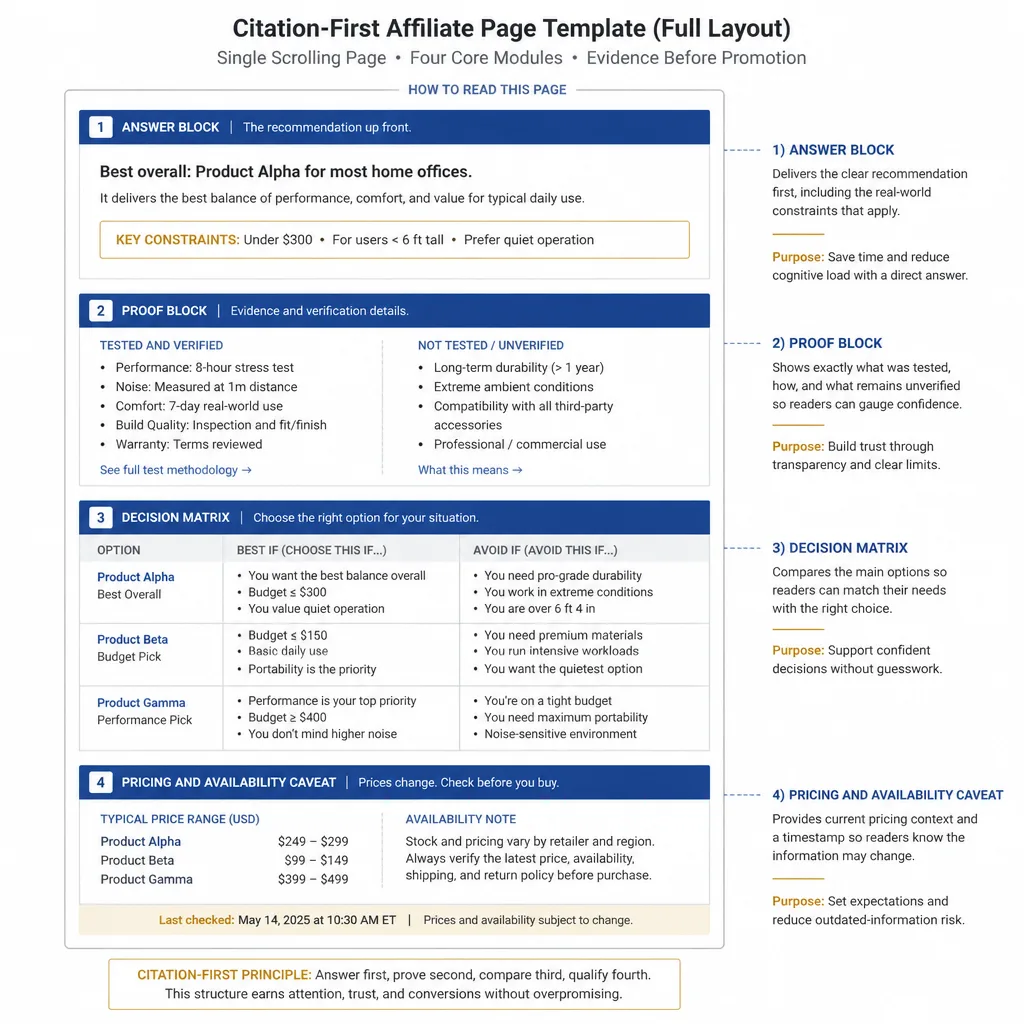
1. Answer Block: the shortest honest answer
This is the quotable summary near the top. It should include:
- the top pick or narrowed recommendation
- the exact use case
- one major limitation
- one or two important constraints
A compact example:
Best standing desk for tall users under $500: FlexiSpot E5 is the strongest fit if you need a higher lift range and decent stability without going past the $500 mark. It is not the best choice if you want premium cable management or a solid-wood top. Price and bundle options change often, so verify the frame-and-top configuration before buying.
That does more work than three paragraphs of throat-clearing.
2. Proof Block: what you tested, compared, and did not verify
This is where the page earns trust. Google’s guidance supports making the creation process legible, and FTC endorsement rules make honesty even more important: do not imply experience you did not have, and do not make claims you cannot support. (developers.google.com)
Useful evidence can include:
- firsthand testing
- official specifications
- support or customer-service confirmations
- policy and warranty review
- expert interviews
- current screenshots or photos
- reputable third-party benchmarks
If testing was partial, say so plainly.
3. Decision Matrix: who each option fits, and who should skip it
A comparison page should help readers rule products out, not just declare winners. That means moving past feature lists and into fit.
| Option | Choose this if | Avoid this if |
|---|---|---|
| FlexiSpot E5 | You need more height range on a moderate budget | You want premium finish quality out of the box |
| Uplift V2 | You care more about accessories and desktop options | You need to stay under a strict budget cap |
| Branch Standing Desk | You want a simpler buying decision and cleaner aesthetics | You need the widest size and customization range |
This is where the page starts acting like a decision tool instead of a sales page.
4. Pricing and Availability Caveat: handle volatility honestly
Commerce pages age badly when they pretend nothing changes. If you cannot maintain exact prices continuously, use ranges, timestamps, and seller-specific notes instead. Google’s product documentation treats price and availability as important attributes, but stale details usually do more harm than good. (developers.google.com)
The Answer Block: Make the Page Quotable
A strong Answer Block usually includes four things:
- the recommendation
- the best-fit use case
- the main tradeoff
- the key constraint
This matters because concise summaries are easier to quote without stripping away meaning.
The constraint should be specific enough to narrow the claim:
- under $300
- for apartments with limited storage
- for Mac users who need offline editing
- for side sleepers under 130 pounds
The narrower the claim, the less likely it is to collapse under edge cases.
Caveats also tend to help more than they hurt. Serious buyers are not put off by limits. They are reassured by them. The wrong click wants certainty theater. The right one wants honest decision support.
The Proof Block: Show Your Work
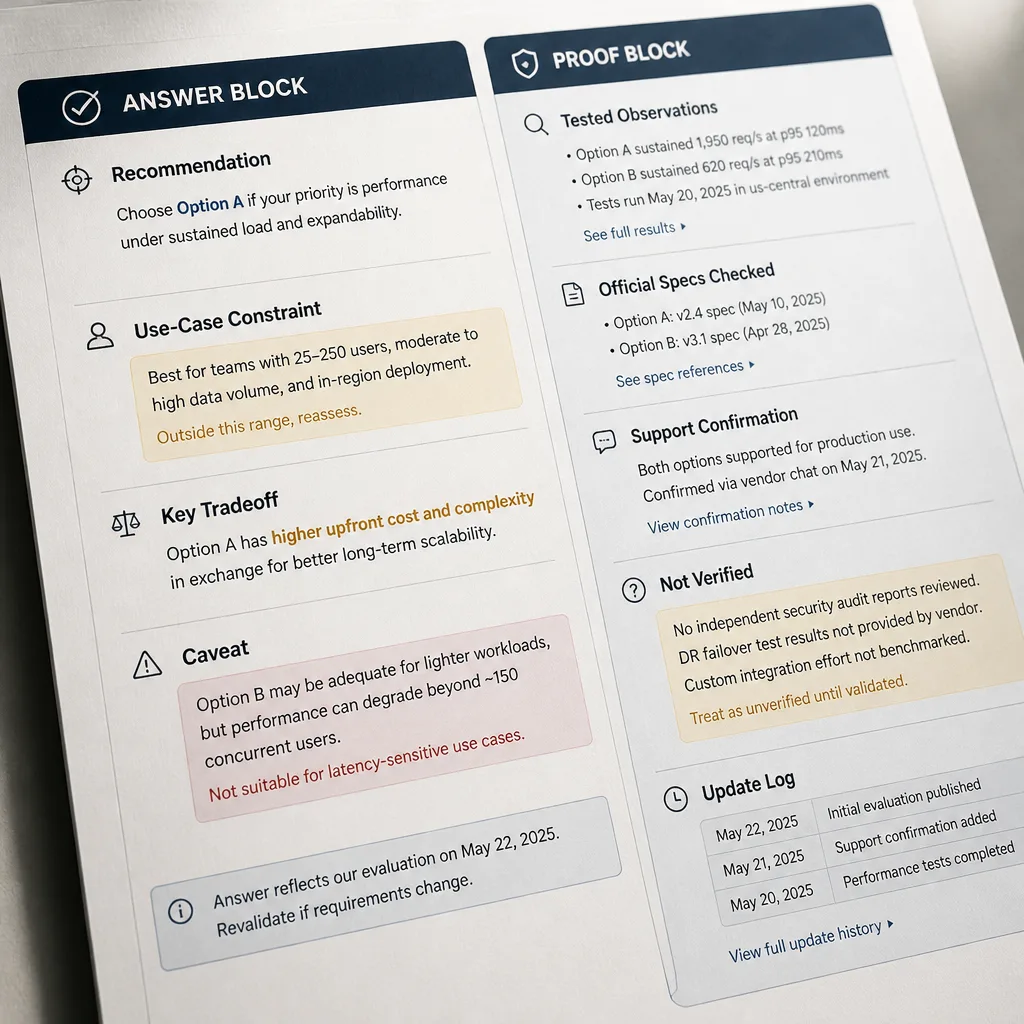
The strongest Proof Blocks separate evidence by source:
- High confidence: firsthand testing, direct photos, official specs, warranty terms, direct support responses
- Medium confidence: expert interviews, reputable benchmarks, retailer confirmations
- Lower confidence: anonymous sentiment, syndicated review summaries
That hierarchy keeps the page honest about what is known and what is inferred.
If testing was partial, disclose the gap. If you tested only one size, one configuration, or one seller experience, say that. If you reviewed return policies across brands but did not assemble every product, say that too. FTC guidance is clear that endorsements should not imply unsupported experience. (ftc.gov)
An update log also helps. Not as a ranking trick, but as discipline.
A simple version is enough:
- Last reviewed: July 2026
- Updated: pricing ranges, warranty notes, discontinued model removal
- Not re-tested this cycle: long-term durability
That helps readers judge freshness and pushes the editorial team to maintain money pages like living assets. Google also introduced Search Console reporting for visibility in generative AI features in June 2026, giving publishers a clearer way to measure whether these pages appear in AI-driven surfaces over time. (developers.google.com)
The Decision Matrix: Turn Comparison Into Choice Support
Features matter less than fit. “48-inch desktop” is a fact. “Works well in small apartments where a 60-inch desk would dominate the room” is decision support.
One of the simplest improvements you can make is adding “choose this if” and “avoid this if” logic. It forces actual judgment. It also keeps every recommendation from collapsing into the same cheerful endorsement.
For high-intent readers, this section answers the hidden question behind most product searches: Am I actually the right buyer for this?
Pricing and Availability: The Section Most Pages Skip
Nothing makes a comparison page feel flimsy faster than stale price claims. If your page says “$299” and the seller says $429, trust breaks immediately.
Use language like this instead:
- “typically sells between $349 and $449”
- “holiday discounts are common, but not predictable”
- “availability varies more on specialty finishes than standard models”
This is more durable than false precision.
Use timestamps when price is central to the query. Use ranges when the number moves often. Use seller-specific notes when bundles, shipping, or stock vary in meaningful ways.
Why This Structure Helps Both AI Visibility and Conversions
Concise summaries with visible limits are easier for systems to interpret and easier for people to scan. Google’s guidance on helpful content and reviews consistently points toward clarity, original analysis, and visible evidence. (developers.google.com)
No official Google document says, “Use this template and you will be cited.” But Google does emphasize original, high-quality content and trusted sourcing in its broader AI search direction. That makes an evidence-backed structure a reasonable strategic response. (blog.google)
The same structure can also improve conversion quality. Clearer claims create cleaner citations. Clearer tradeoffs create better-qualified buyers.
Three Example Outlines for Long-Tail Affiliate Queries
Best X for Y under Z constraint
Query: Best standing desk for tall users under $500
- Answer Block: best pick, height-range constraint, key tradeoff
- Proof Block: tested max height, wobble observations, warranty review, what was not tested
- Decision Matrix: tall users on a budget vs users wanting a premium finish
- Pricing Caveat: frame-only vs bundle pricing, sale volatility
X vs Y for a specific use case
Query: ConvertKit vs MailerLite for solo creators selling one digital product
- Answer Block: which one fits simpler funnels vs growing automation needs
- Proof Block: pricing page review, automation workflow comparison, onboarding test
- Decision Matrix: choose this if you want simplicity, avoid this if you need advanced branching
- Pricing Caveat: subscriber-tier jumps, annual discount notes
Best budget option for a narrow buyer profile
Query: Best noise-canceling headphones for frequent flyers under $250
- Answer Block: strongest value pick, main comfort or battery limitation
- Proof Block: spec verification, flight-use testing if available, support-policy check
- Decision Matrix: budget traveler vs office user vs bass-heavy listener
- Pricing Caveat: airport pricing, seasonal deals, refurbished stock notes
Where This Template Fails
A stronger structure cannot rescue weak research or fake testing. Google’s reviews system still evaluates substance, not just formatting. (developers.google.com)
It is also harder to maintain than a generic roundup. That is the tradeoff. You need update discipline, documentation habits, and someone willing to revise claims when reality changes.
Some categories also demand deeper firsthand evaluation to be credible. In software, mattresses, cameras, and fitness gear, documentation alone is rarely enough. You can still publish a useful comparison without full testing, but you cannot pretend your evidence is stronger than it is.
Better Affiliate Pages Are More Defensible
The real advantage of a citation-first model is not cosmetic. It gives your team a repeatable editorial system for money pages that need to stand up to more scrutiny, from readers, search systems, and sometimes compliance review. Google favors original analysis and transparent review methods, while FTC endorsement rules make unsupported claims and vague commercial influence riskier than many affiliate publishers admit. (developers.google.com)
Use the structure as a discipline, not a formatting trick. The shift is simple: stop treating affiliate pages like persuasion documents with tables attached. Treat them like decision documents with commercial intent handled honestly.
Trust does not come from louder recommendations. It comes from visible reasoning.
FAQ
What is a citation-first affiliate page?
A citation-first affiliate page is a comparison or review page built so its claims are easy to quote, verify, and update. Instead of relying on generic roundup copy, it uses concise answers, visible limits, testing disclosures, and clear decision guidance so both answer engines and human buyers can evaluate it quickly.
Will this template guarantee inclusion in Google AI Overviews?
No. There is no public formula that guarantees citation in AI Overviews. The stronger claim is that this structure aligns with what both readers and search systems tend to reward: clear answers, visible evidence, constrained recommendations, and current information. (developers.google.com)
Why might this structure improve affiliate conversions?
It can improve conversion quality by helping visitors qualify themselves faster. A tighter answer, honest caveats, and a clear best-fit matrix may reduce low-intent clicks, but the remaining visitors are often more likely to trust the recommendation and act on it.
What should go in the Answer Block?
The Answer Block should provide the shortest honest answer to the query. Usually that means the top recommendation, the use case it fits best, the main limitation, and any important constraint such as budget, size, compatibility, or availability.
What belongs in the Proof Block?
The Proof Block should show what you tested, what you observed, what sources you reviewed, and what you did not verify directly. Useful inputs include firsthand testing, official specifications, policy checks, support confirmations, expert interviews, screenshots, and an update log. Google’s people-first guidance explicitly supports helping readers understand how review content was created. (developers.google.com)
How should affiliate pages handle pricing and availability changes?
Avoid fake precision if you cannot keep exact prices current. Use timestamps, price ranges, seller-specific notes, and short caveats about stock or promotional volatility. That is more credible than stale numbers that look precise but are not reliable.
Do I need firsthand testing for every comparison page?
Not always, but you should never imply hands-on experience you did not have. In some categories, direct testing is essential for credibility. In others, a page can still be useful if it clearly separates firsthand observations from documented research and unverified claims. (ftc.gov)
What is the Decision Matrix supposed to do?
The Decision Matrix turns comparison content into choice support. Instead of listing features, it shows who each option is for, who should avoid it, and which tradeoffs matter most.
How often should citation-first affiliate pages be updated?
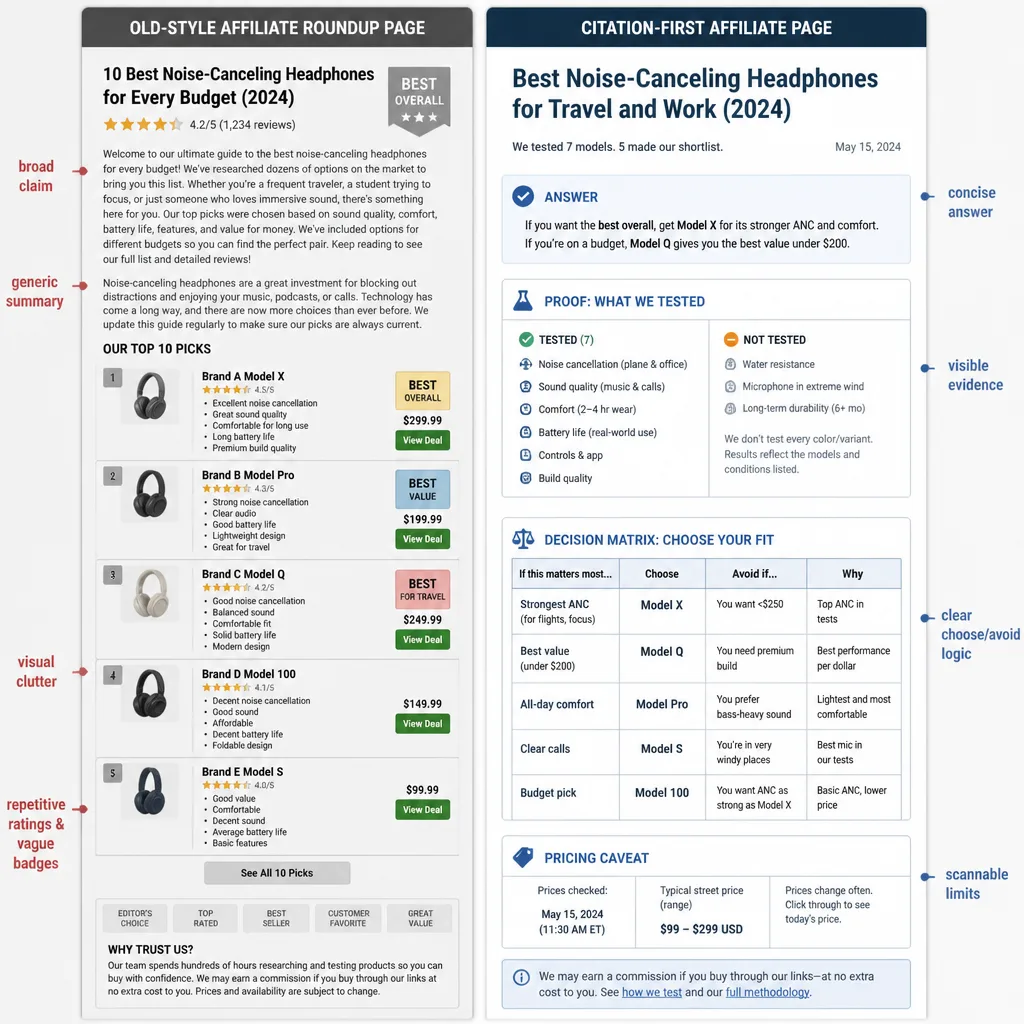
That depends on the category. Fast-moving products with changing pricing, stock, or features may need monthly or event-driven reviews. More stable categories can often be reviewed quarterly. The important part is documenting the review date and updating meaningful claims when conditions change.
Where does this template fail?
It fails when the research is weak, testing claims are exaggerated, or the page is not maintained. Better structure cannot rescue thin affiliate content. It also creates more editorial overhead, so it works best for high-intent pages where trust, precision, and defensibility matter.