SEO vs AEO vs GEO in 2026: A Practical Workflow Split
Most small marketing teams do not have an SEO problem. They have a prioritization problem.
They are told to do SEO, AEO, GEO, CRO, AI search optimization, answer engine optimization, generative engine optimization, and whatever acronym shows up next. Meanwhile, the real work remains the same: publish strong pages, fix technical issues, improve conversion, and explain results to people who care more about pipeline than terminology.
In 2026, the useful distinction is not between labels. It is between outcomes.
Ranking, getting cited in AI-driven search, and getting chosen after the click are connected, but they are not the same job. Lean teams should not build three separate programs. They should run one content and growth system with a clear workflow split:
- SEO gets you retrieved
- AEO/GEO helps you get used inside AI answers
- CRO turns visibility into value[^1][^2]
The simplest way to think about SEO, AEO, and GEO
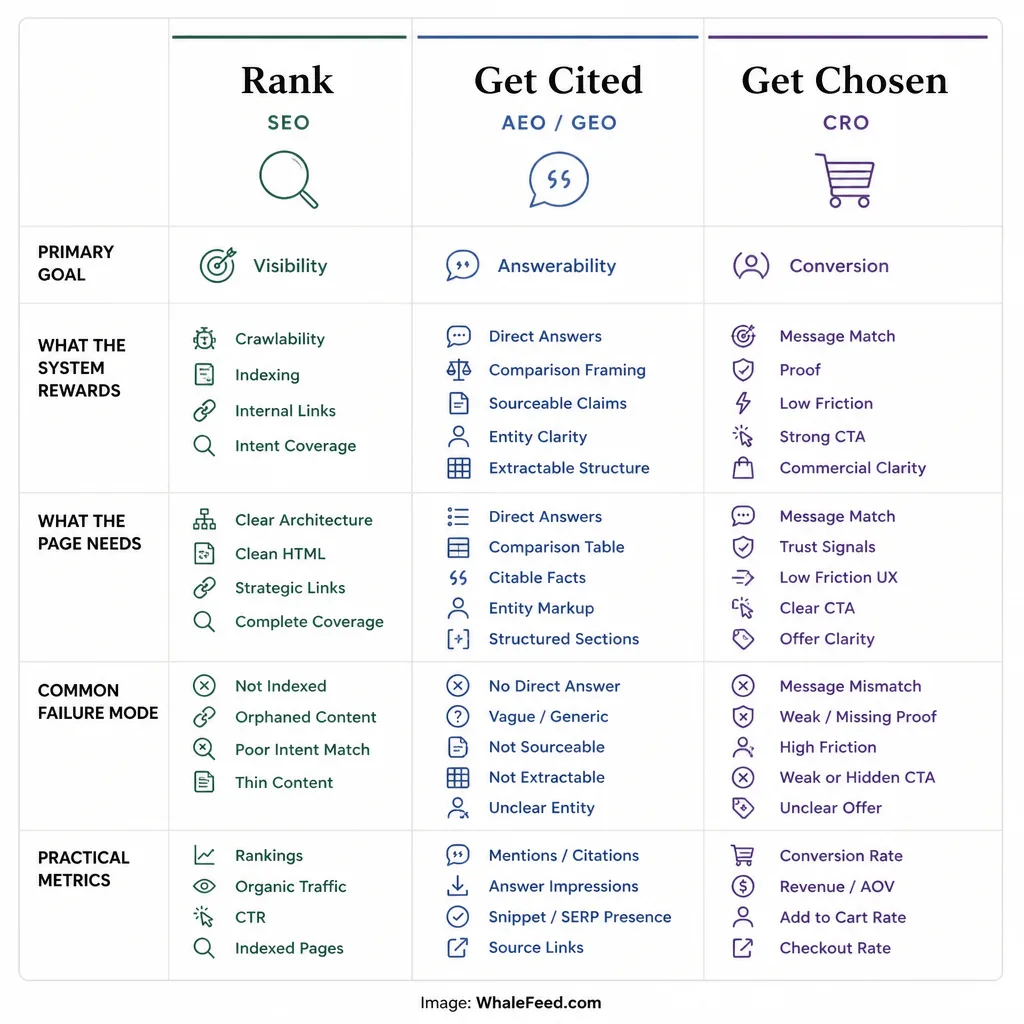
SEO: win retrieval, indexing, and ranking
SEO is still the foundation. It covers the basics that make a page discoverable and eligible to perform at all: crawlability, indexing, internal linking, technical hygiene, intent coverage, and content quality.
That still matters in generative search. Google’s 2026 guidance says SEO best practices remain relevant and foundational for visibility in its generative AI features.[^1][^2] Put plainly: if your pages are weak, hard to crawl, poorly structured, or unhelpful, no formatting trick will rescue them.
AEO/GEO: win inclusion, citation, and recommendation inside AI answers
AEO and GEO are still loose industry terms. Google acknowledges the labels, but pushes back on the idea that there is a separate bag of “AEO hacks” that overrides core search quality systems.[^2]
In practice, this layer is about making content easy to retrieve, understand, extract from, and cite inside AI-mediated search. That means clear definitions, direct answers, useful comparisons, sourceable claims, strong entity context, and pages that help with adjacent sub-questions rather than only one exact keyword.[^2]
CRO: win the click and the next action
CRO is the part people forget when they obsess over AI visibility.
A citation is not revenue. An impression is not pipeline. Even a click means little if the landing page is vague, bloated, or mismatched to the promise that earned attention in the first place.
So the third layer is simple: message match, proof, clarity, friction reduction, and stronger calls to action. This is not an official Google taxonomy. It is an operating model. But it is the piece that keeps visibility work tied to business results.
A cleaner mental model: rank, get cited, get chosen
If you remember one thing, make it this:
- SEO helps you rank
- AEO/GEO helps you get cited
- CRO helps you get chosen
That framing is cleaner than the acronym soup, and much easier to run.
Why the acronyms create more confusion than clarity
Most “new” tactics still depend on old foundations
A lot of AEO and GEO advice is just SEO with a new label.
Clear site architecture. Strong internal links. Useful pages. Solid topical coverage. Content that answers real questions. None of that stopped mattering. If anything, it matters more, because Google says its generative AI features use retrieval and grounding from the Search index before generating answers with links.[^2]
That is the key operational point: AI answers do not float above the web. They still need strong source material.
Where Google’s guidance agrees with the hype, and where it does not
Google’s May 15, 2026 guidance is helpful mostly because it is less magical than the hype cycle. It emphasizes valuable, unique, non-commodity content and explicitly mythbusts common AEO and GEO misconceptions.[^1] It also says you do not need special files like LLMS.txt or other custom machine-readable AI files to appear in Google’s generative AI search features.[^2]
So yes, formatting matters. Clarity matters. Structure matters. But the “secret file” or “hidden schema hack” story is mostly a distraction.
Why ranking and being chosen are different systems
This is the distinction that actually matters:
- A page can rank and still never get clicked because the query is satisfied on the results page.
- A page can get cited in an AI Overview and still fail commercially because the landing page is weak.
- A page can convert well but never appear because it lacks the retrieval signals to surface in the first place.
Different outcome. Different failure mode. Ideally, the same page solves all three.
Real query examples: when SEO wins and when AI answers absorb the click
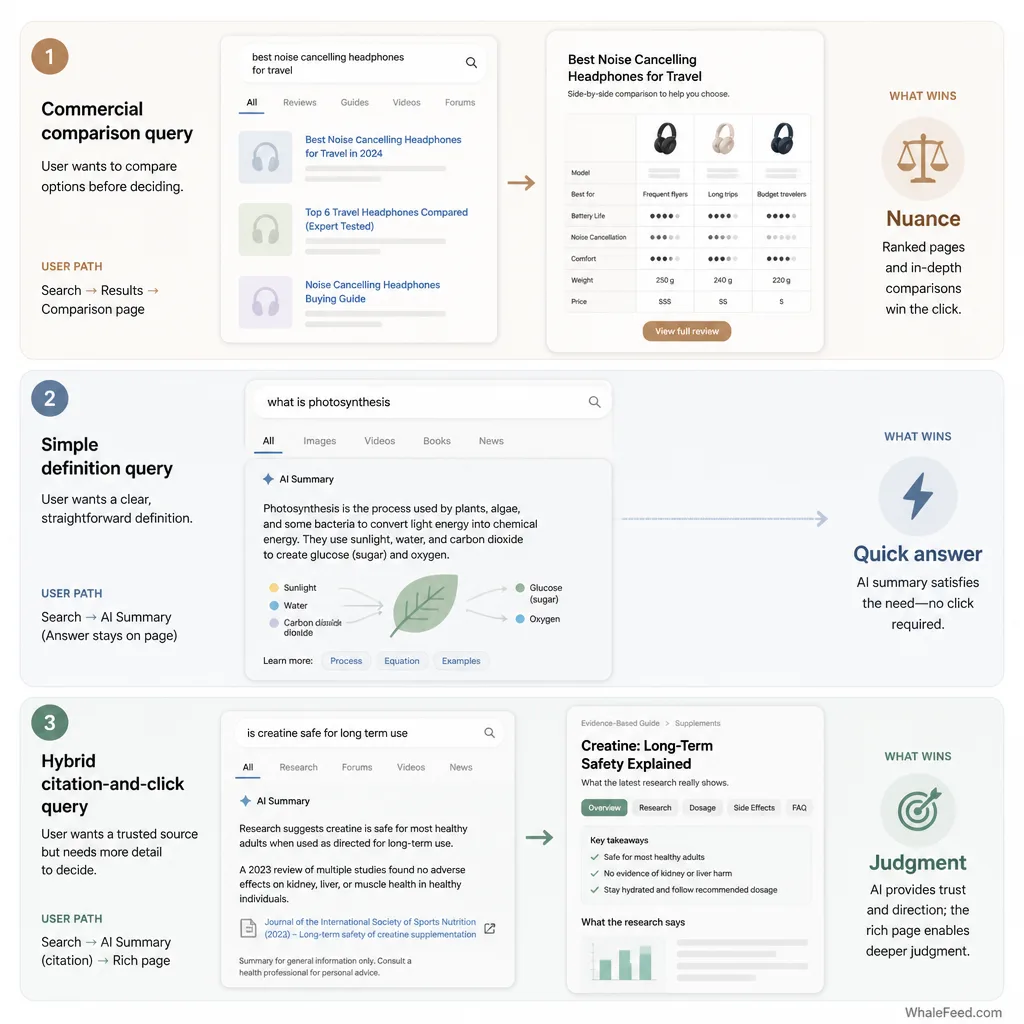
When a traditional ranked page still matters
Take a query like “best CRM for two-person startup with email automation.”
This is still a click-heavy search because the user is choosing between options, pricing models, and tradeoffs. They need nuance. A ranked comparison page, alternatives hub, or decision guide still has room to win because the answer is not one fact. It is a choice.
When AI compression can absorb the informational click
Now take “what is canonical tag in SEO.”
That kind of definition query is vulnerable to answer absorption. Google says AI Overviews appear when its systems determine generative AI is especially helpful, including when users want a quick understanding synthesized from multiple sources.[^3] It is reasonable to infer that summary-style queries are more likely to be compressed into an on-SERP answer.[^3]
That does not mean definition pages are dead. It means a page that only defines the term is easier to replace than one that explains when it matters, what breaks without it, and how to implement it.
When the winner is the source that gets cited and clicked
Consider “HubSpot alternatives for B2B SaaS under $500/month.”
This is the sweet spot. The query invites summarization, but still rewards a page that offers decision criteria, pricing context, migration notes, and best-fit scenarios. In other words, the page can be cited for the summary and still earn the click for the harder part: judgment.
The practical workflow split for lean teams
SEO work: technical hygiene, crawlability, indexing, internal links, intent coverage
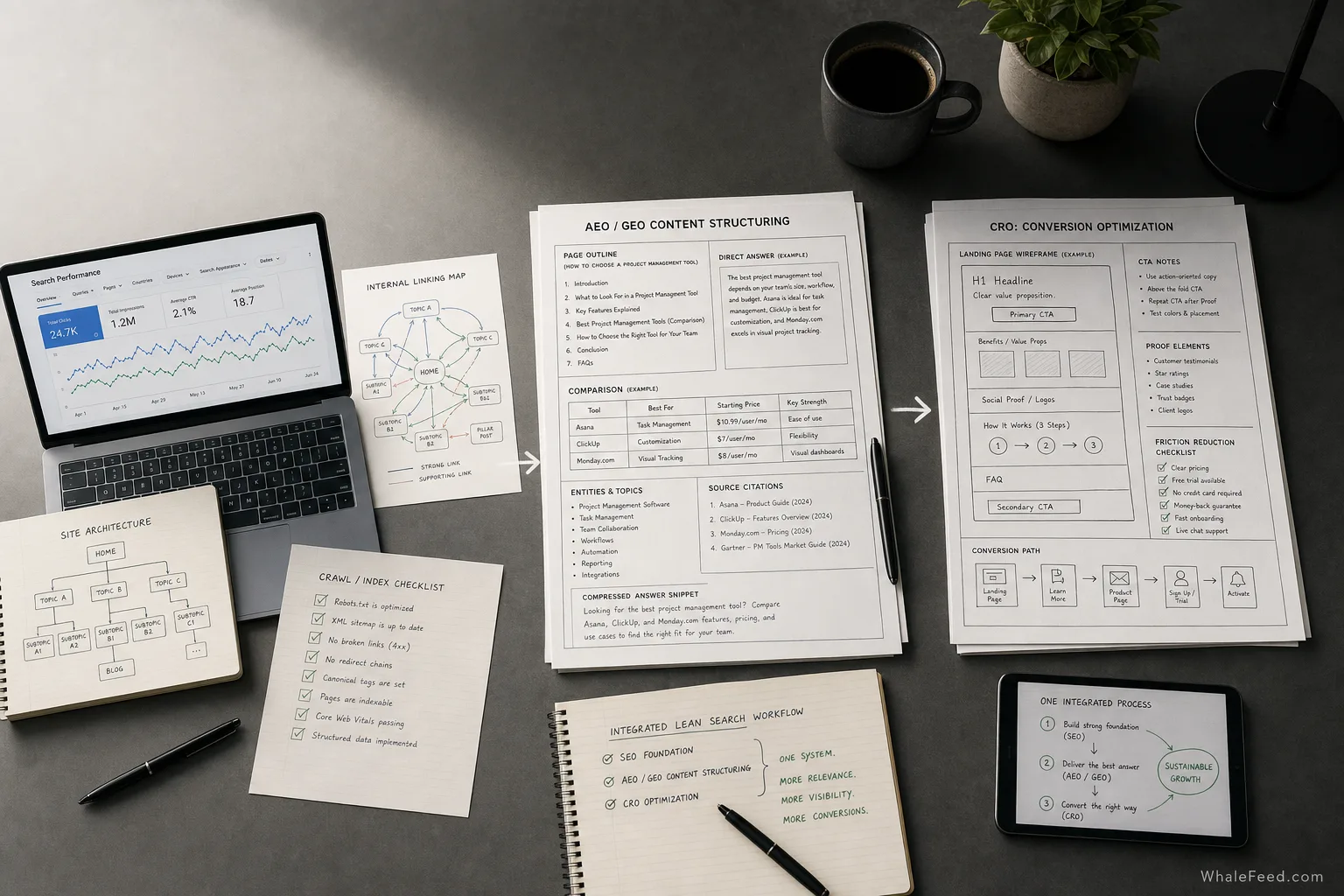
This bucket includes:
- fixing crawl and indexing issues
- cleaning up site architecture
- improving internal linking to money pages
- consolidating overlapping content
- mapping pages to clear search intent
- refreshing outdated content that already has some authority
If this layer is weak, the rest is built on sand.
AEO/GEO work: answer structure, clear definitions, comparison framing, entity signals, sourceable claims
This is where you make pages easier for AI systems to use.
That usually means:
- opening with a direct answer
- defining terms plainly before expanding them
- structuring comparisons so they can be extracted
- adding concrete claims that can be attributed
- using specific headings that answer sub-questions
- covering adjacent subtopics that query fan-out may surface[^2]
A practical example: do not write a vague “best tools” post. Write a page that states who each tool is for, who should avoid it, what it costs, and where it breaks down.
CRO work: message match, page clarity, proof, friction reduction, stronger CTAs
Once the visitor lands, the job changes.
This layer includes:
- matching the intro and CTA to the query intent
- reducing clutter above the fold
- adding proof through screenshots, use cases, pricing context, testimonials, or comparison logic
- making the next step obvious
- removing forms, layouts, or copy that create hesitation
The mistake is treating SEO traffic as the finish line. It is only the handoff.
What overlaps and should not be duplicated
The good news is that these are not three separate content systems.
One strong page can do all three jobs:
- rank because it is technically sound and intent-matched
- get cited because it is clear and sourceable
- convert because it is useful and commercially coherent
That is the goal: one brief, one page, three outcomes.
What to do first with 5 hours a week vs. 20 hours a week
The 5-hour plan
If your team has five hours a week, do less.
- Fix obvious indexing, crawl, and internal linking issues.
- Identify five high-intent pages closest to revenue.
- Rewrite intros, comparisons, and CTAs on those pages.
- Add clearer definitions, tables, and decision framing where useful.
- Stop publishing commodity blog posts that no one will cite, rank, or remember.
A lean team usually grows faster by upgrading a few pages with buying intent than by publishing ten broad posts with no information gain.
The 20-hour plan
With more time, build a repeatable system:
- refresh high-potential existing pages
- build alternatives hubs and comparison clusters
- publish workflow guides and decision pages
- create one or two reusable assets such as templates or calculators
- test layouts and CTAs on high-intent pages
- monitor generative AI visibility where reporting is available
Google announced Search Generative AI performance reports in Search Console on June 3, 2026, but the rollout initially applies only to a subset of sites.[^4] Use it if you have access. If not, do not wait for perfect reporting to improve pages that already deserve attention.
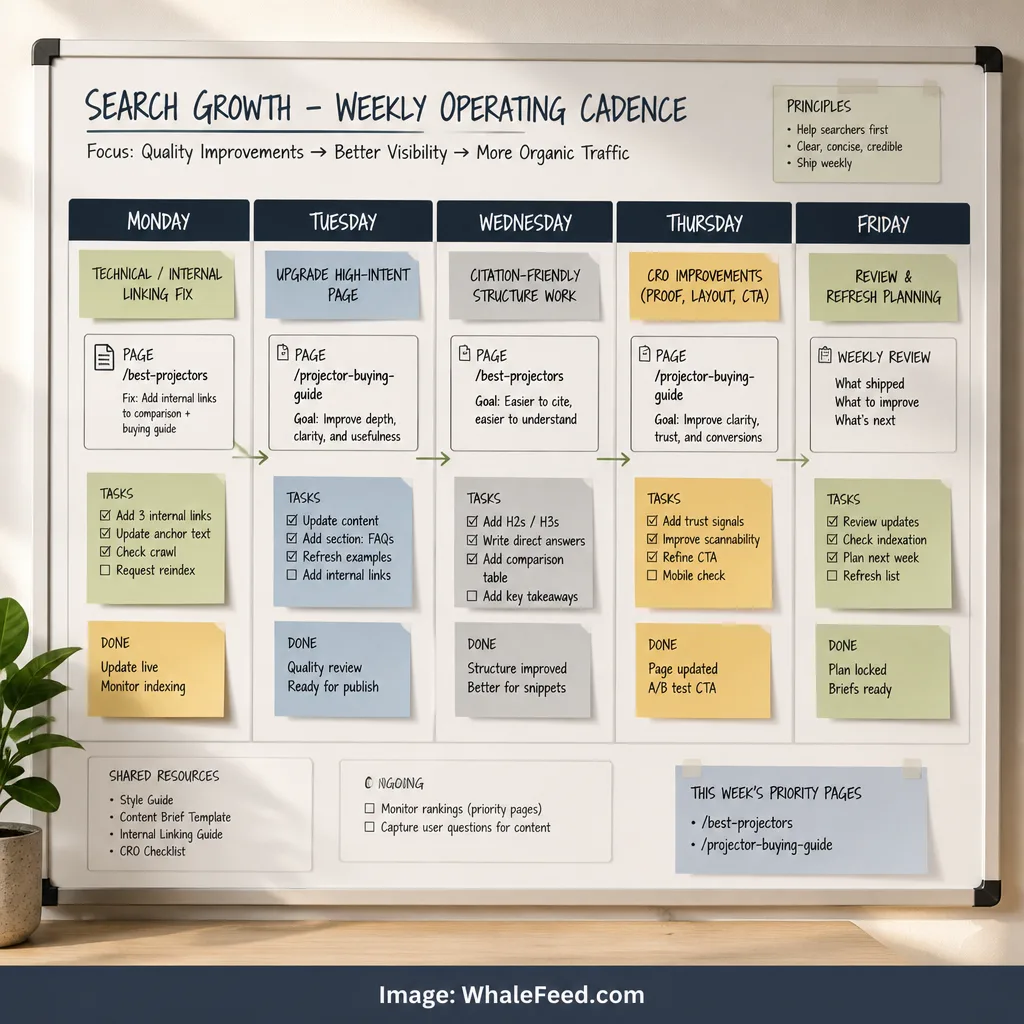
A simple weekly operating cadence
A workable cadence for small teams:
- Monday: fix one technical issue or internal linking gap
- Tuesday: upgrade one existing high-intent page
- Wednesday: improve citation-friendly structure and subheads
- Thursday: strengthen proof, layout, and CTA
- Friday: review page-level performance and note what to refresh next
Not glamorous. Very maintainable.
Content formats that travel well in AI search
Alternatives pages and competitor comparison hubs
These work because they compress well and still leave room for judgment. The AI layer can summarize the options. Your page earns the click by helping the reader choose.
Workflow posts and decision guides
“How to choose,” “when to use,” and “what to do instead” formats are stronger than broad explainers because they combine information with action.
Templates, checklists, and calculators
These hold up well because they do something. A template or calculator often survives AI compression better than a generic article because the reader still needs the asset itself.
Definition-plus-application pages that are easy to cite
If you publish definitional content, do not stop at the definition. Pair it with implementation, examples, failure cases, and decision context.
Why broad informational posts are getting weaker
Google’s guidance emphasizes unique, valuable, non-commodity content.[^1] That should sound familiar, but it matters more now. If your article is a thin summary of what ten other articles already say, it is vulnerable twice: first in rankings, then in AI compression.
What to stop doing in 2026
Broad informational posts with no information gain
If a piece teaches nothing beyond a basic summary, it is easier for both search engines and AI systems to route around it.
Thin listicles built from the same obvious tools
“Top 25 tools” pages with no original evaluation are easy to generate and easy to ignore.
Scaled content that creates surface area but not authority
More URLs do not create more trust. Very often, they create maintenance debt.
Formatting tricks sold as AEO/GEO shortcuts
Do not burn cycles on myths. Google explicitly says special files like LLMS.txt are not required for its generative AI features, and it has publicly framed many AEO and GEO hacks as misconceptions.[^1][^2]
A lean-team operating model you can actually maintain
One content brief, three outputs
A smart brief in 2026 should answer three questions:
- What query and intent are we trying to rank for?
- What parts of this page are most citeable inside AI-driven search experiences?
- What exactly should the visitor do next?
If the brief cannot answer those, the page is probably too vague.
One page should serve ranking, citation, and conversion together
This is the real efficiency play.
You do not need one “SEO article,” one “AEO article,” and one “conversion page.” You need one strong asset that is technically sound, editorially clear, and commercially useful.
How to measure success without creating a reporting mess
Keep reporting simple:
- organic visibility to high-intent pages
- clicks and engagement on refreshed assets
- assisted conversions from organic landing pages
- lead or revenue contribution from comparison and alternatives content
- generative AI reporting in Search Console, if your site has access to the June 2026 rollout[^4]
Do not let reporting complexity become another excuse for inaction.
Conclusion
The best way to think about SEO, AEO, and GEO in 2026 is not as competing disciplines. It is as a workflow split inside one system.
SEO helps your page get found. AEO/GEO helps it get used. CRO helps it get chosen.
For lean teams, that is good news. You do not need three strategies. You need one sharper operating model, fewer low-value pages, better structure on the pages that matter, and a stronger handoff from visibility to action.
The teams that win this shift will not be the ones chasing every acronym. They will be the ones building pages worth retrieving, citing, and acting on.
FAQ
What is the difference between SEO, AEO, and GEO in 2026?
The simplest distinction is by outcome. SEO focuses on retrieval, indexing, and ranking in search results. AEO and GEO are commonly used to describe work that helps content get understood, included, and cited inside generative AI experiences. In practice, Google’s 2026 guidance treats many of these tactics as extensions of strong SEO, not as a separate replacement discipline.[^1][^2]
Is AEO different from SEO, or just renamed SEO?
Some of it is new language for old fundamentals. Clear site architecture, crawlability, topical coverage, internal linking, and useful content still matter. What changes is the output you optimize for: not only rankings, but also answer inclusion, citation, and recommendation inside AI-generated results.[^2]
What does GEO mean in marketing?
GEO usually stands for generative engine optimization. The term is used to describe optimizing content for visibility in generative search and answer engines. The definition is still fluid across the industry, so it is usually more useful to think in workflow goals than acronyms.[^2]
Should small teams run separate SEO, AEO, and GEO programs?
Usually not. Lean teams should run one content system with a practical workflow split. SEO covers the technical and retrieval foundation. AEO or GEO improves answer formatting, source clarity, and citation readiness. CRO makes sure the page earns the click and converts once a visitor arrives.
What should a lean team prioritize first?
Start with fundamentals: fix indexation and technical hygiene issues, improve a small set of high-intent pages, strengthen message match, and stop publishing low-yield commodity content. Once the base is solid, add AI-friendly formatting, clearer definitions, comparisons, and sourceable claims to existing pages.
Which content formats are better suited to AI search in 2026?
Formats that compress well and still preserve usefulness tend to be stronger bets: alternatives pages, comparison hubs, workflow guides, decision frameworks, templates, checklists, and calculators. These formats are easier for AI systems to summarize while still giving readers a reason to click for nuance, depth, or action.
How do you measure AI search visibility in 2026?
Google announced Search Generative AI performance reports in Search Console on June 3, 2026, but the rollout initially applies to only a subset of sites.[^4] For now, teams should combine available Search Console reporting with page-level engagement, assisted conversions, and performance from high-intent pages rather than relying on a single vanity metric.[^4]
Do you need special files like LLMS.txt to appear in Google’s generative AI features?
No. Google’s 2026 documentation says special machine-readable files such as LLMS.txt are not required for visibility in Google Search generative AI features.[^2] Strong SEO fundamentals and high-value content are a better investment than shortcut-style implementation tricks.
[^1]: Google Search Central Blog, “A new resource for optimizing for generative AI in Google Search,” published May 15, 2026. (developers.google.com)
[^2]: Google Search Central documentation, “Optimizing your website for generative AI features in Google Search.” Supporting facts drawn from the research brief and official documentation referenced there, including Google’s statements that SEO remains foundational, generative AI features rely on retrieval and grounding from the Search index, query fan-out is used, many AEO/GEO hacks are misconceptions, and special files like LLMS.txt are not required. (developers.google.com)
[^3]: Google Help documentation describing AI Overviews as appearing when Google’s systems determine generative AI is especially helpful, including when users want a quick understanding from multiple sources. This article’s comments about which query types may be more vulnerable to answer absorption are an inference from that guidance, not a universal rule. Supporting source referenced in the research brief.
[^4]: Google Search Central Blog, “Introducing Search Generative AI performance reports in Search Console,” published June 3, 2026; rollout initially limited to a subset of websites. (developers.google.com)