GEO for Small Business: A 30-Day Experiment Plan to Earn AI Citations
Most GEO advice falls apart when you try to use it in a 1–3 person business. You do not have an agency research team, a programmatic content engine, or months to spend on vague “AI visibility” work that may never produce a lead.
That limitation is useful. It forces a better question: not “How do we show up everywhere in AI?” but “Where does an AI system actually need outside evidence, and can we publish the kind of page it wants to cite?”
That is the opening for small teams. ChatGPT search can show inline citations when it uses web search. Microsoft says Copilot Search shows the sources behind its answers. Google continues to emphasize original, helpful, people-first content over formulaic search-first publishing.[^1][^2][^3] None of that gives you a stable ranking formula. It does point to a practical strategy: publish compact, evidence-rich assets for queries that benefit from proof, comparison, freshness, or calculation.
This article lays out a one-month experiment: pick 10 queries, publish 3 page types, track citations manually, and judge success by business outcomes rather than vanity metrics.
For a tiny business, GEO is not about publishing more. It is about publishing evidence AI actually needs.
Small businesses usually fail at GEO when they reuse old SEO volume logic. They publish broad explainers, generic “best X” lists, and thin opinion posts, then hope AI tools reward the output. In practice, those are often the easiest pages for AI systems to summarize without sending anyone to your site.
That is the first misconception to drop. GEO for small business is usually not a volume game. It is a retrieval-and-utility game.
The better thesis is simple: target prompts where the model benefits from citing proof, numbers, methods, or tools. In practice, that means pages that answer questions like:
- What happened when you tested something for 14 days?
- How does tool A compare with tool B using clear criteria?
- What is the likely ROI, break-even point, or cost estimate for a specific scenario?
These are harder to answer well from generic prior knowledge alone. They create an evidence gap.
What makes a query worth testing for AI citations
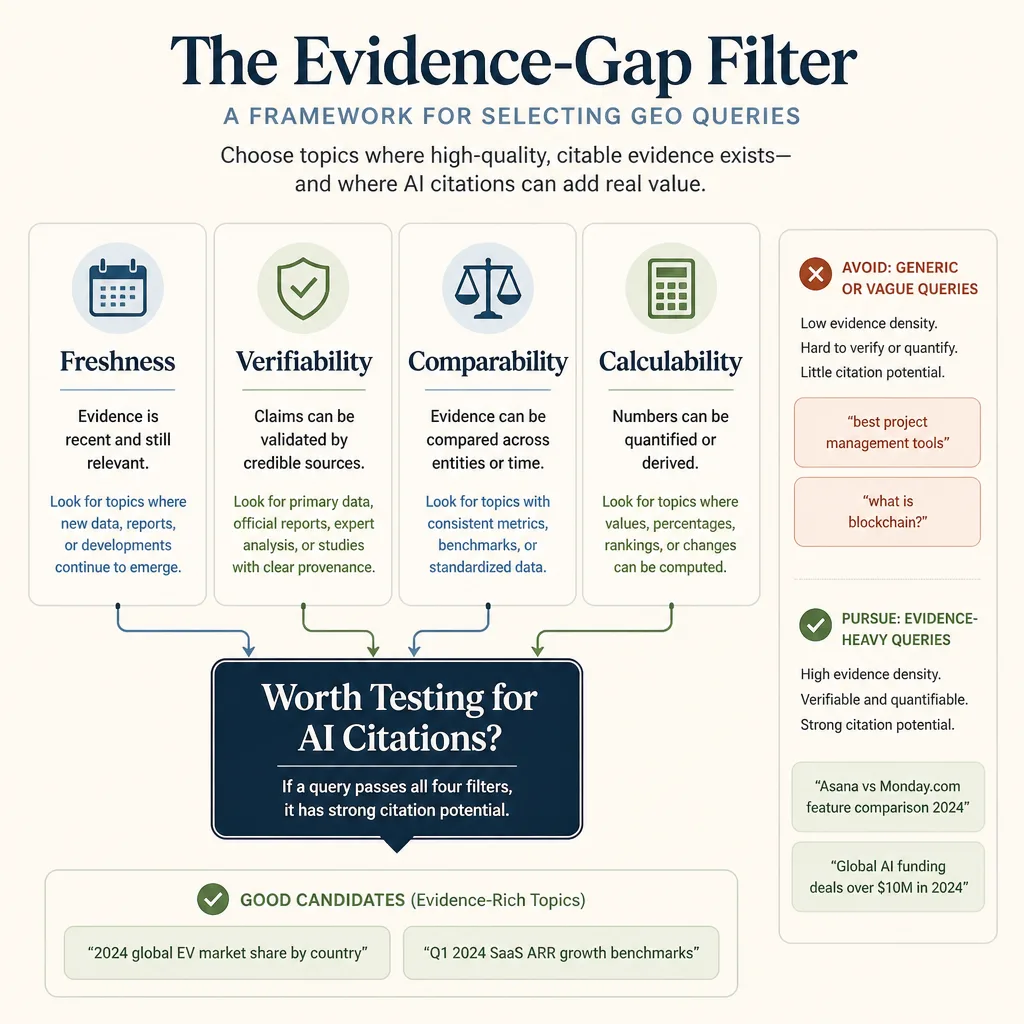
A small team should not start with keywords. Start with prompts that naturally reward outside evidence.
The evidence-gap filter: Freshness, Verifiability, Comparability, Calculability
Use this four-part filter on every candidate query:
Freshness
Does the answer depend on recent data, prices, platform changes, or current observations?
Verifiability
Can the answer point to a source, date, method, screenshot, benchmark, or firsthand observation?
Comparability
Does the user need a side-by-side evaluation with tradeoffs?
Calculability
Does the query involve a formula, estimate, threshold, or scenario-based output?
If a query scores high on at least two of these, it is worth testing. If it scores high on three or four, it is usually a better GEO opportunity than a broad informational term.
Queries to avoid
Avoid topics AI can summarize comfortably without you:
- “What is content marketing?”
- “Best CRM for small business” with no original method
- vague motivation or inspiration topics
- broad definitions
- generic listicles that repackage what everyone else already says
That does not mean broad listicles never work. Established publishers still get cited in many categories. But for a tiny site, the odds improve when your page contains something specific and extractable rather than another roundup.
A simple 10-query selection method for a 30-day test
Create a sheet with these columns:
| Query | F | V | C | Ca | Page Type | Conversion Goal | Notes |
|---|---|---|---|---|---|---|---|
| “Email welcome sequence ROI calculator” | 1 | 1 | 0 | 1 | Calculator | signup | strong commercial tie |
| “ConvertKit vs MailerLite for solo creators benchmark” | 0 | 1 | 1 | 0 | Comparison | affiliate click | needs clear criteria |
| “What happened after reducing landing page fields from 7 to 3” | 1 | 1 | 0 | 0 | Experiment log | lead form | requires real test |
Use binary scoring: 0 or 1 for each dimension. Pick 10 queries with the highest totals and the clearest business relevance.
The three page types that give a small site the best odds
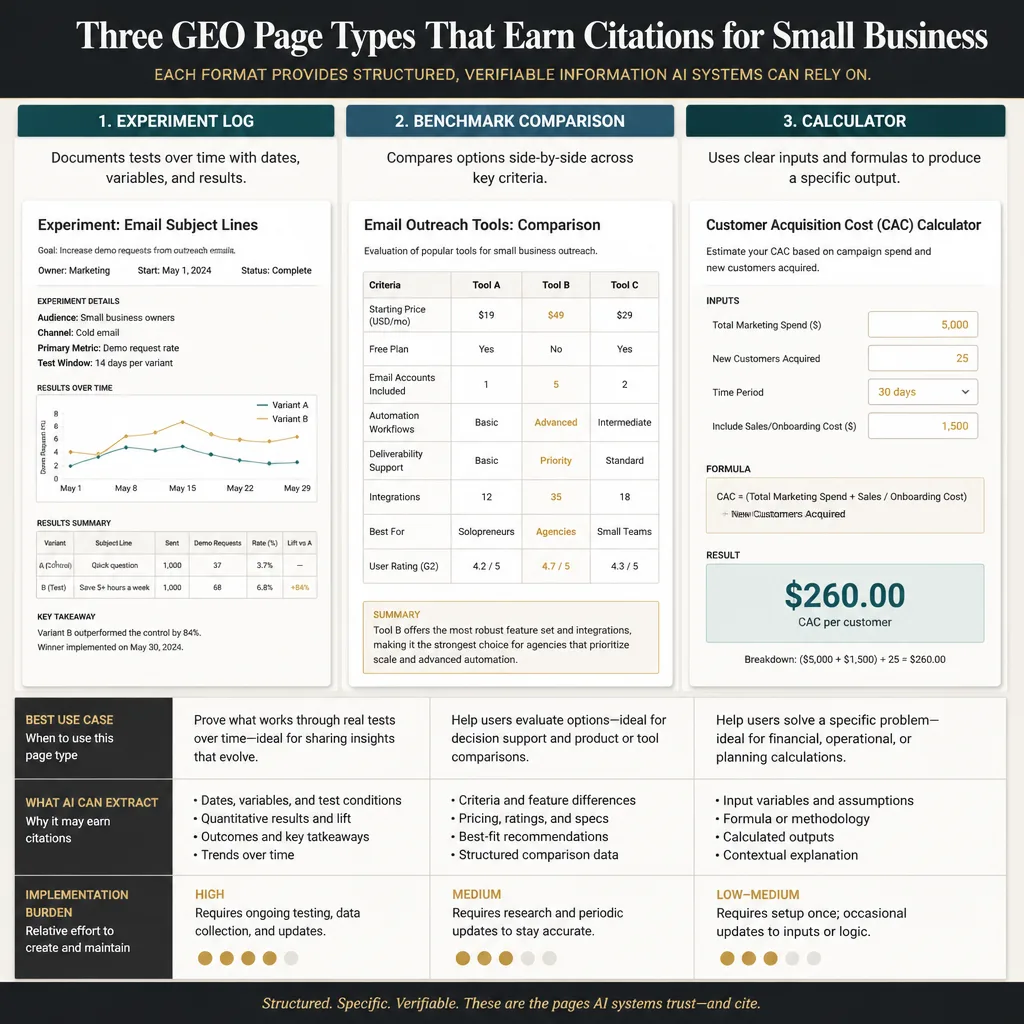
You do not need 20 formats. You need three that are practical and easy to cite.
Experiment log: publish the process, dates, variables, and results
This is the best option when you can test something firsthand.
A useful experiment log includes:
- the question being tested
- exact dates
- setup and tools used
- what changed and what stayed constant
- a small results table
- limitations
- next test
A solo consultant might publish: “14-Day Test: Does adding pricing to a services landing page reduce unqualified calls?” That is naturally more citeable than “Why transparent pricing matters.”
The advantage is not scale. It is specificity.
Benchmark comparison: create side-by-side evidence readers and AI can extract
Comparison pages work when you define the method before the conclusion.
A minimum credible benchmark page should include:
- who the comparison is for
- criteria and weighting, if any
- data sources
- a side-by-side table
- brief takeaways
- caveats
- last updated date
For example, an indie SaaS operator could compare three live chat tools for sites with fewer than 5,000 monthly visitors using setup time, base cost, native integrations, and transcript export quality. That is narrower and more defensible than a giant “best customer support tools” post.
Calculator: provide a reusable utility tied to a decision
Calculators are underrated because they do not look like traditional content. But they create utility, and utility is often more durable than opinion.
Good examples for a small business:
- lead value calculator
- break-even CPC calculator
- affiliate revenue estimator
- email list growth projection
- landing page conversion uplift estimator
The key is relevance. A calculator tied to a real business decision is more useful than a novelty widget.
How to build stat-dense sections without becoming spammy or misleading
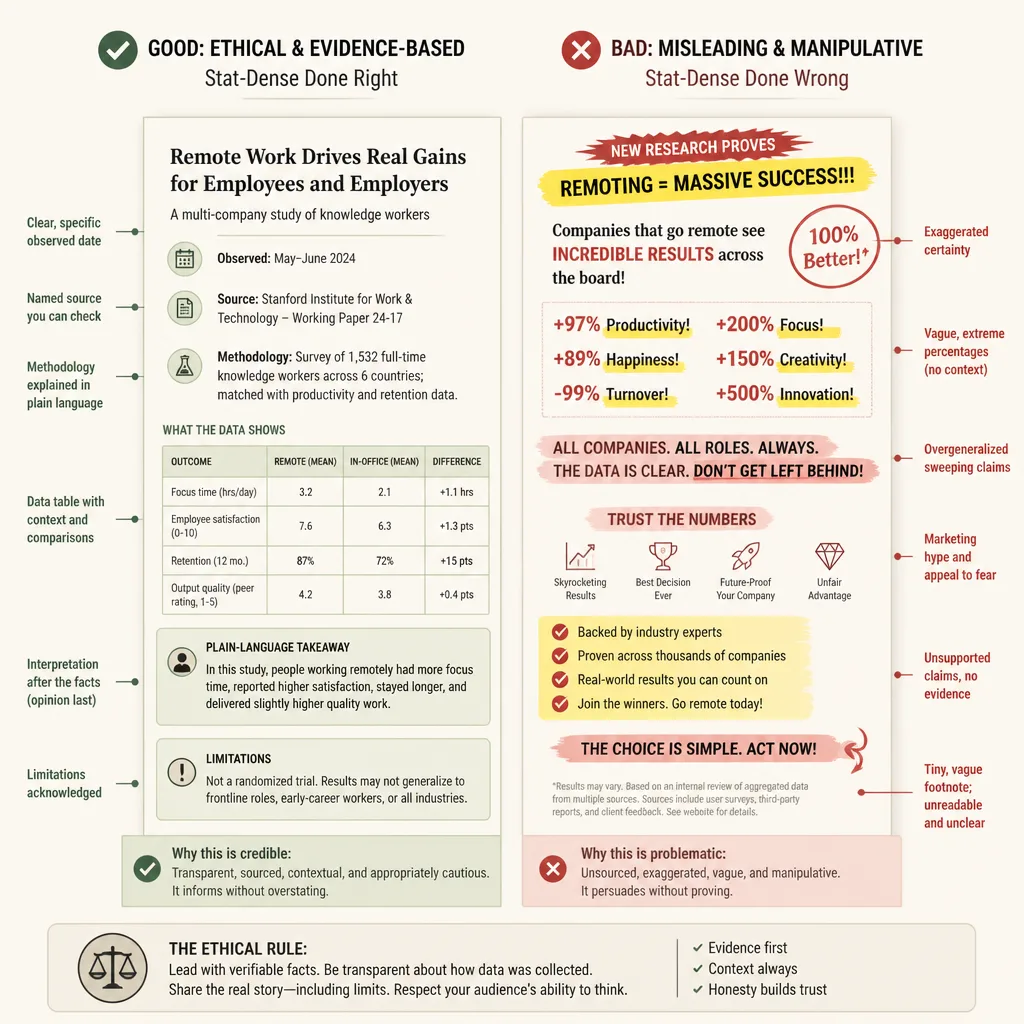
This is where many GEO pages go off the rails.
The goal is not to cram paragraphs with percentages. It is to make evidence easy to verify and easy to extract.
Use sourced numbers, date stamps, methodology notes, and plain-language takeaways
A strong evidence block might include:
- one number
- where it came from
- when it was observed
- how it was measured
- what it actually means
For example:
In our 21-day test from May 3 to May 24, 2026, shortening a signup form from six fields to three increased completion rate from 2.8% to 4.1%. Traffic volume was modest, so treat this as directional rather than conclusive.
That is evidence-rich without pretending to be academic.
Separate facts, interpretation, and opinion
Use this order:
- Fact: what happened
- Interpretation: what you think explains it
- Opinion: what you would do next
That separation helps both human readers and AI systems. OpenAI’s help materials also warn that important facts, quotes, and references should be verified, which is a good reminder not to write with false certainty.[^4]
Ethical rules
Three non-negotiables:
- no fake precision
- no unsourced percentages
- no inflated sample sizes
If your sample is tiny, say so. If your method is imperfect, say that too. Trust beats drama here.
The 30-day GEO experiment plan
Treat this as a content R&D sprint, not a new editorial calendar.
Days 1–3: pick 10 queries and define one conversion goal
Choose one conversion target only:
- newsletter signup
- contact form completion
- demo request
- affiliate click
- calculator completion
One goal keeps the analysis honest.
Days 4–7: create your tracking sheet and page templates
Your stack can stay lean:
- spreadsheet for query tracking
- standard analytics for traffic and conversions
- manual prompt checks across major AI tools
Track:
- query
- page type
- publish date
- prompt variants
- whether cited
- whether linked
- visits
- assisted conversions
- notes
Days 8–15: publish the first experiment log, comparison page, and calculator
That is enough for a minimum viable test.
Do not publish seven mediocre posts. Publish three strong assets.
Each page should include:
- a clear summary near the top
- skimmable tables or inputs
- dated methodology
- internal links to related support pages
- one relevant CTA
Days 16–22: add supporting evidence blocks, FAQs, and internal links
This is where weak pages become useful.
Tighten:
- summary tables
- FAQ blocks
- methodology sections
- update notes
- internal links from related posts or service pages
If schema is easy to implement, add it. But do not let technical extras replace content clarity.
Days 23–27: test prompts manually across AI tools and record citations
Check prompt variations, not just one phrasing.
For example:
- “best break-even CPC calculator for affiliate landing pages”
- “how to calculate break-even CPC for a $49 product”
- “affiliate break-even ad cost formula”
Record whether your page is:
- cited
- linked
- summarized without citation
- ignored
This matters because prompt phrasing can change retrieval behavior. A citation on one variation does not mean you own the topic.
Days 28–30: review citation frequency, visits, assisted conversions, and next-step decisions
Now classify the result:
- Double Down: repeated citation appearances plus at least some assisted traffic or conversions
- Iterate: weak but real signal; improve structure, topic fit, or sourcing
- Stop: no meaningful visibility and no business signal
What to measure if you want this to become a business channel, not just an interesting metric
The biggest GEO mistake is treating citations as the finish line.
Leading indicators
Watch these first:
- citation appearance rate
- number of prompt variants where you appear
- indexed pages
- referral patterns that suggest AI-assisted discovery
- calculator usage depth or page engagement
These tell you whether the format is gaining traction.
Business indicators
Then watch what actually matters:
- signups
- demos
- affiliate clicks
- leads
- replies
- sales or revenue events
Citation presence does not prove business value. Some AI tools answer so completely that users never click through. That is why this should be judged as a business experiment, not a visibility experiment.
How to judge a small-data test without fooling yourself
With a tiny sample, do not claim causation. If a page starts getting cited, the reason could be page clarity, query fit, freshness, crawlability, brand familiarity, or plain prompt luck. Microsoft’s Copilot documentation also notes that grounding improves relevance and gives users citations to verify, but still advises reviewing sources and confirming critical details.[^2]
So look for patterns, not proof. Repeated appearance across a prompt cluster is a signal. One lucky mention is noise.
Failure cases: when this experiment is a bad use of your month
Skip or delay this test if:
- your niche has no real evidence angle
- you cannot produce credible firsthand observations or trustworthy synthesis
- your offer depends on high-volume generic top-of-funnel traffic
- your site has serious crawl or indexation problems
Also skip it if you are tempted to manufacture numbers just to look citeable. That is not optimization. It is liability.
What success looks like after 30 days
Success is not “we published three AI-friendly pages.”
Success is finding out whether your niche has a repeatable evidence format that AI systems cite and humans act on.
If one page type stands out, build a system around it. A consultant who gets traction with experiment logs can turn each client-safe test into a dated, structured case-style asset. A micro-SaaS that sees usage on calculators can build a small cluster of adjacent tools. A niche publisher that gets cited on comparison pages can standardize criteria and update cadence.
The next move is not scale by default. It is selective repetition.
Conclusion
GEO for small business works best when you stop treating it like a content land grab. The goal is narrower. You are trying to find a small set of evidence-rich assets that AI systems repeatedly need for answers requiring proof, comparison, freshness, or calculation.
That is why a 30-day sprint is enough to learn something real. Pick 10 queries. Publish one experiment log, one comparison page, and one calculator. Track citations manually. Then judge the whole effort by whether it contributes to signups, leads, clicks, or revenue.
If you find signal, build on the format. If you do not, stop early and move on. That discipline is one of the real advantages of being small.
FAQ
What is GEO for small business?
GEO for small business means creating content that AI tools are more likely to cite or reference when answering user questions. For a tiny team, the most realistic approach is not mass publishing. It is building a few evidence-rich assets that help AI answer prompts requiring proof, comparison, freshness, or calculation.
Can a 1–3 person business realistically earn AI citations?
Yes, but usually by targeting narrow, evidence-heavy topics rather than broad generic content. Small teams are more likely to earn citations with pages such as experiment logs, benchmark comparisons, and calculators than with generic best-of listicles or high-level explainer posts.
What types of pages are most likely to get cited by AI tools?
The three most practical page types for small businesses are experiment logs, benchmark comparison pages, and calculators. These formats give AI systems something concrete to extract: dates, numbers, methods, formulas, tradeoffs, and decision support.
How do I choose queries for an AI citation experiment?
Use an evidence-gap filter. Prioritize queries where the answer benefits from Freshness, Verifiability, Comparability, or Calculability. In practice, that means prompts involving recent stats, side-by-side comparisons, formulas, cost estimates, or documented results.
Should I publish generic best X content for GEO?
Usually not, especially if you are a very small business without strong authority. AI systems can often summarize generic best X pages without needing your site. You have better odds with content that contains original structure, transparent methods, and specific evidence.
How do I measure whether AI citations are actually helping my business?
Track both leading and lagging indicators. Leading indicators include citation appearance rate, prompt coverage, and AI-assisted visits. Lagging indicators include newsletter signups, leads, demo requests, affiliate clicks, or sales. Citation visibility alone is not enough; the real test is whether it contributes to business outcomes.
What tools do I need for a 30-day GEO experiment?
A simple setup is enough: a spreadsheet for query and citation tracking, standard web analytics, and manual prompt testing across major AI tools. Most solo operators do not need enterprise GEO software to validate whether this channel shows early signal.
What should count as success after 30 days?
Success is not just getting cited. A strong outcome is repeated citation visibility for a few query clusters plus some evidence of downstream action, such as visits, signups, tool usage, inquiries, or assisted conversions. If you see citations but no business signal, the right next step may be to iterate or stop.
[^1]: OpenAI says ChatGPT search responses that use search can include inline citations and a sources panel. (help.openai.com) [^2]: Microsoft says Copilot Search displays the sources and links used to generate answers, and Copilot documentation says grounding provides citations to verify while still requiring source review for critical details. (microsoft.com) [^3]: Google’s Search Central guidance emphasizes helpful, reliable, people-first content, original information, clear sourcing, and content created primarily for people rather than ranking manipulation. (developers.google.com) [^4]: OpenAI’s Help Center notes that AI systems can fabricate quotes, studies, citations, or references, and important information should be verified. (help.openai.com)