Programmatic Landing Pages That Don’t Turn Into Spam: A 2026 Framework for Scalable Pages That Still Convert
Programmatic landing pages keep attracting ambitious teams because they make scale look tidy. One template, one dataset, thousands of URLs. On a spreadsheet, it feels efficient.
In practice, that is where many pSEO projects break down. The issue is rarely automation itself. It is scaling pages before you have scaled usefulness. Google’s current spam policies explicitly target scaled content created mainly to manipulate search visibility rather than help users, and its people-first guidance keeps reinforcing the same standard: create pages that are genuinely useful, not just numerous.[^1][^2]
So the real question in 2026 is not whether you can generate landing pages at scale. It is whether each page has earned the right to exist, be indexed, and attract the kind of visitor your business actually wants.
Programmatic landing pages can scale growth, but they can also scale mediocrity
Why pSEO still attracts ambitious teams
There are valid reasons marketers keep coming back to programmatic SEO.
Long-tail demand is real. Many businesses see repeatable search patterns around locations, use cases, integrations, comparisons, inventory sets, and pricing scenarios. If those patterns map to real buyer intent, programmatic pages can expand search coverage without requiring a custom article for every query.
But scale is not the advantage many teams think it is. It only helps when the pages stay useful after the template is applied.
The real failure mode: not automation, but empty variation
Most weak pSEO systems do not fail because they are automated. They fail because the differences between pages are superficial.
A city page that swaps only the city name is usually not a new page. A comparison page that changes only the product pair in the H1 is not much better. A template that produces 5,000 URLs without adding new evidence, constraints, or decision support is not a growth system. It is a duplication system.
Google’s spam guidance and doorway abuse policies matter here because they focus on manipulative page proliferation, especially when many similar pages funnel users toward the same outcome without distinct value.[^1]
Scale works only when each page earns its reason to exist
That is the standard.
If a page does not help a user more than a category page, internal search result, or filtered list, it probably should not exist as an indexable landing page.
When programmatic SEO is actually justified
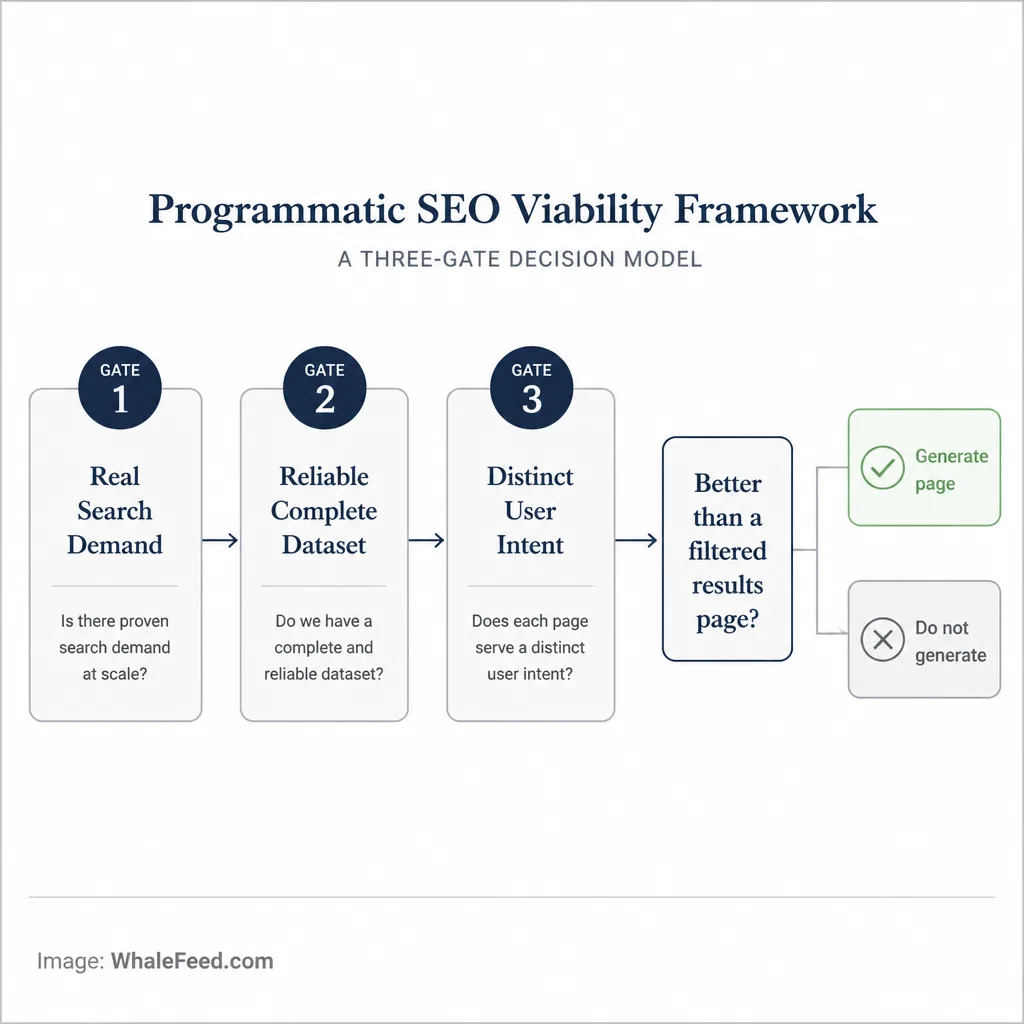
The three conditions that make pSEO viable
Programmatic landing pages are usually justified only when three things are true:
- There is real search demand.
- You have a reliable dataset.
- Each page serves distinct intent.
Miss any one of those and the system gets shaky.
If demand is weak, you are creating URLs for no audience. If the data is incomplete, the pages will feel hollow. If intent is not distinct, you are just slicing one topic into thinner variations.
A simple test: would this page beat a filtered results page?
This is the easiest test I know.
Ask: Would a dedicated page help the user more than a faceted list or site search page?
If the answer is no, do not build the page.
For example:
- A local service page can make sense if the city changes provider availability, pricing ranges, response times, regulations, or proof.
- An integration page can make sense if the connection method, supported features, setup complexity, and limitations vary by tool.
- A calculator page can make sense if the inputs change the output and the recommendation.
But if the page is just “same offer, different keyword,” the filtered experience is probably enough.
When to avoid pSEO
Avoid it when:
- your only variation is keyword phrasing
- your location pages have no real local differences
- your dataset is sparse, stale, or hard to verify
- every page pushes users to the same destination with little page-level value
- you cannot review quality or monitor indexation at scale
That last point matters more than most teams admit.
Choose datasets that create meaningful differences between pages
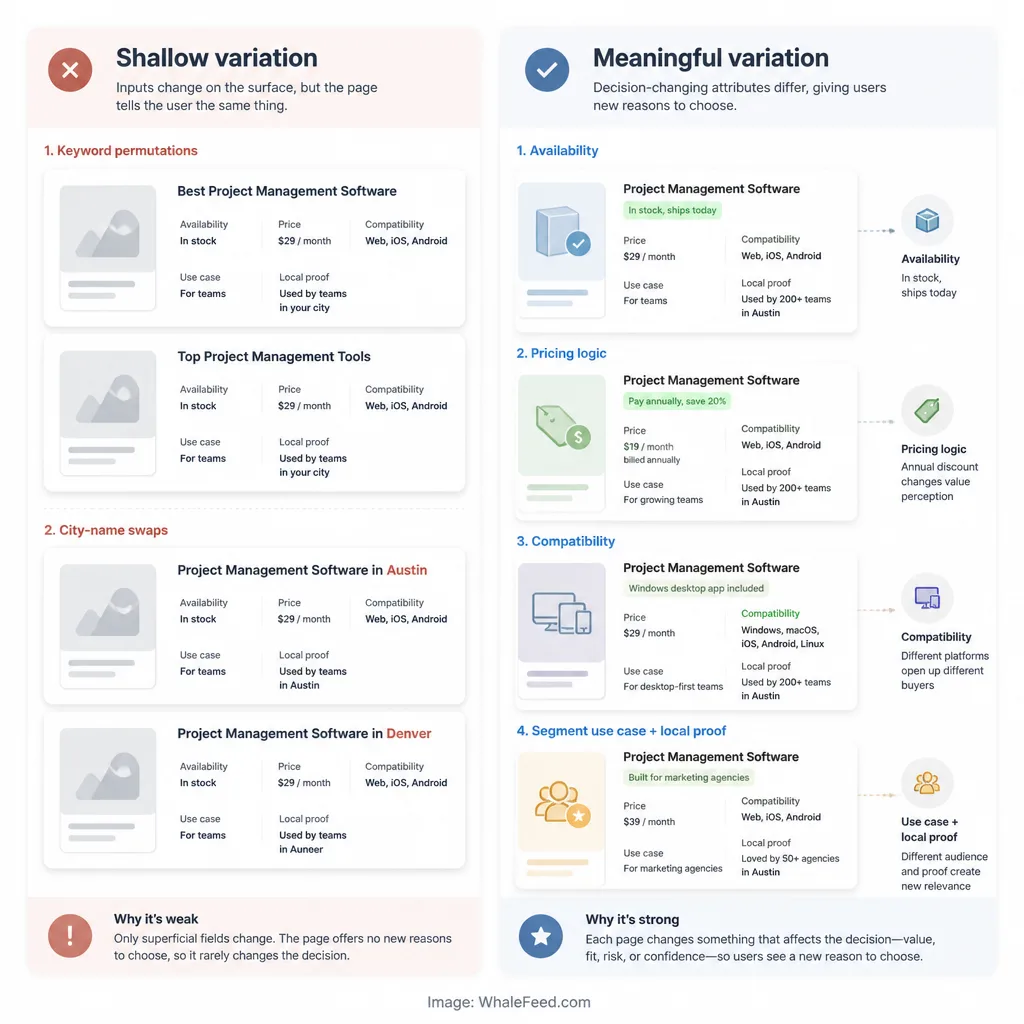
Bad inputs: shallow keyword permutations and cosmetic location swaps
The weakest pSEO projects start with a keyword sheet, not a user problem.
They generate pages like:
- “email marketing software for dentists”
- “email marketing software for chiropractors”
- “email marketing software for accountants”
If the page body barely changes, those are not meaningfully different pages. They are SEO-shaped duplicates.
The same goes for city pages where the only local element is the city name in the title tag.
Good inputs: attributes that change the user’s decision
The strongest datasets contain fields that alter what the user should choose, expect, calculate, or compare.
Useful fields often include:
- inventory or availability
- service coverage
- price ranges or pricing logic
- compatibility details
- supported versions
- feature differences
- implementation constraints
- segment-specific use cases
- local proof, reviews, or regulations
- calculated outputs
This is why the dataset is the real quality unit. The template only expresses what the data makes possible.
What meaningful difference looks like in practice
A local directory page for “coworking spaces in Austin” becomes useful when it shows real availability, neighborhood differences, desk types, pricing bands, amenities, and booking details.
A SaaS comparison page for “Tool A vs Tool B for agencies” becomes useful when it changes the evaluation based on client permissions, white-labeling, reporting depth, pricing model, and onboarding burden.
A calculator becomes useful when different inputs produce materially different outputs and next-step advice.
Short pages can still be valid. Thin is not the same as short. A concise compatibility page can satisfy intent better than a long generic article if it clearly answers whether two systems work together and under what conditions.[^2]
The page types that usually work best
Some programmatic formats naturally create real page-level utility.
Directories
Directories work when the entries are real, differentiated, and decision-ready.
Think marketplaces, service listings, location-specific inventories, or provider indexes where the page helps users narrow choices based on concrete attributes rather than generic descriptions.
Comparisons and alternatives pages
These work best when the compared options change the buying decision in specific ways.
A strong alternatives page does more than list competitors. It explains fit. For example, a CRM alternative page can segment recommendations by sales-team size, complexity, migration burden, and pricing model.
Calculators and estimators
Calculators are one of the cleanest pSEO formats because they create obvious utility.
Mortgage estimators, shipping calculators, SaaS pricing estimators, and ROI tools can justify many landing pages if the assumptions and outputs vary in meaningful ways.
Compatibility matrices and integration pages
These pages tend to work because users often need a binary answer first: does this work with that?
The useful version goes further. It explains supported methods, setup requirements, limitations, version support, and common failure points.
Why these formats work better than generic city or keyword pages
Because the data changes the task.
That is the difference. Good pSEO formats help users decide, compare, estimate, or verify. Weak ones mostly restate the keyword.
Build templates with editorial guardrails, not just dynamic fields
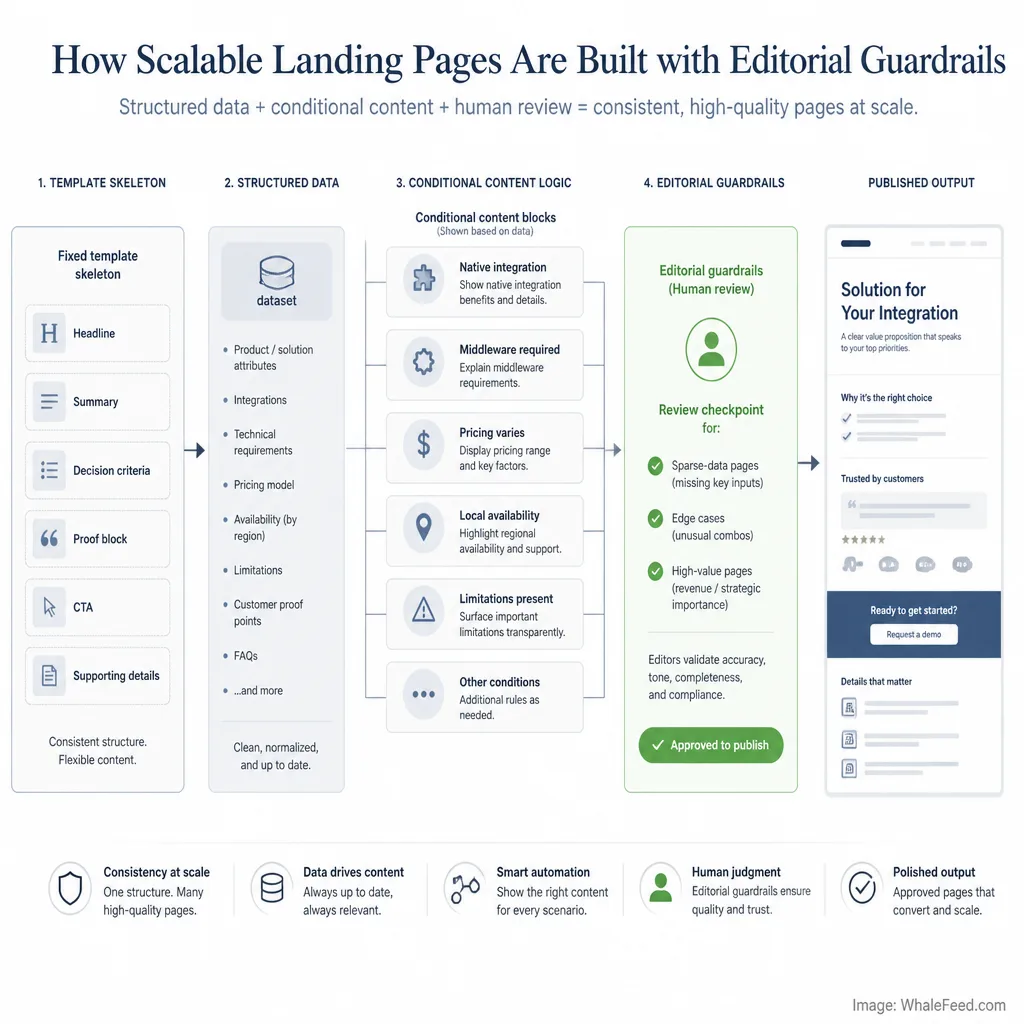
Separate fixed structure from page-specific evidence
A solid template should have a stable skeleton and flexible evidence.
Keep the structure consistent: headline, summary, decision criteria, proof blocks, CTA, and supporting details. But make the most important parts page-specific.
Add proof that changes from page to page
This is where many teams underinvest.
A page becomes stronger when it includes things like:
- actual provider counts in that market
- city-specific delivery windows
- supported integration methods
- pricing bands for that segment
- use-case examples tied to the page query
- limitations users should know before converting
For example, an integration page should not just say two tools connect. It should say whether the connection is native, via Zapier, through API, or limited to one-way sync.
Use conditional blocks, not just token replacement
This is a better model than simple variable insertion.
If a product has native integration, show implementation steps and supported features. If it requires middleware, show setup complexity and tradeoffs. If support is limited, say so.
That is real variation. It reflects conditions, not just nouns.
Where human review should stay in the workflow
Human review should remain for:
- sparse-data pages
- edge-case pages
- legally sensitive or trust-sensitive pages
- templates with low-confidence outputs
- high-value pages that drive revenue
Automation should reduce repetitive work, not remove judgment.
The hidden operational risk is index bloat
Why publishing every possible page is usually a mistake
Most pSEO failures are inventory failures before they are ranking failures.
When you generate every possible URL, you often create more indexable pages than the site can support with value, internal links, editorial review, and crawl demand. Google’s crawl budget guidance specifically notes that sites with a large share of URLs marked Discovered – currently not indexed may have crawl-efficiency issues.[^3]
How to tier pages: index, test, improve, or noindex
Use a four-part model:
- Index: strong demand, complete data, distinct intent, real proof
- Test: promising but uncertain pages you want to evaluate
- Improve: pages with demand but weak data or weak proof
- Noindex or do not generate: pages that fail the usefulness threshold
If you use noindex, make sure the page is still crawlable. Google is explicit that a page blocked in robots.txt may prevent crawlers from seeing the noindex directive.[^4]
Generate pages only when data quality crosses a threshold
There is no official number for how many dynamic fields make a page “unique enough.” That is a judgment call.
But there is a practical rule: do not generate a page until you can surface enough accurate, visible information to justify it as its own result.
If many URLs are near-duplicates, consolidate them. Google’s canonical guidance is clear that duplicate or very similar URLs should be consolidated so crawlers spend more time on genuinely new or updated pages.[^5]
Measure conversion quality, not just traffic
Why vanity traffic misleads teams
Search Console can tell you whether pages are being seen and clicked. It cannot tell you whether those visitors were worth attracting.
That is why pSEO teams often celebrate page growth that produces low-intent traffic, weak leads, or poor downstream activation.
Track qualified outcomes by page segment
Use GA4’s landing page reporting to compare sessions, engagement, key events, and revenue by landing page or landing-page segment.[^6] Then look at attribution paths to understand whether programmatic pages assist conversions earlier in the journey, even when they are not the last touch.[^7] If paid search is part of the mix, Google Ads attribution reporting can also show assisted conversion behavior across conversion paths.[^8]
A simple example:
- comparison pages drive fewer sessions but more demo requests from qualified buyers
- city pages drive more sessions but mostly bounce or produce poor-fit leads
The second set may look better in SEO dashboards and worse in the business.
How to spot pages that rank but attract the wrong visitor
Look for pages with:
- strong impressions, weak engagement
- clicks but low assisted or direct conversions
- leads that fail qualification
- activation or revenue rates far below site averages for that intent class
A page that ranks is not automatically a page that works.
A simple QA checklist for scalable landing pages
Before you index a page set, run this short checklist.
Does the page answer a distinct query with distinct value?
If the user lands here instead of a generic category page, do they get a better answer?
Is the dataset accurate, complete, and visible on-page?
Not hidden in your CMS. Not implied. Visible.
Is there real page-specific proof or only template language?
Look for actual differences: inventory, constraints, pricing logic, compatibility, examples, or local evidence.
Should this page be indexed right now?
Google does not guarantee that every crawlable page will be indexed.[^9] Treat indexation as something to earn, not something to assume.
Does this page attract the kind of visitor the business actually wants?
If the traffic is off-target, the page may be succeeding technically and failing commercially.
A practical way to think about pSEO in 2026
Treat page generation as product design, not content multiplication
The best programmatic landing pages behave more like product surfaces than content stubs.
They help users do something specific: compare, calculate, verify, shortlist, or decide.
Smaller, higher-signal page sets often outperform giant weak inventories
This is not a law, but it is a common pattern.
Smaller sets concentrate attention. They are easier to review, improve, and support with internal links. They are also less likely to flood your site with URLs that never deserved indexation.
Scale is only an advantage when quality survives the template
That is the whole game.
Programmatic landing pages are not bad because they are scaled. They become bad when scale replaces judgment. If the data creates real usefulness, the template expresses genuine differences, and the measurement model tracks qualified outcomes, pSEO can still be an excellent acquisition system in 2026.
Conclusion
The safest way to think about programmatic landing pages is also the most useful: every page is a product decision.
Does it solve a real query? Does it contain page-level evidence? Does it deserve crawl resources, indexation, and a user’s attention? If not, generating it faster does not improve the strategy. It only accelerates the mistake.
The best pSEO systems are usually not the biggest. They are the ones with the clearest standards for when a page should exist, what makes it genuinely different, and how success is measured after the click.
FAQ
What are programmatic landing pages?
Programmatic landing pages are pages generated at scale from a structured template and dataset. They usually target repeatable search patterns such as locations, use cases, comparisons, integrations, inventory sets, or calculated outputs.
Are programmatic landing pages bad for SEO?
Not inherently. They become a problem when the pages offer little original value, rely on cosmetic keyword swaps, or exist mainly to capture rankings. They work best when each page has distinct utility, accurate data, and a clear reason to exist.
When is programmatic SEO worth using?
It is usually worth considering when three conditions are present: real search demand, a reliable dataset, and meaningful page-level differences that help users make a better decision than a generic category or filtered results page would.
What types of programmatic pages tend to work best?
The strongest formats usually include directories, comparison or alternatives pages, calculators, estimators, compatibility pages, and integration pages. These formats naturally support structured data that changes the user’s decision or outcome.
How do you keep programmatic pages from becoming thin content?
Start with datasets that create meaningful variation, not just keyword variation. Then add page-specific proof, conditional content blocks, editorial guardrails, and index only the pages that meet quality and intent thresholds.
What is index bloat in programmatic SEO?
Index bloat happens when a site publishes more indexable URLs than it can support with real value. The result is often wasted crawl budget, duplicate or weak pages, and a large inventory of URLs that bring little traffic or business value.
Should every programmatic landing page be indexed?
No. Some pages should be indexed, some should be improved first, some should be tested under noindex, and some should never be generated at all. Indexation should be a quality decision, not a default setting.
How should teams measure success for programmatic landing pages?
Traffic alone is not enough. Teams should measure conversion quality, assisted conversions, lead quality, activation quality, revenue by page segment, and whether the pages attract the right kind of visitor.
[^1]: Google Search Central’s spam policies state that scaled content abuse involves generating many pages primarily to manipulate rankings rather than help users, and the policies also address doorway abuse patterns. (developers.google.com)
[^2]: Google’s people-first content guidance says its systems prioritize helpful, reliable content created to benefit people, and asks whether content provides substantial value compared with other results. (developers.google.com)
[^3]: Google’s crawl budget documentation notes that sites with a large portion of URLs classified as “Discovered - currently not indexed” can have crawl budget concerns. (developers.google.com)
[^4]: Google’s noindex documentation says noindex works only when the page is crawlable and not blocked by robots.txt. (developers.google.com)
[^5]: Google’s canonical guidance recommends consolidating duplicate or very similar URLs and notes that it is better for Googlebot to spend time on new or updated pages than duplicate versions. (developers.google.com)
[^6]: GA4’s landing page reporting can be used to analyze sessions, engagement, key events, and revenue by landing page. (support.google.com)
[^7]: GA4’s Attribution paths report is designed to show how different interactions contribute across conversion paths. (support.google.com)
[^8]: Google Ads attribution reporting includes assisted conversions, showing how often a dimension appeared on the conversion path. (support.google.com)
[^9]: Google’s documentation on how Search works states that indexing is not guaranteed even when pages are processed. (developers.google.com)