Traffic Diversification Without the Mess: A 90-Day Plan for YouTube, Pinterest, and Newsletter
Diversification sounds prudent. In reality, small teams often translate it into “publish everywhere,” then wonder why quality slips, reporting gets muddy, and nobody knows which channel is worth the effort.
That is the real risk. Adding channels may reduce dependence on one source of traffic, but it also raises operating complexity. If you do not account for maintenance, diversification stops being strategy and turns into workload inflation.
A better way to think about it is portfolio allocation. Each channel should earn its place based on fit, upkeep, and how well it moves people toward an owned audience or an offer. A smaller portfolio run well is usually safer than a larger one run badly.
Traffic diversification is a portfolio decision, not a publishing challenge
A lot of advice treats channel expansion as a sign of ambition: more platforms, more posts, more reach. That logic breaks down fast on a lean team.
Every channel creates hidden debt. YouTube adds scripting, editing, thumbnails, and packaging. Pinterest adds templates and design work. Newsletters add list management and conversion-path upkeep. None of that shows up in the motivational version of diversification.
A simpler filter works better:
- Content fit: Does your existing content naturally suit the channel?
- Team capacity: Can your team produce and maintain that format for 90 days?
- Conversion path: Is there a clear next step after attention?
If one of those is weak, the channel is probably the wrong addition right now.
Choose channels your team can carry for 90 days
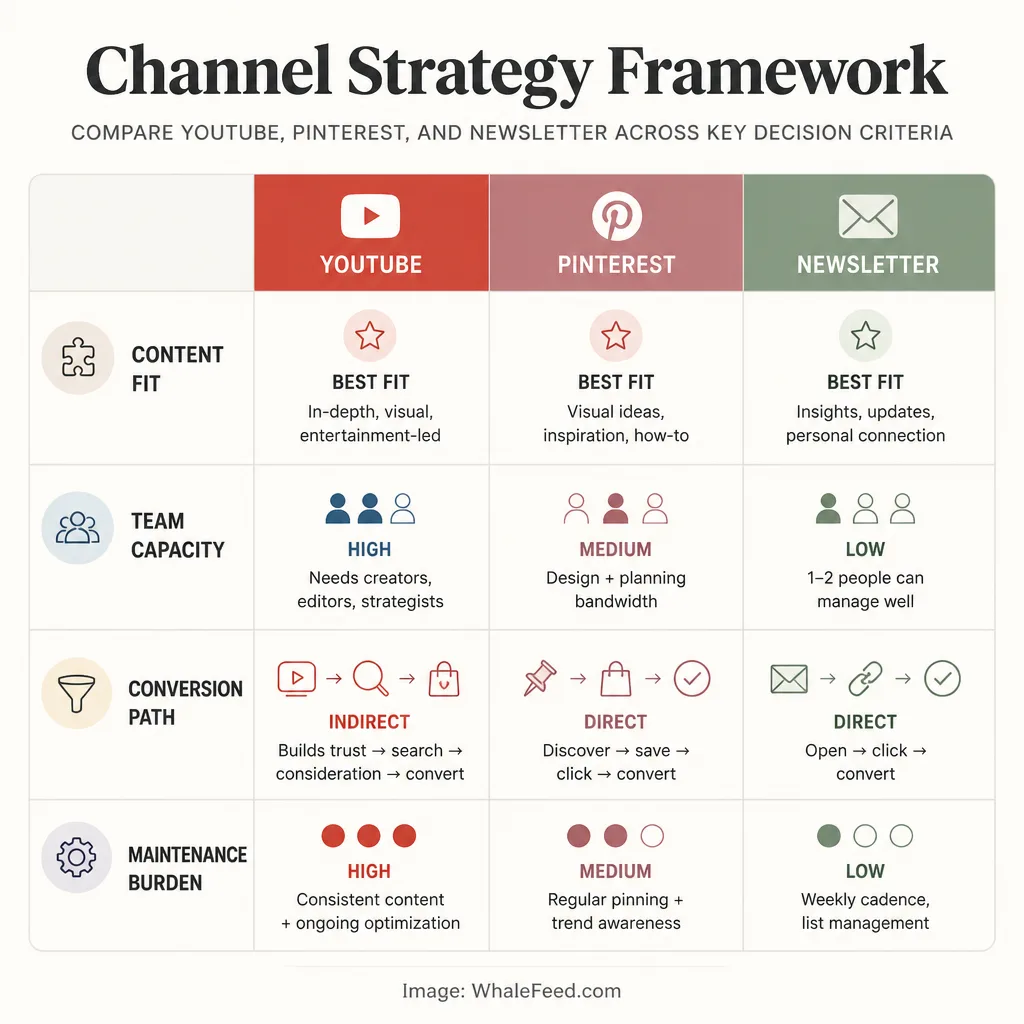
Before rollout, decide based on fit, not platform pressure.
| Channel | Choose this if | Avoid or delay if | Best early role |
|---|---|---|---|
| YouTube | You can teach clearly on camera, through demos, or with voiceover tutorials | Video production will bottleneck the team | Discovery + trust-building |
| You can turn ideas into visual assets like frameworks, checklists, templates, or comparisons | Every asset would need custom design from scratch | Evergreen discovery + assisted traffic | |
| Newsletter | You already have traffic worth capturing and can write useful emails consistently | You expect email to become its own content universe right away | Owned audience + conversion layer |
When YouTube fits
YouTube works best when your expertise can be explained or demonstrated. A SaaS marketer can publish product-led tutorials. A consultant can answer recurring client questions. An affiliate site can turn comparison content into walkthroughs.
When Pinterest fits
Pinterest is still a visual discovery engine, but “visual” does not have to mean lifestyle photography. A B2B team can publish decision frameworks. A service business can share process diagrams. A publisher can turn article takeaways into checklists and comparison graphics.
Why the newsletter should usually be the backbone
The newsletter is the owned layer. Platforms help people discover you. Email gives you a way to reach that audience again without depending on feed ranking.
That does not mean sending more email for the sake of it. It means creating a place where YouTube viewers, Pinterest visitors, and site readers can become subscribers you can reach directly.
A realistic 90-day rollout
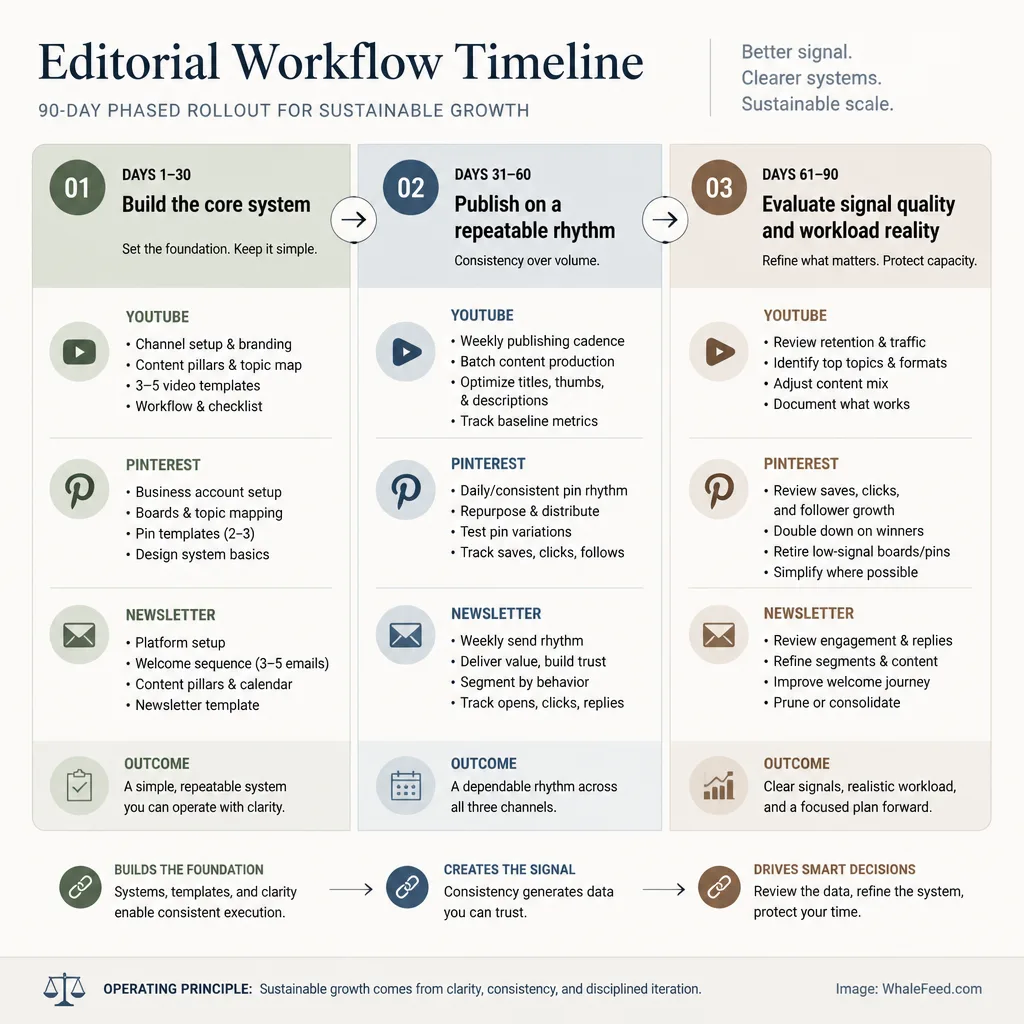
Days 1–30: build the system before chasing volume
Start with infrastructure.
- Define one audience problem cluster
- Create one core offer or next step
- Add email capture to high-intent pages
- Set up a short welcome sequence
- Build 2–3 Pinterest templates
- Define 3–5 YouTube topics tied to site pages
- Make sure analytics are working across all three channels
If you help small ecommerce brands with conversion optimization, your first cluster might be “product page conversion mistakes.” That can become:
- one YouTube explainer
- one companion article or landing page
- three Pinterest assets: a checklist, a before-and-after comparison, and a framework
- one newsletter issue plus one welcome-sequence link
Days 31–60: publish on a rhythm you can repeat
Now the goal is to prove the workflow, not your stamina.
A lean rhythm might look like this:
- YouTube: 1 long-form video every 2 weeks, plus 2–4 Shorts tied to that topic
- Pinterest: 3–5 pins per week using templates
- Newsletter: 1 weekly send built from existing content
The key is structured repurposing. Shorts should support the same topic cluster as the main video, not drift into unrelated side content. That keeps effort connected.
Days 61–90: judge signal quality and workload reality
At this stage, you are not looking for perfect attribution. You are looking for signs that a channel deserves more investment.
Ask:
- Is the team still publishing without quality dropping?
- Are there early signs of traction?
- Is the channel feeding list growth, return visits, or qualified traffic?
- Is repurposing still efficient, or has it turned into re-creation?
If repurposing has become re-creation, the system is already getting expensive.
How the YouTube-to-site funnel works
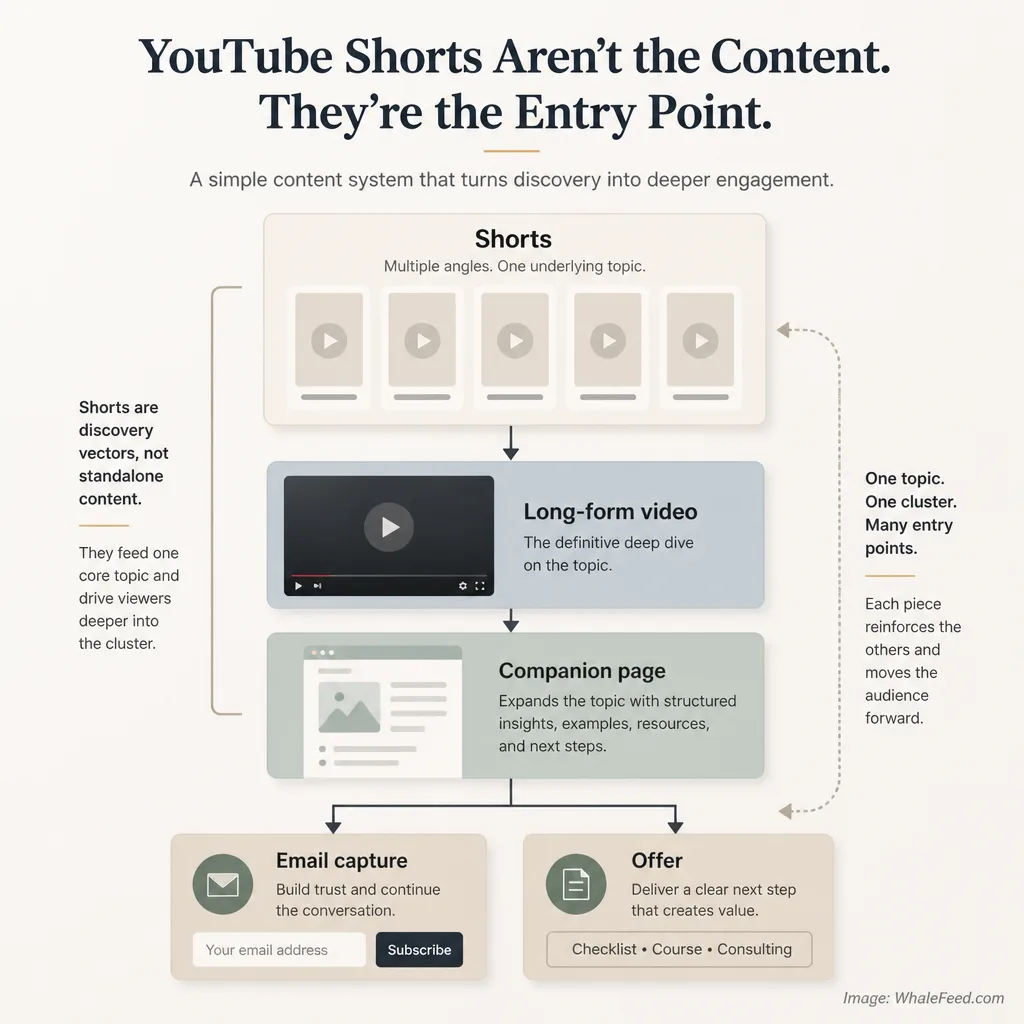
The mistake is treating YouTube as a simple click channel. It often works better as a trust builder with a deliberate next step.
Map Shorts to long-form topics
Use Shorts to introduce a problem, then point viewers to the full topic. A 30-second Short on weak landing page headlines should connect to a deeper breakdown, not a random homepage.
Use companion pages that expand the video
Create site pages that do more than embed the video. Expand the explanation. Add examples, frameworks, screenshots, or downloadable resources.
Do not promise yourself AI citations. Build pages that are useful enough to earn attention on their own.
Match each topic cluster to one next step
One cluster, one offer.
If the video is about Pinterest analytics, the next step might be a checklist. If it is about SEO reporting, the next step might be a template. If every video points somewhere different, the funnel gets muddy fast.
How to make Pinterest work in a non-visual niche
Pinterest gets more useful when you stop asking, “What image should we post?” and start asking, “What useful idea can we package visually?”
Turn ideas into repeatable formats
Good non-lifestyle formats include:
- frameworks
- checklists
- templates
- comparison graphics
- process diagrams
- “mistakes to avoid” cards
A B2B content team might turn “how to brief freelance writers” into a checklist pin, a workflow graphic, and a template teaser. A finance publisher might turn “ETF vs. mutual fund” into a comparison pin.
Build a lightweight system
Do not design from scratch every time. Build a small template pack with consistent layouts, fonts, colors, and calls to action. That is what keeps Pinterest from becoming design chaos.
Measure assisted value, not just last click
Early traction may show up first in:
- save rate
- outbound click rate
- concentration of performance in top pins
That matters because Pinterest often behaves more like a compounding library than a burst channel.
Why the newsletter is the anti-zero-click asset
As more discovery happens inside platform interfaces, owned audience becomes more valuable. Email is not magic, but it is one of the few assets you can keep building even when outside platforms shift.
Put capture points where intent is already high
Do not bury forms in the footer and call it a strategy.
Place capture points:
- on companion pages
- after checklists or templates
- inside high-intent blog posts
- below relevant videos or resource pages
The strongest capture points usually appear where the reader already wants the next step.
Create a short welcome sequence
Keep it lean:
- confirm the value promise
- send one strong resource
- point to one action
That is enough to turn curiosity into a relationship.
Use the newsletter as the repurposing hub
A good newsletter does not create a second content operation. It routes attention to your best work, sharpens your point of view, and tells subscribers what matters.
The maintenance math: what this really costs each week
These are editorial estimates for a lean team, not platform benchmarks. The point is to make the burden visible.
| Channel | Core weekly output | Production | Distribution / setup | Optimization | Analytics / review | Total weekly time | Main hidden cost |
|---|---|---|---|---|---|---|---|
| YouTube | 0.5 long-form video + 2–4 Shorts | 4–7 hrs | 1–2 hrs | 1–2 hrs | 0.5–1 hr | 6.5–12 hrs | Editing and packaging debt |
| 3–5 pins from templates | 1–2 hrs | 1–2 hrs | 0.5–1 hr | 0.5 hr | 3–5.5 hrs | Template and design debt | |
| Newsletter | 1 weekly send + welcome sequence upkeep | 1–2 hrs | 0.5–1 hr | 0.5 hr | 0.5 hr | 2.5–4 hrs | Conversion-path neglect |
A solo operator trying to do all three may be taking on 12 to 21.5 hours of weekly work. That is why “be everywhere” advice usually collapses under real operating conditions.
Early signs a channel is degrading
Channels rarely fail all at once. They decay quietly.
Watch for these signs:
Output continues, but signal quality weakens.
Impressions rise, but watch time, saves, clicks, or return behavior do not.Repurposing becomes re-creation.
The team is “adapting” content so heavily that each channel now needs its own production cycle.Attention does not turn into owned value.
The channel gets views, saves, or opens, but list growth, qualified visits, and downstream action stay weak.Analytics review keeps getting skipped.
That usually means production has consumed the system.
The practical rule
Diversify only to the level you can maintain well.
If resources tighten, keep the assets with the clearest compounding value:
- newsletter
- your strongest discovery channel
- everything else later
A small, disciplined system beats a sprawling one. Before adding another platform, review the next 90 days and ask whether the current mix is producing useful learning, not just visible activity.
Diversification works when channels are chosen for fit, sequenced with restraint, and tied to one owned destination. Safety does not come from channel count. It comes from operational fit.
FAQ
What does traffic diversification mean in practice?
It means building more than one reliable acquisition path so the business is not overly dependent on a single platform, algorithm, or channel. The goal is not to show up everywhere. It is to run a small set of channels well, each connected to a clear conversion path.
How do I know if my team is ready to add YouTube, Pinterest, or a newsletter?
Start with capacity, not ambition. If your team can consistently produce teachable video content, YouTube may fit. If you can turn ideas into repeatable visual assets like frameworks, checklists, and templates, Pinterest may fit. If you already have meaningful traffic to capture, a newsletter usually deserves priority because it creates an owned audience.
Why is diversification sometimes risky for small marketing teams?
Because it lowers platform risk while increasing operating risk. More channels can create editing debt, design debt, fragmented analytics, and weaker execution when the same team is stretched too thin. The problem is not diversification itself. It is the hidden maintenance cost.
How long should I test a new traffic channel before deciding whether to keep it?
A 90-day test is usually enough to set up tracking, publish consistently, and judge early signals. Do not rely only on last-click conversions. Look at leading indicators, assisted impact, and whether the workload is sustainable.
Can Pinterest work for non-visual or B2B niches?
Yes, if the ideas can be packaged visually. Frameworks, templates, comparisons, checklists, and process graphics can all work. The mistake is assuming Pinterest only works for product photography or lifestyle content.
What is the role of a newsletter in a diversification strategy?
The newsletter is the owned layer. Discovery channels help you get found. Email helps you keep the relationship and route attention back to high-value content, offers, or resources without depending on feed algorithms in the same way.
What metrics should I watch first when diversifying traffic?
Start with leading indicators. For YouTube, watch click-through rate, watch time, and returning viewers. For Pinterest, watch saves, outbound click rate, and top-pin concentration. For email, watch subscriber growth, clicks, and welcome-sequence engagement.
When should I cut or reduce a traffic channel?
Reduce or cut it when output continues but signal quality weakens, repurposing turns into full re-creation, analytics review keeps getting skipped, or the channel generates attention without useful downstream action like list growth, qualified visits, or conversions. A smaller channel mix run well is usually stronger than a larger one run inconsistently.