How to Turn a Product Page Into a High-Converting Affiliate Video Script With AI
Most people make the same mistake when using AI for affiliate video scripts: they paste a product page into a chatbot, ask for a script, and get something polished but weak. It sounds like marketing copy, repeats brand claims, and skips the one thing that actually drives conversions: believable buyer logic.
That happens because product pages are written to sell broadly. Affiliate videos have a different job. They need to persuade quickly, for a specific audience, in a format where skepticism is high. Viewers want to know what the product does, who it helps, why it is different, and whether the promise feels credible.
This article lays out a practical workflow you can reuse. You will learn how to pull out real selling points, identify proof and objections, and use AI as an analyst and structuring tool rather than an autopilot copy machine.
Why Most Affiliate Scripts Fail When They Start From Product-Page Copy
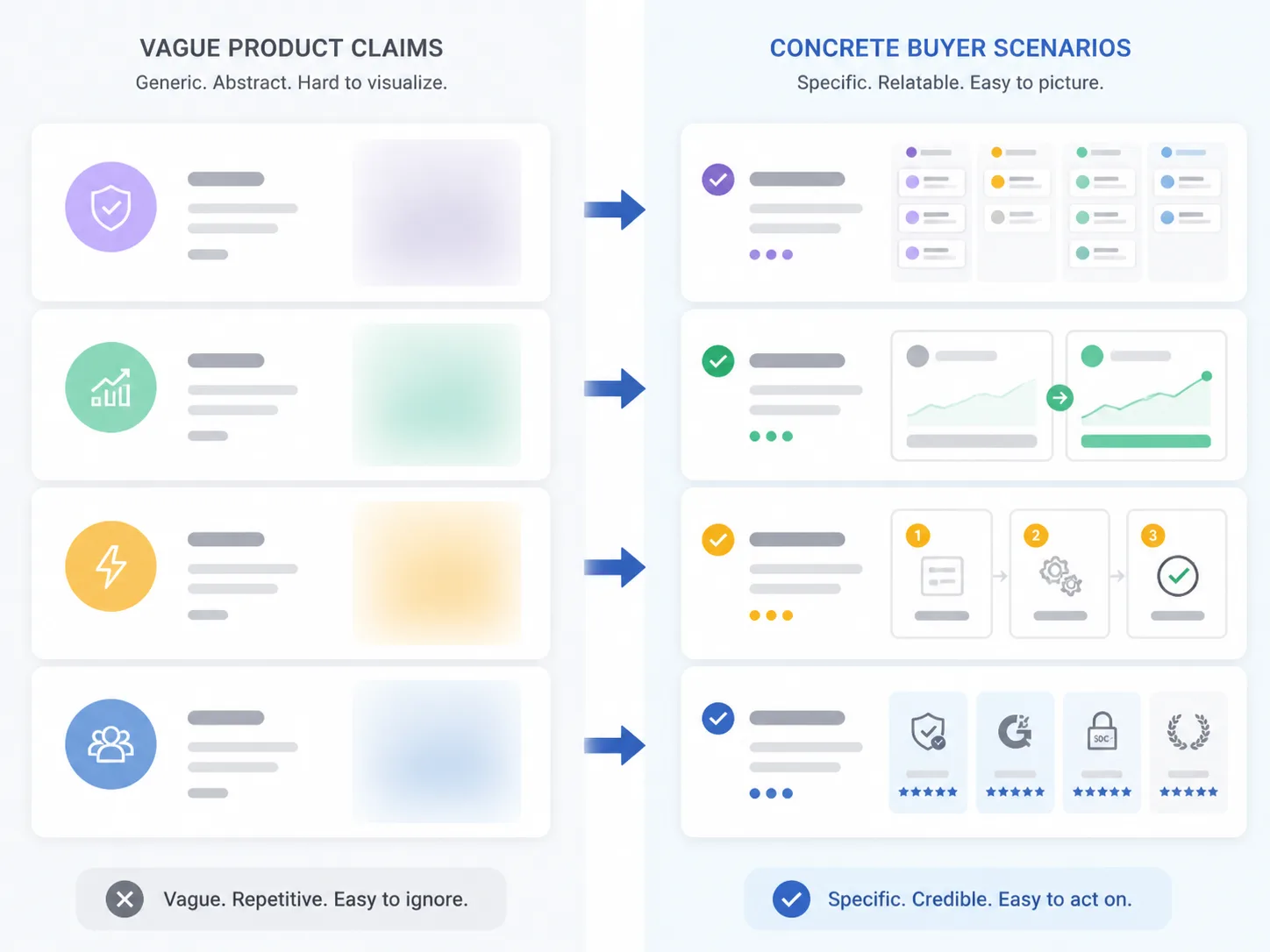
Product-page copy is usually too broad for video.
A page might say:
- “Revolutionary tool”
- “Boost productivity”
- “Trusted by thousands”
- “All-in-one solution”
Those phrases are not necessarily false. They are just too vague to carry a strong script.
In affiliate content, vague claims create three problems:
- They sound unnatural
- They create little belief
- They give you nothing visual to show
If your script says, “This tool boosts productivity,” the viewer still does not know how, for whom, or in what situation. But if your script says, “If your team is juggling tasks in Slack, spreadsheets, and email, this puts ownership and deadlines in one place so fewer handoffs get missed,” the claim becomes concrete.
Key Insight: People do not convert because a script sounds polished. They convert because the result feels specific, plausible, and relevant.
What AI Should Do in This Workflow
AI is useful here, but only in the right role.
What AI should do:
- Extract raw claims and features
- Reframe brand language into buyer language
- Identify likely use cases
- Surface objections and proof gaps
- Structure a storyboard and script
What AI should not do:
- Invent proof
- Exaggerate claims
- Echo hype from the page
- Choose your angle without audience context
- Replace fact-checking
Decision Rule: If a claim cannot be shown, supported, or tied to a real scenario, it should not be a major script point.
Start With the Buyer, Not the Brand Copy
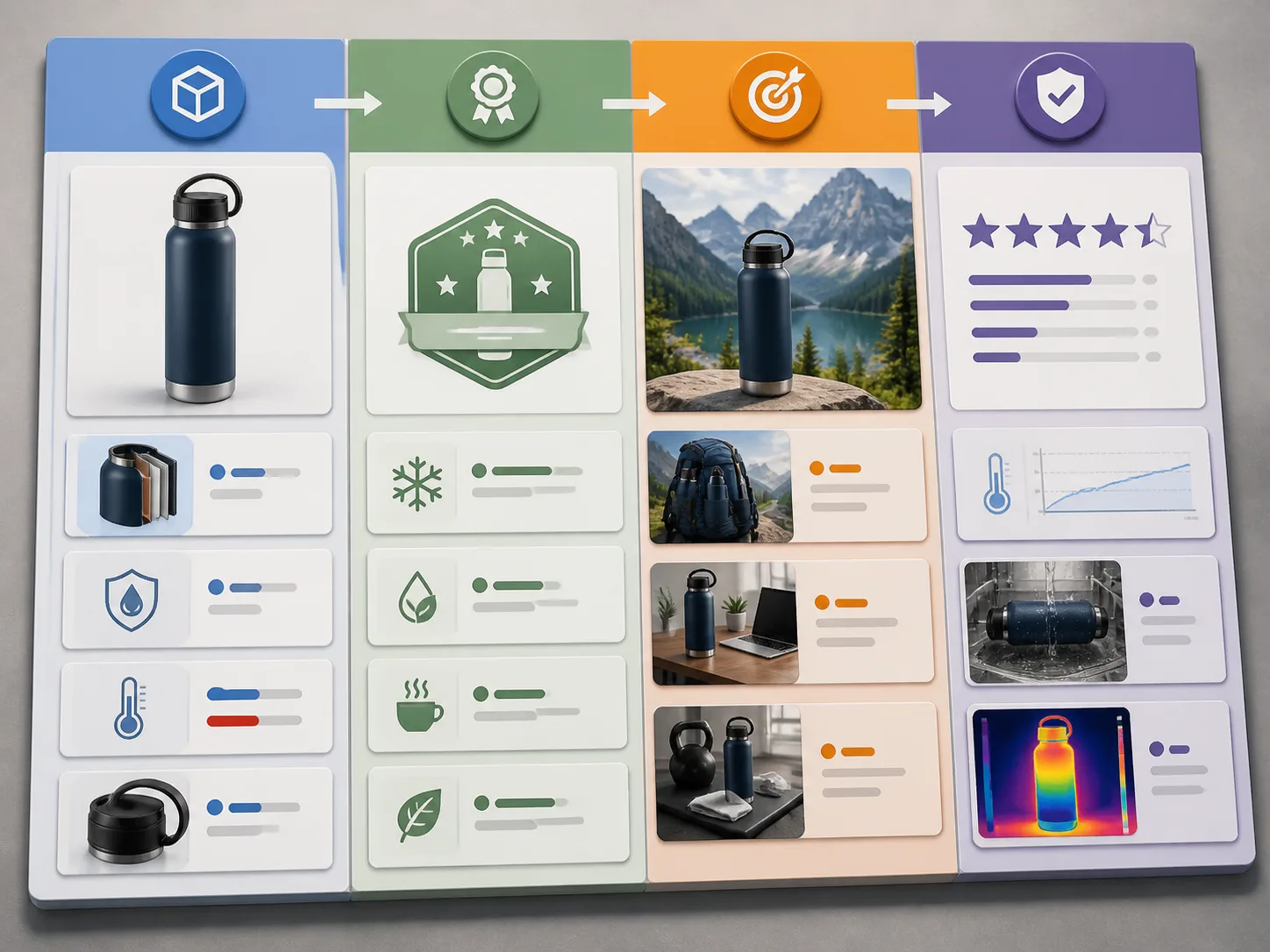
Separate Features, Claims, Outcomes, and Proof
Before you prompt AI, split the page into a few simple categories:
- Feature: What the product has
- Claim: What the brand says it does
- Outcome: What the buyer gets
- Proof: What makes that outcome believable
- Use case: When the outcome matters
Here is a simple example:
- Feature: Stainless steel insulated bottle
- Claim: “Premium hydration experience”
- Outcome: Keeps water cold through a full gym session
- Proof: Double-wall insulation specs, user reviews, leak test
- Use case: One-handed use during workouts, no spills in a gym bag
That is the difference between marketing language and usable script material.
Filter Out Fluff Before It Reaches the Script
Use this filter on every major claim:
| Brand Claim | What It Means to a Buyer | Proof Needed | Better Script Angle |
|---|---|---|---|
| Revolutionary tool | Unclear | Specific use case | Show one task done faster |
| Boost productivity | Saves time or reduces errors | Demo, before/after workflow | Show old process vs. new process |
| Trusted by thousands | Popularity only | Relevant testimonial or customer type | Explain who it fits best |
| All-in-one platform | Fewer tools to manage | Feature walkthrough | Show one workflow in one dashboard |
If a claim cannot survive this filter, it is not ready for the script.
Common Mistake: Treating every benefit as equally important. In most videos, one or two outcomes do most of the work.
The PAGE Method for Turning Product Pages Into Scripts
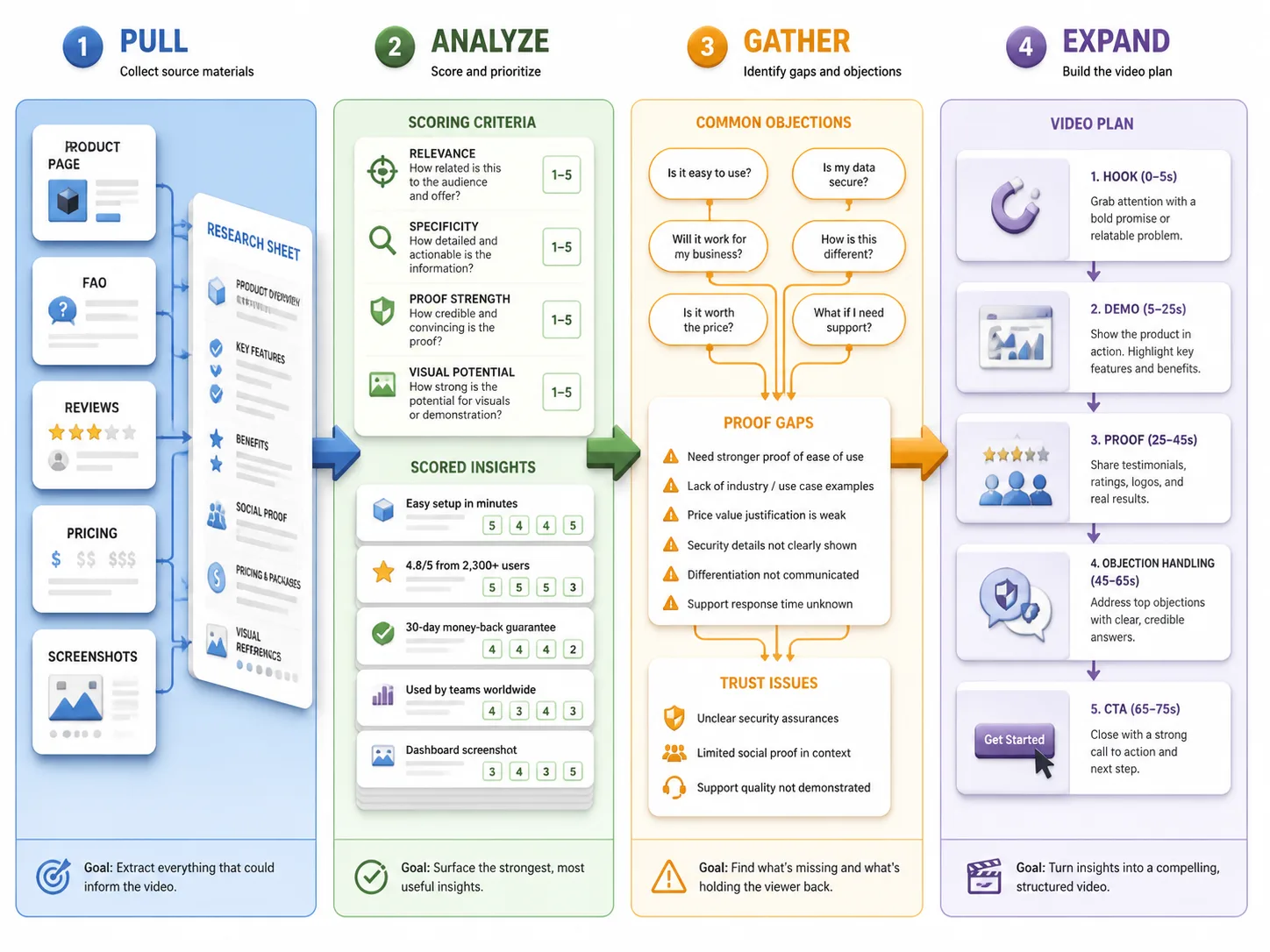
A simple way to structure the process is the PAGE method: Pull, Analyze, Gather, Expand.
The PAGE Framework
| Step | What to Do | Why It Matters | Output |
|---|---|---|---|
| Pull | Extract claims, features, proof, visuals, FAQ, pricing, reviews, and limitations | Prevents weak prompts based on partial data | Raw research sheet |
| Analyze | Convert raw inputs into buyer outcomes, use cases, and differentiators | Turns page content into buyer logic | Ranked selling points |
| Gather | Surface objections, doubts, proof gaps, fit issues, and compliance risks | Builds trust and reduces drop-off | Objection map |
| Expand | Build a demo-first storyboard and script | Makes the script visual and conversion-focused | Script and scene plan |
Pull: Collect the Raw Material
Do not stop at the headline and hero section.
Collect:
- Product page copy
- Pricing
- FAQ
- Reviews and testimonials
- Demo videos or screenshots
- Refund or return policy
- Shipping details if relevant
- Affiliate rules
- Product limitations
If you only feed AI headlines, you will only get headline-level output.
Analyze: Translate Product Information Into Buyer Value
Now turn raw product information into actual buyer logic.
A simple scorecard helps:
- Relevance: Does the target buyer care?
- Specificity: Is the outcome concrete?
- Proof strength: Is there evidence?
- Visual potential: Can it be shown in video?
Score each talking point from 1 to 5 and keep the highest scorers.
Gather: Surface Objections and Credibility Gaps
Objections are not just reasons people say no. They are also reasons people stop watching.
Common examples include:
- Is this worth the price?
- Will this work for beginners?
- Is setup annoying?
- Is this really different from alternatives?
- Are these results typical?
Good scripts answer these naturally, without sounding defensive.
Expand: Build a Demo-First Script
The final step is not “write a persuasive script.”
It is: build a visual sequence around one core problem, one visible result, supporting proof, and one clear CTA.
Bottom Line: AI works best after the inputs are organized. It performs poorly when asked to invent the strategy.
Prompt Template 1: Extract the Real Benefits
What to Give AI
Paste in:
- Product page copy
- FAQ
- Pricing notes
- Reviews or testimonials
- Screenshots or demo notes
- Target audience
- Desired format
Prompt
Analyze the product information below for affiliate video scripting.

Your job is to separate:
1. Features
2. Brand claims
3. Buyer outcomes
4. Available proof
5. Missing proof
6. Best use cases
7. Weak or unsupported claims

Rules:
- Do not repeat slogans unless rewritten into plain buyer language.
- Rewrite every benefit as: “For [user], this helps because [practical outcome] in [specific scenario].”
- Rank the top 3–5 selling points for video based on buyer importance, proof strength, and visual demo potential.
- Flag any claim that lacks evidence.

Output as a table with these columns:
Raw claim | Plain-English meaning | Likely buyer benefit | Proof available | Proof missing | Strongest use case | Script angle

[PASTE PRODUCT MATERIAL HERE]
How to Improve a Weak Response
If the page says:
“The ultimate all-in-one project management tool. Increase productivity, collaborate seamlessly, and achieve more.”
A weak AI response will simply paraphrase that.
A stronger response would say:
- For small teams managing client work across chat and spreadsheets, this centralizes task ownership and deadlines.
- The strongest use case is reducing missed handoffs between team members.
- Proof could include task views, notifications, timeline screenshots, and reviews mentioning fewer status-check meetings.
- Missing proof: quantified time savings.
If the output still sounds generic, add this instruction:
Rewrite every benefit so it sounds like something a customer would actually say out loud. Remove words like innovative, seamless, revolutionary, powerful, game-changing, and ultimate unless directly supported.
Prompt Template 2: Surface Objections Before Writing
Common Objection Categories
Ask AI to review the product through these lenses:
- Price and value
- Trust and credibility
- Ease of setup
- Fit for beginners vs. advanced users
- Compatibility
- Speed of results
- Difference from alternatives
- Hidden limitations
- Shipping or returns for physical products
Prompt
Based on the product information below, identify the most likely objections a skeptical viewer would have before clicking an affiliate link.

Group objections into:
- Price/value
- Trust
- Usability
- Fit
- Speed of results
- Comparison/alternatives
- Limitations or hidden concerns

For each objection, provide:
1. Why the viewer feels this
2. Best proof type
3. Best moment in the script to address it
4. Example response line
5. Suggested visual support

Do not invent proof. If proof is missing, say so clearly.

[PASTE PRODUCT MATERIAL HERE]
Example Objection Map
| Objection | Why Viewer Feels It | Best Proof Type | Script Moment | Example Line | Visual Support |
|---|---|---|---|---|---|
| “This looks like every other PM tool” | The category is crowded | Workflow comparison | Early demo | “What stood out to me is how quickly you can see ownership and deadlines in one view.” | Dashboard walkthrough |
| “Will this take forever to set up?” | New software feels costly in time | Setup demo | Before full feature demo | “I set up a live project in about 10 minutes.” | Time-lapse setup |
| “Is it worth the price?” | Tool fatigue and subscription overload | Pricing context plus use case | After core outcome | “If it replaces two tools and cuts status-check time, the price makes more sense for a small team.” | Pricing screen plus workflow |
Prompt Template 3: Build a Demo-First Video Script
Why Demo-First Usually Converts Better
Video is visual. If your script starts with abstract promises, the viewer has to imagine the proof.
A demo-first script removes that burden. It shows the product in action, which reduces skepticism faster.
That does not guarantee conversions on its own. Offer quality, audience fit, and landing-page alignment still matter. But a demo-first structure usually gives you a better chance to hold attention and build belief.
Prompt
Create an affiliate video script and storyboard based on the product analysis below.

Goal:
Build a demo-first script that sounds credible, specific, and buyer-focused.

Format:
[Short-form / YouTube / UGC-style]

Audience:
[Describe target buyer]

Requirements:
- Start with a specific problem or frustration
- Show a quick preview of the result
- Build around visible product use, not broad claims
- Include only verified or supportable claims
- Address at least one major objection
- Include a natural CTA
- Add affiliate disclosure language where appropriate

Output as a storyboard table with:
Scene number | Visual | Spoken line | On-screen text | Proof element | Objection handled | CTA

Use these inputs:
[PASTE TOP SELLING POINTS, USE CASES, PROOF, OBJECTIONS, LIMITATIONS]
Adjust by Format
Short-form
- Focus on one pain point
- Show one main demonstration
- Use a fast hook
- Stick to one CTA
YouTube
- Add more context
- Include more proof
- Use a comparison section if useful
- Handle more objections
UGC-style
- Use a more personal tone
- Keep the phrasing experience-based
- Stay accurate
- Avoid sounding read from a script
Decision Rule: In short-form, fewer claims usually perform better. One strong result beats five shallow ones.
Before and After: Turning Product-Page Copy Into a Better Script
Weak Version
Product page copy:
“The ultimate all-in-one project management tool. Increase productivity, collaborate seamlessly, and achieve more.”
Weak script:
“Want to boost your productivity and collaborate better? This all-in-one project management tool helps teams achieve more with powerful features. It is easy to use and can transform your workflow. Check it out below.”
This fails because it offers no use case, no proof, no objection handling, and no visual plan.
Improved Version
Stronger angle:
For small client-service teams juggling tasks across chat, email, and spreadsheets, the product reduces missed handoffs by putting task ownership and deadlines in one place.
Storyboard snippet:
| Scene | Visual | Spoken line |
|---|---|---|
| 1 | Messy spreadsheet and Slack messages | “If your team keeps losing track of who owns what, this is the exact problem I was trying to fix.” |
| 2 | Dashboard with tasks, owners, and deadlines | “What I liked here is that every task, owner, and due date sits in one view, so you stop chasing updates across three tools.” |
| 3 | Assigning a task live | “I can assign this in a few clicks, set the deadline, and everyone sees it instantly.” |
| 4 | Timeline or progress view | “For small teams, this matters most when work gets handed off between people and things start slipping.” |
| 5 | Honest qualification | “I would not call it the best fit for every enterprise workflow, but for smaller teams trying to clean up client delivery, it makes sense.” |
| 6 | CTA | “If that is your bottleneck, check the link and see if the workflow fits how your team already works.” |
What Changed
- Slogans became outcomes
- Outcomes were tied to a real buyer
- Claims gained visible proof
- The script became visual
- A limitation increased trust
- The CTA matched the scenario
Bottom Line: Better scripts do not sound more promotional. They sound more believable.
Common Mistakes When Using AI for Affiliate Video Scripts
Repeating Unsupported Claims
AI often restates bold claims with confidence. That is risky, especially for earnings, health, performance, guarantee, or comparison claims.
Verify everything. The FTC requires clear disclosure of material affiliate relationships, and endorsement claims must be truthful and supportable.[^1]
Using Benefits Without Proof or Scenario
“Helps you save time” is not enough.
Show:
- What task
- For whom
- In what situation
- With what evidence
Writing Without a Visual Plan
If there is no storyboard, the script usually turns into talking-head filler.
At minimum, each major spoken point should connect to:
- A screen action
- A physical demonstration
- A testimonial or review
- A comparison
- An on-screen proof cue
Ignoring Compliance or Offer Limitations
Check:
- Affiliate program rules
- FTC disclosure expectations[^1]
- Platform ad policies if you plan to run paid traffic
- Product limitations
- Whether testimonials imply typical outcomes inaccurately
Common Mistake: Asking AI to “make it persuasive” without telling it to stay within verified claims.
Implementation Checklist
Gather This Before Prompting AI
Input Prep Checklist
- Product page copy
- Pricing details
- FAQ
- Reviews or testimonials
- Demo video or screenshots
- Refund or return policy
- Shipping details if relevant
- Affiliate rules and restrictions
- Known limitations
- Target audience
- Video format
- Desired CTA
The Workflow
- Collect the source material
- Run PAGE: Pull
- Run PAGE: Analyze
- Run PAGE: Gather
- Choose one core angle
- Generate the storyboard and script
- Verify every claim
- Rewrite brand language into customer language
- Record and edit with visuals matched to claims
- Test and refine based on watch retention and clicks
If a script starts performing, the next challenge is distribution. At that stage, some marketers look at scaling options, including paid acquisition services such as Traffics.io, but only after the message itself is proven.
Final Review Checklist
- One clear audience
- One main problem
- One visible demonstration
- One proof element
- At least one objection handled
- No unsupported promises
- No copied brand phrasing unless necessary
- Natural CTA
- Affiliate disclosure included where required
- Script sounds like a person, not a landing page
Conclusion
The goal is not faster AI writing. It is clearer, more credible persuasion.
When you turn a product page into an affiliate video script, the result depends less on the model and more on the extraction process. Weak inputs produce polished fluff. Strong inputs produce useful scripts built around outcomes, proof, use cases, objections, and visual moments.
Use the PAGE method as a repeatable system. Let AI organize, rank, and structure the material. Keep the human role where it matters most: choosing the angle, checking the facts, and making sure the script sounds like something a real buyer would believe.
FAQ
Why do affiliate video scripts often fail when they start from product-page copy?
Because product pages are usually written in broad brand language, while video viewers respond to specific, skeptical, scenario-based messaging. If you copy the page directly, the script may sound polished but not convincing.
What should AI do in this workflow?
AI should help extract claims, organize product information, identify likely outcomes, surface objections, and structure a storyboarded script. It should not invent proof, exaggerate claims, or replace fact-checking.
How do I avoid copying the brand’s wording?
Break the page into features, claims, outcomes, proof points, use cases, and limitations. Then ask AI to rewrite each claim in plain buyer language and rank the strongest points by relevance and demo potential.
What is the PAGE method?
PAGE stands for Pull, Analyze, Gather, Expand. You pull the raw material, analyze it for buyer value, gather objections and proof gaps, then expand the strongest points into a demo-first script.
Why does a demo-first script usually convert better?
Because it shows the product solving a specific problem instead of asking the viewer to believe abstract claims. That makes the message feel more concrete and trustworthy.
What should I collect before prompting AI?
Start with the product page, pricing, FAQ, reviews, screenshots, demo videos, refund or return policy, shipping details if relevant, affiliate rules, target audience notes, and intended video format.
How can AI help surface objections?
You can ask it to infer objections from pricing, setup complexity, category competition, missing proof, and product limitations. Useful categories include price, trust, fit, usability, speed of results, and alternatives.
What should a good affiliate storyboard include?
A useful storyboard includes scene number, visual action, spoken line, on-screen text, proof element, objection handled, and CTA placement. That keeps the script visual and grounded.
How do I review an AI-generated script for accuracy and compliance?
Verify every claim against the official product page, documentation, and proof you actually have. Remove unsupported promises, especially around earnings, health, performance, guarantees, or comparisons. Include clear affiliate disclosure where required and follow FTC guidance plus platform-specific policies.
Can this method work for short-form, YouTube, and UGC-style videos?
Yes, but the structure should match the format. Short-form should focus on one problem and one demonstration. YouTube can support more context and proof. UGC-style should sound more personal while staying accurate.
[^1]: Federal Trade Commission, Disclosures 101 for Social Media Influencers