Affiliate Marketing in 2026: 7 Strategies That Work After Cookie Loss
Affiliate marketers and brands have spent years hearing that cookie loss will “break” attribution. That framing misses the real issue. What breaks is lazy attribution: setups that rely too much on the browser to remember users across sites, sessions, and devices.
Affiliate marketing still works in 2026. But it works differently. The teams getting reliable results use first-party tracking, server-side event capture, postback confirmation, and partner-specific attribution rules instead of assuming one browser cookie can do everything.[^1][^2]
This guide does two things. First, it explains what third-party cookie deprecation actually changes for affiliate marketing. Second, it shows which strategies, tracking methods, and setup decisions still support fair attribution, optimization, and partner payouts.
What Cookie Loss Actually Changes
The first thing to clear up is simple: affiliate tracking did not depend entirely on third-party cookies in the first place.
Third-party cookies vs. first-party tracking
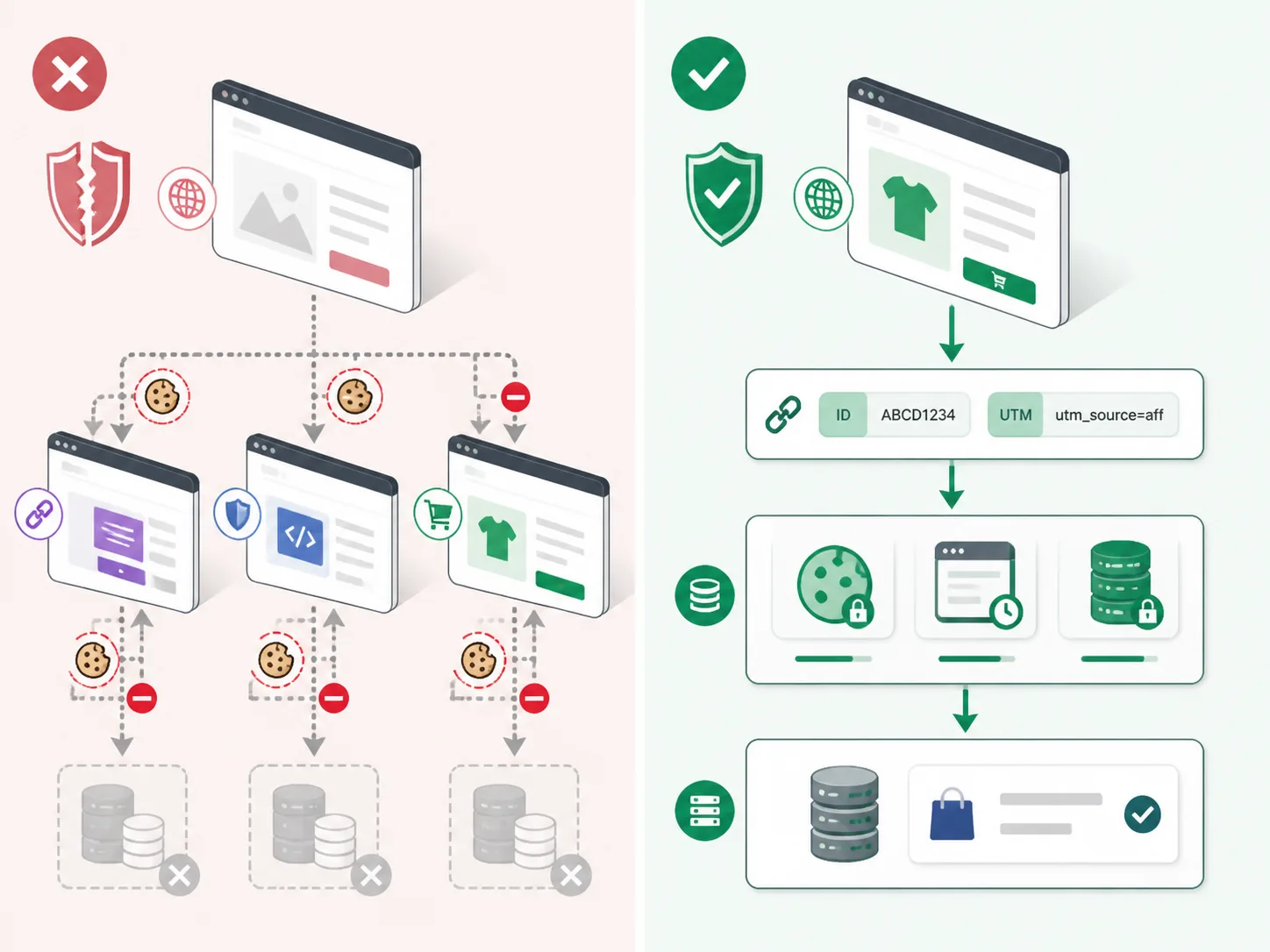
A third-party cookie is set by a domain other than the one the user is visiting. Browsers have restricted these for years, especially Safari and Firefox, and Chrome’s privacy changes continue that shift.[^1][^2][^3]
A first-party tracking setup works differently. The advertiser’s own site stores the affiliate click reference and connects later events, such as signups or purchases, inside its own systems.
That distinction matters because “affiliate attribution without cookies” is not really attribution without tracking. It is tracking built on different infrastructure.
Key Insight: In 2026, affiliate measurement depends less on passive browser memory and more on deliberate signal design.
What still works
Several methods are still useful:
- UTMs for traffic classification
- Affiliate click IDs for partner-level attribution
- First-party cookies for short-term on-site persistence
- Backend sessions or login states for stronger continuity
- Coupon codes for creator and checkout attribution
- Server-side events and postbacks for conversion confirmation
For example, a review publisher links to a DTC supplement brand using UTMs and a network click ID. The brand captures that ID on landing, stores it in a first-party cookie and backend session, then sends the purchase event server-side with the saved ID. That sale can still be attributed cleanly without classic third-party cookie behavior.
Where attribution gets weaker
The weak points are easier to see now:
- A user clicks on mobile and buys later on desktop
- A creator drives awareness, but the customer returns directly days later
- A coupon site captures the final click at checkout
- Browser-only thank-you-page tags fail because of consent settings or script blocking
This is why tracking alternatives are no longer optional upgrades. They are now the baseline.
Bottom Line: Cookie loss does not kill affiliate marketing. It mainly reduces the reliability of browser-only attribution, especially across devices and longer buying cycles.
The New Rule: Build Around Consent, First-Party Data, and Server Signals
A strong post-cookie setup follows a simple model.
The Observe → Preserve → Confirm → Validate model
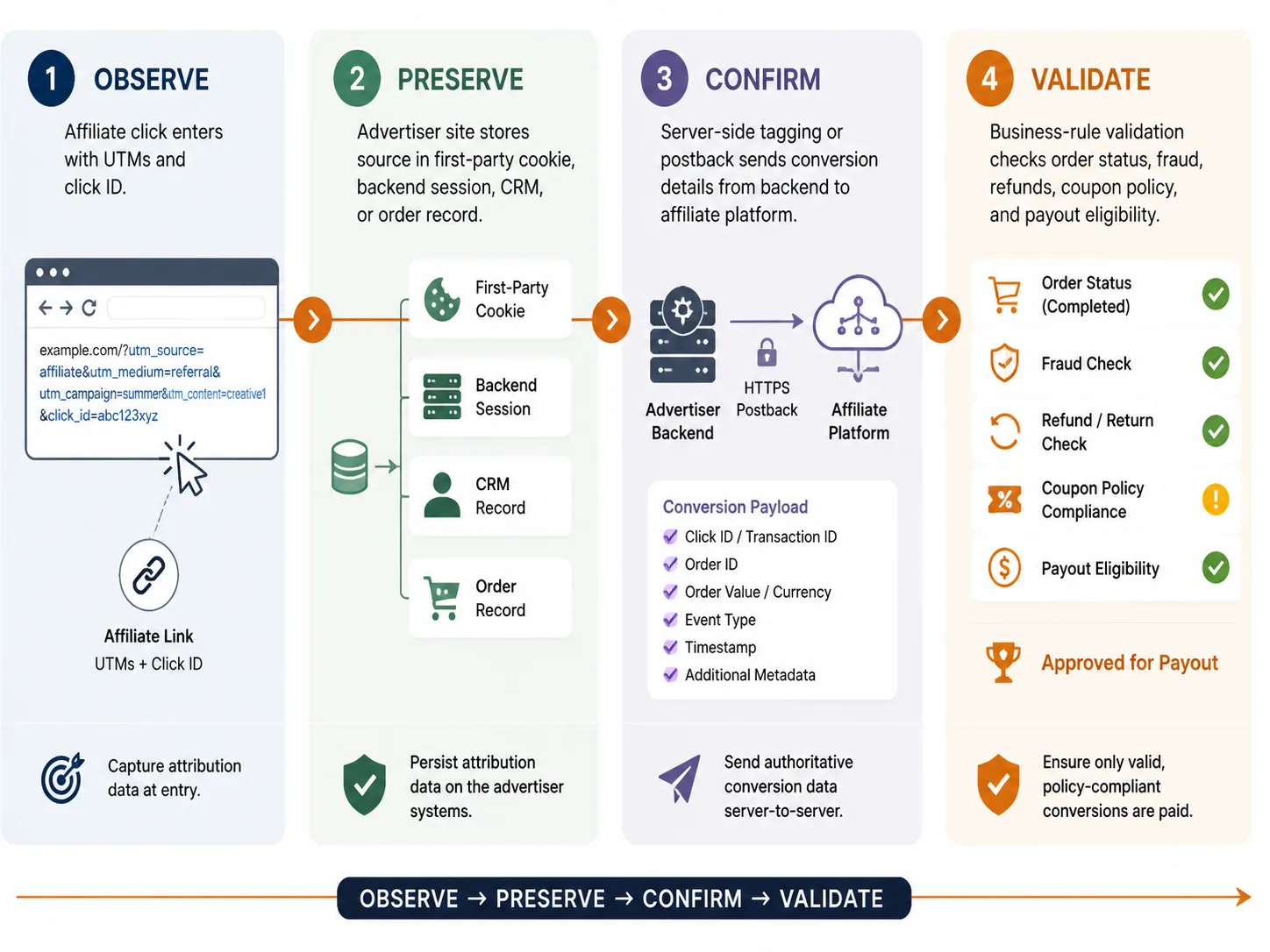
| Step | What it means | Why it matters |
|---|---|---|
| Observe | Capture the affiliate click and parameters | Without the initial click reference, nothing downstream works |
| Preserve | Store the source in first-party systems | Keeps attribution alive beyond the landing page |
| Confirm | Send conversion events server-side or via postback | Reduces dependence on browser tags |
| Validate | Apply business rules before paying commission | Prevents over-crediting low-value partners |
Why first-party data matters more now
If a user signs up, logs in, starts checkout, or creates an order record, the advertiser can attach affiliate source data to that record. That is much more durable than hoping a browser cookie survives every privacy constraint.
For ecommerce, that means preserving source through cart and order creation.
For SaaS, it means passing affiliate source into the CRM and tying it to qualified lead or activated account events.
What server-side tagging helps with
Server-side tagging moves part of data collection and forwarding from the browser to a server environment. That often improves data quality and event control.
But it has limits.
Common Mistake: Server-side tagging improves event transport. It does not solve missing consent, anonymous cross-device journeys, or weak attribution policy.
When postbacks are more reliable
A postback sends conversion data directly from one system to another, so it does not depend on a browser thank-you page loading correctly.
The flow is straightforward:
- A user clicks an affiliate link
- The click ID is passed and stored
- A purchase or qualified lead happens
- The backend sends a postback with the click ID, order ID, value, and status
- The affiliate platform records the conversion
If you capture the click ID early, postbacks are often the most dependable confirmation layer.
7 Strategies That Still Work After Cookie Loss
1. Prioritize content affiliates for high-intent discovery
Content affiliates often perform well in a privacy-first environment because they start with intentional clicks, not passive ad exposure.
Example: a publisher writes “Best protein powders for runners.” A reader clicks through, browses the site, and buys later that evening. The affiliate click ID is stored first-party, and the order is confirmed server-side. That is still a strong attribution path.
Content affiliates are especially useful for:
- Reviews
- Comparisons
- Tutorials
- Niche editorial recommendations
Their main limitation is longer, cross-device buying journeys.
2. Use coupon affiliates selectively
Coupon affiliates still work, but they are easy to over-credit.
Imagine a shopper discovers your brand through a review article or paid social campaign, adds items to cart, then searches for a discount code right before paying. The coupon site gets the final click and appears to have driven the sale, even though most of the demand already existed.
Use coupon partners when you intentionally want:
- Bottom-funnel conversion support
- Acquisition offers
- Controlled promotions
- Inventory movement
Add controls such as:
- Lower commission rates for public code sites
- Approved-code-only rules
- Cart-stage restrictions
- Deduplication against other channels
Decision Rule: If a partner mainly appears at checkout, optimize for incrementality control, not raw conversion volume.
3. Treat influencer affiliates like creator partnerships
Influencer affiliates should not be managed like generic link distributors. They need dedicated tracking assets.
A better setup includes:
- Unique landing pages
- Vanity URLs
- Promo codes
- Partner-specific messaging
- Optional sub IDs by content placement
Example: a skincare creator promotes a bundle on Instagram Stories. Some buyers click and convert immediately. Others return later and use the creator’s code. Browser tracking alone undercounts that impact, but landing-page sessions and code redemptions help fill in the picture.
4. Combine UTMs with first-party click IDs
This is the practical baseline.
- UTMs tell analytics tools where traffic came from
- Click IDs tell affiliate systems which partner should receive credit
Use both.
A link can include source labels plus a unique affiliate identifier and optional sub IDs. On-site, store both the analytics metadata and the affiliate reference. That gives you better reporting and cleaner payout logic.
5. Use server-to-server postbacks to confirm conversions
If your setup still depends mostly on thank-you-page pixels, it is fragile.
Server-to-server postbacks are better for:
- Ecommerce order confirmation
- Lead qualification
- Subscription activations
- Validated commissions after refunds or fraud checks
The limit is simple: if you never captured the click ID, a postback cannot recover it later.
6. Match attribution windows to the buying cycle
There is no universal “best” attribution window.
A better approach:
- Coupon affiliates: often shorter windows
- Content affiliates: often moderate windows
- SaaS or high-consideration offers: sometimes longer windows, ideally tied to CRM events
If your product is a $35 impulse purchase, a broad 30-day window may over-credit affiliates. If you sell B2B software with a 45-day evaluation cycle, a very short window may under-credit research partners.
7. Judge partners by incrementality, not just last-click volume
The important question is no longer, “Did this affiliate appear in the path?”
It is: Did this affiliate create demand or move the buyer meaningfully closer to purchase?
Useful signals include:
- New-to-brand rate
- Average order value
- Margin after commission
- Existing-customer share
- Branded search overlap
- Refund or cancellation rate
- Cart-entry timing
- Code leakage patterns
Smaller teams do not need a full experimentation program to do this well. Even basic comparisons by partner type, customer mix, and checkout-stage behavior can reveal who is adding value.
A Simple Decision Framework: The CCI Model
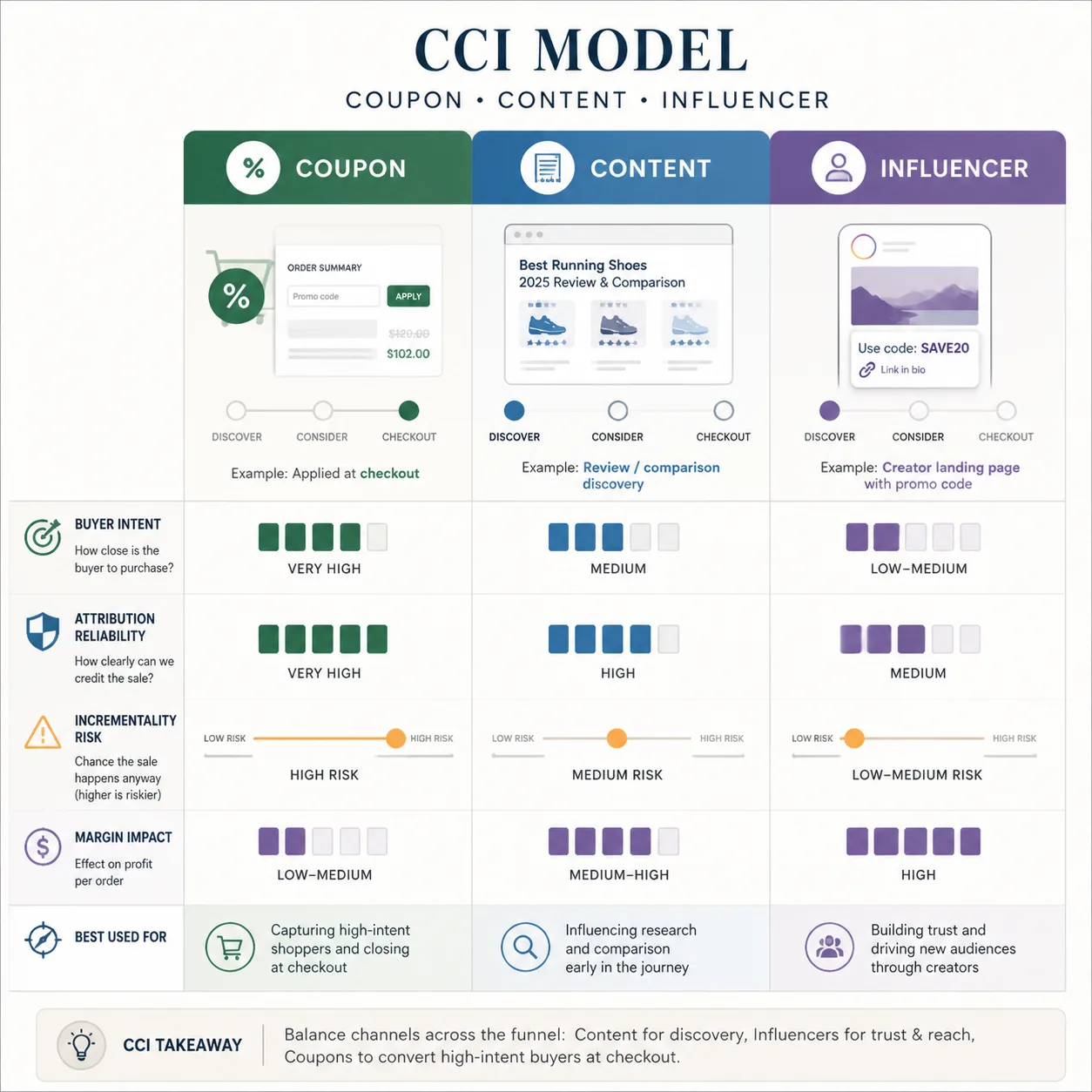
The CCI Model helps you choose between Coupon, Content, and Influencer affiliate types using three factors:
- Intent capture
- Attribution reliability
- Margin impact
| Model | Best For | Attribution Strength | Incrementality Risk | Margin Effect | Recommended Controls |
|---|---|---|---|---|---|
| Coupon | Bottom-funnel conversion support | High visible last-click capture | High | Often compresses margin | Approved codes, shorter windows, deduplication |
| Content | High-intent discovery and research | Moderate to high on same-device click paths | Moderate | Often healthier | First-party click storage, realistic windows |
| Influencer | Trust-driven discovery and launches | Moderate with browser tracking; stronger with codes and landing pages | Variable | Variable | Unique landing pages, codes, blended reporting |
How to choose
Use this rule of thumb:
- If buyers research before purchasing, favor content
- If you need checkout-stage conversion support, use coupon carefully
- If trust and audience fit matter most, invest in influencer
Example use cases
- Ecommerce brand: A skincare DTC brand may use content for discovery, influencers for launches, and tightly restricted coupon affiliates.
- SaaS offer: A B2B software company may prioritize review sites, educators, and niche publishers, then track trials and qualified accounts in the CRM.
- Creator-led product: A digital course seller may rely more on creator affiliates, promo codes, and dedicated landing pages than on broad coupon distribution.
Bottom Line: The best affiliate model is not the one with the most visible clicks. It is the one that fits your buying journey and unit economics.
Tracking Alternatives, Explained Simply
Here is a practical comparison of the main tracking options in 2026.
| Method | Best Use | Strength | Limitation | Setup Complexity |
|---|---|---|---|---|
| UTMs | Traffic classification in analytics | Easy to implement and useful for reporting | Weak for commission logic and persistence | Low |
| First-party cookies + click IDs | On-site source storage after click | Good baseline for attribution | Limited by consent, browser behavior, and cross-device breaks | Medium |
| Server-side tagging | Cleaner event forwarding and data control | Improves signal quality and reliability | Not an identity solution by itself | Medium to High |
| Postback URLs | Direct conversion confirmation | Strong for backend-verified attribution | Requires clean click ID capture and integration | High |
| Coupon codes + landing pages | Creator and fallback attribution | Useful when link tracking is incomplete | Codes can leak or be shared | Low to Medium |
Quick interpretation
- UTMs are great for analytics, but not enough for payout logic on their own.
- First-party cookies and click IDs are still central, but they need solid implementation.
- Server-side tagging improves event transport, not identity resolution.
- Postbacks are strongest when your backend and affiliate platform can exchange conversion signals directly.
- Coupon codes and landing pages are especially useful for creators, podcasts, video partnerships, and in-app social traffic.
Practical Setup Checklist
Link structure
- Define a consistent UTM naming structure
- Pass an affiliate ID or network click ID in every trackable link
- Support sub IDs for placement, creator, or article-level detail
- Avoid broken redirects or parameter stripping
- Standardize destination URL rules with developers
Conversion capture
- Store affiliate click references in first-party systems
- Persist source data into cart, checkout, or lead records
- Capture order ID, value, SKU or offer data, and customer status
- Fire thank-you-page events where needed
- Send backend or CRM events for qualified leads, purchases, or activations
- Validate orders before final commission approval
Attribution rules
- Set attribution windows by partner type and buying cycle
- Define deduplication rules across affiliate, paid search, email, referral, and influencer channels
- Decide how code use affects attribution if another channel touched the user first
- Separate reporting for assist behavior versus final credited conversions
Compliance
- Confirm consent handling where required
- Update privacy disclosures for attribution and partner tracking
- Minimize sensitive data in URLs and tracking parameters
- Set data retention rules
- Review partner and platform agreements for data handling responsibilities
Decision Rule: The goal is not perfect attribution. It is attribution you can trust enough to pay partners fairly and make better channel decisions.
Common Mistakes After Cookie Deprecation
Assuming server-side tagging fixes everything
It improves event delivery, not identity certainty.
Over-crediting coupon affiliates
This remains one of the biggest reporting distortions. High last-click volume can hide low incremental value.
Ignoring consent and compliance
First-party does not mean unrestricted. Privacy rules still apply.
Using windows that do not match the buying cycle
If the window is too long, affiliate claims get inflated. If it is too short, real influence gets missed.
Confusing more data with better decisions
More events do not automatically produce better insight. Focus on data that improves partner evaluation and payout accuracy.
Common Mistake: Many teams improve tracking volume before they improve attribution rules. That produces cleaner data attached to weak decisions.
Conclusion
Affiliate marketing still works after third-party cookie loss, but the operating model has changed.
The strongest setups in 2026 do four things well: they observe the click, preserve the source in first-party systems, confirm conversions server-side, and validate credit with business rules. That is the practical replacement for overreliance on browser memory.
If your setup feels fragile, do not rebuild everything at once. Start here:
- Add UTMs and click IDs consistently
- Preserve attribution in first-party storage and backend records
- Implement postback confirmation where possible
- Tighten windows and deduplication rules by partner type
- Review incrementality, especially for coupon affiliates
That phased approach is usually enough to make attribution more durable, more honest, and more useful.
FAQ
Does affiliate marketing still work without third-party cookies?
Yes. Third-party cookie loss makes some browser-based attribution less complete, especially across devices and longer buying journeys, but affiliate marketing still works through first-party tracking, click IDs, UTMs, postbacks, promo codes, and server-side conversion capture.
What does third-party cookie loss actually change?
It weakens passive cross-site tracking, browser-only conversion matching, and some cross-device attribution. It does not eliminate affiliate tracking. The practical shift is toward first-party data, stored click identifiers, consented data collection, and server-to-server confirmation.
What is the difference between third-party cookies and first-party tracking?
Third-party cookies are set by a different domain than the one the user is visiting and have been heavily restricted by major browsers. First-party tracking uses the advertiser’s own site and systems to store affiliate click context, which is generally more durable for on-site attribution when implemented correctly and handled within privacy rules.
Which tracking alternatives are most useful in 2026?
The most practical options are UTMs for traffic classification, first-party cookies and click IDs for on-site source storage, server-side tagging for cleaner event forwarding, server-to-server postbacks for conversion confirmation, and coupon codes or dedicated landing pages as fallback attribution methods.
How do UTMs and click IDs work together?
UTMs label traffic source, medium, campaign, and partner details inside analytics tools. Click IDs provide a unique affiliate reference that can be stored in first-party systems and later matched to a conversion. Together, they support both reporting and commission logic.
When is postback tracking better than browser-based tracking?
Postback tracking is usually better when you want more reliable conversion confirmation and less dependence on thank-you-page pixels firing in the browser. It works best when the advertiser captures a click ID at entry and sends conversion details directly from the backend to the affiliate platform.
How should brands choose between coupon, content, and influencer affiliates?
Use content affiliates for high-intent discovery and research-stage clicks, coupon affiliates when you intentionally want bottom-funnel conversion support, and influencer affiliates when trust, audience fit, and creator recommendation matter most. The right choice depends on intent capture, attribution reliability, and margin impact.
Why are coupon affiliates often over-credited?
Coupon affiliates often appear near checkout and capture the final observable click. That can make them look more valuable than they really are if earlier demand came from content, paid media, email, or direct brand interest. Without strong business rules, last-click reports can overstate their contribution.
What attribution window should an affiliate program use in 2026?
There is no universal best window. Short buying cycles often justify shorter click windows, especially for coupon partners, while content or SaaS journeys may need longer windows when supported by account creation or CRM timestamps. The window should reflect the real sales cycle, not a default setting.
What should a practical setup include?
A practical setup should include consistent UTMs, affiliate click IDs or sub IDs, first-party storage of source data, backend or CRM persistence, server-side conversion capture where possible, postback URLs for confirmation, clear attribution windows, deduplication rules, order validation, and privacy-compliant consent handling.