How to Make a Winning AI Video Commercial: Script, Prompts, and Shot List
AI can generate video quickly. That is no longer the bottleneck.
The harder part is making a commercial that actually performs. Most AI ads fail before production starts because the offer is vague, the hook is weak, or the ad never gives viewers a reason to believe. A fast workflow only helps if the result is testable and scalable. Otherwise, you are just producing losing creative more efficiently.
This guide shows you how to make an AI video commercial built for performance, not just polish. You will get a repeatable framework, script templates, prompt starters for three common ad styles, scene-by-scene shot lists, and a simple testing plan.
Use this process for paid social, organic content, or rapid creative testing across channels.
What makes an AI video commercial “winning”
A strong short-form ad is not just visually impressive. It does four things quickly:
- Stops attention
- Communicates one clear offer
- Builds belief with proof
- Moves the viewer to a next step
That is true whether the ad is 15 or 30 seconds long.
For paid campaigns, a winner beats your current baseline on the metrics tied to your goal. That usually means better early attention, stronger click behavior, and more efficient conversions later in the funnel.[^1]
For organic content, the signals are different. A winner often shows up through retention, saves, shares, comments with intent, profile visits, or click-outs.
Key Insight: Great AI visuals are not the same as effective advertising. Performance comes from clarity, proof, and pacing.
Why most AI commercials fail early
Weak AI ads usually have one of these problems:
- No clear audience
- No single angle
- Too many claims in too little time
- No believable proof
- A generic CTA with no reason to act
If you fix those before generating visuals, the ad usually improves fast.
Decision Rule: If you cannot explain the offer in one sentence, do not generate scenes yet.
Start with the offer, not the tool
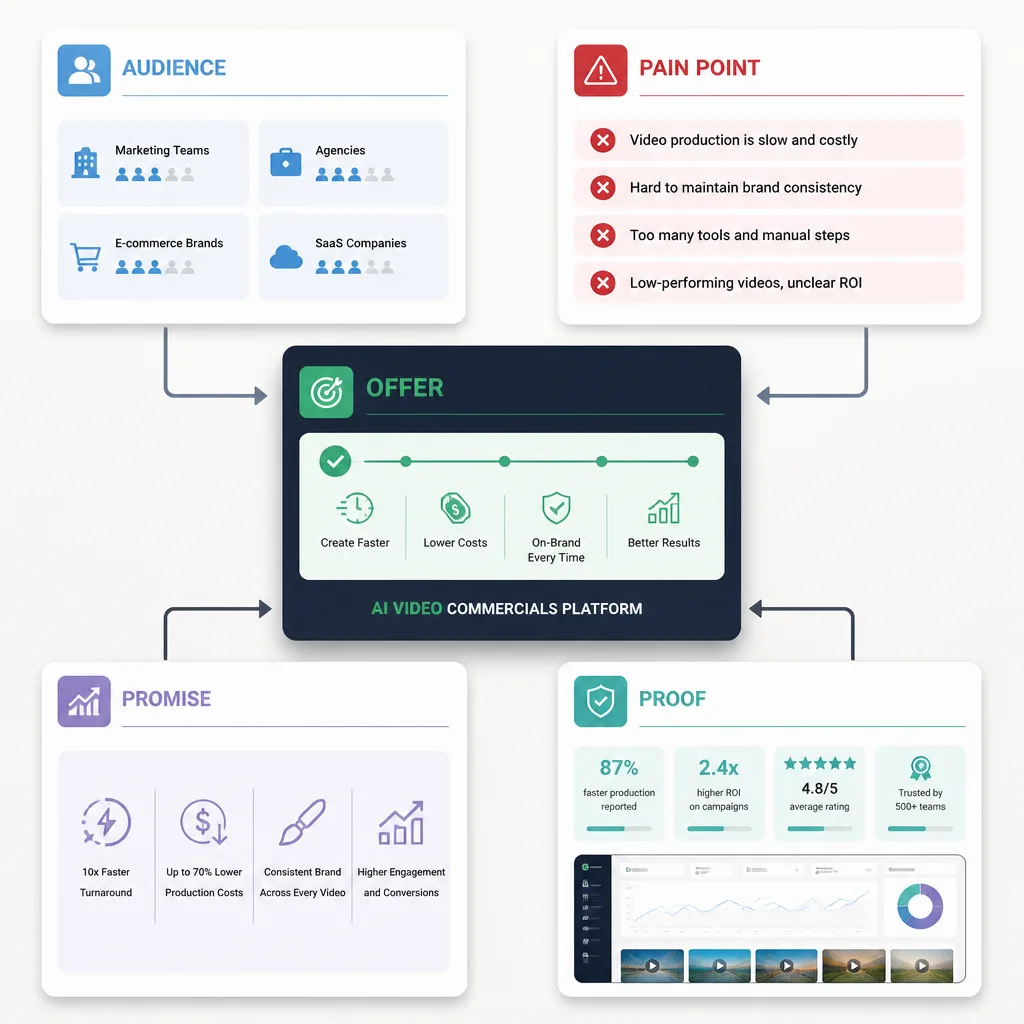
Before you write prompts or scripts, define the inputs that shape the ad.
The 4 inputs you need
- Audience — Who is this for?
- Pain point or desire — What are they trying to fix or achieve?
- Promise — What outcome does the offer create?
- Proof — Why should anyone believe it?
To make the examples concrete, let’s use a hypothetical productivity app called Flowtask.
Its one-line offer could be:
For busy freelancers missing deadlines, Flowtask helps organize tasks in one place and finish work on time, backed by a 14-day free trial and 10,000 active users.
A simple formula that keeps the ad focused
| Element | Question to Answer | Flowtask Example |
|---|---|---|
| Audience | Who is this for? | Freelancers and solo operators |
| Pain point | What hurts right now? | Missed deadlines, scattered tasks |
| Promise | What outcome do they want? | A clearer workflow, fewer missed deadlines |
| Proof | Why believe it? | Active users, trial, visible demo |
If the offer takes more than one sentence to explain, the ad will usually feel crowded.
Bottom Line: AI can compress production time, but it cannot replace offer clarity.
The 15–30 second ad framework
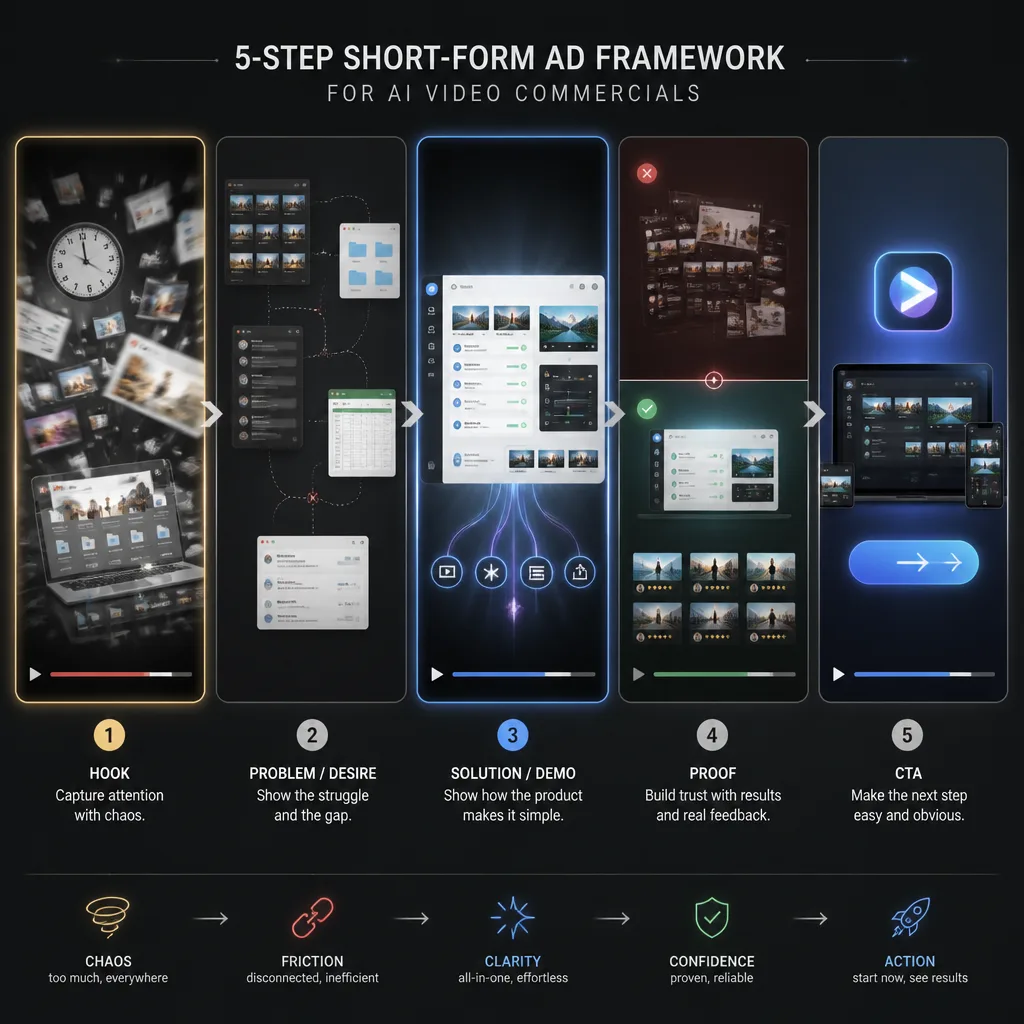
A simple structure works for most short video ads:
Hook
Problem or desire
Solution demo
Proof
CTA
This framework works because each section has a clear job. It also makes testing easier. You can swap the hook, angle, or CTA without rebuilding the whole ad.
| Stage | Goal | Copy Job | Visual Job | Common Failure |
|---|---|---|---|---|
| Hook | Stop scrolling | Open with tension, curiosity, or a result | Pattern interrupt, face-to-camera, bold motion | Starts too slowly |
| Problem/Desire | Create relevance | Name the problem or desired outcome | Show frustration or aspiration | Too abstract |
| Demo | Show the solution | Explain how the product helps | Product use, UI, before/after | Talks about the product without showing it |
| Proof | Build belief | Add credibility or evidence | Review, metric, testimonial, visible result | Unsupported claims |
| CTA | Get action | Tell viewers what to do next | End card, button cue, text overlay | Vague ask |
Hook
The first 1–3 seconds decide whether the rest matters.
Examples:
- “Still missing deadlines because your tasks are everywhere?”
- “I stopped forgetting client work after switching to this app.”
- “If your to-do list lives in five places, watch this.”
Problem or desire
Show the tension quickly and plainly.
Example:
“Most freelancers are juggling email, notes, Slack, and a calendar that never matches reality.”
Solution demo
This is where many AI ads break down. They mention the product but never make the viewer understand it.
Example:
“Flowtask pulls your tasks into one dashboard, so you can see what matters today in seconds.”
Proof
Proof can come from a visible result, user count, testimonial-style line, free trial, screen evidence, or a before/after comparison.
Example:
“I used it for one week and stopped missing handoff dates.”
CTA
The CTA should match the next step.
- Weak: “Learn more”
- Better: “Try Flowtask free for 14 days”
- Better for colder traffic: “See how the workflow works in 60 seconds”
Decision Rule: Use 15 seconds for simple offers and hook testing. Use 30 seconds when you need more demo, trust-building, or objection handling.
Script templates you can adapt
15-second version
Use this when the offer is easy to grasp.
Hook: Still dealing with [problem]?

Problem/Desire: If you want [result] without [pain/friction]...

Solution: [Product name] helps you [core outcome] by [simple mechanism].

Proof: [Proof point: users, result, testimonial, demo evidence].

CTA: Try [product] free / See how it works / Get your [offer].
Flowtask example:
Still missing deadlines because your tasks are all over the place?

If you want a clear workday without juggling five tools...

Flowtask puts all your tasks into one dashboard and shows what to do next.

Used by 10,000+ teams and free to try for 14 days.

Try Flowtask free today.
30-second version
Use this when the viewer needs more context or reassurance.
Hook: Here’s how [audience] can get [result] without [pain].

Problem: Most [audience] struggle with [specific friction], which leads to [negative outcome].

Solution: That’s why we use [product], which helps you [outcome] by [mechanism].

Demo: You can [step 1], [step 2], and [step 3] in one place.

Proof: [Evidence, user result, testimonial, trial, comparison].

CTA: [Specific next step] so you can [benefit from acting now].
How to adjust the script by offer type
- Impulse-friendly product: shorten the problem and lead harder with the result
- SaaS or app: spend more time on demo clarity
- Local service: emphasize proof more than product visuals
- Trust-heavy offer: rely more on credibility and less on flashy editing
Common Mistake: Trying to fit three benefits into one short ad. Pick one angle per ad.
Prompt starters for 3 common ad styles
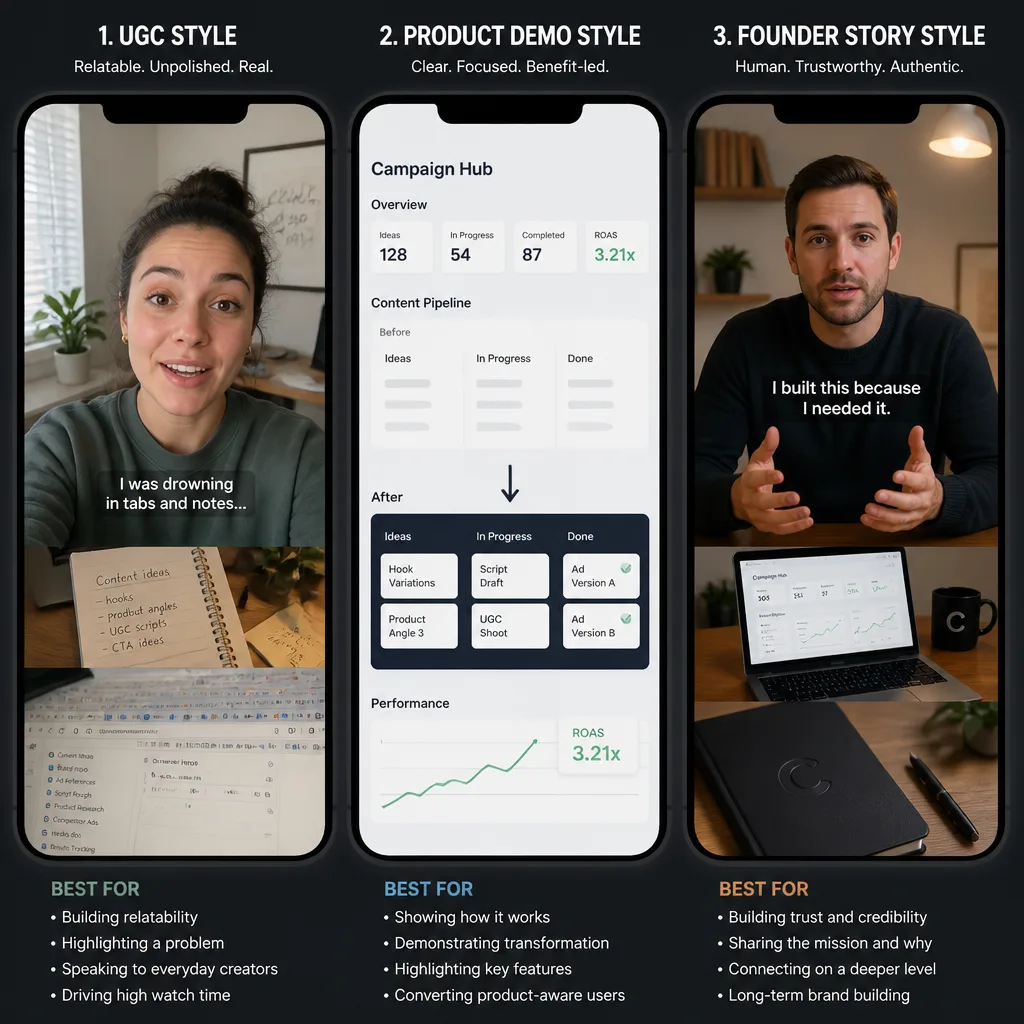
Prompts should describe more than the look. Include subject, action, setting, framing, tone, lighting, and purpose.
UGC-style prompt
Best when relatability and native-feed feel matter most.
Create a short vertical video of a relatable freelancer speaking directly to camera in a home office. Selfie framing, natural light, slight imperfections, conversational energy, authentic social video style. The person looks mildly frustrated at first, then relieved after using a productivity app. Include quick cutaways of checking scattered notes, switching tabs, then opening a clean task dashboard. The purpose is to hook attention and feel believable, not polished.
Product demo prompt
Best when the result can be shown clearly.
Create a vertical product demo ad showing a productivity app interface in close-up and screen-focused shots. Show a cluttered workflow first, then a clean dashboard organizing tasks by priority. Use quick cuts, clear UI emphasis, close-up detail, and simple motion that highlights how the product works. The purpose is clarity and visible transformation, not cinematic style.
Founder story prompt
Best when trust, expertise, or mission matters.
Create a vertical founder-style ad with a calm, credible founder speaking directly to camera in a simple workspace. Medium framing, natural tone, modest polish, warm light, real-business atmosphere. Include cutaways of the product in use and references to customer outcomes. The purpose is trust-building and credibility, not hype.
When to use each style
| Style | Best For | Strength | Limitation |
|---|---|---|---|
| UGC | Relatability, social proof | Native feel, lower resistance | Easy to make generic |
| Product demo | Clear visual transformation | Fast understanding | Weak if the product is hard to show |
| Founder story | Trust-heavy offers | Credibility and authority | Often slower to hook |
Bottom Line: Choose the style that creates belief, not the one that looks most advanced.
Build the shot list from the script
Each line in the script should map to a visual job.
15-second shot map
| Time | Script Beat | Visual |
|---|---|---|
| 0–3s | Hook | Face-to-camera frustration or bold text over chaotic workflow |
| 3–6s | Problem | Fast cuts of scattered tabs, missed tasks, messy notes |
| 6–10s | Solution | App dashboard opens, tasks become organized |
| 10–13s | Proof | User count, testimonial text, before/after workflow |
| 13–15s | CTA | Clean end card with product name and action |
30-second shot map
| Time | Script Beat | Visual |
|---|---|---|
| 0–3s | Hook | Strong problem-first opener |
| 3–8s | Problem/Desire | Relatable work chaos |
| 8–16s | Demo | Step-by-step product use |
| 16–24s | Proof | Trial, testimonial, user result, visible confidence |
| 24–30s | CTA | Specific next step plus benefit of clicking now |
How visuals should work
- Hook visuals should interrupt the feed
- Proof visuals should show evidence, not just mention it
- CTA visuals should make the next step obvious
It also helps to plan around AI video limitations. Synthetic footage often struggles with text rendering, hands, continuity, and precise product details. Many advertisers get better results by combining AI scenes with real screen recordings, motion graphics, captions, or manual editing.
Decision Rule: If a shot looks good but does not move the message forward, cut it.
One offer, three ad variants
Here is how the same Flowtask offer can become three structured tests.
1. Hook test
Keep the angle and CTA the same. Change only the opening line.
- Hook A: “Still missing deadlines because your tasks are everywhere?”
- Hook B: “I stopped missing client deadlines after switching to this app.”
- Hook C: “If your to-do list lives in five places, watch this.”
2. Angle test
Keep the hook and CTA stable. Change the promise.
- Angle A: Time-saving — “See what matters today in seconds.”
- Angle B: Stress reduction — “Stop ending every day feeling behind.”
- Angle C: Client reliability — “Never miss another handoff deadline.”
3. CTA test
Keep the hook and angle stable. Change only the ask.
- CTA A: “Try Flowtask free for 14 days.”
- CTA B: “See how the workflow works in 60 seconds.”
- CTA C: “Get your task system set up today.”
This gives you variation without making results impossible to interpret.
How to test before scaling
What to keep constant
Keep these stable across tests:
- Same audience
- Same offer
- Same landing page
- Similar budget range
- Same platform placements where possible
- Mostly the same script body
What to change
Test one major variable at a time:
- Hook
- Angle
- CTA
If you change everything at once, you will not know what caused the outcome.
Metrics that help you judge a winner
Platform definitions vary, so check each system’s official metric definitions in Meta Ads Manager, TikTok Ads Manager, Google Ads, or the platform you use.[^2][^3]
| Metric | What It Diagnoses | What Better Performance Suggests |
|---|---|---|
| Hook rate / 3-second view rate | First impression strength | The opening is earning attention |
| Hold rate / watch-through | Mid-ad clarity and pacing | The message stays engaging |
| CTR | Relevance of angle + CTA | People want the next step |
| CPC | Efficiency of click generation | The creative is competitive |
| CVR | Offer-page alignment | Clickers like what they find |
| CPA | Final acquisition efficiency | The full funnel is working |
A quick diagnosis model:
- Low hook rate: weak opener
- High hook rate, low hold rate: the opening works, but the middle loses people
- Good hold rate, low CTR: the angle or CTA is weak
- Good CTR, low CVR: landing page or offer alignment is weak
- Good CTR and CVR, high CPA: traffic quality, bidding, or economics may need work
Bottom Line: The winner is not the ad with the most views. It is the ad that moves people through the funnel more efficiently than your baseline.
If you find a strong creative and need help scaling traffic around it, advertiser-focused services like Traffics.io may become relevant once you move from creative testing to growth execution.
Common mistakes that hurt performance
Overproduced visuals with no message
Some AI ads look cinematic but never answer the viewer’s real question: Why should I care?
Too many claims, not enough proof
“Save time, grow faster, reduce stress, increase revenue” is too much for a short ad. Pick one promise and support it.
Weak first three seconds
If the ad opens with something slow, branded, or generic, it often loses before the demo starts.
Generic CTA
“Learn more” is rarely enough on its own. The viewer should know what happens next and why it is worth clicking.
Common Mistake: Starting with a logo animation instead of a problem, result, or pattern interrupt.
Production checklist
Pre-production
- Define the audience
- Name one pain point or desire
- Write the promise in one sentence
- Choose one proof type
- Pick one ad angle
- Decide on 15s or 30s
- Draft a specific CTA
Generation and editing
- Finalize the script before generating scenes
- Turn each script line into a visual prompt
- Generate multiple options per scene
- Add captions for sound-off viewing
- Tighten pacing and remove non-essential shots
- Make the first 3 seconds instantly clear
- Export three variants for testing
Testing and iteration
- Set one primary KPI
- Launch variants to the same audience
- Review hook and hold metrics first
- Review CTR, CVR, and CPA second
- Diagnose the bottleneck
- Change one variable in the next round
Decision Rule: Follow this order: offer → angle → script → shot map → prompts → edit → variants → test → diagnose → iterate
Final takeaway
AI is best used to compress production time, not to replace strategy.
If you want an AI video commercial that wins, start with the offer. Build around one clear angle. Use a simple structure: Hook → Problem/Desire → Demo → Proof → CTA. Then map each line to a visual purpose, create a few disciplined variants, and judge the ad by funnel performance, not aesthetics.
That is what turns AI video generation into a usable ad system instead of a content experiment.
FAQ
What makes an AI video commercial effective?
An effective AI commercial does more than look polished. It grabs attention in the first few seconds, communicates one clear offer, shows believable proof, and drives a measurable next step such as a click or conversion.
What should I define before creating the ad?
Start with four inputs: target audience, pain point or desire, promise, and proof. If the offer is not clear in one sentence, the ad usually is not ready for production.
How long should the commercial be?
A 15-second ad is usually best for simple offers and fast hook testing. A 30-second version works better when you need more demo, trust-building, or objection handling.
What structure works best for a short ad?
A reliable structure is Hook → Problem or Desire → Demo → Proof → CTA. It keeps the ad focused and makes testing easier.
When should I use UGC, product demo, or founder story?
Use UGC when relatability matters most. Use a product demo when the result is easy to show. Use a founder story when trust, expertise, or brand credibility matters most.
How should I test ad variants?
Keep the audience, offer, landing page, and budget range stable. Change only one major variable at a time, such as the hook, angle, or CTA.
Which metrics matter most?
Start with attention metrics like hook rate, 3-second view rate, and hold rate. Then look at downstream metrics such as CTR, CPC, conversion rate, and CPA.
Why do many AI commercials fail even when they look good?
Most fail before production starts. The usual causes are weak hooks, vague offers, too many claims, thin proof, and generic CTAs. AI can speed up production, but it cannot fix unclear positioning.