SEO Alternatives That Actually Work: 9 Traffic Channels You Can Build Without Ranking #1 on Google
SEO still matters. For many businesses, it remains one of the best compounding acquisition channels available. But building too much of your growth model around Google rankings is fragile, especially now that search results are crowded by ads, platform features, and AI-generated answers that can reduce clicks.[^1][^2]
The better question is not, “What replaces SEO?” It is, “Which traffic channels fit my offer, my team, and my timeline?” A channel can look great in a strategy deck and still fail once the operational burden shows up.
That is the real filter for every option below: intent quality, speed to signal, and hidden cost. The best SEO alternative is not the one with the most hype. It is the one your business can run well.
SEO diversification is not about abandoning search
Why relying on one acquisition channel becomes dangerous
Diversification only works if you diversify failure modes, not just traffic sources.
That distinction matters. SEO plus Google Search Ads is not the same as SEO plus YouTube plus partnerships. The first pair still depends heavily on the same intent environment. If search behavior shifts, auctions get more expensive, or SERP click-through drops, both channels feel it.
The risk rarely looks obvious at first. It shows up later, after the team has already built reporting, hiring, forecasting, and content production around one feedback loop.
The real question: which channel fits your offer, team, and timeline
Some channels capture existing demand. Others create it. Some borrow trust. Others build it slowly.
If you sell a considered B2B SaaS product, YouTube demos and partner webinars may do more than a broad paid social campaign. If you sell a low-friction ecommerce offer, niche newsletters or marketplaces may produce faster signal than community building.
The point is not to try everything. It is to rule most options out quickly.
How to evaluate a traffic channel before you commit
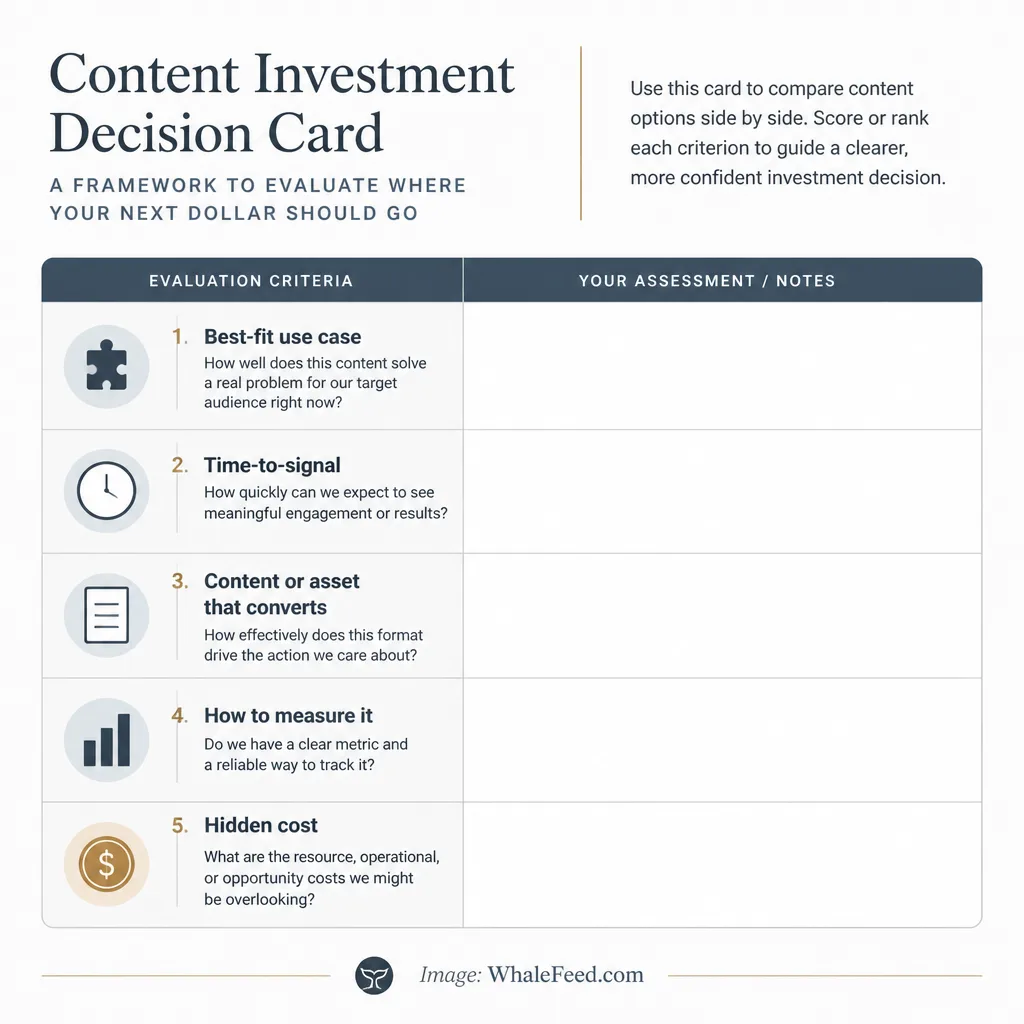
Use the same five questions for every channel:
Best-fit use case
What kind of product, buyer, and sales cycle does this actually suit?
Time-to-signal
Will you learn in days, weeks, or months whether the channel has potential?
Content or asset that converts
What is doing the real work here: a video, landing page, listing, webinar, or referral loop?
How to measure it
Do not force every channel into last-click logic. Some are better judged by assisted conversions, branded search lift, or demo requests.
The hidden cost most teams underestimate
This is where bad channel bets usually live. Community looks cheap until moderation and reputation management absorb the team. Video looks scalable until production becomes the bottleneck.
1. Reddit and community-led acquisition
Best for trust-sensitive, problem-aware audiences
Community-led acquisition works best when buyers want peer validation before they act. Think developer tools, expert services, workflow software, or products in categories where public comparison is normal.
A founder-led SaaS can work well here because expertise feels visible. A polished brand account posting generic promotion usually does not.
Time-to-signal: fast for qualitative learning, slower for repeatable volume.
What converts: detailed replies, transparent founder posts, narrow educational posts, AMA-style threads, honest comparisons.
How to measure: referral traffic, demo requests that mention the community, tagged-link signups, branded search lift, reply quality.
What works without sounding promotional
The safest pattern is simple: solve the problem first, mention the product only when it is genuinely relevant.
A good Reddit comment reads like a mini consulting session. A bad one reads like someone waiting for permission to paste a CTA.
Hidden cost: moderation, patience, and reputation risk
Community traffic is not free. You pay for it with time, emotional labor, and the risk of public rejection if your intent feels extractive.
One strong post can drive a spike. That does not automatically make it a channel.
2. YouTube search and problem-led video
Best for products that benefit from demonstration or explanation
If your product is easier to understand when seen, YouTube deserves serious attention. This is especially true for SaaS, education, productized services, and tools with visible workflows.
A project management SaaS, for example, may get more qualified interest from a “ClickUp vs Asana for agency workflows” video than from a broad top-of-funnel blog post.
Time-to-signal: weeks to early engagement signal, longer for reliable pipeline.
What converts: tutorials, comparison videos, product walkthroughs, integration demos, objection-handling videos.
How to measure: watch time, retention, site clicks, demo requests, self-reported attribution, branded search lift.
Why YouTube can behave like search with stronger intent signals
Many YouTube users arrive with clear problem statements: how to do something, which tool to choose, whether a workflow actually works. That makes YouTube feel search-like, with one big advantage: buyers can see competence, not just read claims.
For considered purchases, that matters.
Hidden cost: production consistency and creative bottlenecks
The hard part is usually not topic selection. It is publishing consistently without lowering quality.
Scriptwriting, recording, editing, and on-camera confidence can turn one promising experiment into a stalled channel quickly.
3. Programmatic landing pages, done carefully
Best for structured intent at scale
Programmatic pages work when search intent follows a pattern: location pages, integration pages, category pages, use-case pages, or structured inventories.
A local service platform, for instance, might build useful city-and-service pages. A software company might create integration or role-based landing pages.
Time-to-signal: medium. Faster than waiting for pure editorial momentum in some cases, but highly dependent on indexing and usefulness.
What converts: pages with real utility, clear context, unique examples, filters, comparisons, localized proof, relevant CTAs.
How to measure: indexation, engagement by page cohort, conversion by template type, assisted conversions.
What separates useful pages from thin spam
The difference is not scale. It is usefulness.
A good programmatic page helps someone make a decision. A bad one exists only because a template could generate it.
Hidden cost: template quality, duplication risk, and maintenance
Programmatic does not mean automatic. The burden is ongoing QA, content quality control, internal linking, and data maintenance.
The page factory is easy. Scalable usefulness is hard.
4. Partnerships and co-marketing
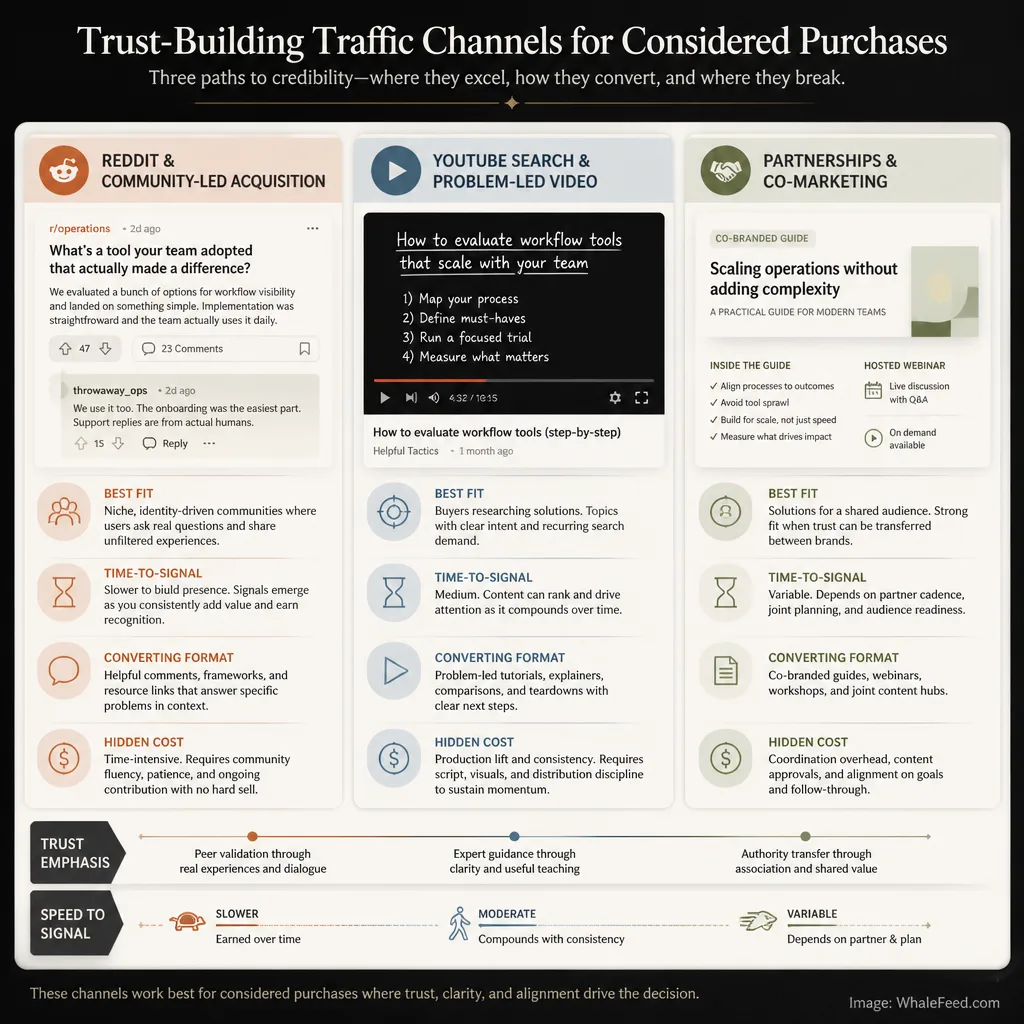
Best for borrowed trust and overlapping audiences
Partnerships work when someone else already has the audience and credibility you need, and your offers are complementary rather than competitive.
This is especially strong in B2B SaaS, services, and ecosystem products.
Time-to-signal: medium. Often faster than SEO, slower than paid demand capture.
What converts: webinars, co-authored guides, integration launches, list swaps, bundles, customer stories.
How to measure: partner-sourced leads, webinar attendance quality, influenced pipeline, conversion by partner type.
Formats that tend to work
A CRM tool and a sales enablement platform can co-host a webinar. A design agency and a CRO consultant can swap newsletter placements. An app integration launch can create both relevance and distribution.
Hidden cost: coordination and uneven execution
Partnerships often look better in strategy decks than in real calendars.
The hidden tax is coordination. Scheduling slips. Promotion quality varies. Audience overlap can look strong on paper and weak in reality.
5. Affiliate and referral loops
Best when the product has clear value and trackable outcomes
Affiliate channels work when outside partners can credibly recommend you. Referral loops work when users are naturally motivated to invite others.
Those ideas are related, but they are not the same system.
Time-to-signal: affiliate can be quick once partners activate; referral loops often take longer to design well.
What converts: co-branded pages, review assets, referral prompts inside onboarding, milestone-based asks, simple attribution links or codes.
How to measure: active partners, referred signups, retention of referred users, margin after commissions, fraud rate.
Affiliate recruitment vs. true referral design
Affiliate is external distribution with incentives.
Referral is product-led or customer-led distribution built into the user experience.
If your product does not create a natural sharing moment, the referral program may exist without ever becoming meaningful.
Hidden cost: fraud, margin pressure, and partner enablement
A referral program can be elegant. An affiliate program can become an ops problem.
Low-quality partners, coupon leakage, and constant enablement work can quietly eat margin.
6. Niche newsletters and sponsorships
Best for concentrated attention, not broad reach
Newsletter sponsorships are often underestimated because people fixate on list size.
That is usually the wrong metric.
A 12,000-subscriber newsletter read closely by ecommerce operators can outperform a 200,000-subscriber general business newsletter if the audience fit is sharper.
Time-to-signal: fast. Often one of the quickest channels to test.
What converts: native placements, founder notes, short problem-solution copy, case-study-backed blurbs, targeted lead magnets.
How to measure: CTR, landing page conversion rate, cost per qualified lead, post-click quality, branded search lift.
Why small lists can beat larger media buys
Trust density matters more than raw reach.
People subscribe to niche newsletters because they trust the filter. You are not just renting inbox space. You are renting someone else’s judgment.
Hidden cost: creative testing and list-quality variance
Inventory quality varies more than many buyers expect. The same audience category can perform very differently depending on tone, curation quality, and how promotional the issue feels.
7. Paid demand capture: brand, category, and competitor intent
Best for converting existing intent faster than organic alone
If people are already searching for your brand, category, integrations, or competitors, paid demand capture can work quickly.[^3]
This is usually the fastest feedback channel on the list.
Time-to-signal: days.
What converts: branded campaigns, competitor comparison pages, category landing pages, focused forms, retargeting layers.
How to measure: impression share, CPC, CTR, conversion rate, CAC, branded vs. non-branded performance.
Where paid capture helps, and where it does not
Paid search is excellent at harvesting demand. It is much weaker at creating it.
That is why some teams scale search ads successfully while others simply pay to intercept traffic that would have converted anyway.
Hidden cost: CPC inflation and attribution confusion
Auction pressure rises. Competitor terms can get expensive. Branded campaigns can blur incrementality. And when several channels assist the same deal, last-click reporting can flatter paid search more than it deserves.
8. Marketplaces and third-party platforms
Best when discovery already happens inside the platform
Sometimes the smartest move is not building demand elsewhere. It is showing up where buyers already browse.
Examples include software marketplaces, ecommerce platforms, service directories, and freelance marketplaces.
Time-to-signal: often fairly fast if the platform already has traffic.
What converts: optimized listings, strong screenshots, reviews, social proof, comparison-friendly copy, platform-native offers.
How to measure: listing views, in-platform leads, click-through to site, review volume, conversion after fees.
Common examples
A Shopify app should care about the Shopify ecosystem. A freelancer may get more immediate buyer visibility from a strong platform profile than from a standalone website.
Hidden cost: platform dependence and fee compression
This can solve discoverability while recreating the same strategic problem: dependence on a gatekeeper you do not control.
9. AI app directories and emerging discovery layers
Best for AI-native products and early-category visibility
For AI products, directory presence can matter even when raw traffic is modest. It can support early legitimacy, comparisons, mentions, and discovery among curious early adopters.
Time-to-signal: quick to launch, uncertain in business impact.
What converts: complete listings, clear use-case positioning, screenshots, demos, testimonials, crisp differentiation.
How to measure: click-outs, profile views, signups, mention lift, assisted conversions.
Why these directories can still matter
Some discovery layers matter less for direct sessions and more because they create citation paths, category presence, and repeated brand exposure.
That said, this is one of the least settled channels on the list.
Hidden cost: low-quality listings and uncertain staying power
Many AI directories are thin, spammy, or short-lived. Treat them as supplemental, not foundational, unless you see real evidence of qualified traffic.
How to choose the right channel
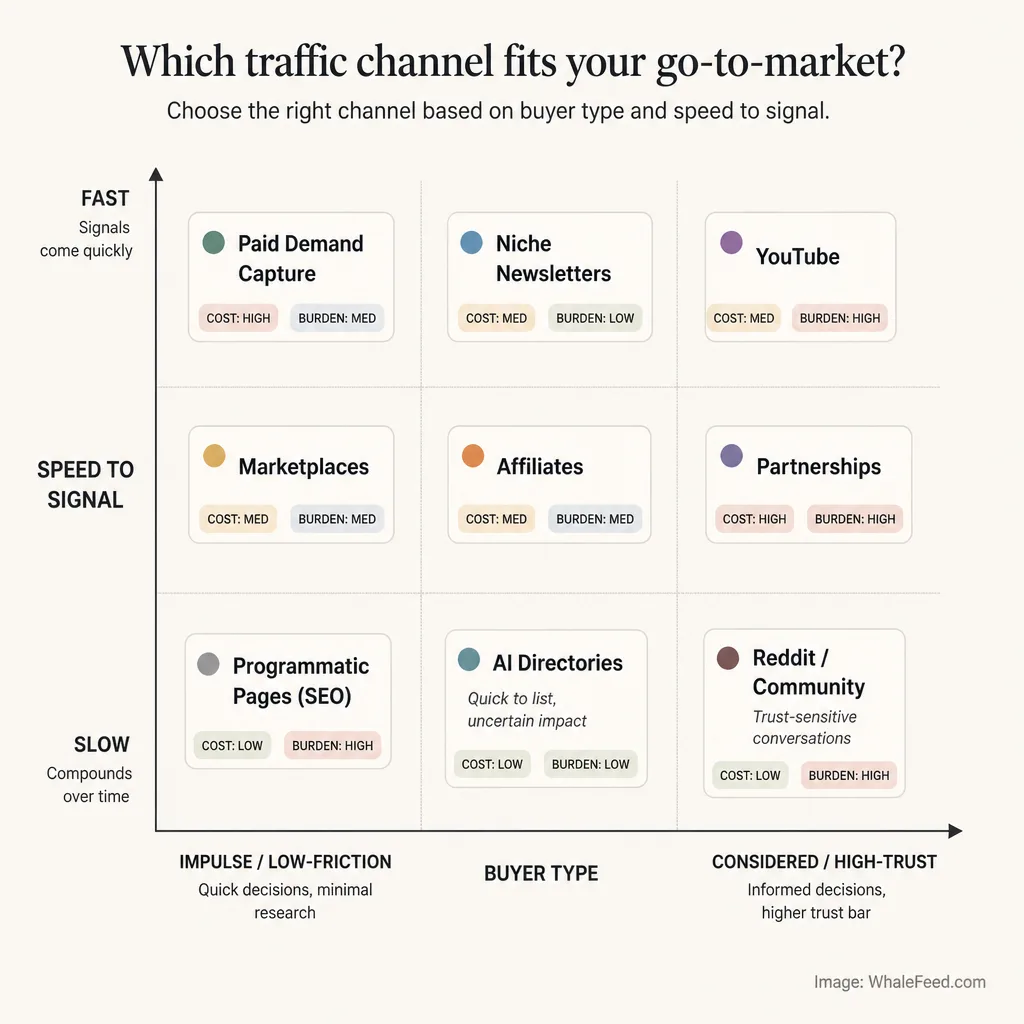
Here is the simplest way to narrow the list.
If you need speed, start here
Paid demand capture and niche newsletter sponsorships.
They produce fast signal and help when you need answers in weeks, not quarters.
If you need trust, start here
Reddit or community-led acquisition, YouTube, and partnerships.
These usually help more with considered purchases, skeptical buyers, and expert audiences.
If you need scale, start here
Programmatic landing pages, marketplaces, and strong affiliate systems can scale, but only if the operating model is sound.
If you sell impulse purchases vs. considered purchases
Impulse or low-friction offers usually fit:
- paid demand capture
- newsletter sponsorships
- marketplaces
- affiliates
Considered purchases usually fit:
- YouTube
- partnerships
- communities
- referrals
| Channel | Speed to Signal | Cost Level | Trust Requirement | Best Fit | Hidden Burden |
|---|---|---|---|---|---|
| Reddit/community | Medium-fast | Low-media, high-time | High | Considered | Moderation and reputation |
| YouTube | Medium | Medium | High | Considered | Production consistency |
| Programmatic pages | Medium-slow | Medium | Medium | Both, if structured | QA and maintenance |
| Partnerships | Medium | Medium | High | Considered | Coordination |
| Affiliate/referral | Medium | Medium-variable | Medium-high | Both | Fraud and enablement |
| Niche newsletters | Fast | Medium | Medium | Impulse to mid-consideration | Creative testing |
| Paid demand capture | Fastest | Medium-high | Lower | Impulse to considered | CPC and attribution noise |
| Marketplaces | Fast-medium | Medium-variable | Medium | Impulse to considered | Platform dependence |
| AI directories | Fast to list, uncertain impact | Low | Low-medium | AI-native products | Low-quality surfaces |
A simple rule for traffic diversification
Do not chase nine channels
More channels do not automatically reduce risk. Bad diversification creates reporting noise, diluted execution, and shallow presence everywhere.
Build one fast-feedback channel, one trust channel, and one compounding channel
That is a much better starting mix.
For example:
- Fast-feedback: paid demand capture or newsletter sponsorships
- Trust: YouTube, Reddit/community, or partnerships
- Compounding: YouTube library, programmatic pages, referral loops, or marketplace review equity
A good channel mix should not just increase traffic. It should make the business less fragile.
Conclusion
The goal is not to swap one dependency for another. It is to build a channel mix with different mechanics, strengths, and failure modes.
If you remember one thing, make it this: the wrong channel rarely fails immediately. It fails after the team has already built process around it. Choose channels whose speed, trust profile, and operational burden actually match your business. Then go deep enough to learn whether they deserve a permanent place in the mix.
FAQ
What are the best alternatives to SEO for getting traffic?
The best alternative depends on your offer, timeline, and team capacity. Common options include Reddit and community-led acquisition, YouTube search, programmatic landing pages, partnerships, affiliate and referral loops, niche newsletters, paid demand capture, marketplaces, and AI app directories.
What is the fastest traffic channel to test besides SEO?
Paid demand capture and niche newsletter sponsorships usually produce the fastest signal. They can generate clicks and conversion data within days, while channels like YouTube, partnerships, and referral loops often need more setup before they become reliable.
Which non-SEO channels work best for B2B SaaS?
B2B SaaS often performs well with YouTube demos, comparison videos, co-marketing partnerships, webinars, paid brand and category search, and referral programs. These channels fit longer sales cycles and products that benefit from explanation and trust.
Are Reddit and community-led channels really worth the effort?
They can be, especially in trust-sensitive categories where buyers want peer validation before converting. The tradeoff is that community acquisition is not free traffic. It requires patience, useful participation, and careful reputation management.
Do programmatic landing pages still work?
They can, when the pages offer real utility and match structured intent, such as local, integration, or category pages. They tend to fail when teams generate thin, duplicative pages with little unique value or no maintenance plan.
How should I measure non-SEO traffic channels?
Use channel-specific metrics instead of relying only on last-click attribution. Depending on the channel, useful indicators include assisted conversions, demo requests, branded search lift, watch time, partner-sourced leads, referral code usage, listing views, and conversion rate by landing page or partner.
Which channels work better for impulse purchases versus considered purchases?
Impulse or low-friction purchases often fit paid demand capture, newsletter sponsorships, marketplaces, and affiliate placements. Considered purchases usually benefit more from YouTube, partnerships, communities, and referrals because buyers need more trust and evaluation time.
Should I replace SEO completely with other traffic channels?
Usually not. The stronger strategy is diversification, not replacement. SEO can still be valuable, but relying on it too heavily creates risk. A more resilient mix often includes one fast-feedback channel, one trust-building channel, and one compounding channel.
Are AI app directories a real traffic source?
Sometimes, but their value is uneven. For AI-native products, they may help with early discovery, citations, and credibility even if direct traffic is modest. Their long-term value is still uncertain, so they are usually best treated as a supplemental channel rather than a core growth engine.