Traffics.io Growth Engine: Autopilot Multi-Site SEO & AEO Growth
Most business owners know the standard content marketing playbook: publish useful articles on your main site, hope they rank, and turn that traffic into leads.
The problem is that one site often captures less demand than it should.
A company blog has built-in limits. It speaks in one brand voice, lives on one commercial domain, and usually has to do several jobs at once: educate, build trust, explain services, and convert visitors. That works for some content, but not for every question people ask before they are ready to contact a business.
Traffics.io Growth Engine is built on a different premise. Instead of asking one website to carry the whole load, it creates a network of purpose-built content sites, each designed for a different angle, audience, or search journey. The point is not to publish more content for the sake of it. It is to cover intent more fully, support the main website in a natural way, and avoid turning content operations into a second full-time job.
What Growth Engine is actually solving
Why a single blog often misses real demand
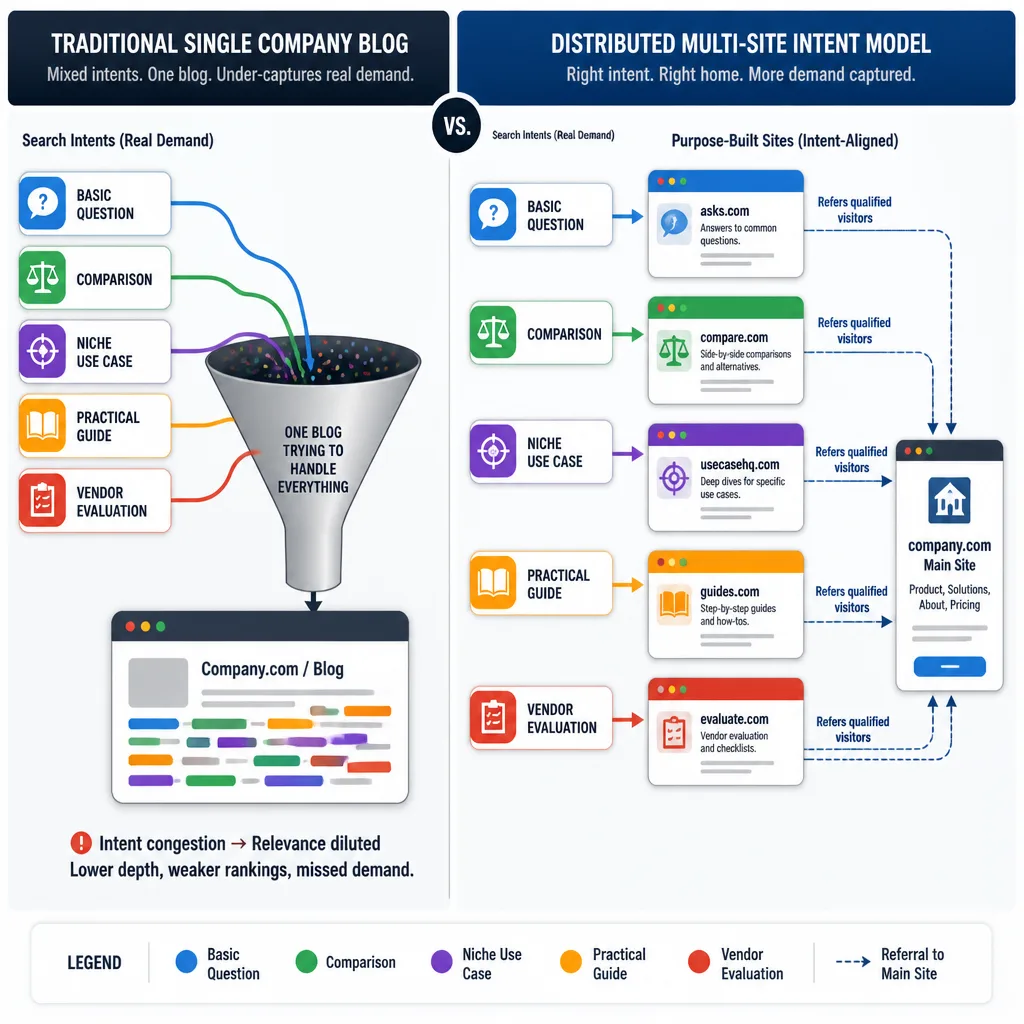
A typical company blog usually performs best closer to the bottom of the funnel. It can handle service pages, case studies, industry commentary, and some educational content. But it often struggles with broader or earlier-stage intent.
That matters because customers rarely follow a neat path. One person starts with a basic question. Another compares options. Another is looking for a niche use case. Another wants practical advice before they ever evaluate vendors.
Trying to serve all of that on one branded site can make the content feel unfocused. Some topics are too broad. Others feel too editorial for a sales-driven domain. And some adjacent opportunities simply do not fit the structure or tone of the main site.
Take a marketing services business. Its main site probably needs to stay focused on trust, offers, pricing, and conversion. But useful search demand also exists around educational explainers, method comparisons, niche industry questions, and problem-specific guides. Publishing all of that on the brand domain can get awkward quickly.
The core idea: organize content by intent, not just topic
This is the real shift behind Growth Engine.
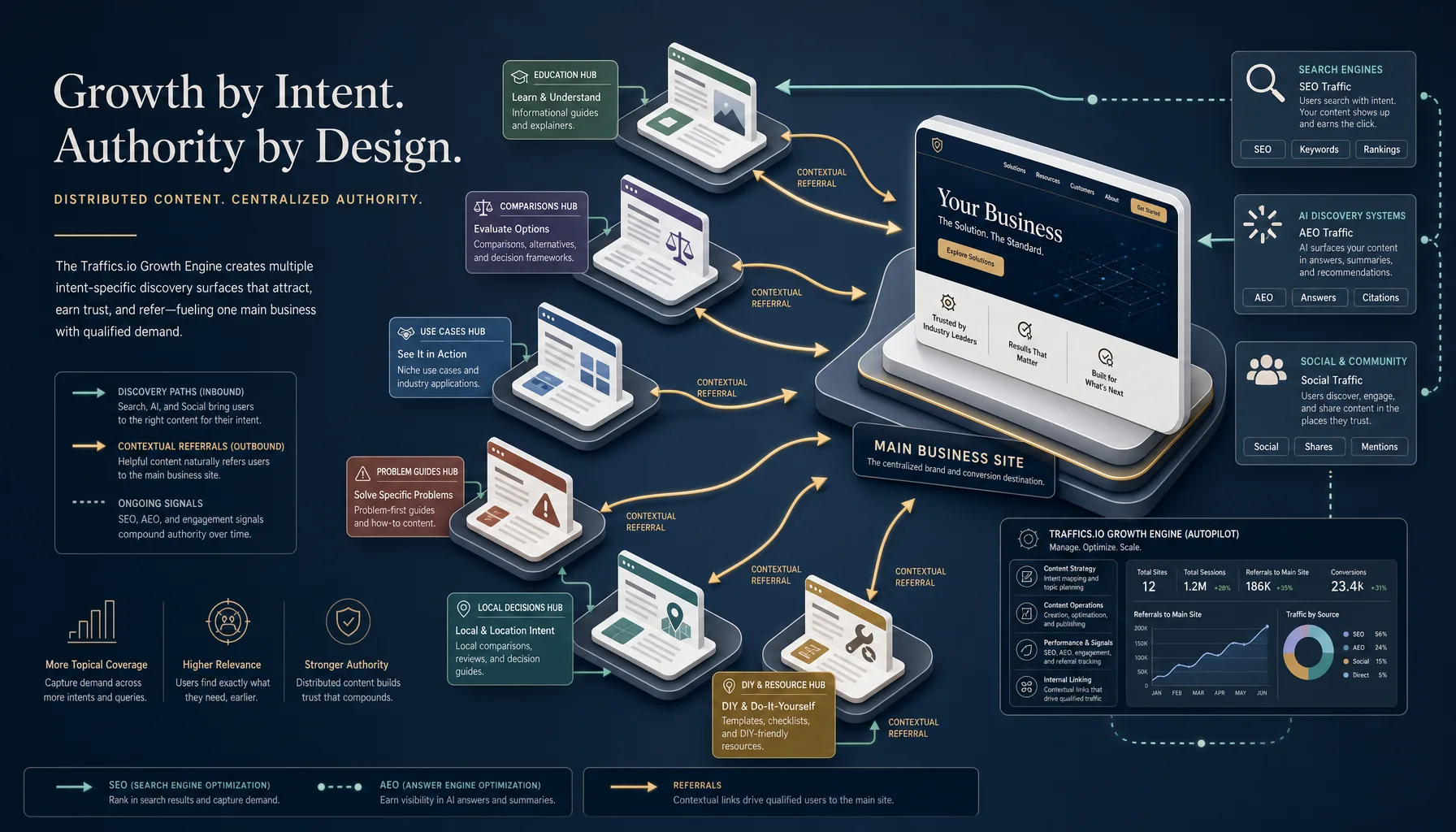
Traffics.io presents it as a demand-capture system, not just a managed blogging service. The idea is to distribute content across multiple editorial properties based on audience intent. Each site has a clear role. One might be educational. Another might focus on comparisons. Another could serve a niche segment. Another might address problem-specific searches.
That distinction matters. A multi-site network only works if the sites are genuinely different and useful. This is not about duplicating articles across domains or scattering thin content across the web. It works when each site earns its place by serving a distinct search journey.
How Growth Engine works
A network of independent, purpose-built sites
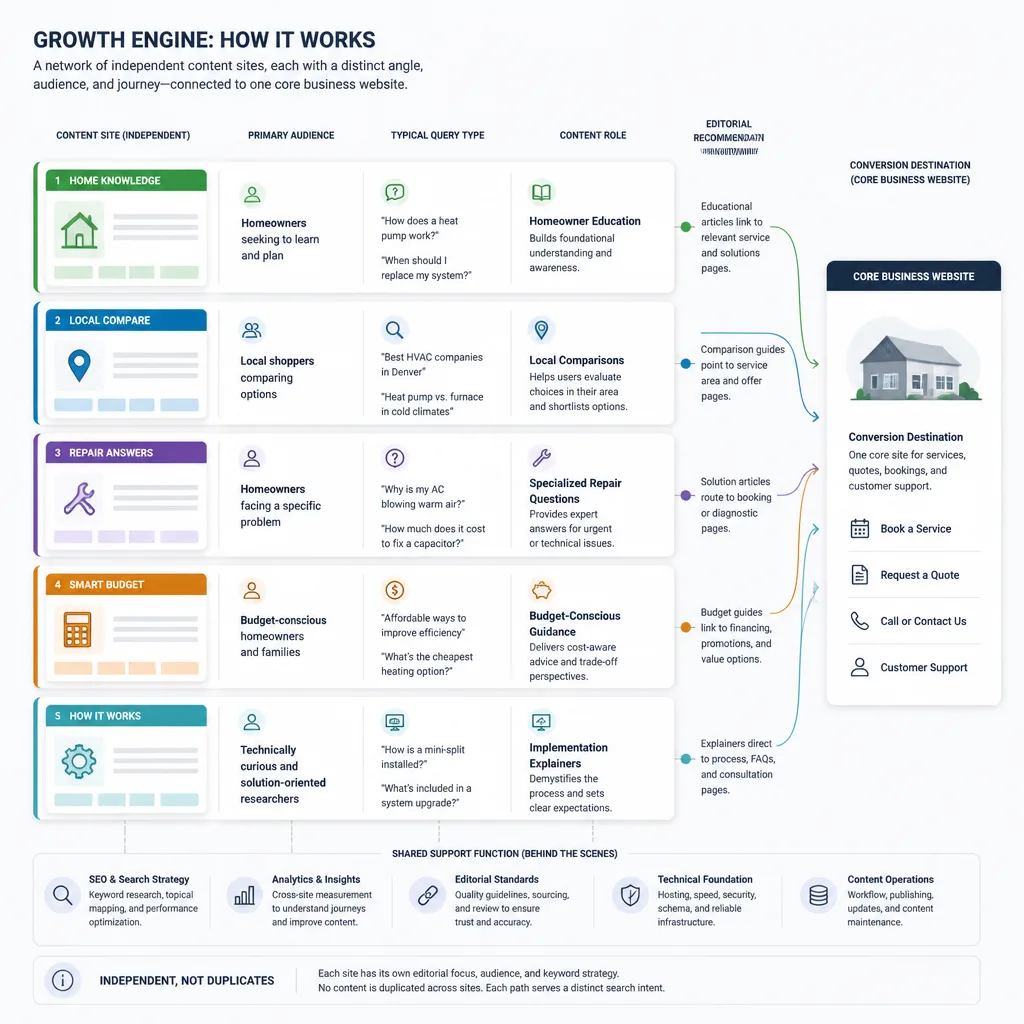
Traffics.io Growth Engine builds and operates multiple independent sites tied to a business's market. These sites are not replacements for the main website. They are support assets around it.
A helpful way to think about the network is as a portfolio of editorial properties. Each one captures a different slice of demand. Together, they create more ways for people to discover topics related to the business.
A home services company, for example, might have:
- a site focused on homeowner education
- a site built around local comparisons and decision guides
- a site targeting specialized repair questions
- a site aimed at budget-conscious or DIY-adjacent searchers
Those are different audiences with different questions, even if they ultimately buy in the same category.
Distinct angles, audiences, and search journeys
This is where the model becomes strategically interesting.
Search engines and AI discovery systems evaluate pages in context. A tightly themed site can sometimes create clearer topical relevance than a broad company blog mixing many intents together. That does not mean multiple sites always win. It means narrower editorial framing can be stronger when a business serves several kinds of search intent.
Someone might search for:
- how a service works
- the best option for a small business
- alternatives to hiring an agency
- who can help solve a specific problem
Those are not the same kind of query. They do not always belong in the same voice or on the same type of page.
How the sites support the main business website
The main website remains the brand and conversion destination.
The supporting sites help through contextual referrals, editorial recommendations, and relevant backlinks. The key point is that this should function as useful editorial guidance, not as a manipulative linking scheme.
That distinction matters. If the sites are relevant, differentiated, and genuinely helpful, the referral path feels natural. A reader learns something on a niche article, then clicks through to the main site when they are ready for a quote, service, or conversation.
Why a distributed model can outperform a centralized content hub
Better alignment with search intent
The strongest case for a distributed content network is not volume. It is alignment.
A single blog often forces very different intent stages into one environment. Growth Engine separates them. That gives each site room to be more specific, more useful, and more natural for the reader.
Search visibility often improves when content matches the real shape of a query instead of forcing everything into a brand-owned format.
Broader coverage without cluttering the main domain
Many businesses miss demand not because they lack a blog, but because they only cover a narrow band of brand-adjacent topics.
Growth Engine can expand into related territory, including:
- top-of-funnel education
- comparison content
- niche use cases
- implementation questions
- industry-specific variations
The advantage is broader reach without turning the main site into a catch-all content hub.
More natural referral paths
Referral traffic tends to work best when it comes from useful context. If someone reads a strong article tailored to their exact problem, a recommendation to the main business site can feel earned rather than inserted.
That is one of the quieter strengths of the model. It creates several editorial settings where the business can be introduced at the right moment.
SEO, AEO, and social amplification
How the network supports organic search
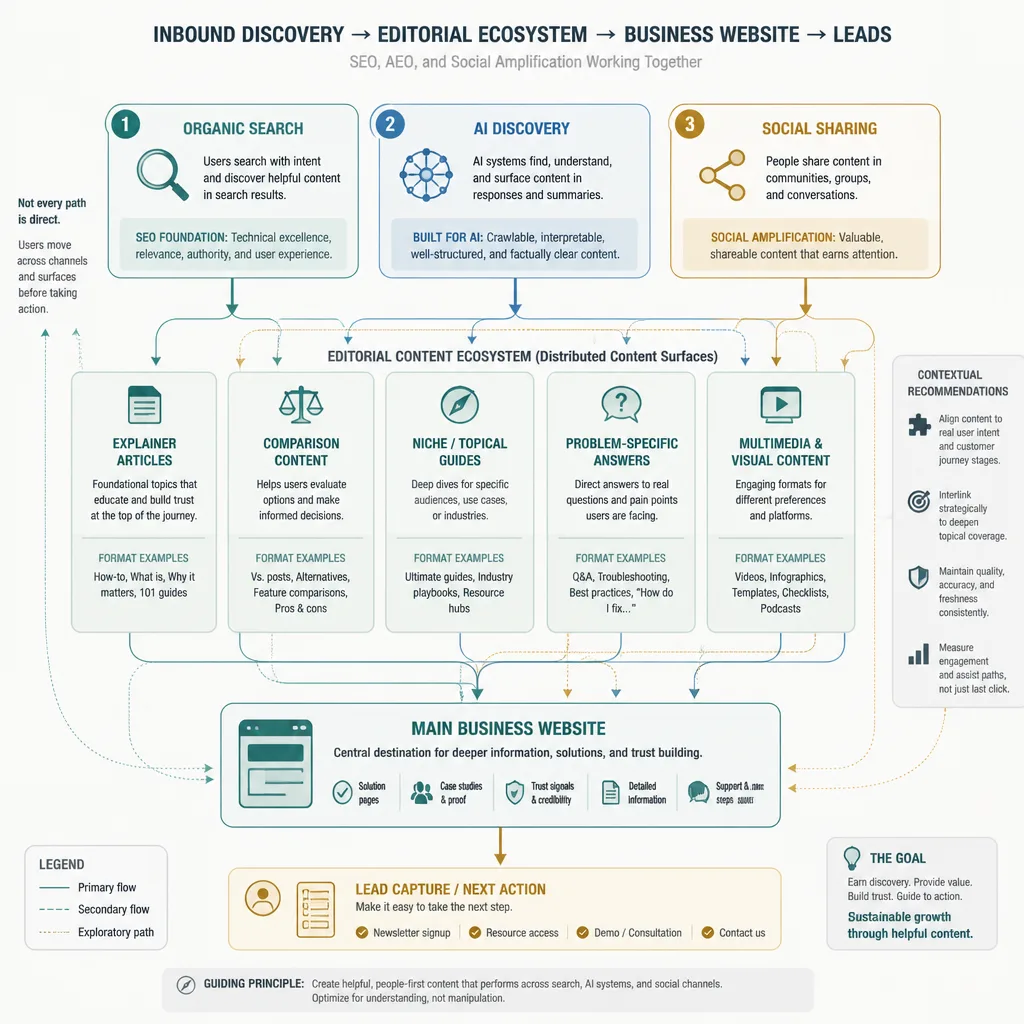
From an SEO perspective, the leverage comes from creating more entry points into search.
A distributed content network can target long-tail searches, adjacent themes, and narrower intent clusters that may be difficult to house on the main domain. That can expand organic acquisition potential, especially for businesses serving multiple audience segments or service angles.
This is not a promise of rankings. Outcomes still depend on execution, competition, relevance, and content quality. But the strategic logic is straightforward: more relevant surfaces can create more discovery opportunities.
Why AEO changes the value of distribution
AEO, or answer engine optimization, overlaps with SEO but is not the same thing. SEO focuses on ranking in search results. AEO focuses on making content understandable and usable for AI systems that summarize, cite, or surface information.
That matters because discovery no longer happens only through traditional search results. Businesses increasingly care whether their content is accessible, interpretable, and present across the web in formats AI systems can work with.
The durable principle is simple: a broader high-quality web presence can improve discovery beyond a single domain. The uncertain part is how each AI system chooses to crawl, interpret, and surface content. That behavior is still changing, so AI visibility should be treated as an opportunity, not a guaranteed outcome.
How editorial assets can extend reach beyond search
Not every useful article succeeds through Google alone.
Independent editorial sites can publish pieces that are easier to share because they do not always read like brand marketing. A niche guide, practical explainer, or comparison article may travel further when it is framed around reader value instead of corporate messaging.
That gives Growth Engine another layer of reach: traffic can come from search, referrals, and social sharing rather than from a single channel.
What “autopilot” means in practice
Lower operational burden for the business owner
Autopilot does not mean magic. It means Traffics.io handles the heavy operational work: setup, publishing, maintenance, and ongoing management.
That matters because the hard part of content marketing is rarely writing one article. It is keeping the system running over time.
For many small and midsize businesses, content becomes expensive in attention long before it becomes effective in traffic.
What the dashboard makes visible
Growth Engine reduces execution burden without hiding performance.
Business owners get a centralized dashboard where they can review activity across the network, track lead registrations, monitor Contact Us inquiries, and see overall performance. That is important because the usual objection to a multi-site model is complexity.
The dashboard is what makes distributed infrastructure manageable.
Where oversight still matters
Autopilot should not be mistaken for strategy-free automation.
A business still needs to review performance, make sure site themes stay aligned with its market, and judge whether the network is attracting useful traffic rather than vanity traffic. Editorial judgment still matters. Quality still matters. Fit still matters.
The dashboard: measurement, leads, and visibility
Lead registrations and Contact Us inquiries in one place
One practical strength of Growth Engine is that it connects traffic to business outcomes. Owners can see lead registrations and Contact Us submissions in one place instead of guessing whether distributed publishing is doing anything useful.
That answers a common concern: can performance be measured beyond the main brand domain? Yes, and it should be.
Traffic, sources, and referral breakdowns
The dashboard also shows traffic volume, traffic sources, and referral breakdowns across the network.
That matters because distributed strategies are harder to evaluate by intuition alone. Without consolidated reporting, a business only sees fragments. With centralized visibility, it can evaluate which sites, channels, and referral paths are actually contributing.
Search and AI crawler visibility
A more current feature is visibility into search and AI discovery activity. Growth Engine reports which crawlers accessed the network, when they visited, and how often they returned.
This needs careful interpretation. Crawler activity signals access and indexing interest. It does not prove rankings, AI citations, or lead generation. Still, as AI-assisted discovery becomes more relevant, this reporting can be operationally useful.
Optional comment moderation
If comments are enabled on published articles, moderation can also be handled through the dashboard.
That may seem minor, but it reinforces an important point: distributed publishing still needs governance.
Extensibility: fitting into a broader marketing stack
Analytics and tracking integrations
Each site in the network can be extended with tools like Google Analytics and other tracking systems.
That makes the network more than a publishing layer. It becomes part of a measurable acquisition system.
Chat widgets, CRM connections, and engagement tools
Businesses can also add chat widgets, CRM integrations, and other engagement tools depending on how they qualify and route leads.
For one business, that may mean basic traffic tracking. For another, it may mean CRM attribution and chat-assisted lead capture. The right setup depends on the sales process.
Why extensibility matters
Not every business monetizes traffic in the same way.
A high-ticket service provider may care most about qualified inquiries. A local business may care about calls. A marketing operator may care about attribution across several touchpoints. Extensibility allows the same infrastructure to adapt to those differences.
Who Growth Engine is best for and where it may be less effective
Best-fit business profiles
Growth Engine is a strong fit for businesses that:
- need more organic visibility across multiple intent stages
- serve more than one audience segment or topic cluster
- lack the time or in-house capability to run a sophisticated editorial operation
- want centralized reporting across a broader content footprint
This often includes SMB owners, advertisers, and marketing leaders trying to grow organic acquisition without building a large internal team.
When a simpler strategy may be enough
Not every business needs a distributed content network.
If the offering is very narrow, adjacent search demand is limited, or the company already has a strong in-house SEO and editorial team, a focused single-site strategy may be enough. In some cases, tighter brand concentration and internal control matter more than expanding surface area.
A simple framework for evaluating fit
The easiest way to judge fit is through four lenses:
| Lens | Question |
|---|---|
| Coverage | Are you missing demand because your main site cannot credibly cover enough topics? |
| Intent Fit | Do customers arrive through different search journeys that deserve different editorial framing? |
| Operational Load | Would building this internally cost more time and management than it is worth? |
| Measurement | Do you need centralized reporting across multiple properties, leads, and discovery signals? |
If the answer is yes to most of these, Growth Engine becomes much more compelling.
The tradeoff is straightforward: more properties create more strategic surface area. That can be powerful, but only if the sites stay coherent, relevant, and quality-controlled.
The practical takeaway
Growth Engine is most useful when your bottleneck is not publishing a few blog posts. It is when one website cannot cover the full range of demand in your market.
Traffics.io Growth Engine approaches that problem as infrastructure. It uses a distributed content network to match different intents more precisely, support the main business site through contextual pathways, and reduce the daily burden of running a serious content operation.
That does not make it the right answer for every business. But if you need broader intent coverage, lower operational load, and clearer visibility across search, referrals, and emerging AI discovery signals, it is a model worth evaluating carefully.
FAQ
What is Traffics.io Growth Engine?
Traffics.io Growth Engine is a managed content growth system that builds and operates a distributed network of independent content sites for a business. Each site targets different topics, audience segments, and search intents, then supports the main business website through contextual recommendations, editorial links, and lead pathways.
How is Growth Engine different from running a single company blog?
A single company blog publishes under one brand voice and one domain context, which can limit how naturally it covers broad educational, comparative, niche, and adjacent-intent topics. Growth Engine spreads that coverage across multiple purpose-built sites so content can align more closely with different user journeys.
Why can a distributed content network outperform a centralized content hub?
It can outperform a centralized hub when a business needs broader intent coverage and clearer audience segmentation. Independent sites can create stronger topical focus, more relevant editorial framing, and more entry points into search and AI-assisted discovery than one mixed-intent brand blog.
Does Growth Engine replace the main business website?
No. The main website remains the core brand and conversion destination. Growth Engine expands discovery around it by publishing useful supporting content across independent sites that can refer qualified visitors back to the business when that recommendation makes sense.
Is a multi-site SEO strategy spammy?
Not by default. The approach becomes risky when sites are duplicative, thin, manipulative, or irrelevant. A legitimate distributed content network depends on each site being distinct, useful, audience-specific, and editorially coherent.
What does “autopilot” mean in Growth Engine?
Autopilot means Traffics.io handles setup, publishing operations, maintenance, and ongoing management so the business owner does not have to run the system day to day. It reduces execution burden, but it does not remove the need for strategic oversight and performance review.
How does Growth Engine help with SEO and AEO?
For SEO, it creates more opportunities to target adjacent topics, long-tail queries, and different stages of search intent. For AEO, it expands the business's web presence across multiple useful properties that can be crawled, interpreted, and potentially surfaced by AI-driven discovery systems. Because AI discovery is still evolving, this should be treated as a strategic advantage rather than a guaranteed result.
What can business owners see in the Growth Engine dashboard?
The dashboard provides centralized visibility into lead registrations, Contact Us inquiries, traffic volume, traffic sources, referral breakdowns, and optional comment moderation. It also shows search and AI crawler activity, including which crawlers visited, when they accessed the network, and how often they returned.
Can Growth Engine track leads and inquiries across the network?
Yes. One of the practical advantages of the system is that distributed publishing remains measurable through a centralized dashboard that consolidates lead registrations and Contact Us submissions across the network.
What integrations are possible with Growth Engine sites?
Each site can be extended with tools such as Google Analytics, chat widgets, CRM integrations, tracking scripts, and other third-party engagement or measurement systems. That makes the network adaptable to different lead generation and attribution workflows.
Who is Growth Engine best for?
It is best suited to small and midsize businesses, advertisers, and marketing operators who want more organic visibility but do not have the time, in-house expertise, or operational capacity to run a sophisticated multi-property content strategy themselves.
When is a simpler content strategy enough?
A simpler strategy may be enough for businesses with very narrow offerings, limited adjacent search demand, or strong internal editorial and SEO teams that can execute a focused single-site or multi-site strategy on their own.