Generate Leads Fast on Facebook: Step-by-Step Ads + Offers
Most businesses that want Facebook leads quickly are not looking for a brand strategy. They want an answer to a simpler question: how do we get qualified people to raise their hands in the next few days without burning budget?
That changes the playbook. Fast lead generation on Facebook is rarely about clever funnels, endless targeting layers, or “growth hacks.” It usually comes down to removing friction at each step: choosing an offer people already want, making the conversion path easy, writing ads that are unmistakably clear, and following up before interest fades.
Facebook can work quickly because discovery and action often happen in the same session, especially on mobile. But that convenience creates a trap. Cheap clicks can turn into cheap leads, and cheap leads can become expensive noise if they are unqualified or handled slowly.
This guide lays out a practical system for generating leads quickly from Facebook, with a bias toward what works in days, not months. The goal is usable pipeline, not vanity metrics.
Why Facebook can generate leads quickly — and why it often doesn’t
Facebook is one of the faster paid channels because it can compress the path from attention to submission. Someone sees an ad, taps, fills out a form, and becomes a lead in minutes. Meta’s lead ads are built for that exact use case.[^1]
But speed at the top of the funnel is not the same as speed to revenue.
A lot of campaigns look promising because they generate impressions, clicks, and form submissions. Then sales starts calling and finds out half the leads do not answer, some are poor fits, and others were only mildly curious. That is why it helps to separate four outcomes:
- impressions
- clicks
- leads
- qualified leads
A campaign with a $12 cost per lead may be worse than one with a $45 cost per lead if the second produces booked calls and real opportunities.
It is also worth being blunt about organic Facebook. Organic posts can produce leads if you already have a strong community, local visibility, or a founder-led audience. But if you need leads this week, paid Facebook is usually the faster and more predictable option.
The core idea for the rest of this article is simple: Facebook gets fast when friction is low and intent is clear.
Before you launch: define what a “lead” means for your business
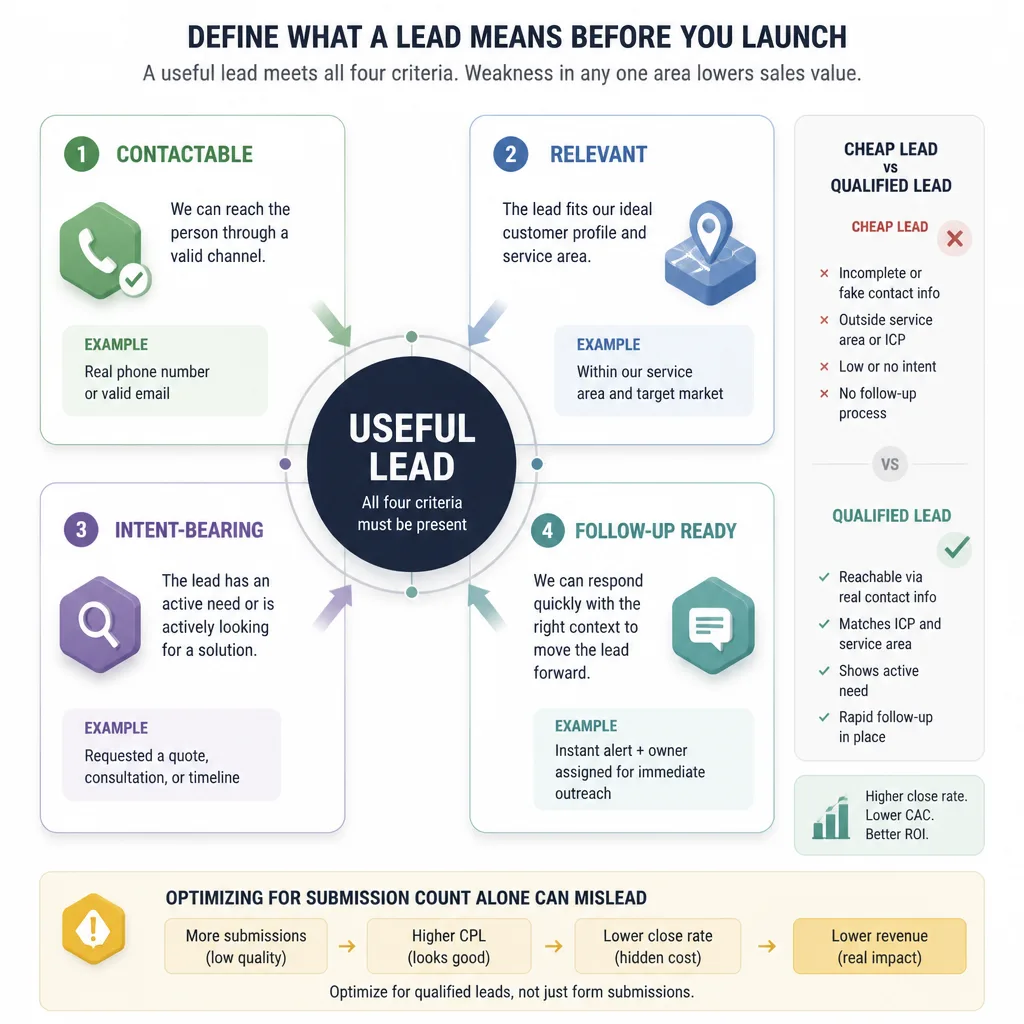
A lot of businesses waste money by optimizing for submission count instead of sales usefulness.
Before you build a campaign, define a lead with a simple qualification framework. A useful lead should be:
- Contactable: real phone number, real email, reachable person
- Relevant: fits your geography, role, service need, or business type
- Intent-bearing: shows actual interest in solving the problem
- Follow-up ready: your team can act on it immediately
That definition sounds obvious, but it changes decisions. If you only care about cheap form fills, you will design the campaign very differently than if you care about booked estimates, demo requests, or consultation calls.
Pick one primary conversion event before you spend money. For most businesses, that should be something closer to revenue than “downloaded a thing.”
Examples:
- local roofer: quote request
- B2B agency: audit request or booked strategy call
- SaaS company: demo request
- medspa: appointment request
- financial consultant: application or consultation request
The faster you want results, the more tightly your campaign should be tied to existing demand rather than general awareness.
The fast-lead filter: urgency, value, and follow-up capacity
Before launch, run your offer through three questions.
First, is there urgency? People request roof inspections after storm damage. They request demos when they are actively evaluating software. They ask for quotes when the need is live. If your market does not feel the problem yet, Facebook may still generate leads, but they usually move slower.
Second, is the value obvious? “Get a free estimate” is easy to understand. “Download our ultimate guide to operational excellence” is not.
Third, can you follow up quickly? A decent ad campaign can look broken when the real problem is lead handling. Research summarized by Harvard Business Review found that faster response materially improves the odds of contact and qualification.[^2] The exact uplift varies by context, but the pattern is consistent.
Step 1: Pick the fastest offer, not the most creative one
If you want leads quickly, choose an offer that matches immediate intent.
This is where many campaigns drift off course. Teams spend time inventing something novel when they would get better results from a plain, direct offer with a clear next step.
In practice, fast Facebook lead generation often comes from offers like:
- free quote
- estimate request
- consultation
- audit
- demo
- eligibility check
- appointment request
- limited-time assessment
- pricing request
These work because they meet buyers where they already are. They do not ask prospects to enter a long nurture sequence first.
A local HVAC company, for example, will usually get leads faster with “Book a free AC repair estimate today” than with “Download our home comfort guide.” A B2B service firm may get faster traction from “Request a 15-minute pipeline audit” than from a generic ebook.
That does not mean educational offers never work. It means they are usually slower if your goal is near-term pipeline.
Offers that usually convert faster on Facebook
Different business models need different offers, but the pattern is consistent.
For service businesses, the fastest offers are often quote-driven or diagnostic:
- free estimate
- free consultation
- inspection
- audit
- strategy session
For B2B, the strongest fast offers usually combine practical value with clear sales intent:
- demo request
- audit
- strategy call
- benchmark report tied to a follow-up conversation
For local businesses, speed often comes from appointment-led or pricing-led offers:
- same-week appointment
- free consultation
- seasonal promotion
- new patient special
- limited-time estimate
These offers convert because they reduce decision effort. The buyer understands what they get and what happens next.
Offers that attract volume but weak intent
Some offers make lead counts look healthy while quietly hurting sales efficiency.
Common examples:
- generic ebooks
- broad giveaways
- loosely related contests
- sweepstakes with little connection to the core service
These can reduce cost per lead, but they often reduce lead quality too. That tradeoff is not always worth it.
If your sales team needs serious buyers, an $8 lead magnet lead may be more expensive than a $60 consultation lead once you factor in no-shows, poor fit, and time spent chasing people with little buying intent.
Step 2: Choose the right conversion path: Instant Form, landing page, or Messenger
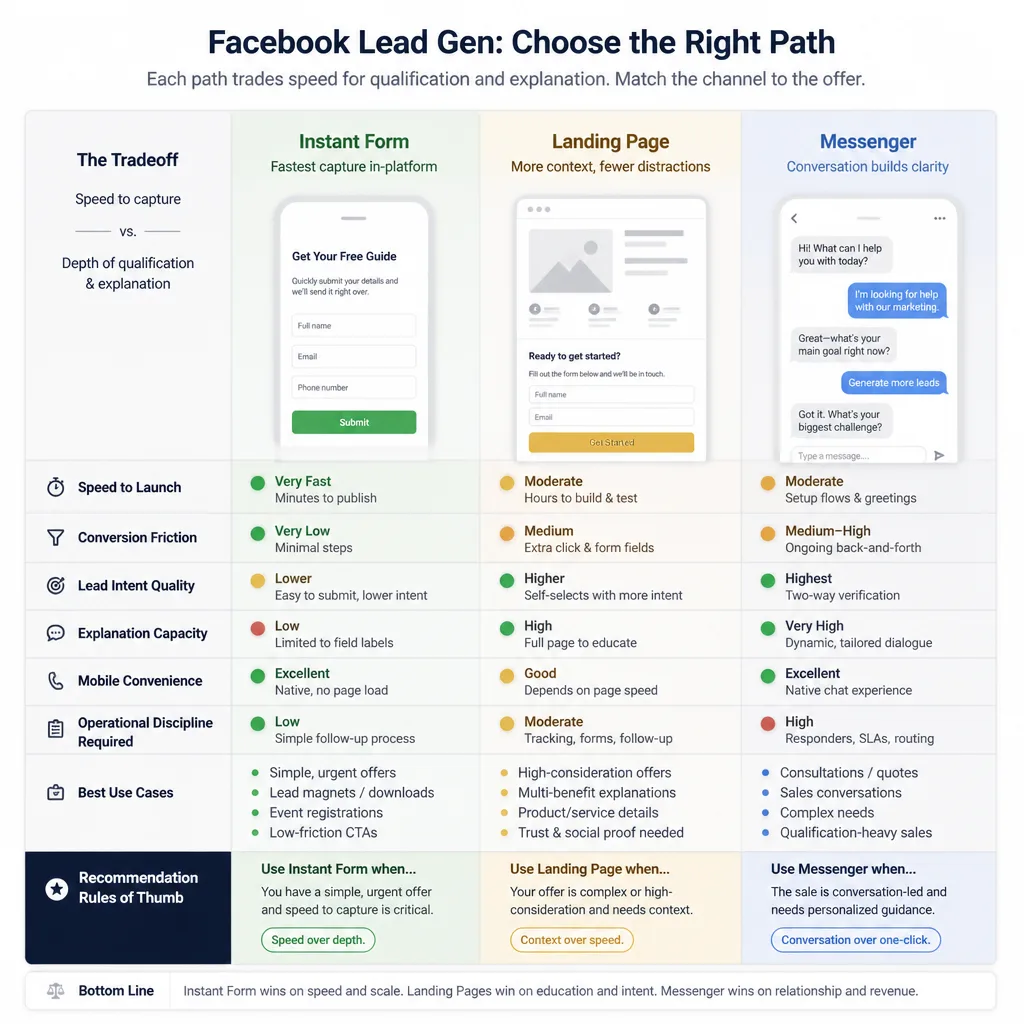
The fastest path is not always the best one. It depends on how much trust and explanation the offer needs.
There are three common options:
- Facebook Instant Forms
- landing pages
- Messenger
Each creates a different balance between speed and quality.
When Facebook Lead Ads are the fastest option
For simple offers, native lead ads are often the fastest route to market. Users stay inside Facebook or Instagram, forms can autofill contact details, and the mobile experience is streamlined.[^3]
This tends to work especially well for:
- local services
- mobile-first offers
- short buying cycles
- simple quote or appointment requests
A roofing company after severe weather is a good example. “Get a free roof inspection” is easy to understand and time-sensitive. An Instant Form reduces friction and can produce submissions quickly.
The tradeoff is that lower friction can also lower intent. That is a medium-confidence rule, not a universal one. In some accounts, Instant Forms produce excellent quality. In others, they create more casual submissions. The difference usually comes down to the offer, qualification, and follow-up.
When a landing page is worth the extra step
Landing pages add friction, but useful friction can improve quality.
If your offer is high-ticket, complex, regulated, or trust-sensitive, a landing page often earns its keep. It gives you space to explain the offer, add proof, answer objections, and filter poor fits.
Examples where a landing page is often worth it:
- B2B services with multi-thousand-dollar retainers
- specialized medical or wellness services
- financial services
- software demos with category education needs
A B2B agency offering a growth audit may find that a focused landing page with examples, process details, and qualification copy outperforms a native form on downstream meetings, even if raw CPL is higher.
A practical decision rule for choosing the path
Use this rule:
- Simple and urgent offer: Instant Form
- Complex or high-consideration offer: landing page
- Conversation-led sale: Messenger or a form-plus-call workflow
Do not choose based on what is trendy. Choose based on how much explanation your buyer needs before committing.
Step 3: Build a campaign around one audience, one offer, one promise
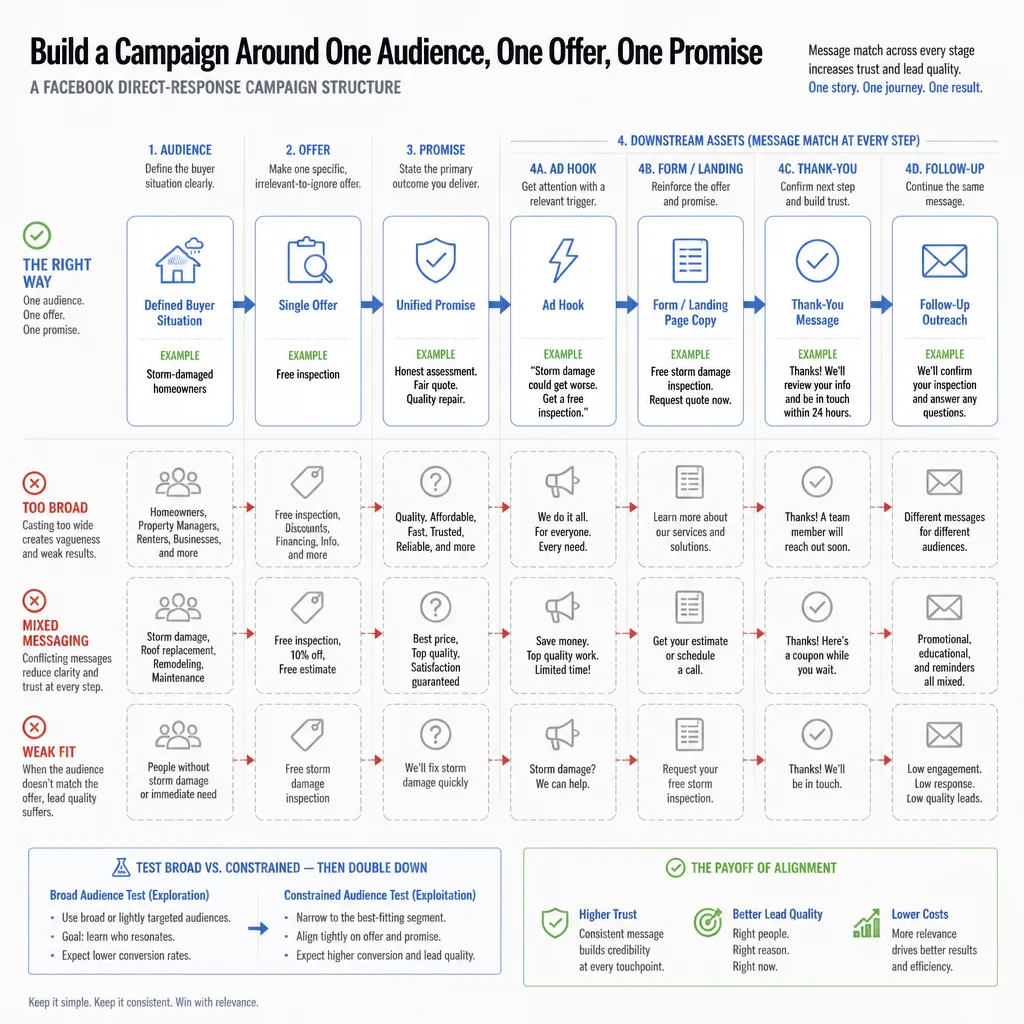
Weak campaigns often try to speak to too many people at once.
If your ad is trying to reach every small business owner, every homeowner, or every possible buyer state, the message gets vague. Vague messages rarely generate fast leads.
Instead, structure the campaign around one buyer situation.
For example:
- homeowners dealing with recent storm damage
- founders who need more booked sales calls
- local patients looking for cosmetic treatment pricing
- HR teams actively evaluating recruiting software
The tighter the situation, the easier it is to write clear ads and qualify leads.
This is also where message match matters. The ad hook, the offer, the form or page copy, and the follow-up message should all describe the same promise. If the ad says “Get a free growth audit,” the form should not suddenly feel like a generic newsletter signup. Misalignment lowers trust and quality.
How to define a fast-response audience
A fast-response audience is not just a demographic segment. It is a group likely to already feel the problem.
That distinction matters.
For a local plumber, it may be homeowners in the service area with an urgent repair need. For a B2B SaaS company, it may be operations leaders already comparing tools. For a lead gen agency, it may be founders who need pipeline this quarter, not just “people interested in marketing.”
The best Facebook campaigns often use the offer and creative as part of the filtering system. The ad itself tells the wrong people to ignore it.
Broad vs detailed targeting: what usually works now
Many advertisers still assume more targeting detail always means better performance. That is outdated.
Meta’s platform has changed over time, with less granular targeting in some areas and more reliance on machine learning and conversion signals. Overly narrow audiences can restrict delivery without improving fit.[^4]
That does not mean broad targeting always wins. It means you should test instead of assume.
A practical starting point:
- one broader audience with strong creative filtering
- one more constrained audience based on obvious relevance signals
Then compare not just CPL, but qualified lead rate.
Step 4: Create ads that make the next step feel obvious
Fast lead-gen ads are usually direct-response ads, not mini brand films.
The job of the ad is simple: help the right person understand the offer quickly and feel comfortable taking the next step.
That means reducing uncertainty. Who is this for? What do I get? Why should I trust it? What happens after I submit?
The 4-part ad formula
A useful framework is:
- Problem or goal
- Specific offer
- Credibility or proof
- Clear CTA
A few examples:
Local service ad
“Storm damage on your roof? Get a free inspection and same-day estimate from a licensed local team. 200+ homeowners served this season. Request your quote now.”
B2B agency ad
“Not getting enough qualified demos? Book a 15-minute pipeline audit and we’ll show where your lead flow is breaking. Used by SaaS teams scaling outbound and paid acquisition. Request your audit.”
Medspa ad
“Thinking about laser treatments but unsure about cost or fit? Book a consultation to review options, pricing, and next steps with our team. Reserve your appointment.”
None of these are clever. That is the point.
Creative formats that often work well
There is no universal best creative, but a few formats repeatedly work in lead generation:
- simple static images with a clear headline
- talking-head videos from the founder or expert
- testimonial-led ads
- before-and-after framing where compliant and appropriate
Talking-head video can work especially well in higher-trust categories because it creates familiarity quickly. Static image ads often work well when the offer is already strong and easy to grasp.
Common copy mistakes that slow lead generation
A few mistakes show up constantly:
- being clever instead of clear
- hiding the offer in vague brand language
- weak calls to action
- unsupported claims
- failing to explain the next step
If your ad gets attention but not leads, clarity is usually the first thing to inspect.
Step 5: Design the form or landing page for conversion and qualification
The form should be easy to complete but hard to misunderstand.
That sounds minor, but it matters. The goal is not maximum form fills. It is useful form fills.
What to include in a high-converting lead form
Whether you use an Instant Form or landing page, include:
- a clear headline
- a short benefit-focused description
- minimal required fields
- one useful qualifying question if needed
- privacy reassurance
- a strong thank-you step explaining what happens next
If you need a phone call to close the lead, ask for a phone number. If geography matters, ask for ZIP code or service area. If budget matters, consider one light qualifier rather than a long interrogation.
For many businesses, a good minimum form looks like:
- name
- phone
- one qualifier, such as service need, timeline, or company size
That is often enough to preserve speed while filtering obvious poor fits.
How to improve lead quality without killing volume
You do not need ten questions to improve quality.
Usually, one or two small changes do more:
- use the review step in the form
- add one intent-based question
- make the next step explicit
- set expectations clearly
Examples:
- “Our team will call within one business hour.”
- “Best for homeowners in the Austin area.”
- “Best for B2B teams already spending on paid acquisition.”
- “You’ll be asked to book a consultation after submitting.”
That kind of copy discourages low-intent submissions without adding major friction.
Step 6: Set a realistic test budget and launch fast
There is no universal good Facebook lead gen budget, and there is definitely no universal good CPL.
Results vary by niche, geography, competition, offer strength, and deal value. A local cleaning service and an enterprise software company should not use the same benchmark.
So instead of asking, “What should my CPL be?” ask, “Can I afford enough data to judge signal quickly?”
A simple testing framework for the first 7 days
For a fast first test, keep variables tight:
- 1 offer
- 2 to 3 creatives
- 1 to 2 audiences
- 1 conversion path
That is enough variation to learn without creating noise.
Avoid changing five things at once. If results are weak, you want to know whether the issue is the offer, the creative, the audience, or the form.
What to watch in the early data
In the first week, watch:
- click-through rate
- cost per click
- form open rate or landing page engagement
- form completion rate
- cost per lead
- contact rate
- response speed
- booked meeting rate
- qualified lead rate
A useful diagnostic pattern:
If CTR is healthy but form completion is weak, the ad may be doing its job but the form or page is adding too much friction.
If lead volume is fine but meetings are weak, the problem may be qualification, follow-up, or sales handling.
Step 7: Follow up fast or waste the lead
This is where a surprising number of Facebook campaigns fail.
The ad works. The form works. The lead arrives. Then it sits in someone’s inbox for six hours.
That delay is expensive.
Why response time changes lead quality in practice
Lead quality is not fixed at the moment of submission. It degrades.
The Harvard Business Review summary of lead response research found that companies responding within an hour were much more likely to contact and qualify leads than those waiting longer.[^2] Exact lift varies across studies and markets, so treat any specific percentage cautiously. But the directional conclusion is strong: faster follow-up improves your odds.
This is especially true with Facebook leads, where initial intent may be real but lightweight. If you call quickly, you catch the buyer while the context is still fresh.
A practical follow-up sequence
For a small team, this is enough:
- Immediate confirmation email or SMS, where compliant
- First call attempt as quickly as operationally possible
- Second contact attempt if no answer
- Short reminder or nurture sequence
- Clear CRM ownership and status tracking
Use native integrations or a workflow tool like Zapier to route leads into your CRM immediately. Fast campaigns often fail because leads depend on manual exporting.
If your team can only call twice a day, do not choose a conversion path that depends on real-time conversation.
Where a service like Traffics.io may fit
Some businesses understand the strategy but struggle with execution: campaign setup, testing discipline, lead routing, optimization, and scale.
That is where an outside partner can help. If you need support with campaign management and optimization, a service like Traffics.io can be relevant for advertisers and business owners who want a more managed approach. What matters most is not the vendor name. It is making sure someone owns the system end to end.
Step 8: Retarget people who showed interest but didn’t convert
Retargeting is often one of the cheapest ways to generate incremental leads.
Why? Because these people already engaged. They watched a video, visited a page, opened a form, or interacted with your brand. You are not starting from zero.
Common retargeting audiences include:
- video viewers
- page engagers
- landing page visitors
- form openers where available
- prior leads excluded from prospecting campaigns
Attribution can be messy across devices and time windows, so do not expect perfect measurement. But as a direct-response principle, retargeting is consistently useful.
Retargeting messages that work better than repeating the first ad
Do not just rerun the same ad.
Retargeting works better when it addresses the reason someone did not convert:
- objection handling
- stronger proof
- clearer explanation of the process
- careful urgency
Examples:
- “Wondering what happens after you request a quote? Here’s our 3-step inspection process.”
- “Still comparing options? See how three local homeowners used this service.”
- “Only booking five consultations this week.”
The message should move the buyer forward, not restart the conversation.
Step 9: Improve quality before you scale volume
Scaling a weak lead-gen system does not solve the problem. It magnifies it.
If your sales team is already complaining about lead quality, increasing budget usually produces more complaints, not more revenue.
How to diagnose poor lead quality
Poor lead quality usually comes from one of five places:
- mismatch between ad promise and actual offer
- audience too broad for the proposition
- weak or nonexistent qualification
- slow follow-up
- poor sales script or handoff
Notice that only some of these are ad-platform problems.
A campaign generating 30 leads per week with weak booking rates may not need more targeting layers. It may need clearer offer framing or a faster first call.
When to increase budget and when to rebuild
Scale when downstream numbers hold.
That means leads are:
- being reached
- booking calls or appointments
- showing real fit
- converting at an acceptable rate relative to cost
Rebuild when raw lead volume exists but downstream conversion is weak.
As a rule, optimize for:
- cost per qualified lead
- cost per booked meeting
- cost per acquisition
Raw CPL matters, but it should not drive the whole system.
Common reasons Facebook lead generation fails
Most failed campaigns are not mysterious. They usually break in familiar ways:
- the offer is weak
- the ad is vague
- the audience is poorly matched
- the form creates too much friction or too little qualification
- the business sends cold traffic to a homepage instead of a focused conversion path
- no one follows up quickly
- tracking stops at submission count
- expectations are unrealistic
There is also a channel-fit issue worth acknowledging. In some industries, Google Search can convert faster than Facebook because intent is more explicit. Someone searching “emergency plumber near me” may be further along than someone scrolling social. Facebook can still produce leads quickly, but it is not always the highest-intent source.
That is not a reason to avoid Facebook. It is a reason to judge it honestly.
A 72-hour action plan to get your first Facebook leads
If you want to move quickly, do not overbuild.
Day 1:
Choose one offer, one audience, and one conversion path. Define the primary conversion event. Write down what counts as a qualified lead.
Day 2:
Build 2 to 3 ads using the problem-offer-proof-CTA structure. Create your Instant Form or landing page. Connect lead routing to your CRM, email, or notifications.
Day 3:
Launch. Monitor clicks, form opens, completions, and first lead notifications. Make sure follow-up happens immediately. Within the first few days, review not just CPL but contact rate and meeting quality.
This is enough to generate signal quickly without building a system that is too complicated to diagnose.
Conclusion
If you want to generate leads quickly from Facebook, the fastest strategy is usually the simplest one that still preserves intent.
That means choosing an offer people want now, sending them through the right conversion path, writing ads with a single clear promise, and following up before the lead cools off. Most of the speed comes from friction reduction, not hacks or endless targeting tricks.
The businesses that win here do not obsess over cheap submissions. They build a short path from ad to useful conversation.
If you are launching soon, start with one direct offer, one audience, one conversion path, and one follow-up workflow. Get the basics right before adding complexity. In Facebook lead generation, clarity usually beats cleverness, and response speed often matters more than another round of ad tweaks.
FAQ
How do I generate leads quickly from Facebook?
The fastest route is usually a paid campaign built around a direct offer, a low-friction conversion path, and rapid follow-up. In practice, that means choosing one clear offer such as a quote, demo, consultation, or estimate; using either an Instant Form or a focused landing page; writing ads that clearly state the problem, offer, proof, and next step; and responding to new leads quickly. Speed usually comes from reducing friction, not adding funnel complexity.
Are Facebook Lead Ads worth it for fast lead generation?
Often, yes. Facebook Lead Ads can be one of the fastest ways to collect leads because users stay inside the platform and forms are easier to complete on mobile. That said, lower friction can also reduce lead intent if the form is too easy and the next step is unclear. They tend to work best for simple, timely offers and shorter buying cycles.
Should I use a Facebook Instant Form or a landing page?
Use an Instant Form when the offer is simple, urgent, and easy to understand without much explanation. Use a landing page when trust, detail, or qualification matter more, especially for higher-ticket or more complex services. A landing page adds friction, but that friction can improve quality if buyers need more information before converting.
How much should I spend to test Facebook lead generation?
There is no universal test budget or ideal cost per lead because results vary by industry, geography, deal size, audience, and offer strength. A practical approach is to test one offer, two to three creatives, one or two audience variations, and one conversion path over the first week. The goal is not just to buy cheap leads, but to gather enough data to judge click-through rate, form completion, contact rate, booked meetings, and qualified lead rate.
What is a good cost per lead on Facebook?
A good cost per lead is one that works relative to your conversion rates and customer value. A $15 lead can be expensive if almost none become real opportunities, while a $90 lead can be excellent if a strong percentage turn into booked calls or sales. It is more useful to evaluate cost per qualified lead, cost per booked appointment, or cost per acquisition than to chase a generic CPL benchmark.
Why am I getting Facebook leads but no sales?
Usually because the breakdown is happening after form submission. Common causes include weak offer-to-audience fit, misleading ad messaging, poor qualification, slow response time, inconsistent follow-up, or a weak sales process. Many campaigns that look like ad failures are really lead-handling failures.
Can organic Facebook posting generate leads fast?
Sometimes, but usually not as predictably as paid campaigns. Organic posting can work if you already have a strong local audience, active community, or founder-led brand with reach. For most businesses that need leads in days rather than months, paid Facebook lead generation is the more reliable path.
How can I improve lead quality from Facebook ads?
Improve quality by tightening message match between the ad and the offer, setting clearer expectations, adding one or two qualifying questions, and making the next step explicit. You should also review downstream metrics like contact rate and booked-call rate, not just lead volume. Fast follow-up matters too, because even good leads lose value when response times are slow.
How long does it take to get leads from Facebook?
If the campaign is set up properly, you can start seeing submissions within days, and sometimes on the first day. But getting leads is not the same as getting qualified leads or sales opportunities. The more useful question is how quickly you can produce contactable, relevant leads and move them into calls, demos, quotes, or applications.
When should I scale a Facebook lead generation campaign?
Scale when downstream quality holds up, not just when CPL looks cheap. If leads are being contacted, booked, and qualified at acceptable rates, increasing budget can make sense. If lead volume is high but meeting rates or close rates are weak, fix the offer, targeting, qualification, or follow-up before spending more.