Online Marketing Fundamentals: A Practical Funnel Map From First Click to Repeat Purchase
If you’re learning online marketing fundamentals, one problem shows up quickly: there’s activity, but it’s hard to tell where results are breaking down. You may be getting clicks, visits, email signups, cart adds, or leads, yet revenue still feels inconsistent.
That matters because funnel problems are expensive. If the leak is on the product page, buying more traffic won’t fix it. If the real issue is weak trust before inquiry, a higher click-through rate won’t solve it either. Many beginners treat the funnel like a diagram. In practice, it works better as a diagnosis tool.
This article gives you a practical funnel map you can use right away: awareness → consideration → conversion → retention. More importantly, it shows what changes at each stage through four variables: message, offer, proof, and friction.
By the end, you should be able to look at your business and ask a better question than “How do I get more traffic?” Instead ask: Where are the right people getting stuck, and what should I change first?
Why Most Funnels Leak Before the Sale
What beginners usually get wrong about funnels
Many beginners think a funnel is just a sequence of channels or pages.
For example: Facebook ad → landing page → checkout. Or Google search → service page → contact form.
That’s only part of the picture. It shows the path, but not the decision happening in the buyer’s mind. A funnel becomes useful when it helps you understand why people move forward or stop.
Another mistake is treating the funnel as rigid and linear. Real journeys are messier. Someone might see your ad, leave, compare competitors, return through branded search, read reviews, and buy two days later. The path loops. The value of a funnel model is not that every buyer follows it neatly. The value is that it helps you identify the decision stage they’re in.
The real job of a funnel
A good funnel does not push everyone to buy.
Its job is simpler: move the right person to the next reasonable decision.
At the top of the funnel, that decision may be: “This looks relevant. I’ll keep reading.”
In the middle: “This seems like a better fit than the alternatives.”
Near the bottom: “This feels safe enough to buy now.”
After the sale: “This worked. I’ll buy again or continue.”
That shift matters because the same message does not work across every stage. A cold visitor usually does not need a checkout prompt first. They need relevance.
The four-stage funnel map
We’ll use a simple model called The Funnel Diagnosis Map:
- Awareness
- Consideration
- Conversion
- Retention
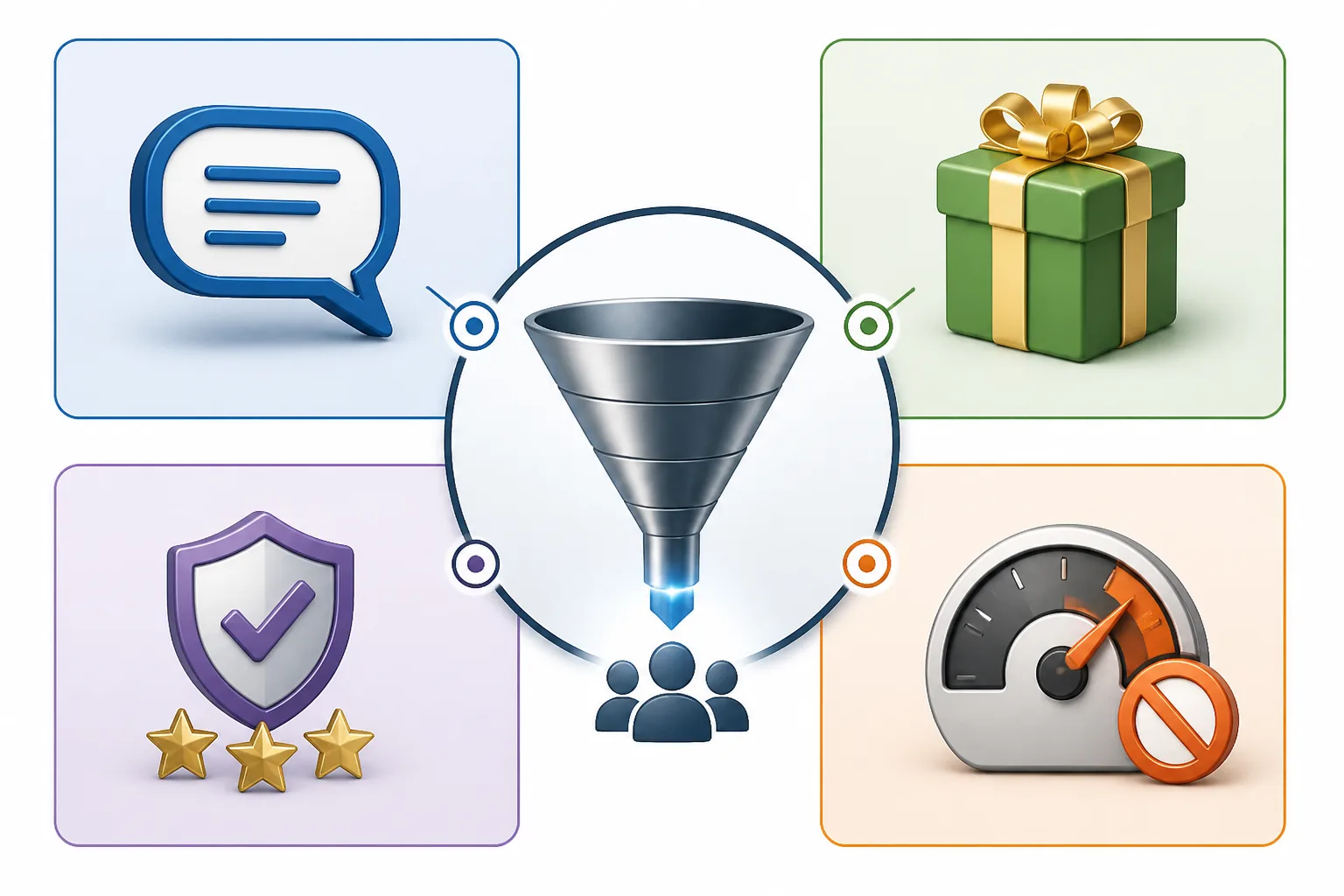
Across each stage, evaluate four things:
- Message: what you say and how well it matches the buyer’s current intent
- Offer: the next step you ask for, or what you give in exchange
- Proof: what reduces doubt and builds trust
- Friction: anything that makes the next step feel confusing, risky, slow, or unnecessary
The stages themselves are familiar. The practical value comes from using these four variables to find where performance is leaking.
The Practical Funnel Map
A simple definition of each stage
Here is the simplest way to think about the funnel.
Awareness: the person is deciding whether you are relevant enough to pay attention to.
Consideration: they are evaluating fit and comparing you with alternatives, including doing nothing.
Conversion: they are close enough to act that details now matter—price, risk, timing, effort, process, and reassurance.
Retention: the first conversion has happened, and now the question is whether the relationship continues through repeat purchases, renewals, referrals, or upsells.
What changes at each stage
The easiest way to understand funnel stages is to stop treating them as labels and start treating them as changes in buyer psychology.
| Stage | Message | Offer | Proof | Friction |
|---|---|---|---|---|
| Awareness | “This is relevant to you” | Low-commitment next step | Light trust signals | Remove confusion and mismatch |
| Consideration | “This is a strong fit” | Product page, case study, demo, consultation | Deeper evidence | Reduce uncertainty and comparison pain |
| Conversion | “You can act safely now” | Clear purchase or inquiry step | Risk-reducing proof | Remove checkout, form, or scheduling barriers |
| Retention | “You made the right choice; here’s what’s next” | Reorder, upgrade, referral, renewal | Experience-based trust | Remove onboarding and follow-up gaps |
A quick example helps.
Imagine a skincare brand selling acne treatment.
At awareness, the message might be: “Still getting breakouts even with a good routine?”
At consideration: “Why this formula helps reduce clogged pores without stripping your skin.”
At conversion: “Free shipping over $40, 30-day guarantee, and visible ingredient list.”
At retention: “Your bottle is likely running low—reorder now or switch to subscription.”
The product is the same. The buyer’s decision is not.
How to read the funnel as micro-decisions
A practical funnel is a chain of small decisions.
A prospect is not only deciding whether to buy. They are also deciding:
- Is this for me?
- Is this credible?
- Is this better than the alternatives?
- Is this worth the cost or effort?
- Do I trust what happens next?
- Should I do this now?
This model helps you diagnose leaks more accurately.
If people click but bounce, they may be answering “not relevant” or “not what I expected.”
If they browse but don’t engage further, they may be thinking “not clearly better” or “not convinced.”
If they add to cart but abandon checkout, they may be thinking “too risky” or “too much effort.”
If they buy once and disappear, they may be thinking “good enough once, but no reason to return.”
That is when funnel analysis becomes useful.
Stage 1: Awareness — Earn Attention From the Right People
What awareness means in practice
Awareness is often confused with reach or impressions.
Those metrics matter, but awareness is really about relevance. The question is not whether people saw your message. It’s whether the right people recognized themselves in it.
Someone in awareness is usually not ready to buy. They are deciding whether to care.
For a service business, that might mean a business owner seeing an ad about wasted Google Ads spend and thinking, “Yes, that’s my problem.”
For ecommerce, it might mean a shopper seeing content about recurring acne breakouts and thinking, “That sounds like me.”
What the message should do
At this stage, your message should do one thing quickly: connect to a real problem, desire, use case, or identity.
It should not try to explain your entire brand story. It should not ask for too much commitment. And it should not sound generic.
Compare these two service-business messages:
Before: “Award-winning digital solutions for ambitious brands.”
After: “Need more qualified leads from Google Ads without wasting budget? Our 7-day audit shows where spend is leaking.”
The first is broad and self-focused. The second matches a problem and suggests a clear next step.
For ecommerce, the same principle applies:
Before: “Premium skincare for modern lifestyles.”
After: “Breakouts that keep coming back? Start with a simple acne routine that targets clogged pores without over-drying.”
The stronger message is not more creative. It is more relevant.
What kind of offer works before trust exists
Before trust exists, the offer should usually be low commitment.
That can mean:
- Educational content
- A quiz
- A category page
- A short introductory video
- A free estimate prompt
- A lead magnet
- A product collection page instead of a hard checkout push
Why does that work? Because the buyer is still deciding whether to invest attention. A low-commitment offer asks for the next small step, not the final one.
A skincare brand may get better results from a “Find your acne routine” quiz than from “Buy now.”
A local PPC agency may do better with a short guide on common paid traffic leaks than with “Book a strategy call” for completely cold traffic.
What proof matters early
Proof at awareness should be light, fast, and easy to process.
Useful forms include:
- Review count snippets
- Client logos
- Press mentions
- Before-and-after thumbnails
- Clear positioning
- Social engagement signals
- A clear statement of who the solution is for
At this stage, proof does not need to answer every objection. It just needs to reduce the chance that the visitor dismisses you too early.
Common sources of friction in awareness
Awareness friction often appears before the visitor has even processed the offer.
Common examples:
- Poor audience targeting
- Vague positioning
- Ad-to-page mismatch
- Slow-loading pages
- Mobile-unfriendly layouts
- Headlines full of jargon
- Asking for too much too soon
If a cold visitor clicks an ad promising simple acne help and lands on a dense product page filled with ingredient jargon and no orientation, friction is already high.
How to tell if awareness is weak
A weak awareness stage usually shows up as poor early engagement.
Look for signals like:
- Low click-through rate on ads
- High bounce rate from cold traffic
- Low scroll depth
- Short time on page
- Low progression to product, category, or service-detail pages
- Weak match between audience and destination
If very few of the right people engage at all, start your diagnosis here.
Stage 2: Consideration — Help People Evaluate You Against Alternatives
What changes at this stage
Once someone moves into consideration, the question changes.
They are no longer asking, “Is this relevant?”
They are asking, “Why this option instead of another one?”
This is where many businesses underperform. They get attention, but fail to help the buyer evaluate fit.
How the message should shift
At consideration, your message should become more specific.
Instead of only naming the problem, explain:
- How the product or service works
- Who it is for
- What makes it different
- What outcome a buyer can reasonably expect
- Why it may be a better fit than alternatives
For the skincare brand, awareness content might talk about recurring breakouts. Consideration content should explain ingredient choice, skin-type fit, usage expectations, and differences from harsher acne products.
For the PPC agency, awareness may focus on wasted spend. Consideration should clarify process, audit method, reporting style, ideal client profile, and likely improvement areas.
Offers that work in consideration
Consideration-stage offers help a prospect evaluate without forcing a final commitment.
Examples include:
- Product detail pages
- Comparison guides
- Case studies
- Demos
- Consultations
- Sample work
- FAQ sections
- Pricing previews
- Email sequences that answer objections
The point is not just to move the buyer forward. It is to reduce uncertainty.
What proof reduces uncertainty here
Proof in consideration needs to be more detailed than proof in awareness.
Strong forms of proof include:
- Detailed testimonials with context
- Case studies with specific outcomes
- Before-and-after examples
- Product reviews with usage details
- Transparent process explanations
- Expert endorsements
- Side-by-side comparisons
- FAQs that handle realistic objections
Generic proof often fails here.
“Great service, highly recommend” does little for someone evaluating fit.
“Reduced wasted spend by 28% in 45 days after removing low-intent keywords and rebuilding two landing pages” is much more useful.
Common friction points in consideration
Consideration friction is often an information problem.
Common issues include:
- Unclear differentiation
- Weak or generic testimonials
- Missing pricing context
- Too many options
- Hard-to-find details
- No explanation of who the offer is best for
- Poor page structure
- Missing objection handling
For ecommerce, a shopper may read the page but still not know whether the product is meant for oily skin, sensitive skin, hormonal acne, or all of the above.
For services, a visitor may like the homepage but still not understand what happens after they book.
Signals that prospects are interested but not convinced
This stage leak often looks like interest without action.
Watch for patterns like:
- Healthy product page views but low add-to-cart
- Multiple service-page visits but few form starts
- Good email open rates but weak click-through
- Return visits without meaningful next-step actions
- Visitors spending time on pricing or FAQ pages but not converting
That usually means the audience is not wrong. They’re just not convinced yet.
Stage 3: Conversion — Make the Buying Decision Easy and Safe
What conversion really means
Conversion does not just mean a click.
It means the core transaction step for your business.
For ecommerce, that usually means a completed purchase.
For a service business, it may mean a qualified inquiry, a booked consultation, a paid audit, a signed proposal, or a deposit.
This matters because a campaign can produce cheap clicks and still fail if the buying step is weak.
How message and offer must become concrete
At conversion, your message needs to remove ambiguity.
The buyer wants to know:
- What exactly am I getting?
- What happens next?
- How much does it cost?
- How long will this take?
- What if it doesn’t work?
- Can I trust this process?
This is where vague messaging becomes expensive.
For ecommerce, the offer may need concrete details such as bundle savings, shipping thresholds, delivery windows, subscription terms, and guarantees.
For services, the offer may need a short booking form, a clear consultation promise, response-time expectations, and a simple explanation of what happens after inquiry.
Proof that removes last-minute hesitation
Conversion proof is not broad reputation proof. It is decision-point reassurance.
Useful examples include:
- Review excerpts near the CTA
- Return policy summaries
- Guarantees
- Secure checkout indicators
- Delivery clarity
- Warranty terms
- Client outcomes near form submission
- What happens after booking
- Response-time promises
Baymard Institute’s checkout research consistently shows that avoidable friction and uncertainty at checkout can hurt completion rates.[^1] In practice, buyers need reassurance close to the action, not buried elsewhere.
The biggest friction points before purchase or inquiry
Conversion friction is usually practical.
For ecommerce, common issues include:
- Hidden shipping costs
- Forced account creation
- Long checkout
- Weak mobile checkout
- Limited payment methods
- Distracting layouts
- Promo-code clutter
- Unclear return terms
For service businesses, common issues include:
- Long contact forms
- Unclear CTA labels
- Difficult scheduling
- Asking for too much detail too early
- No expectation-setting
- Slow follow-up after inquiry
A useful before-and-after example for ecommerce:
Before: Shipping cost revealed late, account creation required, return policy only in the footer.
After: Shipping estimate on product page, guest checkout enabled, return summary near add-to-cart, express payment options available.
For services:
Before: Contact form asks for budget, timeline, project scope, attachments, and phone number before trust is built.
After: Short qualification form with a clear promise: “Tell us your main goal and current spend. We’ll reply within one business day with next steps.”
How to diagnose a conversion leak
A conversion leak usually appears when intent is visible but completion is low.
Examples:
- Strong add-to-cart rate but weak checkout completion
- Many form starts but few submissions
- Good consultation bookings but low show rate
- Proposal views without signed closes
- Repeated objections around risk, cost, timing, or confusion
If people clearly want to move forward but stop at the transaction step, the leak is likely here.
Stage 4: Retention — Turn One Purchase Into More Revenue
Why the funnel does not end at checkout
A lot of beginner funnel advice stops at the sale.
That’s a mistake.
For many businesses, the economics improve dramatically on the second purchase, renewal, upsell, or referral. If retention is weak, acquisition can look less profitable than it really is.
A skincare brand may barely break even on the first order but become healthy on repeat orders. A service business may earn modestly on the first project but grow profit through ongoing work and referrals.
How the message changes after the first conversion
After conversion, the buyer’s mental state changes again.
They are no longer asking, “Should I trust you enough to buy?”
They are asking:
- Did I make the right choice?
- How do I get the best result?
- What should I do next?
- Is there a reason to continue?
So the message should shift from persuasion to value delivery, onboarding, reinforcement, and next-best action.
Retention offers
Retention offers should follow the natural next step.
For ecommerce, common examples include:
- Reorder reminders
- Subscription options
- Complementary products
- Bundles
- Loyalty rewards
- Win-back emails
For service businesses, common examples include:
- Ongoing maintenance plans
- Additional service lines
- Quarterly reviews
- Referral offers
- Repeat project prompts
- Reactivation campaigns
The key is timing and relevance.
A skincare brand should not send random upsells immediately after purchase. A better approach is to onboard first, then send a replenishment reminder around the time the product is likely running low.
Proof and trust after the sale
Post-purchase proof is based less on claims and more on experience.
Useful forms include:
- Onboarding milestones
- Product usage tips
- Visible support responsiveness
- Customer success updates
- Personalized recommendations
- Proof that similar customers got better outcomes with continued use
If the buying experience feels polished but support is slow and confusing, retention drops fast.
Sources of retention friction
Retention friction often hides in neglect.
Common examples:
- No onboarding
- Poor support access
- No follow-up
- Irrelevant email flows
- No reminder at reorder time
- Hard rebooking process
- No account visibility
- No natural next offer
The business may think the customer “just wasn’t loyal.” In reality, the next step may never have been made clear.
How to spot weak retention
Acquisition can look healthy while retention quietly underperforms.
Look for signals like:
- Decent first-order conversion but low repeat purchase rate
- Low subscription retention
- Weak customer lifetime value
- Poor email engagement after purchase
- One-time clients who do not rebook
- Low referral activity despite satisfied customers
If first purchases are happening but total customer value is disappointing, check retention before assuming you need more traffic.
A Simple Funnel Diagnosis Framework
How to use the framework
For each funnel stage, ask four questions:
- Message — Does what we say match what the buyer needs at this stage?
- Offer — Is the next step appropriate for the current level of trust and intent?
- Proof — Have we reduced the doubts most likely to stop movement?
- Friction — Have we made the next step feel easy, clear, and safe?
This framework stops random guessing.
If awareness is weak, the issue may be message mismatch.
If consideration is weak, the issue may be lack of proof.
If conversion is weak, friction may be doing more damage than the offer itself.
If retention is weak, the offer may be mistimed or the post-purchase message may be missing.
Questions to ask when performance drops
At awareness:
- Does the headline name a real problem or desire?
- Does the ad promise match the landing page?
- Is the audience qualified?
- Is the first screen immediately clear?
- Is the next step low commitment?
At consideration:
- Does the page explain why this is for me?
- Does it explain why this instead of alternatives?
- Is there enough detail on outcomes, process, ingredients, or fit?
- Are objections handled?
- Is proof specific or generic?
At conversion:
- Is the CTA obvious?
- Are costs and terms clear?
- Is the form or checkout too long?
- Is reassurance visible near the decision point?
- Are there mobile or technical barriers?
- Is follow-up speed acceptable?
At retention:
- Do customers get onboarding help?
- Is there a natural next offer?
- Are reminders timed to actual usage or service cycles?
- Is support easy to access?
- Do loyal customers get recognized?
Why traffic problems and conversion problems are often confused
Low sales can come from low traffic, but they can also come from weak progression inside the funnel.
This confusion is common because traffic metrics are easy to see. Funnel leaks require more interpretation.
For example, a store may say, “We need more traffic.” But if product page views are healthy and add-to-cart is weak, the problem is probably in consideration, not awareness.
A service business may say, “Our ads aren’t working.” But if the ads are bringing qualified visits and the inquiry form is long and confusing, the problem is conversion friction, not traffic volume.
That distinction matters because one fix scales performance. The other scales waste.
Example 1: Ecommerce Funnel Map From Ad Click to Repeat Order
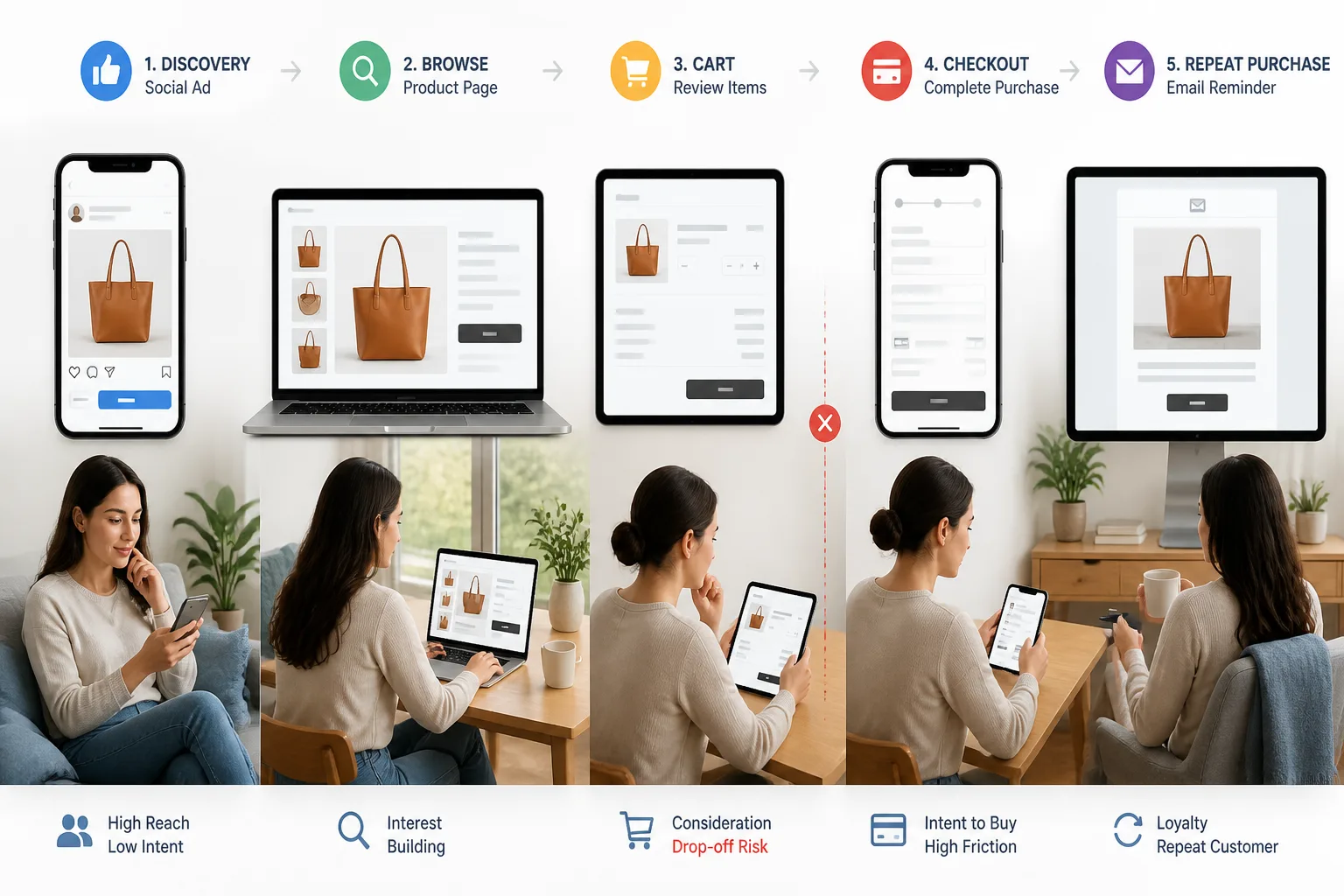
Let’s use a skincare brand selling an acne treatment serum.
Awareness example
The brand runs Instagram and Google ads targeting people searching or browsing around recurring breakouts.
A weak awareness message might say: “Premium botanical skincare.”
A stronger one might say: “Breakouts that keep coming back? Start with a simple acne routine for clogged pores and oily skin.”
That works better because it quickly tells the right person, “This may be for me.”
A suitable awareness offer could be:
- A category page for acne solutions
- A short quiz to match routine by skin type
- An educational landing page on common routine mistakes
If cold traffic lands directly on a product page with no context, awareness may collapse even if the product is good.
Consideration example
Now the shopper is evaluating.
The product page needs to do more than show the bottle and price. It should explain:
- What problem the serum is for
- Who it is best for
- Key ingredients and why they matter
- How to use it
- What to expect over time
- How it compares to harsher alternatives
- Whether it works with sensitive or oily skin
Strong proof might include:
- Reviews that mention real use cases
- Before-and-after photos
- Ingredient explanations
- FAQs on purging, irritation, and routine order
A common ecommerce leak happens here: traffic is fine, product page views are strong, but shoppers do not add to cart because they cannot judge fit confidently.
Conversion example
The shopper adds the serum to cart. Now the question becomes, “Do I feel safe finishing this purchase?”
Strong conversion support includes:
- Shipping cost visibility before checkout
- Delivery estimate
- Guest checkout
- Apple Pay or Shop Pay
- Return or guarantee summary
- Review snippets near add-to-cart
- Clear bundle or subscription explanation
A common leak: the shipping fee appears late, checkout requires account creation, and return terms are unclear. That combination can create abandonment even when product interest is high.[^1]
Retention example
The first order is complete, but the funnel is not.
A strong retention flow might look like this:
- Day 0: order confirmation and what happens next
- Day 3: how to use the serum correctly
- Day 10: realistic expectation-setting
- Day 25: complementary cleanser or moisturizer suggestion
- Day 35: reorder reminder or subscription offer
This works because the message follows the customer’s actual experience. It does not jump straight into selling again.
Where ecommerce brands commonly leak revenue
Ecommerce brands often leak revenue in three places:
Weak product-page consideration
- Not enough detail
- Generic reviews
- Poor fit explanation
Checkout friction
- Hidden costs
- Long checkout
- Weak mobile experience
- No guest checkout
No retention timing
- No replenishment reminder
- No useful post-purchase education
- No cross-sell tied to the first purchase
Example 2: Service Business Funnel Map From First Visit to Booked Client
Now let’s use a local PPC agency helping small businesses reduce wasted ad spend and generate more qualified leads.
Awareness example
Cold awareness traffic usually responds to specificity.
A weak message might say: “Full-service marketing solutions for growing companies.”
A stronger message might say: “Paying for Google Ads clicks that never become leads? We audit local campaigns to find wasted spend and missed conversion opportunities.”
The second version names the problem and implies the next step.
A low-friction awareness offer could be:
- A short audit guide
- A landing page explaining common paid traffic leaks
- A free estimate of wasted spend range
- A short video breaking down what usually goes wrong
Consideration example
Once the visitor is interested, they need to evaluate fit.
A strong consideration experience for the agency would include:
- A page explaining who the service is for
- A simple overview of the audit process
- A case study with context and result
- FAQ answers on timeline, budget, and expectations
- A pricing range or at least pricing context
- Examples of what gets reviewed
Specific proof matters here.
“Trusted by businesses nationwide” is weaker than “Reduced cost per qualified lead by 31% for a local home services company after fixing search term waste and rebuilding two landing pages.”
Conversion example
For a service business, conversion is often an inquiry or booked call, not just a page click.
This stage often fails because forms ask for too much too soon.
A weak process:
- Long contact form
- No timeline
- No explanation of what happens after submission
- Slow follow-up
A stronger process:
- Short form asking for business type, main goal, and current channel
- CTA that says what happens next
- Calendar booking or fast manual response
- Follow-up within one business day
If people reach the inquiry page but do not submit, the leak is often friction or lack of final reassurance.
Retention example
After the first engagement, the agency should not go quiet.
A stronger retention path could include:
- Clear onboarding
- First 30-day review
- Monthly reporting with interpretation
- Recommendations for next-stage improvements
- Expansion into landing page optimization or retargeting
- Referral prompts after clear wins
- Periodic check-ins for former clients
In services, retention is often less about automation and more about disciplined communication.
Where service businesses commonly lose qualified leads
Service businesses often lose leads in these areas:
Message too generic at the top
- Visitors cannot tell whether the service fits their problem
Weak proof in consideration
- No specific outcomes
- No process clarity
- No fit explanation
Too much friction at inquiry
- Long forms
- Unclear next steps
- Slow response
Poor follow-up after the initial project
- No nurture
- No repeat offer
- No referral system
The stage logic is the same as ecommerce, but the proof, friction, and conversion events differ.
How to Find Your Biggest Funnel Leak in 30 Minutes
Start with the business goal, not the channel
Do not begin with “How are our Facebook ads doing?” or “How is SEO performing?”
Start with the core business outcome.
For ecommerce, that might be completed purchases.
For services, it might be qualified booked consultations.
Channels are inputs. Funnel leaks show up in business outcomes.
Review each stage using a simple checklist
Here is a fast 30-minute audit workflow.
Minutes 1–5: Define the main conversion goal
- What is the primary conversion?
- What path should most people take to reach it?
Minutes 6–10: Map one main funnel path
- Ecommerce: ad → category page → product page → cart → checkout → post-purchase email
- Service: search/ad → service page → case study/FAQ → inquiry page → call booking → follow-up
Minutes 11–20: Review stage drop-offs
- Where do people stop moving forward?
- Is the drop-off mostly at awareness, consideration, conversion, or retention?
Minutes 21–25: Classify the leak
- Is this mainly a message problem?
- An offer problem?
- A proof problem?
- A friction problem?
Minutes 26–30: Pick one highest-impact fix
- What single change is most likely to improve movement at the leaking stage?
Identify the single highest-impact fix first
Do not try to fix everything at once.
If your product page gets attention but add-to-cart is weak, adding more ad channels is unlikely to help. Improve fit explanation, proof, or page clarity first.
If inquiry-page traffic is strong but submissions are low, shorten the form and improve next-step clarity before changing traffic sources.
The best first fix is usually the one at the tightest bottleneck, not the one that feels most exciting.
What to change before spending more on traffic
Before spending more on traffic, check whether one of these is clearly broken:
- Headline-to-page mismatch
- Weak product or service explanation
- Missing proof
- Hidden costs
- Difficult checkout
- Long inquiry forms
- No post-purchase or post-lead follow-up
More traffic into a broken path usually increases cost faster than revenue.
Common Funnel Mistakes Beginners Make
Using the same message at every stage
This is one of the most common mistakes.
The ad, landing page, product page, and checkout all repeat the same broad brand language, even though the buyer’s questions have changed.
A stage-aware funnel adjusts the message as intent deepens.
Pushing for conversion before enough trust exists
Cold traffic often gets sent straight to a hard sell.
That can work in some low-friction situations, but beginners often overdo it. If the buyer does not trust you yet, asking for full commitment too early creates resistance.
Adding offers without enough proof
Discounts, bundles, lead magnets, and upsells do not compensate for weak trust.
If the page still does not answer “Why should I believe this?” then extra offers often add noise.
Mistaking low traffic for a broken offer
Sometimes you do need more qualified traffic.
But many businesses assume this too early. If people are arriving and not progressing, the leak may be stage mismatch, weak proof, or friction inside the funnel.
Ignoring retention and repeat purchase value
This is especially costly.
A business may chase lower acquisition cost while leaving easy revenue on the table after the first sale. In many models, retention improvements lift profitability faster than top-of-funnel expansion.
From Funnel Map to Action Plan
How to turn your diagnosis into weekly priorities
A useful weekly rhythm is simple:
- Pick one funnel path
- Find the clearest drop-off
- Classify it by message, offer, proof, or friction
- Make one meaningful change
- Re-measure before changing something else
Examples:
- Rewrite ad and landing-page headlines to improve awareness relevance
- Add comparison content and stronger reviews to improve consideration
- Simplify checkout or shorten the inquiry form to improve conversion
- Add timed reorder emails or onboarding to improve retention
This is slower than random tinkering, but much more reliable.
What to measure at each stage
You do not need perfect attribution to improve a funnel. You do need stage-level visibility.
Awareness
- Reach
- Impressions
- CTR
- Bounce rate from cold traffic
- Scroll depth
- New visitor engagement
Consideration
- Product page views
- Service page depth
- Return visits
- FAQ or case study engagement
- Add-to-cart rate
- Email click-through rate
Conversion
- Checkout completion
- Form completion
- Booked calls
- Show rate
- Proposal acceptance
- Purchase completion rate
Retention
- Repeat purchase rate
- Reorder rate
- Renewal rate
- Upsell take rate
- Referral rate
- Customer lifetime value
Avoid forcing generic benchmarks onto your business. Relative drop-offs and trend changes are usually more useful.
When to improve the funnel before scaling traffic
Improve the funnel first when:
- Qualified traffic is arriving but not progressing
- Product or service pages are underperforming
- Checkout or inquiry friction is obvious
- Repeat purchase or follow-up is weak
- You cannot explain why conversion is low
Once the path is functioning and the main leaks are understood, then scaling awareness makes more sense.
That is also when managed acquisition support can be useful. If you are already seeing healthy movement through the funnel and need help increasing qualified traffic volume, a service like Traffics.io can make sense as part of the growth plan. It is far more effective when you are sending traffic into a path that already converts reasonably well.
Where tools or managed traffic services can support growth
Tools help with visibility. Services help with execution. Neither fixes a broken funnel on its own.
Use tools when you need:
- Better analytics visibility
- Heatmaps or session recordings
- Email automation
- A/B testing
- CRM follow-up discipline
Use outside traffic support when:
- Your core funnel path is clear
- Your stage bottlenecks are mostly known
- Your message and landing experience are aligned
- You are ready to buy more qualified attention without scaling waste
Conclusion
A funnel is not just a marketing diagram. It is a way to understand where the buyer’s next decision breaks down.
If you remember one thing, make it this: each stage changes the buyer’s psychology, so your message, offer, proof, and friction need to change too.
If very few qualified people engage, look at awareness.
If they engage but do not evaluate seriously, look at consideration.
If they evaluate but do not act, look at conversion.
If they buy once and disappear, look at retention.
Start with one funnel path. Find one clear leak. Classify it. Fix that before buying more traffic.
That is one of the most practical ways to turn online marketing fundamentals into action.
FAQ
What is an online marketing funnel in plain language?
An online marketing funnel is a simple way to map how someone moves from first discovering your business to buying and coming back again. In practice, it helps you see what a prospect needs at each stage so you can guide the next decision instead of treating every visitor the same.
What are the main sales funnel stages?
The main stages in this article are awareness, consideration, conversion, and retention. Awareness is when someone notices a problem or option. Consideration is when they compare alternatives. Conversion is when they decide to buy or inquire. Retention is what happens after the first purchase, including repeat orders, renewals, and referrals.
How do I know where my funnel is leaking?
Start by looking at where people stop moving forward. If few qualified people engage at all, the leak is often in awareness. If they browse but do not seriously evaluate, the issue is often consideration. If they show intent but do not complete the purchase or inquiry, check conversion. If they buy once and never return, the leak is usually retention.
What changes at each stage of the funnel?
Four things should change as people move through the funnel: message, offer, proof, and friction. Early on, your message should create relevance and your offer should be low commitment. In the middle, your message should show fit and your proof should reduce uncertainty. At conversion, the offer should be concrete and friction should be low. In retention, the focus shifts to value delivery, repeat purchase, and next steps.
What does awareness mean in practice?
Awareness means the person is deciding whether your message is relevant enough to pay attention to. They are not usually ready to buy yet. At this stage, your job is to connect quickly to a real problem, desire, or use case and make the next step feel easy.
What kind of offer works best before trust exists?
Low-commitment offers usually work best before trust exists. That can include educational content, a quiz, a category page, a free estimate prompt, an introductory video, or a lead magnet. The goal is not to force a sale too early but to earn the next small step.
How do you distinguish a traffic problem from a conversion problem?
A traffic problem means not enough of the right people are reaching your funnel. A conversion problem means people are reaching it but not moving forward. If traffic is decent but product pages, forms, or checkout steps underperform, the problem is usually inside the funnel rather than at the top.
What proof matters most in the consideration stage?
In the consideration stage, proof should reduce uncertainty and help the prospect compare you with alternatives. Useful proof includes case studies, detailed testimonials, before-and-after examples, product reviews, clear process explanations, pricing context, and FAQs that answer common objections.
What does conversion mean for ecommerce versus service businesses?
For ecommerce, conversion usually means a completed purchase. For a service business, it may mean a qualified inquiry, a booked consultation, a paid audit, or a signed proposal, depending on the sales process. The important point is to define conversion based on the real business outcome, not just a click.
Why does the funnel not end after the first purchase?
Because the first purchase often does not represent the full value of a customer. Many businesses become more profitable when they improve repeat purchase rate, renewals, upsells, referrals, or reactivation. If retention is weak, acquisition can look less effective than it actually is.
What are common funnel mistakes beginners make?
Common mistakes include using the same message at every stage, pushing for conversion before trust exists, adding offers without enough proof, assuming low traffic is always the main problem, and ignoring retention after the first sale or lead.
What should I fix before spending more on traffic?
Fix the tightest bottleneck first. If your landing pages, product pages, forms, or checkout experience are weak, more traffic usually scales waste. Improve the stage where qualified prospects are dropping off most clearly, then re-measure before increasing ad spend.
[^1]: Baymard Institute, checkout usability research: https://baymard.com/research/checkout-usability