How to Define Your Target Audience Without Guesswork: Jobs-to-Be-Done + Message Testing
If you have tried to define your target audience and ended up with labels like “small business owners” or “busy professionals,” you have already run into the real problem. Those descriptions may look fine in a strategy document, but they do not tell you what message to lead with, which pain point matters most, or why someone would act now.
That is why so many audience exercises fail to improve campaigns. The issue is rarely a lack of data. Most teams already have sales notes, customer calls, reviews, CRM comments, and internal opinions. What they lack is a method they can actually use to make decisions.
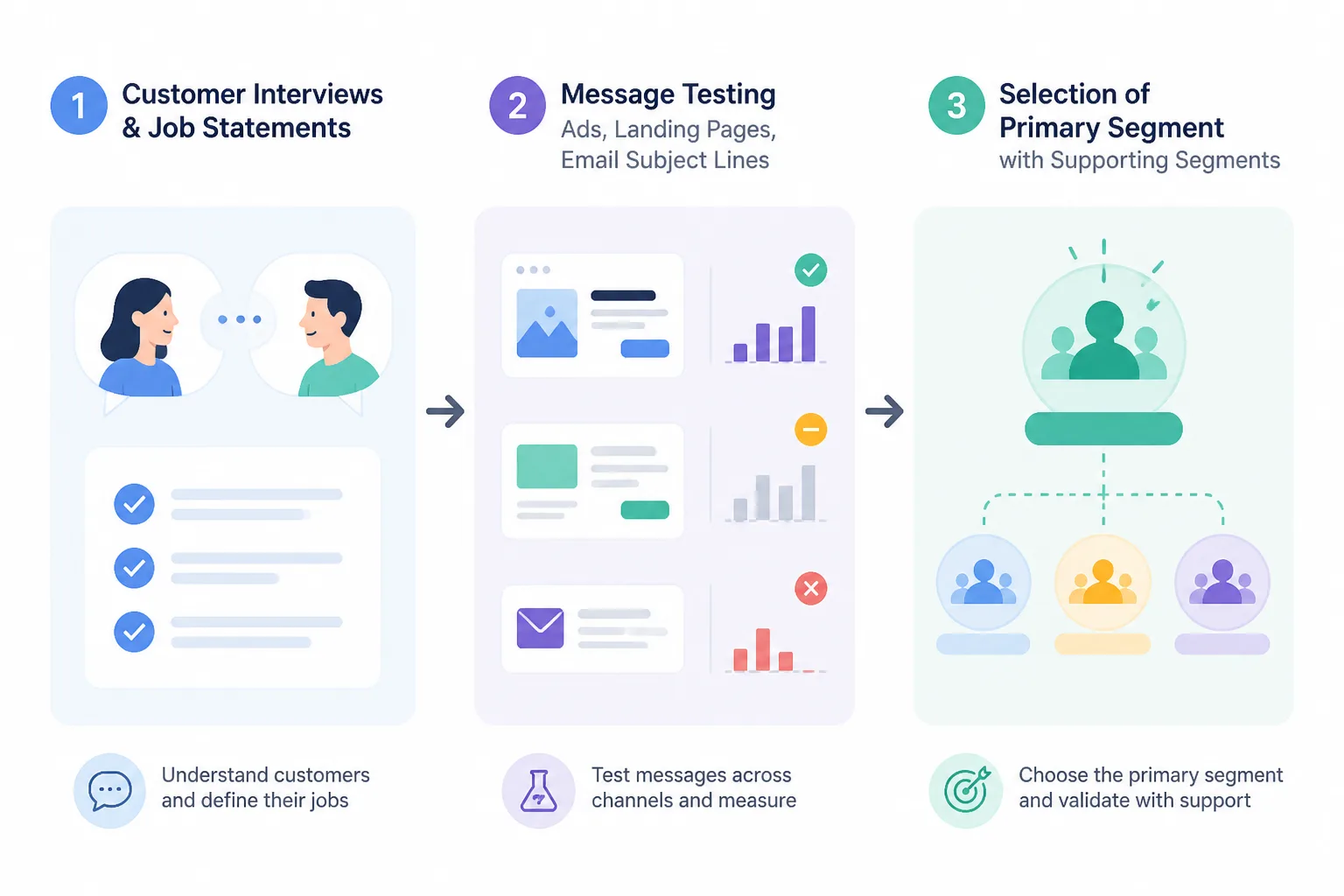
This article gives you one. It is a simple two-step process: first, define your audience through customer jobs rather than vague traits; second, validate those jobs with fast message testing before you commit to positioning, content, or ad spend. Jobs-to-Be-Done has been shaped through the work of Clayton Christensen, Bob Moesta, and Alan Klement as a way to understand what progress customers are trying to make in context.[^1][^2]
By the end, you will have a practical system: a short list of customer job statements, a message test plan, and a way to choose one primary segment without ignoring the rest.
How to define your target audience without guesswork
Why most audience profiles fail
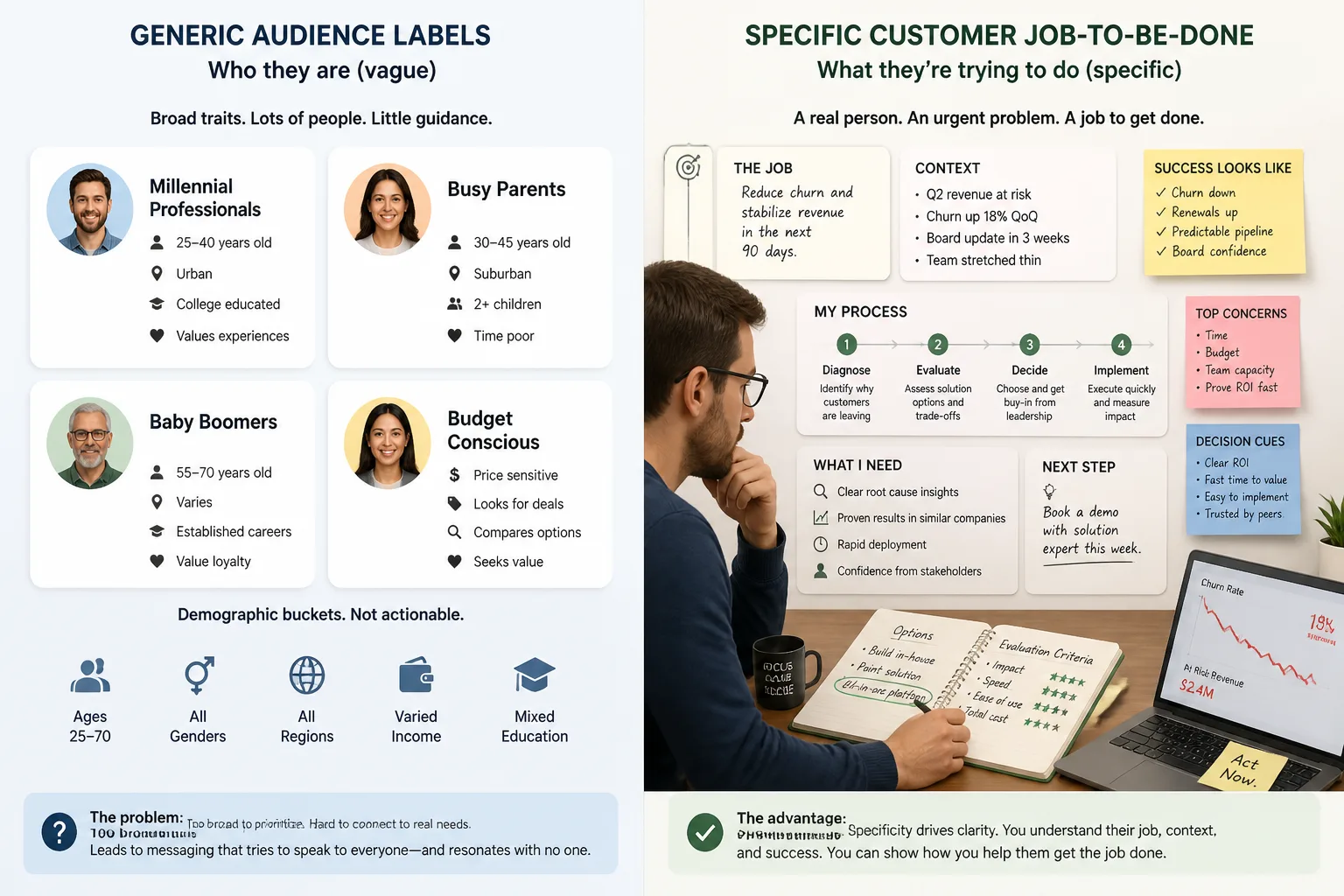
Most audience profiles describe people, not decisions.
They tell you who someone is: age, role, company size, industry, income, maybe a few interests. That can help with media targeting or market sizing. But it usually does not explain why someone starts searching, what feels urgent, or what message will make them respond.
For example, “marketing managers at SaaS companies” is a valid segment label. But it does not tell you whether those managers care most about reducing wasted ad spend, clarifying homepage messaging, or proving campaign ROI before a budget review.
Those are different problems, and they require different messages.
That is the weakness of many persona exercises. They create profiles that feel complete but do not help with positioning or messaging.
The real goal: understand what people are trying to get done
A target audience becomes useful when it helps you answer three practical questions:
- What progress is this person trying to make?
- What made that progress urgent?
- What message is most likely to resonate right now?
That is a better standard than simply asking, “Can we describe this person?”
Instead of starting with “Who is our customer?”, start with this:
What was happening when they began looking for a solution?
That question gets you closer to behavior, motivation, urgency, and buying context.
What you should have by the end
By the end of this process, you should have:
- 3 to 5 candidate customer job statements
- 2 to 3 message angles for each job
- A lightweight test plan using ads, landing pages, or email
- A scorecard to choose one primary segment based on evidence
That is enough to move from internal opinion to an audience strategy you can use.
A better model: define audiences by jobs, not traits
What Jobs-to-Be-Done means in plain language
Jobs-to-Be-Done, often shortened to JTBD, is built on a simple idea: customers “hire” a product or service to make progress in a specific situation.[^1]
In plain language, a customer job is the progress someone wants to make when something changes and their current approach no longer feels good enough.
A founder does not buy homepage copy because they fit a demographic. They buy because signups are inconsistent, investors are asking questions, and they need visitors to understand the product faster.
A service business owner does not buy lead generation help just because they are a “small business owner.” They buy because lead flow has become unpredictable and they want a lower-risk way to test offers before spending more on promotion.
The job is the progress they want to make.
The difference between traits, segments, and customer jobs
These ideas are related, but they are not the same.
Demographics or firmographics describe traits.
Examples: age, job title, company size, industry, revenue.Segments group people with similar characteristics or contexts.
Examples: early-stage SaaS founders, local service businesses, in-house ecommerce teams.Customer jobs explain the progress someone wants to make in a specific situation.
Example: “When paid acquisition costs rise and creative performance becomes inconsistent, ecommerce teams need a faster way to test message angles before scaling spend.”
You may still use demographics and firmographics for channel targeting. But if you want stronger positioning and messaging, jobs are usually more useful than traits alone.
Why different customers can hire the same solution
Two customers can look very different on paper and still hire the same solution for the same reason.
A solo consultant and an ecommerce marketing manager might share this job:
“We need a faster way to test landing page messaging before spending heavily on ads.”
Their industries, budgets, and day-to-day work are different. But the progress they want is similar enough that the same core message might work for both.
This matters because many teams split audiences too early based on surface traits. They assume different roles or company types always need different positioning. Sometimes that is true. Sometimes it is not.
The job helps you tell the difference.
When JTBD works well and where it does not
JTBD works especially well when buying behavior is shaped by:
- a recent trigger
- a frustrating gap in current options
- a clear desired outcome
- meaningful tradeoffs or risk
That is common in SaaS, services, consulting, ecommerce tools, and many B2B buying situations.
But JTBD is not a complete replacement for every other segmentation method.
Used too narrowly, it can underweight:
- budget constraints
- procurement complexity
- brand preference
- category awareness
- stakeholder politics
- regulatory requirements
- identity-driven purchases
For example, in enterprise buying, the same customer job may exist across multiple companies, but procurement, security review, and implementation complexity can change who is actually viable to target. In those cases, jobs explain demand, while firmographics and buying-process data help with execution.
Use JTBD to understand motivation. Use other inputs to understand reachability and sales reality.
Step 1: Write customer job statements
Start with moments of struggle
When you define your audience, start with struggle moments.
Do not begin with categories like founders, agencies, or local businesses. Begin with the moment something stopped working.
Examples:
- lead flow became unpredictable
- cost per acquisition jumped
- the homepage stopped converting
- the sales team kept hearing the same objection
- an upcoming budget review increased pressure to show results
These moments matter because they reveal demand in context.
If someone says, “We work with small business owners,” that is too broad to guide action.
If they say, “We help service businesses whose referrals have slowed down and who need to test lead-gen offers before investing more in ads,” that is far more useful.
The anatomy of a strong job statement
A strong customer job statement usually includes five elements:
A specific situation or trigger
What changed?The progress the customer wants to make
What are they trying to improve?A clear desired outcome
What result are they aiming for?A friction, cost, or risk
What are they trying to avoid?Language that sounds real
Does it sound like something an actual buyer would say?
Without those elements, job statements tend to become vague or product-centered.
A simple formula you can use
Use this formula:
When [trigger/situation], I want to [make progress], so I can [desired outcome] without [main friction, cost, or risk].
A shorter version also works:
When X happens, people need to Y so they can Z.
The longer version is better for message testing because it captures both motivation and resistance.
Examples: weak descriptions vs strong job statements
Weak: Our target audience is small business owners who need marketing help.
Strong: When lead volume becomes unpredictable, service business owners need a simple way to test which offer and message will generate qualified inquiries so they can invest in promotion with less risk.
Weak: Busy startup founders.
Strong: When a founder has early traction but inconsistent signups, they need to identify which customer problem to lead with on the homepage so more qualified visitors understand the product quickly.
Weak: Ecommerce brands that need better ads.
Strong: When paid social performance becomes unstable, ecommerce teams need a way to test creative and message angles before scaling budget so they can reduce waste and defend spend decisions internally.
The stronger versions tell you what message to write. The weaker ones do not.
Capture functional, emotional, and situational context
Good audience definitions are not purely functional.
A buyer may want to reduce wasted spend. That is the functional layer. They may also want to feel more confident before presenting results to a boss or client. That is the emotional layer. And they may need an answer before next week’s budget review. That is the situational layer.
You do not need to force all three into every sentence, but you should look for them in your research.
For example:
When acquisition costs rise before the monthly budget review, a growth manager needs clearer message-testing data so they can reallocate spend confidently without defending weak assumptions.
That statement includes:
- functional: get clearer message-testing data
- emotional: feel confident
- situational: before the monthly budget review
That extra context sharpens messaging.
A practical framework for generating job statements
The Trigger–Struggle–Desired Outcome framework
A simple way to write job statements is the Trigger–Struggle–Desired Outcome framework.
- Trigger: What happened that pushed the customer to act?
- Struggle: What became frustrating, risky, slow, or inadequate?
- Desired Outcome: What progress do they want to make now?
Here is an example from a service business:
- Trigger: referrals slowed down for two straight months
- Struggle: the owner does not know which offer to promote and does not want to waste money on random ads
- Desired Outcome: test a message that can generate qualified leads with lower risk
That becomes:
When referrals slow down and lead flow becomes inconsistent, service business owners need a low-risk way to test offers and messaging so they can generate qualified leads without wasting budget.
This framework works because it connects customer language to buyer timing.
Questions to ask in research
You do not need a formal research project to do this well.
Look at customer interviews, sales calls, reviews, onboarding notes, support tickets, CRM comments, churn notes, and open-text survey responses. Then ask questions that focus on chronology and context.
Useful prompts include:
- What was happening when you started looking for a solution?
- What had changed?
- What had you already tried?
- What was frustrating about the current approach?
- What were you hoping would improve?
- What nearly stopped you from buying?
- What alternatives did you consider?
- What would success have looked like in the first 30 days?
These questions align with established JTBD interview practice, which often explores pushes, pulls, anxieties, and habits in the buying process.[^2][^3]
How to cluster patterns without overcomplicating it
Do not overbuild this.
A spreadsheet is enough.
Create columns like these:
- Source
- Trigger
- Struggle
- Desired outcome
- Emotional cue
- Current workaround
- Exact quote
- Draft job statement
Then review your notes and highlight repeated patterns.
Cluster by recurring triggers, frustrations, and desired outcomes first. Do not group by demographics unless those traits clearly change the buying context.
For example, if you keep seeing:
- “traffic is coming in but not converting”
- “we do not know what value prop to lead with”
- “we need to test messaging before redesigning the page”
those belong together even if one quote came from a founder and another came from a marketing manager.
How many job statements you need at first
Usually, 3 to 5 candidate job statements are enough.
More than that often creates confusion instead of clarity. Early on, you want usable hypotheses, not a full taxonomy of every possible buyer.
If you cannot narrow your research into 3 to 5 candidate jobs, you probably still have raw data rather than audience clarity.
Step 2: Validate each job with fast message testing

Why message testing comes before bigger decisions
A job statement is still a hypothesis until the market responds to it.
That is why message testing should come before bigger decisions like rewriting your homepage, rebuilding campaigns, or narrowing your positioning.
Many audience ideas sound persuasive internally. Fewer hold up with real traffic.
Message testing helps you find out which audience-job-message combination creates actual response, not just internal agreement.
What to test first
At this stage, test the message angle first.
The most useful variables are:
- Headline: what problem or outcome you lead with
- Promise: what progress you claim to help create
- Pain framing: what frustration or risk you name
- Use case framing: what situation you anchor the message in
- CTA language: what next step you ask for
Keep the offer, design, layout, and targeting as stable as possible. Otherwise, you will not know whether the audience or the message caused the result.
Three fast testing methods
Ads
Paid ads are useful for quick directional signal.
They help answer: does this pain point or promise earn attention from the audience we think we want?
Good signals include relative click-through rate, cost per click, and comments or replies where available. Google Ads and Meta both support controlled experimentation workflows for creative variants.[^4][^5]
But ads alone can mislead. Curiosity clicks are common. A dramatic promise may raise CTR while attracting the wrong people.
Use ads for early signal, not final proof.
If you need clean paid traffic to run lightweight message experiments, you can use your existing ad platforms or a service such as Traffics.io if you want help getting traffic to tests. The goal is not scale yet. The goal is learning.
Landing pages
Landing pages are better for depth.
They answer: after the click, does this audience-job-message combination hold interest and motivate action?
Useful signals include:
- signup or demo conversion rate
- scroll depth
- time on page
- bounce behavior
- form completion
- on-page feedback or chat comments
A landing page test is often the best second step after ads because it shows whether interest survives contact with your actual promise.
Email subject lines
If you already have a relevant email list or community, subject line tests can be a fast, low-cost option.
They are useful for early directional feedback, especially when you want to compare pain framing or use-case language.
But they have limits. Opens are less reliable than they used to be because of privacy and deliverability changes. Clicks, replies, and downstream actions are usually more trustworthy than opens alone.[^6]
What a fair test looks like
A fair test isolates the main variable.
If you are testing audience-message fit:
- keep the offer the same
- keep the CTA the same
- keep page design similar
- keep targeting rules similar
- keep timing reasonably comparable
- test one main angle at a time
For example, if you want to compare three job statements, create three headline variants on similar landing pages with the same form, proof block, CTA, and traffic source.
Then you can actually interpret the results.
How to avoid false positives
False positives happen when a test looks strong but is telling you the wrong thing.
Common causes include:
- curiosity clicks from sensational copy
- vague “get better results” messaging
- discount framing that attracts low-fit traffic
- broad targeting that inflates click volume
- changing too many variables at once
A high CTR with low landing page conversion usually means the message created interest, but not relevant interest.
False negatives happen too.
Common causes include:
- low-quality traffic
- too little budget
- low sample size
- weak page experience
- poor channel fit
- slow page load
- targeting mismatch
If every variant performs badly, do not immediately assume all job statements failed. Sometimes the traffic is weak, the offer is unclear, or the test setup is flawed.
How to read results without overreacting
What success looks like at this stage
Success here is not perfect certainty.
It is directional evidence that one audience-job-message combination resonates more than the others.
That means you are looking for:
- stronger relative engagement
- better downstream behavior
- clearer qualitative reinforcement
- repeated customer language that matches the winning angle
Do not wait for absolute certainty before making a practical decision.
Quantitative signals to watch
The exact metric depends on the test type, but these are usually useful:
- click-through rate
- cost per click
- landing page conversion rate
- cost per lead
- email click rate
- reply rate
- relative performance differences between variants
Avoid chasing generic benchmark numbers. Benchmarks vary too much by channel, offer, and audience to help much here.
Compare variants against each other under similar conditions. That is what matters.
Qualitative signals matter too
Some of the best audience evidence is qualitative.
Watch for:
- prospects repeating your phrasing back to you
- replies that mention the same pain point
- objections that cluster around one concern
- comments that show immediate relevance
- sales calls where one message angle leads to easier conversations
- demo questions that reveal stronger buying intent
If one variant gets moderate numerical performance but produces clearer, more relevant replies, that can be more valuable than a curiosity-driven winner.
How to tell weak traffic from weak messaging
Here is a practical rule.
Weak traffic usually looks like this:
- all variants underperform
- session quality is shallow across the board
- targeting feels broad or mismatched
- search terms or placements look irrelevant
- few visitors fit the intended use case
Weak messaging usually looks like this:
- traffic quality seems reasonable
- one message gets clicks but people leave quickly
- visitors do not understand the offer
- questions reveal confusion, not disinterest
- adjacent message angles perform much better
If the right people are arriving but not connecting with the framing, fix the message first.
If nobody relevant is arriving, fix traffic quality first.
When to iterate the message vs change the segment
Iterate the message when:
- the segment shows interest in the problem
- related variants perform unevenly
- customer calls confirm the pain but not your phrasing
- the offer fits, but the wording feels abstract or generic
Reconsider the segment when:
- multiple message angles fail with the same group
- adjacent segments show stronger traction
- the pain appears weak or infrequent
- conversion intent stays low even when relevance seems clear
A good testing mindset looks for disconfirmation, not comfort. Build tests that could prove your favorite segment wrong.
What to do when segments overlap
Why overlap is normal
Overlap is common, especially in B2B, SaaS, and services.
Different roles, industries, or company types often share the same underlying job. What changes is the vocabulary, buying process, or proof they need.
That is normal.
How to identify the shared job
Look beneath the persona and ask:
- What changed for them?
- What progress do they want?
- What risk are they trying to reduce?
- What would success look like?
For example, an agency and an in-house ecommerce team may both want to:
test creative angles before scaling ad spend
That is the shared job.
But the emotional layer may differ:
- The agency wants proof it can show clients.
- The in-house team wants confidence before reporting internally.
So the core job may be the same even if the examples and proof should differ.
When to merge and when to separate
Merge segments when the same core message works across them.
Separate them when context materially changes:
- the buying trigger
- the proof they need
- the budget reality
- the buying process
- the language they respond to
- the offer they are likely to choose
For example, startups and mid-market firms may share a homepage-clarity job, but if the mid-market version requires internal approvals and stakeholder buy-in, it may deserve a separate campaign path.
A simple decision rule
Use this rule:
If the answer is yes to all three, merge for now.
- Same job?
- Same buying context?
- Same message response?
If the job is the same but the context or response differs meaningfully, keep them separate in execution.
How to choose one primary segment without losing the rest
The Primary Segment Scorecard
Once you have candidate segments, you need a way to choose.
Use a Primary Segment Scorecard.
Score each segment from 1 to 5 on these dimensions:
Pain intensity
How urgent and costly is the problem?Reachability
Can you reliably reach them through ads, search, communities, partnerships, email, or outbound?Conversion potential
Are they likely to take the next step in your business model?Strategic fit
Does the segment align with your product strengths, pricing, delivery model, and roadmap?
You can add more factors if needed, such as retention potential or willingness to pay. But these four are enough for most teams.
Example scorecard
Here is a simple example for a messaging consultancy.
| Segment | Pain Intensity | Reachability | Conversion Potential | Strategic Fit | Total |
|---|---|---|---|---|---|
| Service businesses with unstable lead flow | 5 | 4 | 4 | 5 | 18 |
| Early-stage founders with homepage clarity issues | 4 | 3 | 3 | 4 | 14 |
| Ecommerce teams testing creative angles | 4 | 4 | 2 | 3 | 13 |
This kind of scoring reduces politics.
A segment may be interesting, but if you cannot reach it or close it well, it should not become the primary focus yet.
Why primary does not mean exclusive
Choosing a primary segment does not mean rejecting everyone else.
It means choosing one segment to anchor:
- homepage messaging
- lead offer framing
- campaign creative
- proof selection
- sales narrative
- content priorities
Adjacent segments can still be served. They just should not shape the core message first.
Broad positioning often feels safer internally, but it usually weakens conversion.
How to build one core message and adapt it
Start with one messaging spine for the primary segment:
- the core job
- the key pain
- the main promise
- the strongest proof
Then adapt selectively for adjacent groups.
Usually you only need to change:
- examples
- terminology
- proof points
- objections addressed
- CTA framing
You do not need a new positioning system for every neighboring segment.
A worked example: from vague idea to validated segment
Starting point: “small business owners”
Imagine a company that helps businesses test offers and landing page messaging before scaling paid acquisition.
Their initial audience definition is:
small business owners
That is too broad. It includes too many triggers, budgets, and buying contexts.
Turning research into three job statements
They review:
- 6 sales calls
- 10 customer onboarding notes
- 15 support and chat conversations
- 20 reviews and survey responses
Three patterns emerge.
Job 1: Lead stability
When referrals and inbound leads become unpredictable, service business owners need a low-risk way to test offers and messaging so they can generate more qualified inquiries without wasting ad budget.
Job 2: Homepage clarity
When founders are getting traffic but inconsistent signups, they need to identify which problem-solution message belongs on the homepage so qualified visitors understand the product faster.
Job 3: Ad spend efficiency
When paid campaigns become volatile, ecommerce teams need to test creative and message angles quickly so they can reduce wasted spend before scaling budget.
That is already much more useful than “small business owners.”
Running a simple message test
Now they turn each job into a headline:
- Variant A: Find the message that brings in more qualified leads
- Variant B: Clarify what customers need before you rewrite your homepage
- Variant C: Test offers before you waste more ad spend
They create three simple landing pages with:
- the same layout
- the same CTA
- the same form length
- similar proof blocks
- the same traffic source
Then they run a small paid test over several days.
A realistic outcome might look like this:
| Variant | CTR | Landing Page Conversion Rate | Qualitative Signal |
|---|---|---|---|
| A: Qualified leads | Moderate | Highest | Strong replies from service businesses describing unstable lead flow |
| B: Homepage clarity | Highest | Low | Many clicks, but weaker form completion and more curiosity behavior |
| C: Waste less ad spend | Moderate | Moderate | Good relevance from ecommerce teams, but lower sales readiness |
This is common. The most clicked message is not always the best segment.
Choosing the primary segment
If they combine test results with the scorecard, they may conclude:
- Service businesses with unstable lead flow should be the primary segment.
- The pain is intense.
- The message drives conversion, not just clicks.
- The segment is reachable.
- The offer fits their service model.
The founder-homepage segment may still be interesting, but it might need a different offer or more education before conversion. The ecommerce segment may be viable later, but if budgets are lower-fit or sales cycles are harder, it should not lead positioning today.
That is what evidence-based audience definition looks like.
Common mistakes that bring guesswork back
Confusing audience size with audience fit
A broader audience often feels safer because it seems to preserve more opportunity.
In practice, broad segments usually dilute message strength.
“Small business owners” is larger than “service business owners with unstable lead flow who want to test offers before buying more ads.” But the second segment is much more actionable.
Specificity usually beats theoretical reach.
Writing jobs as product features
This is a common mistake.
Bad job statement:
Customers need AI-powered analytics dashboards.
That is not a job. It is a proposed solution.
Better:
When campaign results become hard to explain, marketing teams need clearer performance evidence so they can make budget decisions with less guesswork.
The job should describe customer progress, not your feature list.
Testing too many variables at once
If you change the headline, CTA, page design, offer, audience targeting, and pricing at the same time, you are not running a useful test.
You are creating noise.
Change one main dimension at a time. Otherwise, you get debate instead of learning.
Choosing a segment based on opinion
Many teams say they want evidence, then choose based on:
- founder preference
- the loudest sales anecdote
- the largest TAM slide
- one memorable customer
- internal prestige
That defeats the process.
Use a simple rule: a segment should become primary only when it shows strength across three evidence layers:
- observed customer language
- behavioral response in tests
- business fit on the scorecard
Stopping after one test

One weak test is not final truth.
Sometimes the segment is wrong. Sometimes the wording is wrong. Sometimes the channel is wrong. Sometimes the traffic is poor.
Do not stop at the first ambiguous result. Clean up the test and run another round.
A 7-day workflow to define and validate your target audience
Day 1–2: collect customer language
Gather material from:
- customer interviews
- sales calls
- onboarding notes
- support tickets
- reviews
- CRM notes
- churn feedback
- survey comments
Pull out exact phrases related to triggers, frustrations, outcomes, objections, and alternatives tried.
Aim for 5 to 10 meaningful sources if you are moving quickly.
Day 3: draft job statements
Use the Trigger–Struggle–Desired Outcome framework to write 3 to 5 candidate job statements.
Do not polish too early. Make them clear enough to test.
A useful worksheet format is:
- source quote
- trigger
- struggle
- desired outcome
- emotional tension
- draft job statement
Day 4: choose test angles
Turn each job statement into:
- one headline
- one promise
- one supporting proof point
- one CTA
Keep the rest of the page or ad structure stable.
Day 5–6: run message tests
Choose one or more of these:
- paid ads for fast directional relevance
- simple landing pages for deeper validation
- email subject line tests if you have a list
Keep variables controlled. You are trying to compare messages, not redesign the business in public.
Day 7: review results and pick a primary segment
Review both the numbers and the language.
Ask:
- Which variant drew the most relevant engagement?
- Which one converted best?
- Which one produced the clearest qualitative signal?
- Which segment scores highest on pain, reachability, conversion potential, and strategic fit?
Then choose one primary segment and define your next test.
Final takeaway: clarity comes from evidence, not personas alone
If you want to define your target audience without guesswork, remember the two-step method:
Define by jobs
Write customer job statements based on trigger, struggle, and desired outcome.Validate through message testing
Test message angles before making major positioning decisions.
That is the shift that makes audience work useful. Not more personas. Not more internal debate. Better evidence.
If one message clearly wins, build around it. Update your homepage, campaigns, and sales narrative for that primary segment. Then run a second round of tests on proof points, offer framing, or CTA language.
If results are mixed, do not abandon the method. Refine the job statement. Check traffic quality. Separate overlapping contexts if needed. Then rerun a cleaner test.
Audience clarity is rarely a single insight. More often, it is the result of repeated evidence.
FAQ
How do I define a target audience without guessing?
Start with customer evidence instead of internal assumptions. Look for the moments when buyers began searching for a solution, write 3 to 5 job statements around those situations, then validate each one with fast message tests such as ads, landing pages, or email subject lines.
What is the Jobs-to-Be-Done approach in audience research?
Jobs-to-Be-Done is a way to understand what progress customers are trying to make in a specific situation. Instead of focusing only on who they are, it focuses on what triggered the search, what struggle they faced, and what outcome they wanted.
How is a customer job different from demographics or personas?
Demographics describe traits like age, role, or company size. Personas package those traits into profiles. A customer job explains why someone takes action in a specific context. That makes it more useful for positioning, messaging, and campaign decisions.
How do I write a useful customer job statement?
Use a formula like: When [trigger], I want to [make progress], so I can [desired outcome] without [friction or risk]. A strong job statement includes the situation, the progress the customer wants, and the barrier they want to avoid.
What should I test first when validating a target audience?
Test the message angle before larger positioning changes. Start with headline, promise, pain framing, use-case framing, and CTA language. Keep the design, offer, and targeting as stable as possible so you can see which message resonates.
What are the fastest ways to test audience-message fit?
The fastest options are paid ads, simple landing pages, and email subject line tests if you already have a list. Ads are good for quick relevance signals, landing pages help validate deeper interest, and email can provide low-cost directional feedback from an existing audience.
What should I do if multiple audience segments seem valid?
Check whether they share the same underlying job, buying context, and message response. If all three are similar, you can often merge them into one practical segment. If the job is similar but the context or messaging needs differ, keep them separate in execution.
How do I choose one primary segment without losing the rest?
Use a scorecard. Rate each segment on pain intensity, reachability, conversion potential, and strategic fit. Choose one primary segment for your core message, then adapt proof points, examples, and terminology for adjacent segments later.
How many job statements do I need before I start testing?
In most cases, 3 to 5 candidate job statements are enough. That gives you enough variety to compare real options without turning the process into a large research project.
When does Jobs-to-Be-Done need support from other segmentation methods?
JTBD is useful for understanding buyer motivation, but it should be supplemented when budget, procurement, regulation, brand preference, or firmographic differences strongly affect how people buy. In those cases, jobs explain demand, while other segmentation methods help with targeting and sales execution.