Growth Engine by Traffics.io: An Autopilot Content Site Network for SEO
Most business owners understand the problem: they need more visibility in search, more consistent content, and more ways for potential customers to find them before they are ready to buy. What they often lack is the time, team, or operating structure to run a serious publishing system across multiple channels.
That is where Growth Engine by Traffics.io comes in. Rather than asking a business to build an in-house content operation, it creates a managed network of content sites designed to reach different audiences, address different search intents, and send relevant traffic back to the main website.
The key idea is that this is not just “more blogging.” It is better thought of as acquisition infrastructure. The value comes from combining intent-focused content sites, contextual paths back to the main business, social distribution support, and centralized lead handling. When those pieces are aligned, a business can expand discoverability without taking on the daily burden of managing the system itself.
What Growth Engine actually is
A network of intent-focused content sites, not just a single blog
In simple terms, Growth Engine is a managed content site network from Traffics.io. It creates multiple supporting websites, each built around a specific topic, audience segment, or search intent. Those sites publish content that stands on its own while also creating natural opportunities to connect readers with the main business website.
That distinction matters.
A standard company blog usually has to do everything under one domain and one brand voice. It tries to educate beginners, answer comparison searches, speak to different customer types, and stay tied to the core offer. In practice, that often leads to broad, uneven content that is harder to target well.
Growth Engine takes a different approach. Each supporting site stays focused on a narrower subject or audience. That makes the content easier for readers to relate to and easier for search systems to understand.
How those sites support the main business website
The supporting sites are not meant to stand alone. They act as entry points into the broader business ecosystem.
A reader might find an informational article because it answers an early-stage question. Within that article, the main business website can be mentioned naturally, not as a forced promotion, but as the next step for someone who wants deeper help, a service provider, or a way to get in touch.
That is the useful way to think about backlinks here. The value is not the link by itself. It is the relevant bridge between helpful content and the business’s actual offer.
Why a multi-site model can work better than putting everything on one domain
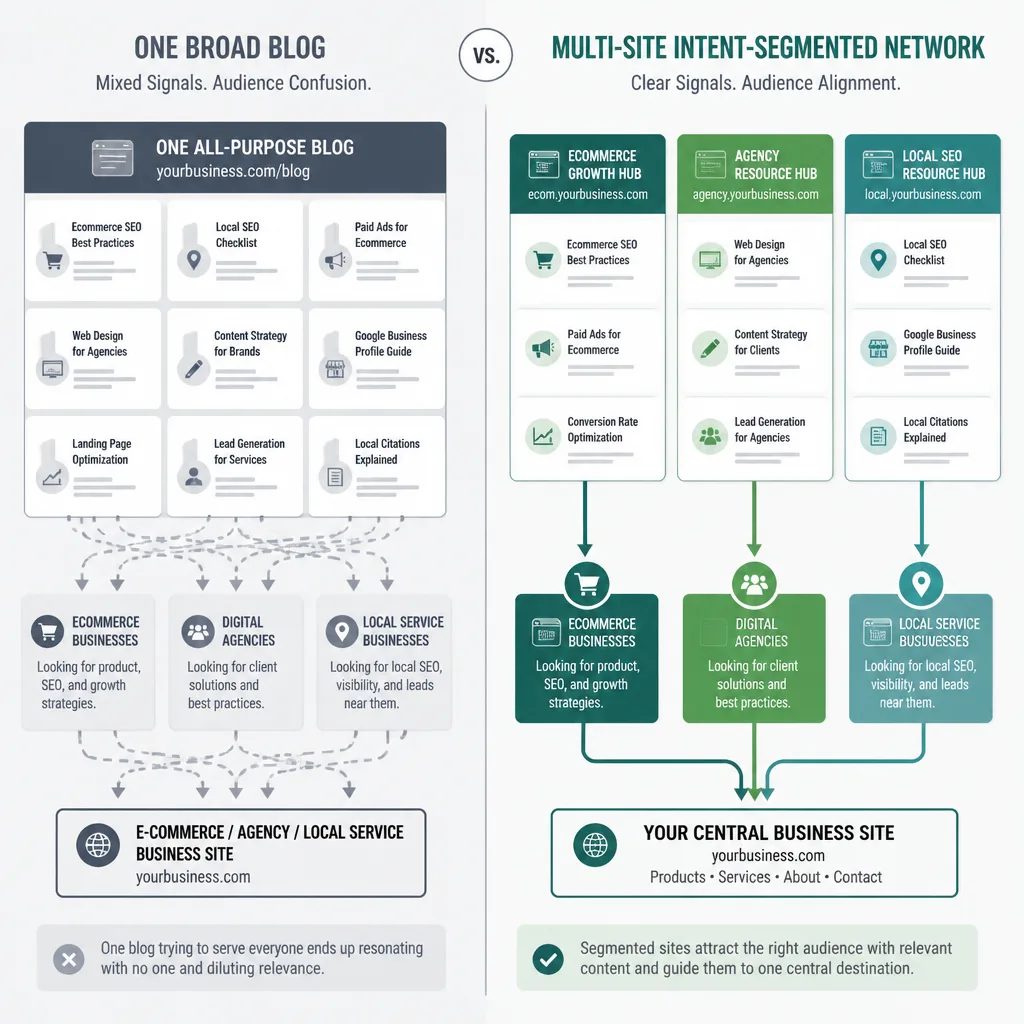
A fair objection is: why not publish everything on the main site?
Sometimes that is the right move. Many businesses should strengthen their core site first. But once a company serves multiple adjacent audiences or covers several intent clusters, one domain can start carrying too much strategic weight.
Different audiences search differently
People with similar needs do not always search the same way.
An agency owner, an e-commerce founder, and a local service business may all need marketing help, but they usually describe their problems differently, respond to different examples, and search with different levels of sophistication.
If all of that sits on one company blog, the editorial voice often smooths over those differences. Separate content sites allow more precise framing.
For example, imagine a business that serves:
- e-commerce brands
- agencies
- local service companies
One blog can mention all three. Three focused content properties can speak directly to each group using examples, language, and concerns that feel native to that audience.
Intent segmentation creates clearer topical relevance
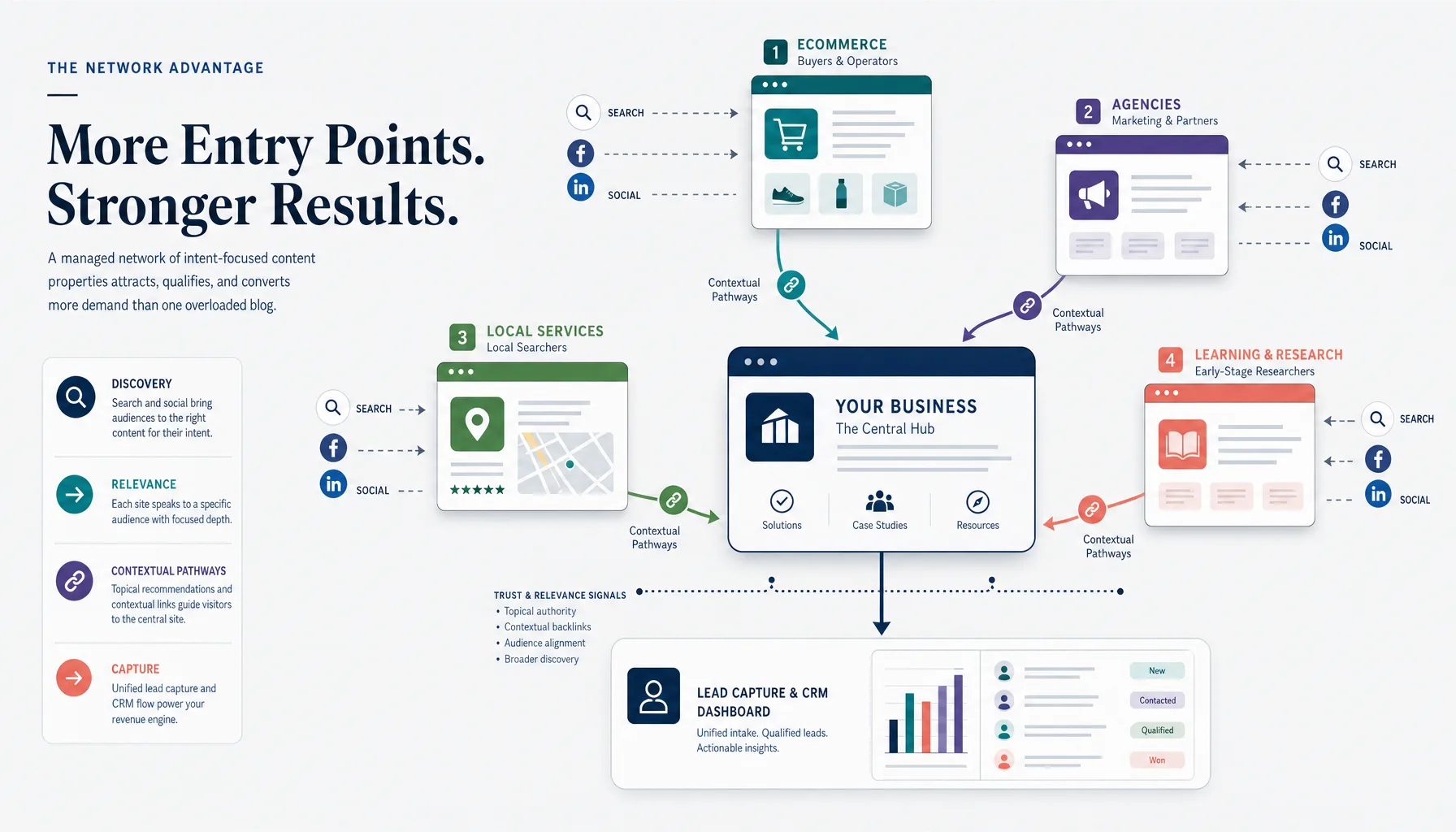
This is where the model becomes more strategic than it first appears.
When a site stays tightly focused, it can build clearer relevance around a defined subject area. That helps readers understand what the site is about, and it may also help search systems place the content in a more coherent context.
That does not mean separate domains are automatically better for rankings. They are not. Quality, trust, relevance, and competition still matter. But if one broad business site is trying to cover too many angles at once, segmentation can make the content architecture easier to understand.
Contextual paths back to the main site can improve conversion opportunities
Early-stage content and conversion-focused pages do different jobs.
A main service site may convert well once visitors arrive, but struggle to rank for broader informational topics. Supporting content sites can capture that earlier attention. Then, when readers are ready to compare options, learn more, or make contact, they can be guided to the main site, where stronger conversion assets usually live.
One practical advantage of this model is that it separates discovery from conversion without disconnecting them.
How Growth Engine works in practice
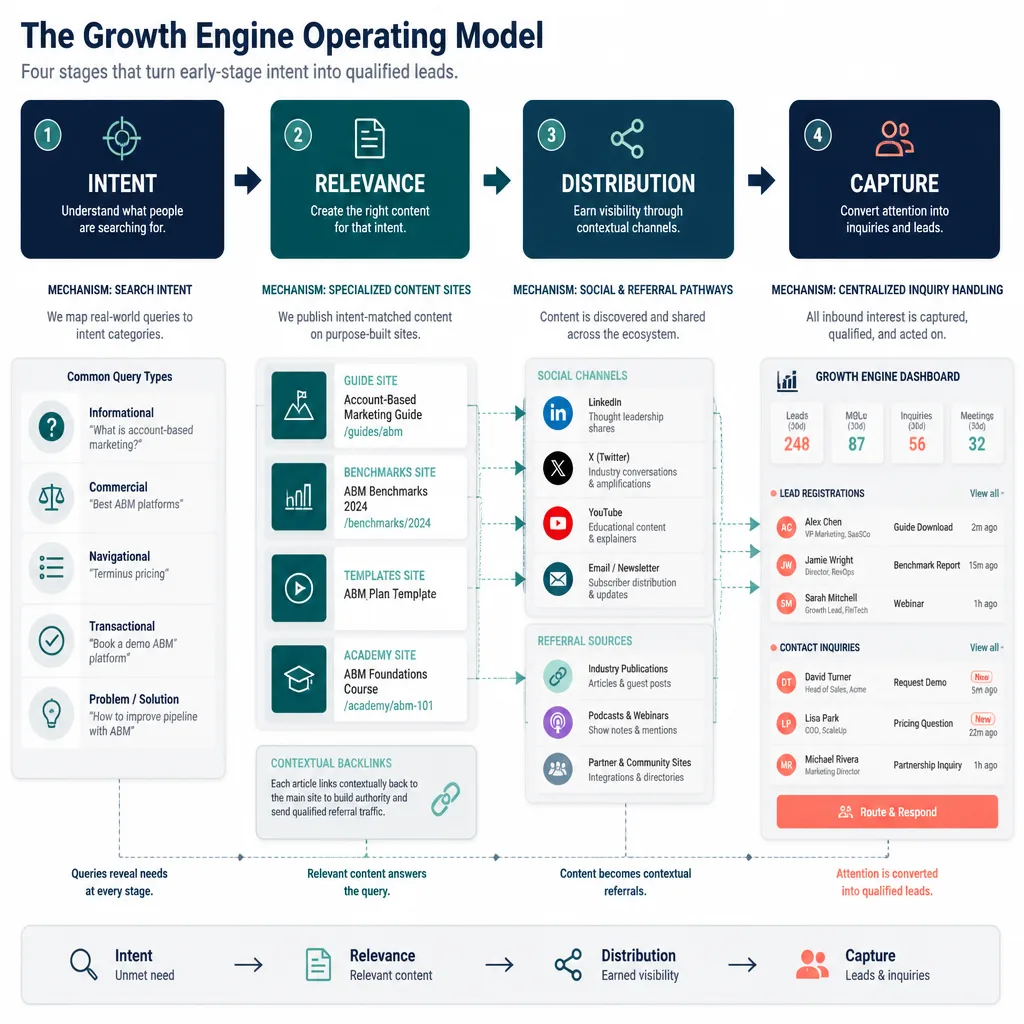
A simple way to understand the system is this:
Intent -> Relevance -> Distribution -> Capture
That is the engine.
Distinct site angles built around topics, audiences, and search intent
Each content site is built around a specific angle rather than functioning as a generic article warehouse.
One site might speak to a certain customer type. Another might focus on a topic cluster related to the business’s offer. Another might target a different stage of awareness, where people are still learning before they are ready to buy.
That matters because search visibility often comes from matching the shape of a user’s question, not just publishing more content.
Contextual backlinks, recommendations, and supporting content
As content is published across the network, the main business website can be referenced where it genuinely fits.
That could mean:
- linking to a service page when a reader wants implementation help
- recommending the business within a relevant comparison or explainer
- directing readers to a contact page when the article naturally leads there
Used this way, contextual backlinks are part of the reading experience. They help move someone from interest to action.
This is also what separates a legitimate content-support model from a low-quality link scheme. If the sites are useful, topically aligned, and built for real readers, the links serve a reader purpose. If the sites exist only to push link signals, the value falls apart.
Cross-channel sharing for added social traction
Search is only part of the picture.
Growth Engine also makes it easier to circulate content across social channels, which can help new pieces gain initial visibility and create additional touchpoints. Social traction is often shorter-lived than search traffic, but it still matters because discovery is rarely linear.
Someone might first see a post on social media, later search the topic, and eventually visit the main business site. That path is often more realistic than a clean one-click conversion journey.
Optimization for both SEO and AEO
Growth Engine is positioned for both SEO and AEO.
SEO remains the familiar goal: helping content appear in traditional search results.
AEO, or answer engine optimization, is the newer layer. In practical terms, it means structuring content so it is clear, understandable, and usable in environments that increasingly surface direct answers, summaries, and AI-assisted responses.
This area is still evolving, so it is best treated as a current marketing consideration rather than a guaranteed channel. But the broader principle is solid: content should be easy for both people and search systems to interpret.
What “autopilot” really means for the business owner
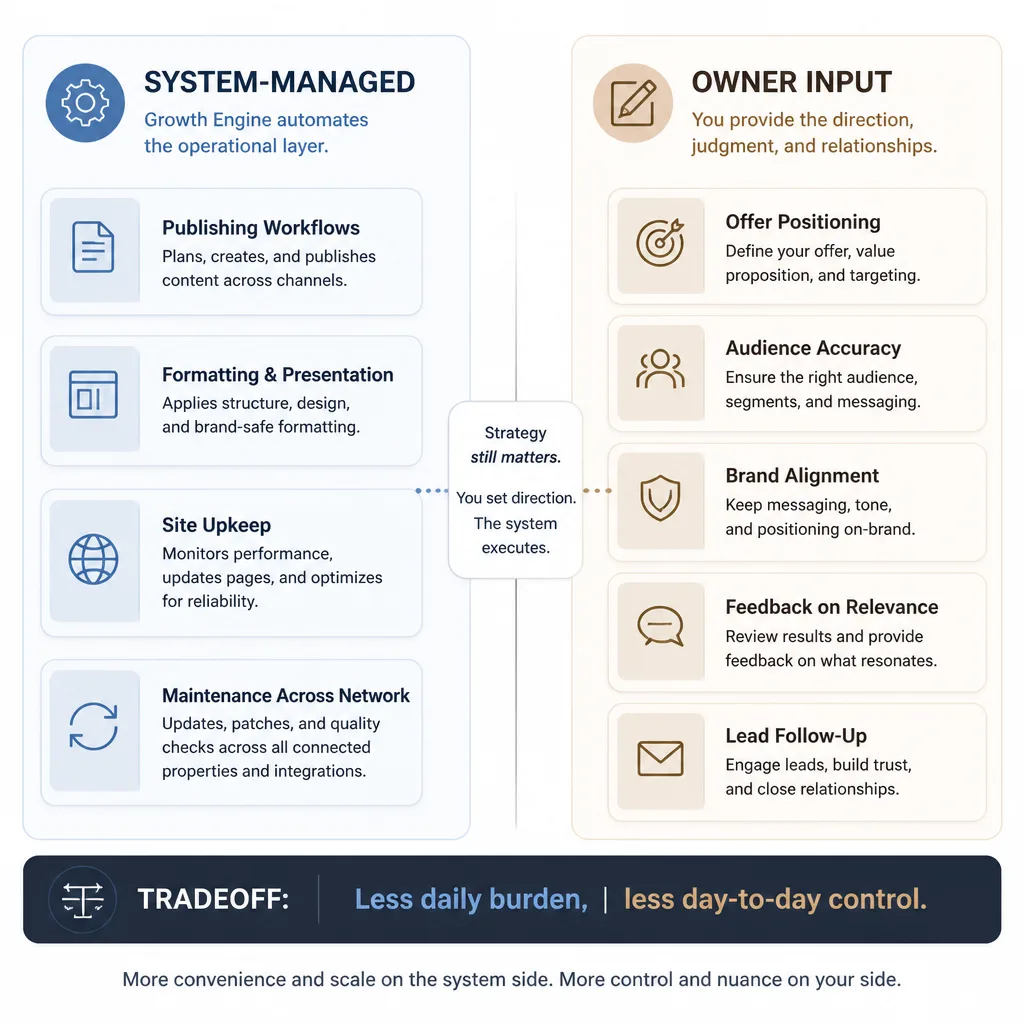
“Autopilot” can sound better than it is, so it helps to define it clearly.
Minimal publishing and maintenance burden
Here, autopilot means the business owner does not have to manage the daily mechanics of running multiple content properties.
That includes much of the routine work that usually slows content programs down:
- publishing workflows
- content formatting
- site upkeep
- ongoing maintenance across the network
For a founder or small team, that reduction in operational burden is often the main appeal.
Where owner involvement still matters
Autopilot does not mean strategy disappears.
The business owner still needs to contribute where judgment matters most:
- offer positioning
- audience accuracy
- brand alignment
- feedback on relevance
- lead follow-up and sales readiness
A managed system can reduce content operations. It cannot replace understanding your market.
The tradeoff between control and convenience
There is always a tradeoff.
If someone else runs the machinery, you usually give up some day-to-day control over editorial choices, publishing cadence, and site-level adjustments. Some businesses accept that because the convenience is worth it. Others, especially brands with strict messaging requirements, may find it frustrating.
That is not a flaw so much as a decision. Growth Engine makes more sense when the business values coverage and efficiency more than full editorial control over every asset.
The centralized dashboard and why it matters
A multi-site system can create visibility. It can also create chaos if inquiries are scattered.
Lead registrations and Contact Us inquiries in one place
One practical feature of Growth Engine is the centralized dashboard, where business owners can manage lead registrations and Contact Us inquiries across the network.
That sounds simple, but it matters.
Without a central intake point, multi-property publishing can create fragmentation: one lead here, another inquiry there, comments somewhere else, and no clean operational flow. Centralization turns the network into a usable business system rather than a loose collection of websites.
Optional article comment moderation
There is also optional moderation for comments on published articles.
It is not the headline feature, but it solves a real problem. Engagement adds maintenance overhead, and small teams rarely want to log into multiple properties just to manage comment activity.
Operational simplicity for lean teams
The more sites involved, the more centralization matters.
This is part of why Growth Engine should be seen as infrastructure. It is not only about publishing content. It is also about keeping the downstream workflow manageable for businesses that do not want a growing acquisition system to become an admin burden.
Who Growth Engine is best suited for
Like most marketing systems, this model is strong in some situations and less compelling in others.
Businesses with broad topic coverage or multiple audience segments
Growth Engine is best suited for businesses that need to address more than one type of customer, more than one service line, or more than one search-intent cluster.
If your business serves several adjacent audiences, separate content properties can help each group find content that feels directly relevant to them.
Teams that need organic growth without building a content department
This is also a strong fit for lean companies.
If you want more organic discoverability and inbound lead flow, but do not want to hire writers, editors, SEO managers, and content ops staff just to keep the system running, a managed service becomes much easier to justify.
For the right business, that is the core appeal of Traffics.io’s Growth Engine: it provides a structured publishing and distribution layer without requiring a full internal media operation.
When the model may be less useful
It may be less useful if:
- your business is in a very narrow niche
- your main website already handles segmentation well
- you already have a strong in-house editorial and SEO team
- your content needs extremely tight brand or compliance control
In those cases, the added value of external supporting properties may be limited.
What to evaluate before adopting a system like this
A multi-site content model only works when the pieces fit together naturally.
Quality and relevance of site themes
The first question is whether the supporting site themes are genuinely related to the business.
They should feel like logical informational environments, not random traffic containers. If a reader would be surprised by the connection, the alignment is probably weak.
Alignment between satellite content and the core offer
The bridge back to the main site should make sense.
If the supporting content attracts attention that has no meaningful connection to the business’s offer, the system may generate impressions without creating useful demand. Relevance is what turns discoverability into acquisition.
Lead handling and conversion readiness
More entry points only help if you can respond well when people show interest.
That means the business should be ready to:
- review incoming inquiries
- follow up consistently
- route leads efficiently
- convert interest once it arrives
A content network can widen the top of the funnel. It cannot fix a broken follow-up process.
Reasonable expectations for SEO and social traction
This kind of system usually compounds over time.
There is no universal timeline, and no credible provider should promise one. Traction depends on niche difficulty, site quality, publishing consistency, topical fit, competition, and how well the business converts the attention it gets.
That is the right expectation to keep in mind: potential growth in discoverability, not guaranteed rankings or immediate lead volume.
The bigger idea behind Growth Engine
From isolated content efforts to a content distribution system
The deeper value of Growth Engine is not that it produces articles.
It turns content from a scattered activity into a system. Instead of asking one blog to do everything, it creates multiple specialized doorways into the business, each designed to capture attention from a specific angle and route it toward a central brand and inquiry flow.
That is a meaningful strategic shift.
Why compounded discoverability matters over time
A single site gives you one main publishing location.
A network of relevant content properties gives you multiple chances to appear where people search, browse, and discover information. Over time, that can create a compounding effect: more discoverable assets, more contextually relevant entry points, and more opportunities for readers to encounter the brand before they are ready to buy.
That does not make the model universally better. But for the right business, it can solve a practical problem: how to expand organic and social reach without building an internal content machine from scratch.
Conclusion
Growth Engine by Traffics.io makes the most sense when a business needs more than a blog but less than a full in-house publishing department.
Its real advantage is not simply “more content” or “more backlinks.” It is the structure: multiple intent-matched content sites, contextual paths back to the main business, distribution support, and centralized lead capture in one system. That combination can broaden discoverability while keeping the operational burden low.
The key takeaway is simple: if your business serves different audiences, covers multiple topic areas, or struggles to maintain consistent content production, Growth Engine is best understood as acquisition infrastructure. The real question is not whether more websites sound impressive. It is whether a managed network of relevant content properties can create clearer entry points into your business than one overloaded domain.
FAQ
What is Growth Engine by Traffics.io?
Growth Engine is a managed content site network from Traffics.io. It creates multiple topic- and intent-focused content websites that support a business’s main website through discoverability, contextual promotion, and centralized lead capture.
How is Growth Engine different from a normal company blog?
A normal company blog publishes everything under one brand domain. Growth Engine uses multiple specialized content properties, each built around a distinct audience, topic cluster, or search intent, which can create clearer relevance and more entry points into the business.
Why would a business use multiple content sites instead of one website?
Different audiences search differently and respond to different framing. A multi-site model can help a business address separate intent groups more clearly than a single broad blog, while still guiding qualified readers back to the main website when appropriate.
How does Growth Engine help with SEO?
Growth Engine can improve organic visibility by expanding the number of relevant content assets connected to a business. Each site targets defined topics and search intents, which can increase discoverability and create contextual paths back to the main website. Results still depend on content quality, relevance, competition, and execution.
What role do contextual backlinks play in Growth Engine?
Contextual backlinks are meant to function as useful references within relevant content, directing readers to the main business website when the next logical step is to learn more, compare solutions, or make contact. The value comes from relevance and user fit, not links in isolation.
Is Growth Engine a private blog network or link scheme?
It should not be understood that way if the supporting sites are genuinely useful, topically aligned, and built for real readers. The distinction comes down to purpose and quality. A legitimate model focuses on audience relevance, useful content, and natural recommendations rather than creating sites only to pass link signals.
How does Growth Engine support AEO?
Growth Engine is designed to support both SEO and AEO by publishing content that is structured for discoverability in traditional search and in answer-driven environments. In practice, that means content should be clear, understandable, and usable in search experiences that increasingly surface direct answers and summaries.
What does autopilot mean in practice?
Autopilot means the system is managed for the business owner, reducing the need to handle day-to-day publishing, formatting, and maintenance across multiple content sites. It does not mean strategy becomes unnecessary or that the owner never needs to provide input.
What still requires business owner involvement?
Business owners still need to provide strategic input around offer positioning, target audiences, brand accuracy, and lead follow-up. A managed system can reduce operational work, but it cannot replace business judgment or sales readiness.
What does the centralized dashboard do?
The dashboard gives business owners one place to manage lead registrations and Contact Us inquiries across the network. It also allows optional moderation of article comments, which helps keep a multi-site setup operationally simple.
Who is Growth Engine best suited for?
Growth Engine is best suited for businesses with multiple audience segments, broad topic coverage, several service lines, or limited internal content resources. It can be especially useful for teams that want more inbound discovery without building a full in-house publishing operation.
When might Growth Engine be less useful?
It may be less useful for businesses in a very narrow niche, companies that already have strong in-house editorial and SEO operations, or brands whose main website already handles content segmentation effectively.
How long does it take to see results from a content-site network?
There is no universal timeline. Search and content traction usually build over time, and results vary based on niche difficulty, site quality, topical relevance, publishing consistency, authority, and how well the business converts incoming interest.