Does llms.txt Actually Help? A Neutral Testing Methodology for Sites Under 500 Pages
A familiar pattern shows up in AI-era SEO: a new file or protocol appears, and the internet instantly splits into two camps. One side calls it an easy win. The other says it does nothing. llms.txt has landed squarely in that zone.
The issue is not that the idea is absurd. It is that the evidence is thin, uneven, and easy to overinterpret. llms.txt is a real proposal with a plausible mechanism, but it is not a widely adopted standard or a confirmed ranking or citation lever across major AI platforms.[^1]
For small sites, the useful question is not “Should I believe the hype?” It is simpler: can you test it cleanly, cheaply, and without adding technical noise? That is the point of this article.
llms.txt is not magic, but it is testable
Why the debate gets polarized
llms.txt lives in an awkward middle ground. It sounds technical enough to feel important, but not established enough to come with strong evidence. That mix tends to produce bad takes in both directions.
Some people treat it like a shortcut to AI citations. Others dismiss it because they do not see immediate traffic changes. Both reactions miss the harder point: small sites rarely produce enough signal to prove or disprove subtle effects quickly.
The right frame: a low-cost discovery hint, not a growth lever
That is the most useful way to think about it. llms.txt is best treated as a low-cost discovery and context hint, not a guaranteed SEO tactic or AI visibility switch.[^1][^2] If you test it, treat it like any low-signal change: keep the implementation clean, isolate the variable as much as possible, and be ready to conclude that the result is inconclusive.
What llms.txt is trying to do
The basic idea
The official proposal describes /llms.txt as a Markdown file placed at the root of a site to provide brief background, guidance, and links to important resources that may help language models use website information at inference time.[^1] The logic is straightforward: HTML can be noisy, while a short Markdown map is easier to parse.
Think of it as a curated content inventory, not a control panel.
For a compact site with useful but scattered content, that may help some systems discover key pages more efficiently. It may also do nothing measurable. Both outcomes are plausible.
How the proposal is structured
The proposal calls for a root-level /llms.txt file and outlines a structured Markdown format that includes a site name, short summary, and links to relevant resources.[^1] It also discusses linking to more detailed Markdown files where appropriate.[^1]
That is where implementation discipline starts to matter. A tidy map can help. A messy one can expose problems you already had.
What it is not
This is where many articles get sloppy.
llms.txt is not the same as robots.txt. robots.txt is a crawler access preference file. llms.txt is a discovery and context hint.[^2][^3][^4] It is also not a canonicalization mechanism, not a sitemap replacement, and not evidence that your pages will be cited more often.
OpenAI’s current publisher guidance, for example, emphasizes allowing OAI-SearchBot if you want content discovered and cited in ChatGPT search; it does not position llms.txt as a requirement.[^2] Anthropic and Perplexity also document crawler behavior through bots and robots.txt, not through a universal llms.txt standard.[^3][^4]
For sites under 500 pages, the main question is not “can I add it?”
The real question: is the site complex enough for the test to matter?
On a 40-page brochure site, the likely upside is small. Your content is already easy to enumerate. A new discovery file may add very little.
On a 200-page niche publisher, documentation hub, or small SaaS site with guides, comparisons, support content, and clear topical clusters, the case is stronger. Not because llms.txt is powerful on its own, but because content organization matters more once the site has some depth.
When a small site may benefit more than a tiny brochure site
A realistic candidate usually has some combination of:
- multiple content clusters
- a handful of genuinely valuable pages worth prioritizing
- uneven internal discovery paths
- some AI referral visibility already, even if small
- enough measurement discipline to track before-and-after patterns
A documentation-heavy SaaS site is a good example. So is an affiliate site with a tight topical focus and a manageable archive of evergreen guides.
When the likely upside is too small to matter
If your site has five core pages, weak content, unresolved indexation issues, or barely any measurable traffic, llms.txt is unlikely to change much. At that point, the problem is not discoverability hygiene. It is that the site has too little signal or too little value.
Low-risk vs. risky implementation patterns
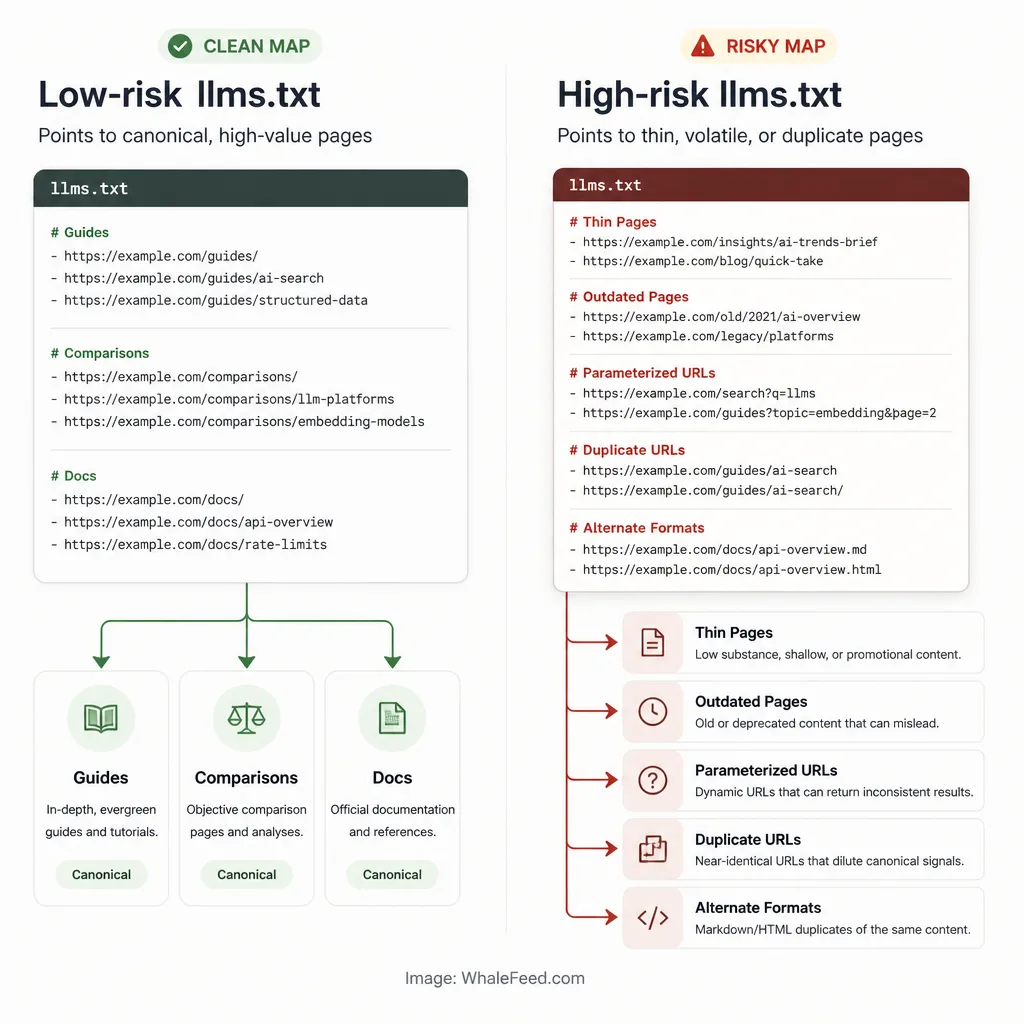
Likely harmless: link to core, canonical, already-public pages
The safest pattern is also the least exciting. Include only your best public pages: canonical URLs, already intended for discovery, already useful to humans, and already aligned with your internal linking and sitemap strategy.
That keeps llms.txt from turning into a second-rate dump of everything you have ever published.
Potentially useful: group key pages by topic or intent
A compact site map organized by topic often makes more sense than a flat URL list. If your site has sections like “Beginner guides,” “Product comparisons,” and “Documentation,” say that clearly and link only to the strongest pages in each group.
This is one of the few places where the file might add real clarity instead of redundancy.
Risky: surface thin, outdated, parameterized, or duplicate URLs
This is the real danger. Not the file itself, but what it points to.
If you dump tag pages, tracking-parameter URLs, old affiliate pages, thin archive pages, or near-duplicates into llms.txt, you are not improving clarity. You are widening the path to weak inventory. Bing’s guidance is blunt on the broader principle: duplicate URLs dilute signals and reduce confidence in selecting a preferred version for search and grounding results.[^5]
Imagine a 300-page review site with one strong “best email tools” guide, three older near-duplicate comparison pages, and a handful of UTM-tagged campaign URLs still live. Adding all of them to llms.txt does not improve discovery. It creates ambiguity.
Risky: create canonical confusion between HTML, Markdown, and alternate versions
The official proposal discusses linking to Markdown resources where useful.[^1] That can be fine in theory. In practice, alternate versions need governance.
Google’s canonical guidance warns against conflicting canonical signals and explicitly says robots.txt should not be used for canonicalization.[^6] If you expose HTML pages, Markdown mirrors, and alternate versions without a clear preferred-URL strategy, you may make the site harder to interpret, not easier.
What not to do
Do not use llms.txt as a blocking or access-control mechanism.
If your goal is crawler access control, use robots.txt where appropriate. If your goal is to prevent indexing, use the proper indexing controls. OpenAI, Anthropic, and Perplexity all document crawler behavior separately from any llms.txt discussion.[^2][^3][^4]
A neutral testing methodology a solo operator can actually run
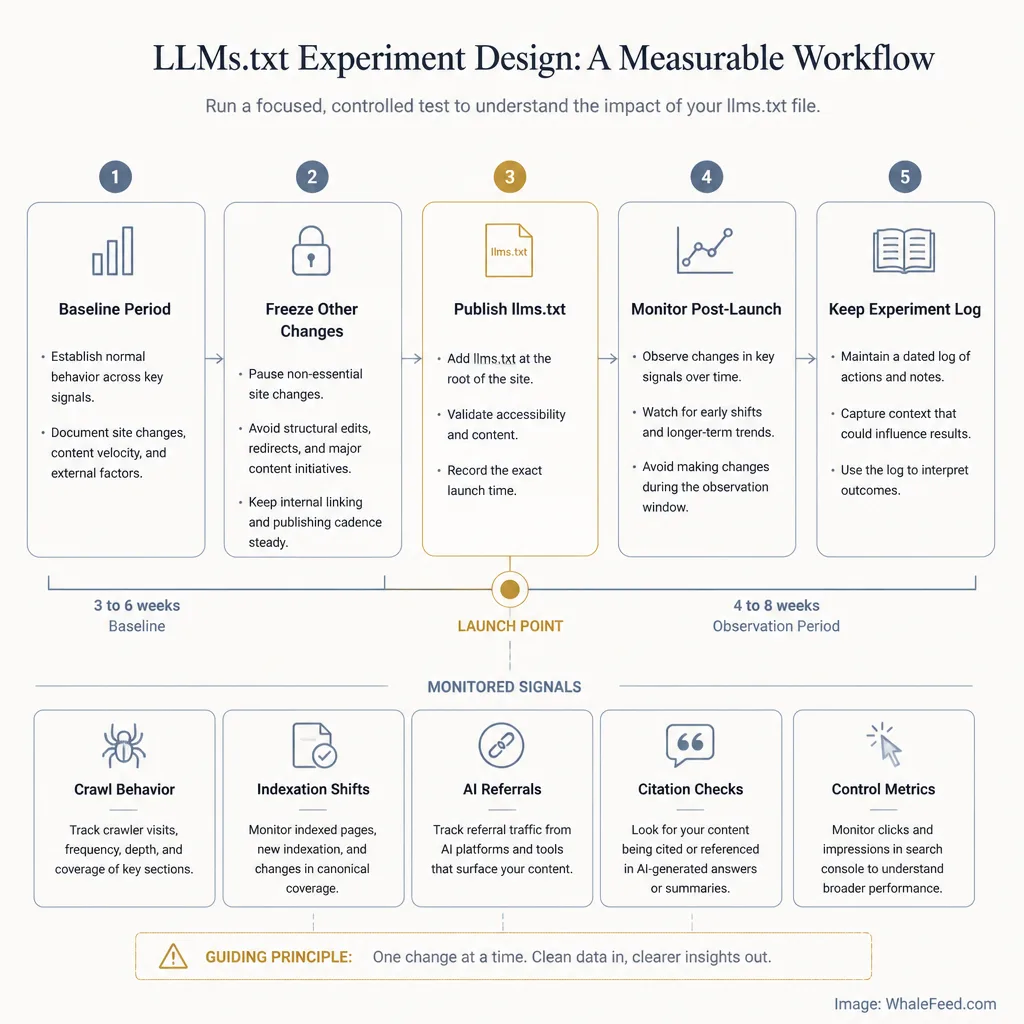
1. Set a baseline period
For a modest-traffic site, a practical baseline is 3 to 6 weeks. If traffic is spiky, seasonal, or recently affected by other changes, lean longer.
The goal is not statistical perfection. It is to understand what “normal” looks like before you add another variable.
2. Freeze other major changes if possible
Do not launch llms.txt at the same time you:
- change templates
- rewrite internal links
- publish a large content batch
- fix canonical tags
- migrate analytics
- clean up indexation problems
You can do those things. Just not all at once if you want a readable test.
3. Publish llms.txt and document the change window
Publish the file once, note the exact date, save the exact contents, and log which URLs you included. Also confirm that the file returns a normal 200 response and is not accidentally blocked by your CDN or firewall.
A simple spreadsheet is enough: date, file version, included URLs, and any concurrent site changes. That small habit prevents a lot of hindsight fiction later.
4. Monitor a post-launch period long enough to catch weak signals
A reasonable observation window is 4 to 8 weeks. Some sites will still produce inconclusive results after that. That is not a failure of method. It is the reality of low-volume testing.
5. Keep a simple experiment log
This matters more than people think. When results are noisy, memory becomes biased fast. Write down weekly notes: bot activity changes, odd indexation shifts, referral blips, and whether any important pages were revised during the test.
What to monitor during the test
Crawl behavior
If you have server or CDN logs, look for directional changes in fetches to the pages named in llms.txt. Perplexity, OpenAI, and Anthropic all document identifiable crawlers or user agents, though their roles differ.[^2][^3][^4]
Most small-site owners will not have perfect logs. That is fine. Use what you can see.
Indexation shifts
This is one of the most important checks. If alternate versions, weak URLs, or duplicates start surfacing more often, that is a warning sign. It does not prove llms.txt is harmful. It usually means your URL set is messy.
AI referral patterns
If you allow OAI-SearchBot, OpenAI says you can track ChatGPT referral traffic in analytics platforms.[^2] That makes AI referrals worth watching. It does not make them a clean attribution source.
One small spike means very little. Look for repeated directional movement over time.
Citation frequency
If you want to check citation visibility manually, use a fixed prompt set: a few branded prompts, a few topic prompts, and a few comparison-style prompts.
Do not change the prompts every week and call that a test.
Control metrics
Search Console page groups matter more than sitewide vanity swings here. If your llms.txt emphasizes 20 core pages, watch those pages as a group. If they stay stable while weak pages start surfacing, that tells you something. If nothing moves, that tells you something too.
How to interpret the results without fooling yourself
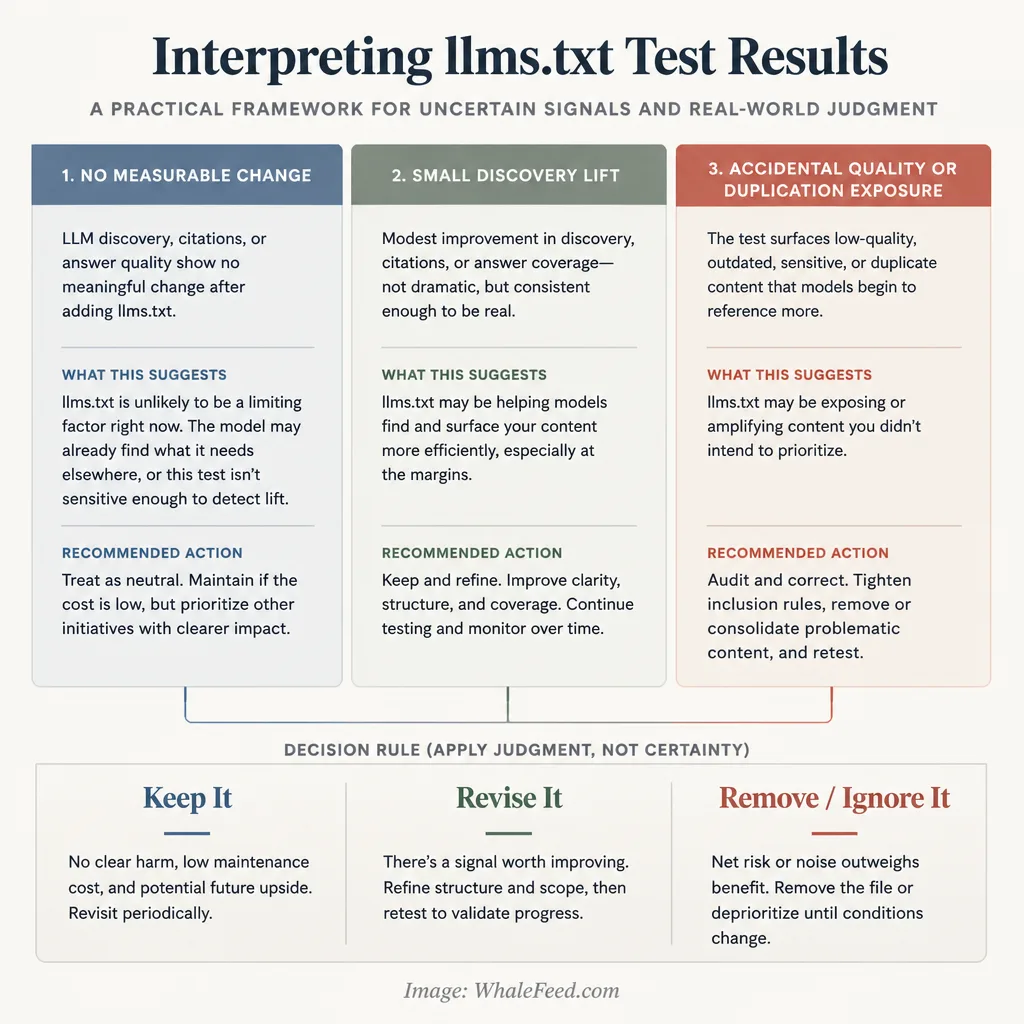
Outcome 1: no measurable change
This is probably the most common result.
It does not automatically mean llms.txt is useless. It may mean the site was already simple enough, the relevant platforms did not use the file in a meaningful way, or the true effect size was too small to detect. On small sites, “no measurable change” often just means “no trustworthy signal.”
Outcome 2: a small discovery or retrieval lift
This is the optimistic but still realistic result.
Maybe key pages get fetched a bit more often. Maybe you see occasional incremental AI referrals. Maybe a target page appears more consistently in manual citation checks. That is worth noting, but not overselling. Bing’s AI Performance documentation is useful here because it explicitly says changes in citation trends are observational and may reflect content changes, user demand, the broader web ecosystem, or AI system behavior, not one specific update.[^7]
Outcome 3: accidental quality or duplication exposure
This is the negative result that often teaches you the most.
If weaker pages, alternate formats, or duplicate URLs start attracting more attention, the takeaway is usually not “never use llms.txt.” It is “your mapped URL set needs cleanup.” In other words, the experiment exposed an existing hygiene problem.
A simple decision rule: keep it, revise it, or remove it
Keep it if the file stays clean and the risk stays low
If the file is small, accurate, easy to maintain, and not creating signal confusion, there is little reason to remove it. Even a low-signal file can be worth keeping if maintenance is close to zero.
Revise it if you exposed too much or mapped weak URLs
This is the most common practical fix. Trim it down. Keep only the pages you would be comfortable featuring in a sitemap, an internal “best of” hub, or a manual outreach email.
Remove or ignore it if the maintenance burden exceeds the signal
A tactic stops being free the moment it creates upkeep. If you are babysitting the file, debating alternate versions, and still seeing nothing useful, move on.
When llms.txt is probably not worth your time
A practical checklist
Skip the test, at least for now, if most of these are true:
- your site is basically a brochure site
- you have fewer than a few dozen meaningful content pages
- canonical issues are unresolved
- duplicate or parameterized URLs are still floating around
- internal linking is weak
- indexing is unstable
- you cannot monitor Search Console or analytics consistently
- you are hoping
llms.txtwill compensate for thin content
That last one is the trap. A discovery hint cannot rescue content that is not worth discovering.
What to prioritize first
Before you spend time on llms.txt, fix the basics that are more likely to matter:
- clean canonical signals[^6]
- duplicate URL control[^5]
- stronger internal linking
- better core pages
- more stable indexation
- cleaner sitemaps and crawl paths[^5]
Those are not as fashionable. They are also more likely to pay rent.
Conclusion
llms.txt is neither a joke nor a shortcut. For small sites, it is a modest, testable idea with a plausible mechanism and uncertain upside.[^1][^2][^3][^4]
That is exactly why it should be approached with restraint. Publish a clean file. Point it only at your best canonical pages. Change little else. Watch directional patterns, not one-off screenshots. And if the result is “nothing meaningful happened,” accept that answer without forcing a story around it.
The real value of the experiment is not proving that llms.txt works. It is learning whether your site is clean enough, coherent enough, and measurable enough for a tactic like this to matter in the first place.
FAQ
What is llms.txt supposed to do?
llms.txt is meant to act as a lightweight discovery map for large language models. Instead of controlling access like robots.txt, it gives a site-level summary and points to important pages or resources that may be easier for AI systems to interpret.[^1][^2]
Does llms.txt work for small sites?
Maybe, but the effect is often small or hard to detect. For sites under 500 pages, llms.txt is best treated as a low-risk experiment in discoverability and content clarity, not as a proven visibility tactic.[^1][^2]
Can llms.txt hurt SEO?
The file itself is usually not the main risk. The bigger risk is pointing it at thin, duplicate, outdated, parameterized, or alternate-format URLs that create signal confusion or surface weak pages more clearly.[^5][^6]
Is llms.txt the same as robots.txt?
No. robots.txt is a crawler access preference file, while llms.txt is a discovery and context hint. They solve different problems and should not be treated as interchangeable.[^1][^2][^3][^4]
How long should a llms.txt test run?
A practical approach for smaller sites is a 3 to 6 week baseline, followed by a clearly logged launch date and a 4 to 8 week observation window. Low-traffic sites may still end up with inconclusive results. That timing is practical guidance, not a formal industry standard.
What metrics should I monitor after adding llms.txt?
Watch for directional changes in crawl activity, Search Console impressions and clicks by page group, indexation anomalies, visible AI referral traffic, and manual citation checks using a fixed prompt set.[^2][^4][^7]
What are the most realistic outcomes of a llms.txt experiment?
The three realistic outcomes are no measurable change, a small discovery or retrieval lift, or accidental exposure of low-quality or duplicate URLs. The third outcome is often the most actionable because it points to cleanup work.
When is llms.txt not worth testing?
It is usually not worth the effort for tiny brochure sites, sites with only a handful of core pages, or sites that still have unresolved canonical, duplication, indexing, or internal linking problems.[^5][^6]