The Small-App Flywheel: A Practical System for Building a Network of Micro-Products That Compound Revenue
Most founders building a small app hit the same fork in the road. They either keep polishing one product until growth stalls, or they ship unrelated tools that add maintenance without creating momentum.
The issue is not ambition. It is system design. When each new app starts from zero, you reset acquisition, support, positioning, and trust every time. That gives you more products, but not more leverage.
A small-app flywheel fixes that. Instead of treating each micro-product like its own business, you build a portfolio where each app makes the next one easier to acquire, convert, support, or improve. Done well, that can lower effective CAC, increase LTV, and turn a scattered set of tools into a compounding asset.
This article explains how to do it: how to choose the first wedge app, how to structure a hub-and-spoke portfolio, how to connect products without hurting trust, and how to decide when to launch the next app instead of improving the current one.
What the small-app flywheel actually is
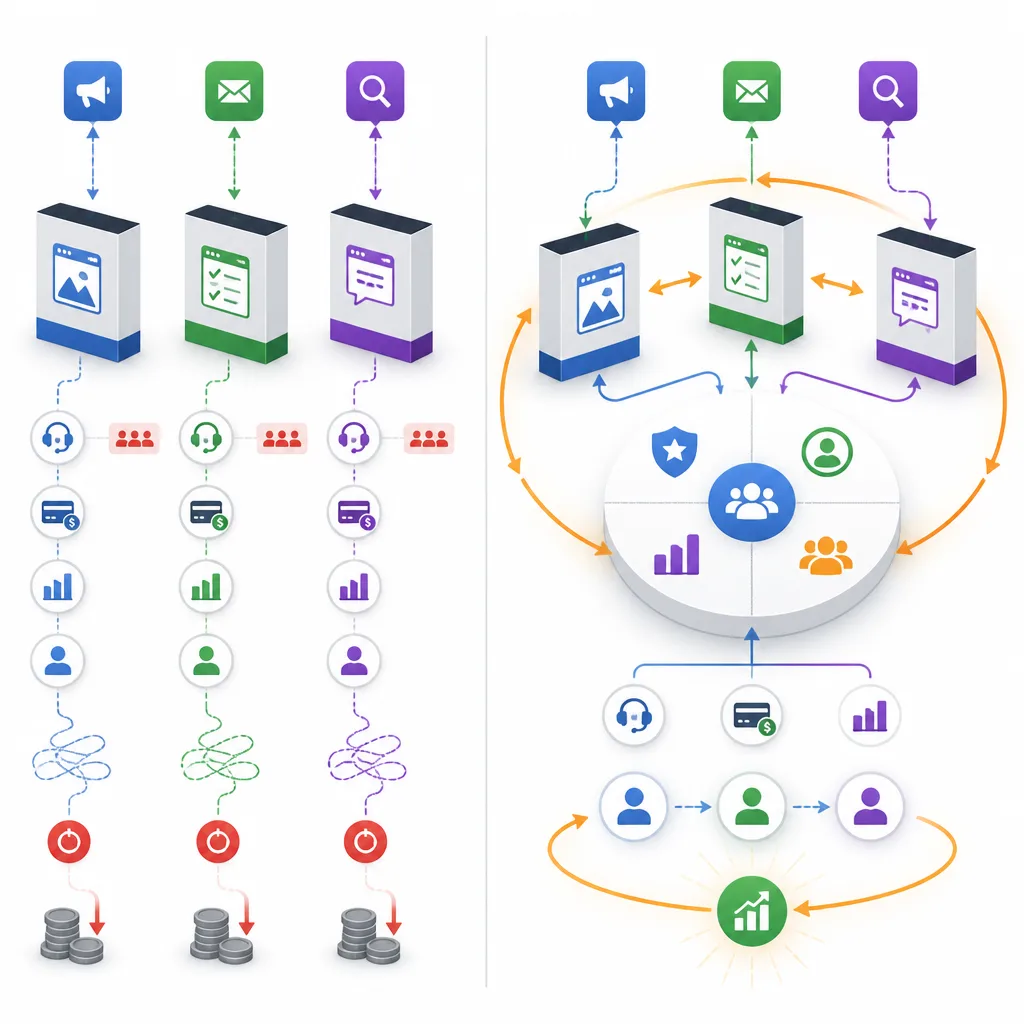
A small-app flywheel is not just “build lots of micro-products.”
It is a portfolio system where each product creates shared leverage for the next one. That leverage usually comes from five sources:
- Audience
- Trust
- Workflow fit
- Infrastructure
- Learning
If one app attracts the right audience, the next can launch to warm users instead of cold traffic. If one app earns trust, the next converts faster. If both tools fit naturally into the same workflow, cross-promotion feels helpful rather than intrusive.
Key Insight: A collection of apps may share code. A flywheel shares leverage.
That distinction matters. Shared code can reduce development time, but it does not lower CAC on its own. Shared audience, trust, and workflow often do.
Where this model works well, and where it breaks down
The small-app flywheel works best when:
- The apps serve the same persona
- The jobs are adjacent within the same workflow
- Distribution channels overlap
- You can reuse onboarding, billing, analytics, or support systems
For example, a founder building tools for content marketers has a much better chance of compounding than someone building one tool for SEO teams, one for HR managers, and one for Shopify merchants.
It breaks down when:
- Products target different buyers
- Support needs are highly customized
- Brand positioning becomes confusing
- Cross-sell feels forced
- Each app needs its own acquisition strategy
Bottom Line: This model works when one product meaningfully improves the economics of the next.
The hub-and-spoke model: the simplest way to organize a micro-product portfolio
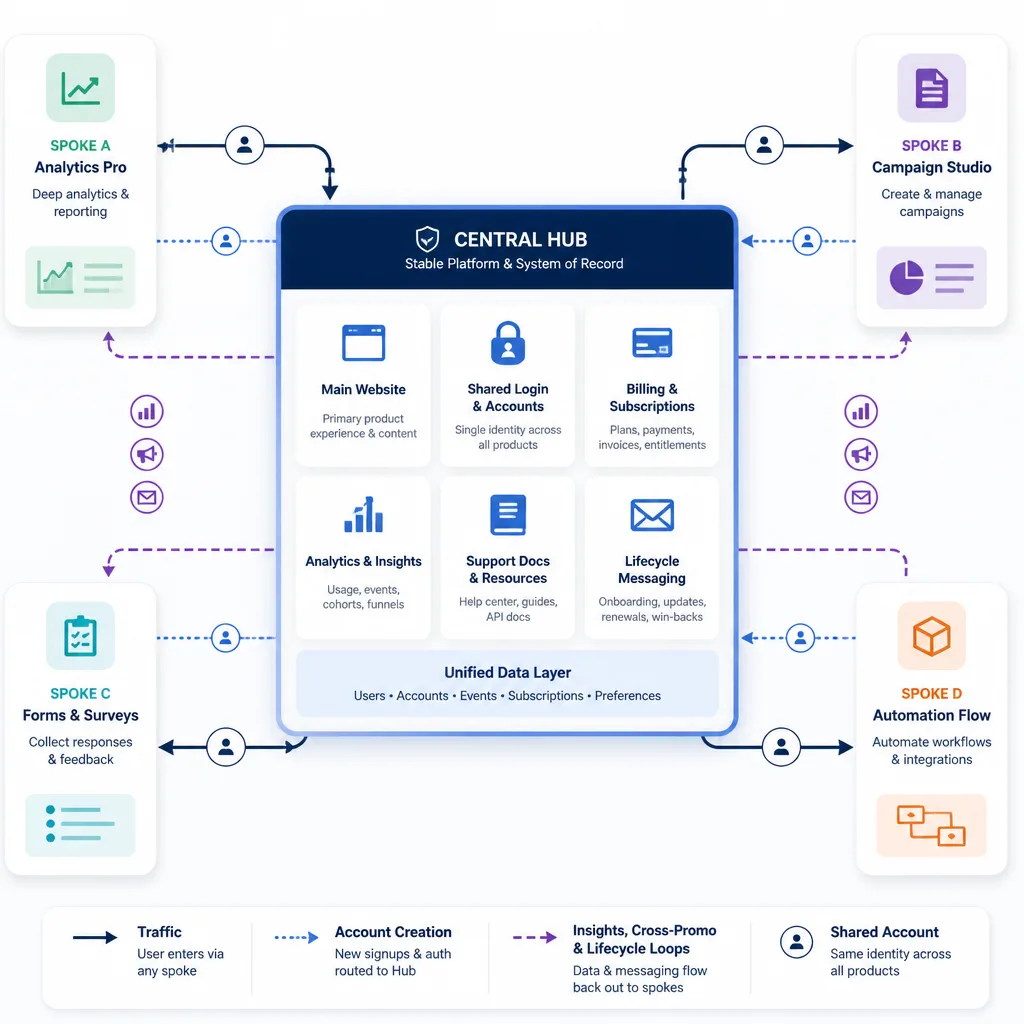
The easiest structure for a micro-SaaS portfolio is a hub-and-spoke model.
The hub centralizes trust and reusable assets. The spokes are focused tools that solve adjacent problems for the same user.
How traffic, users, and insight move through the system
Think of the hub as the part that compounds. It might be:
- Your main brand
- A content site
- A flagship app
- A shared account system
- A unified billing and analytics layer
The spokes are narrower products with clear jobs to be done.
The HUB Framework
| Component | Main role | Best example | What it should own | Risk if weak |
|---|---|---|---|---|
| Hub | Centralize trust and reusable assets | Main brand, website, flagship app, shared login | Audience, analytics, billing, support docs, navigation, cross-promo logic | Every new app feels like a separate startup |
| Spoke 1 | Solve a narrow, high-intent problem | Landing page headline audit tool | Clear use case, fast value, relevant CTA to related apps | Traffic without monetization or onward movement |
| Spoke 2 | Extend the workflow | Message-match generator | Adjacent job, cross-sell opportunity, shared user context | Feels random or duplicative |
| Spoke 3 | Improve retention or monetization | CRO experiment tracker | Deeper engagement, LTV expansion, recurring use | Support burden rises without enough added value |
In practice, traffic may enter through a spoke. A user might find a free title preview tool through search, create an account, and then discover a paid internal linking assistant. That user still enters the hub through shared identity, brand, and lifecycle messaging.
This is why the hub does not need to be a large platform. It just needs to be the place where trust and systems accumulate.
Decision Rule: If a new app does not clearly plug into your existing brand, audience, or workflow, it is probably not a spoke. It is a side project.
How to choose your first app: start with a wedge, not a platform
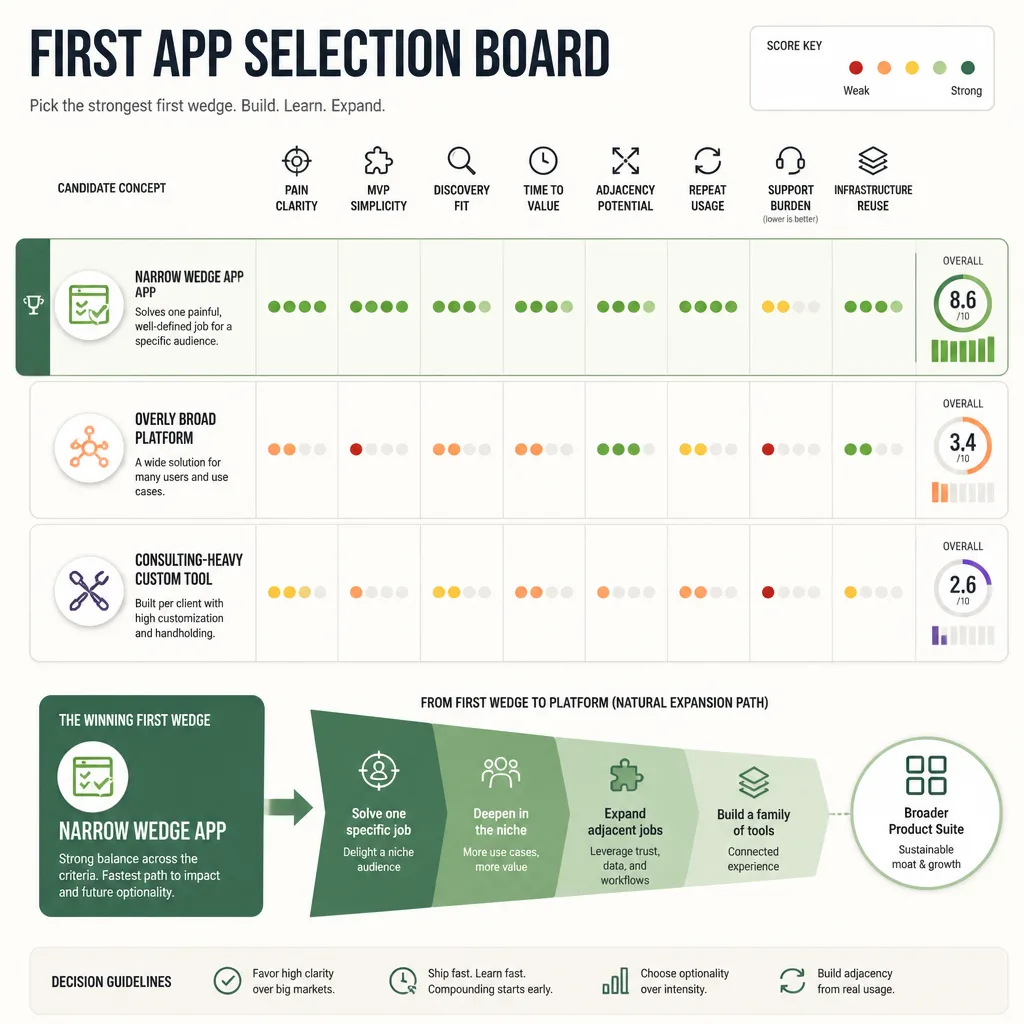
Your first app should not be a platform vision. It should be a wedge.
A wedge app is narrow, obvious, and useful enough to attract a specific user with a specific problem. It works because it is easy to understand and easy to try.
A practical scoring model: The Wedge Score
Use this before building. Rate each idea from 1 to 5.
| Criteria | What to look for | Why it matters |
|---|---|---|
| Pain clarity | The problem is obvious and costly | Easier positioning and faster adoption |
| MVP simplicity | You can ship core value quickly | Reduces build risk |
| Discovery fit | Clear SEO, community, referral, or paid angle | Lowers distribution friction |
| Time to value | User sees benefit fast | Improves activation |
| Adjacency potential | Opens natural follow-up tools | Enables expansion |
| Repeat usage | Users come back often enough | Helps retention and monetization |
| Support burden | The app is simple to maintain | Prevents portfolio drag |
| Infrastructure reuse | Parts can power future apps | Keeps future builds cheaper |
A strong first app usually scores high on pain clarity, discovery fit, and adjacency potential.
Examples of strong and weak first-app choices
Strong first-app choice: a landing page headline audit tool for founders running paid traffic.
Why it works:
- Easy to explain in one sentence
- The user has a clear trigger: “my page is not converting”
- It can be demonstrated quickly
- It opens adjacent products such as message-match tools, experiment planning, or ad creative helpers
Weak first-app choice: “an all-in-one growth operating system.”
Why it fails:
- Too broad to position
- Long time to value
- Hard to validate quickly
- Creates platform complexity before demand is clear
Another weak pattern is software that is really disguised consulting. If every customer needs custom setup or custom logic, you are not building a leverage-friendly wedge.
Common Mistake: Founders often choose the app they want to own in three years instead of the wedge they can prove in three weeks.
Bottom Line: If you cannot describe the user, problem, trigger, and acquisition path in one sentence, the first app is probably too broad.
A practical framework for expansion: build each new app to reduce CAC for the next
Once your first app works, the next question is not “what else can we build?” It is “what can we build that reuses what we already earned?”
The Leverage Stack
| Leverage layer | What gets reused | How it helps | When it works best | Failure mode |
|---|---|---|---|---|
| Audience Leverage | Email list, SEO traffic, community, remarketing pools | Lowers top-of-funnel cost | Same audience, similar intent | Traffic overlaps but buying intent does not |
| Trust Leverage | Brand reputation, prior success, UX familiarity | Improves conversion rate | First app delivered a clear positive outcome | One bad product damages all others |
| Workflow Leverage | Natural next-step placement in the user journey | Makes cross-promo feel useful | New app solves the problem before or after the current task | Recommendation feels forced |
| Infrastructure Leverage | Shared auth, billing, design system, analytics | Cuts build and ops cost | Portfolio uses similar account logic | Tech debt spreads across all products |
| Learning Leverage | User interviews, event data, objections, feature requests | De-risks what to build next | You have enough signal from the right users | You expand based on noisy feedback |
Here is what that looks like in practice.
Suppose your first app helps marketers audit landing page headlines. Users complete an audit and then ask, “How do I improve message match between my ad and page?” That creates learning leverage. You now know the language they use, the pain points they mention, and the adjacent job they care about.
Your second app becomes a message-match assistant. You launch it to your existing list and inside the first app after users finish an audit. That gives you audience leverage and workflow leverage. If users already trust the first tool, conversion improves through trust leverage. If both products use the same login, billing, and analytics, you also gain infrastructure leverage.
Ethical data sharing and when not to connect products
Products should connect only when the connection helps the user and is transparent.
Useful examples:
- Recommending a related app after a user completes a task
- Letting users opt into sharing saved settings across tools
- Showing available tools inside one account area without auto-enrolling them
Bad examples:
- Importing user data into another product without consent
- Auto-subscribing users to unrelated emails
- Aggressive interstitials before the user gets value
- Cross-promoting tools that do not fit the current workflow
Privacy expectations around transparency, purpose limitation, and consent are well established in modern data protection frameworks, including GDPR-style principles.[^1]
Decision Rule: Connect products only when the relationship is obvious, useful, and under the user’s control.
If you need to validate whether a wedge product has enough demand to justify expansion, a small paid acquisition test can help. In that context, a service like Traffics.io can support advertisers and business owners in testing messaging and channel response before they invest in a broader portfolio. The goal is not to buy growth blindly. It is to test whether the same acquisition learning could later support multiple related apps.
The launch decision: when to build the next app vs. optimize the current one
This is where many portfolios go wrong. Founders confuse early traffic, or their own boredom, with readiness to expand.
The real question is simple: Has the current app taught you enough and built enough leverage to make the next app cheaper or safer to launch?
A decision rule to use monthly or quarterly
Use this five-part review:
-
Activation and retention
- Are users reaching value reliably?
- Are enough of the right users coming back?
-
Acquisition repeatability
- Do you have at least one channel that consistently brings relevant users?
- Do you understand the messaging that pulls them in?
-
Adjacent demand
- Are users repeatedly asking for the next related outcome?
- Do interviews and behavior point to the same adjacent job?
-
Support burden
- Is the current app stable enough that a second app will not overwhelm you?
- Are support issues mostly understood and documented?
-
Leverage readiness
- Can the next app reuse at least two existing assets, such as audience and billing, or workflow and analytics?
A practical rule:
Build the next app only when the current one has stable value delivery, repeatable acquisition, and clear adjacent demand from the same audience.
If activation is weak, retention is poor, or the audience is wrong, optimize first. Otherwise you are multiplying unresolved problems.
A sample flywheel in practice
Imagine a solo founder serving performance marketers.
App 1: Landing page headline audit
App 2: Ad-to-landing-page message-match assistant
App 3: Simple CRO experiment backlog tracker
This sequence works because each app solves a job next to the previous one.
- App 1 attracts users through SEO and content around landing page conversion
- Users who finish audits often need help turning insights into better messaging
- App 2 appears as a contextual recommendation after an audit is complete
- Users running repeated tests then need a lightweight way to track hypotheses and experiments
- App 3 becomes a retention product for more serious teams
Now the compounding starts:
- The same email list promotes all three tools
- The first app builds trust for the second
- Shared onboarding reduces friction
- Product data reveals which users are best suited for the next app
- Revenue per acquired user rises, even if top-of-funnel CAC stays similar
A hypothetical example might look like this:
- App 1 reaches 1,500 monthly users from search and newsletter distribution
- 12% start a trial
- Interviews reveal repeated demand for message-match help
- 35% of early App 2 signups come from existing users and in-app referrals
- App 3 converts a smaller segment, but materially increases LTV among active customers
What could go wrong in this scenario
The apps can still fail if:
- App 1 attracts DIY beginners who will never pay
- Cross-promo clicks are high but referred users churn quickly
- App 3 is too operationally heavy for a solo founder
- The product line starts serving different buyer types
This is why you should measure downstream behavior, not just clicks. A cross-promo placement is successful only if the referred users activate and retain.
Common mistakes that make a micro-product portfolio stall
Adding products before retention is proven
Common Mistake: Launching a second app because the first got attention, not because it created durable value.
Traffic is not enough. Feature requests are not enough. If the first app has weak retention, you may be hearing noise from the wrong users.
Other common mistakes include:
- Building unrelated tools for vanity MRR
- Overusing one customer list until trust drops
- Creating free tools with no role in monetization or qualification
- Treating every adjacent feature as a separate product opportunity
- Underestimating billing, browser, API, and support maintenance across multiple apps
Another subtle mistake is forcing a bundle too early. Users do not want a portfolio. They want help with the next problem in their workflow.
Bottom Line: Expand from validated user behavior, not founder restlessness.
Implementation checklist: how to build your small-app flywheel in the next 90 days
Here is a realistic 12-week plan for a solo builder or small team.
Weeks 1–2: choose the wedge
- List 5–10 possible micro-app ideas
- Score them using the Wedge Score
- Select one narrow problem with clear pain and discovery fit
- Write a one-sentence positioning statement
Weeks 3–4: build the MVP
- Ship only the core outcome
- Set up basic analytics events for activation and repeat usage
- Reuse patterns that can carry forward: auth, UI components, billing flow
Weeks 5–6: launch and instrument
- Launch through one or two channels you can learn from
- Track activation rate, usage depth, and support friction
- Capture user language from onboarding and support conversations
Weeks 7–8: interview users and test distribution
- Talk to activated users and churned users
- Identify the task before and after your app in their workflow
- Test whether your messaging attracts the right audience
- If relevant, run small paid demand tests before scaling channels
Weeks 9–10: map adjacent demand and cross-promo
- Look for repeated adjacent job requests
- Design one ethical cross-promo path
- Decide what should be shared across apps and what should remain separate
- Add preference controls for linked experiences or communications
Weeks 11–12: decide whether to optimize or expand
- Is activation healthy enough to trust your signal?
- Is retention strong enough to show real value?
- Do users consistently point to the same adjacent problem?
- Can the next app reuse at least two existing leverage assets?
- Is support stable enough to handle another product?
If the answer is mostly yes, build the next spoke. If not, improve the current app until the leverage is real.
Conclusion
The small-app flywheel is not about collecting tiny products. It is about building a portfolio where each app improves the economics of the next.
That happens only when products share leverage: audience, trust, workflow fit, infrastructure, and learning. Without that, each new app resets CAC and adds complexity.
Start with a wedge, not a platform. Organize around a hub and spokes. Expand only when the current app has proven value and the next app clearly benefits from existing assets.
The goal is not more SKUs. It is more leverage per user acquired.
FAQ
What is a small-app flywheel?
A small-app flywheel is a portfolio strategy where each micro-product makes the next one easier to acquire, build, convert, or support. The goal is not to launch many apps, but to create shared leverage through audience, trust, workflow fit, infrastructure, and learning.
How is a small-app flywheel different from just building multiple micro-products?
A collection of micro-products can still behave like separate businesses with separate CAC, support, and positioning costs. A true flywheel exists only when products reinforce each other through shared channels, contextual cross-promotion, reusable systems, and adjacent user needs.
What makes a good first micro-app?
A strong first app is a wedge product: narrow, easy to explain, quick to deliver value, and tied to a clear user problem. It should also have obvious discovery hooks and open a path to adjacent tools later.
When should I launch the next app instead of optimizing the current one?
Usually only after the current app shows solid activation or retention, repeatable acquisition, and clear adjacent demand from the same audience. If the first app still has weak positioning or poor retention, adding another product often multiplies the same problems.
How can multiple small apps reduce CAC?
They reduce CAC when they reuse acquisition inputs such as SEO clusters, email lists, in-app recommendations, partnerships, or paid channel learnings. They can also improve economics by increasing LTV through cross-sell, even when top-of-funnel CAC stays similar.
What is the hub-and-spoke model for a micro-SaaS portfolio?
In this model, the hub centralizes trust and shared assets such as brand, audience, analytics, billing, or a flagship product. The spokes are narrower apps that solve adjacent jobs for the same user, making the overall portfolio easier to grow than isolated tools.
Should all micro-products live under one brand?
Not always, but one master brand is often simpler when products serve adjacent jobs for the same audience. Separate brands can make sense when positioning, pricing, or buyer identity diverge enough that trust does not transfer well.
How should cross-promotion work without feeling spammy?
Cross-promotion should be contextual, useful, and timed around the user’s workflow. The best recommendations appear after a meaningful outcome or at a clear next step, not as aggressive interruptions unrelated to what the user is trying to do.
When is it ethical to share data across products?
Only when the sharing is transparent, relevant to the user’s benefit, and handled with clear controls. Good practice includes data minimization, purpose limitation, consent for non-obvious use cases, and settings that let users manage linked products or communications.
Can free tools be part of a small-app flywheel?
Yes, but only if they have a clear role in the portfolio. Free tools can work as acquisition spokes, but they become a distraction when they generate traffic or support load without creating qualified demand for paid products.
[^1]: For example, see the GDPR principles summarized by the European Commission.