Resubscribe and Re-Permission Done Right: Timing, Signals, and Copy That Won’t Trigger Complaints
Most re-permission mistakes start the same way: a list goes quiet, revenue pressure rises, and someone decides a “last chance” email can’t hurt.
It can.
A poorly timed re-permission email often pushes people toward the easiest reaction available. If the message feels unexpected or pushy, that reaction may be “report spam,” not “unsubscribe.” That matters because Gmail says bulk senders should keep spam rates below 0.10% and avoid ever reaching 0.30% or higher, while Yahoo also advises bulk senders to stay below 0.3% and make unsubscribing easy.[^1][^2]
The better question is not, “Can we send one more email?” It is, “Is this contact still low-risk enough that one more email is worth the complaint exposure?” In practice, that makes re-permission a narrow exception, not a default list-cleaning tactic.
If prior consent is strong, recent sentiment is neutral or positive, and the contact has shown some sign of life, a re-permission ask can make sense. If consent is unclear, support history is messy, or the contact has been dormant too long, suppression is usually the better choice.
Re-permission is not a default cleanup tactic
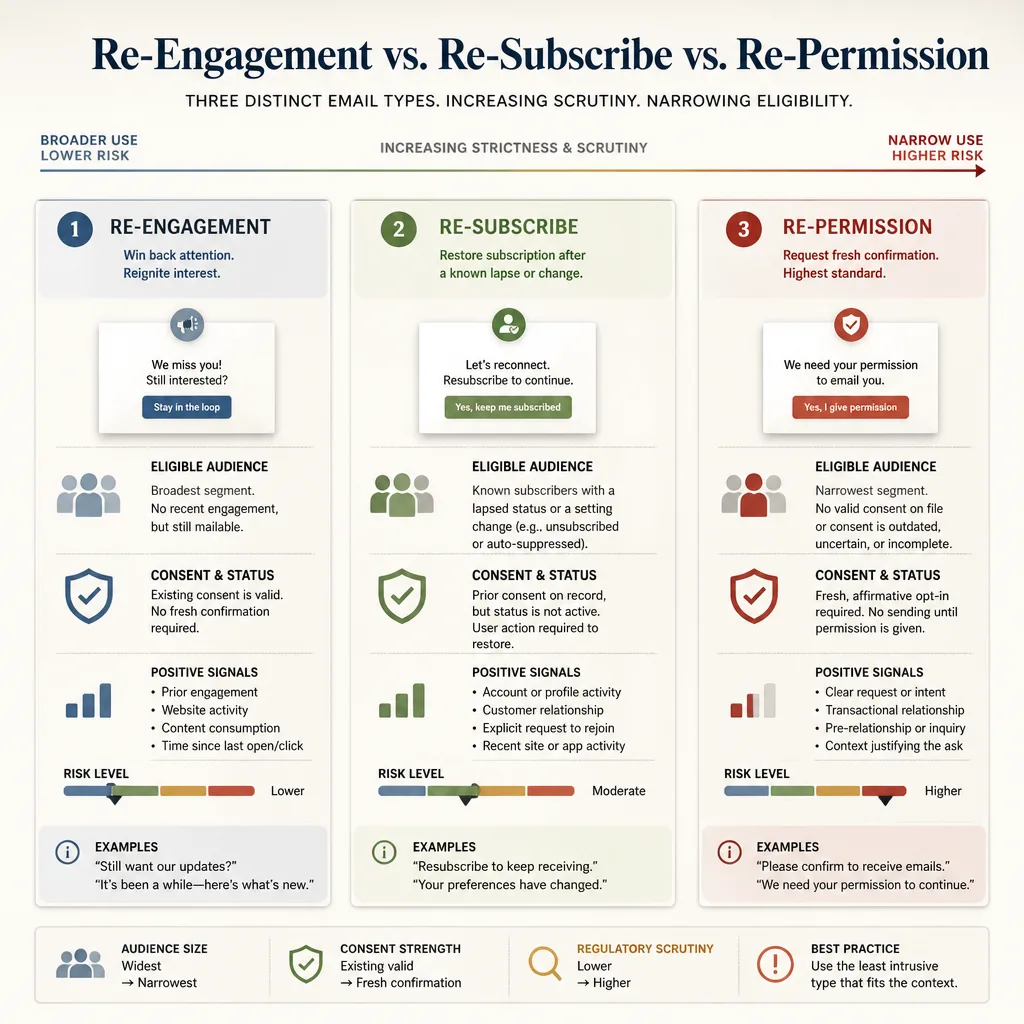
Before deciding on timing or copy, define what you are actually sending. These terms are often blurred together, but they are not interchangeable.
The core distinction: re-engagement vs. re-subscribe vs. re-consent
A re-engagement email goes to people you can still legitimately mail and tries to revive interest with content, preferences, or an offer.
A re-subscribe email asks someone to opt back in after a lapse, a settings change, or a clear break in subscription status.
A true re-permission or re-consent email is stricter. It asks for fresh confirmation because the existing permission basis is weak, old, incomplete, or strategically risky.
That distinction matters because the standard changes. Re-engagement assumes the address is still safe to mail. Re-permission assumes you are getting close to the point where “technically possible” and “strategically wise” are no longer the same.
When a re-permission ask is justified
A re-permission email is most defensible when three conditions are true:
- You have credible prior consent
- There is some recent positive signal
- There is no negative sentiment or suppression history
That might describe a weekly newsletter subscriber who clicked two months ago and then went quiet. It does not describe a refunded customer, a past complainer, or a migrated contact with unclear provenance.
Klaviyo’s guidance is useful here: it supports permission-based sending and explicitly rejects purchased, scraped, prospecting, and other non-consented lists.[^3] The broader lesson is simple. Strong collection practices are safer than trying to rehabilitate questionable contacts later. Double opt-in helps reinforce that by filtering out invalid entries and low-intent signups before they become a deliverability problem.[^4]
Why many lists are better cleaned than re-asked
This is the point many teams resist: sometimes the right answer is to quietly remove names.
SparkPost notes that poor list hygiene hurts reputation even when nobody visibly complains, and recommends removing unengaged recipients based on send-frequency windows rather than letting stale cohorts accumulate.[^5] It also warns that if never-engaged and not-recently-engaged recipients dominate your audience, you should revisit list hygiene.[^6]
A stale address is not neutral inventory. It is potential reputation drag.
The real decision is timing, not wording
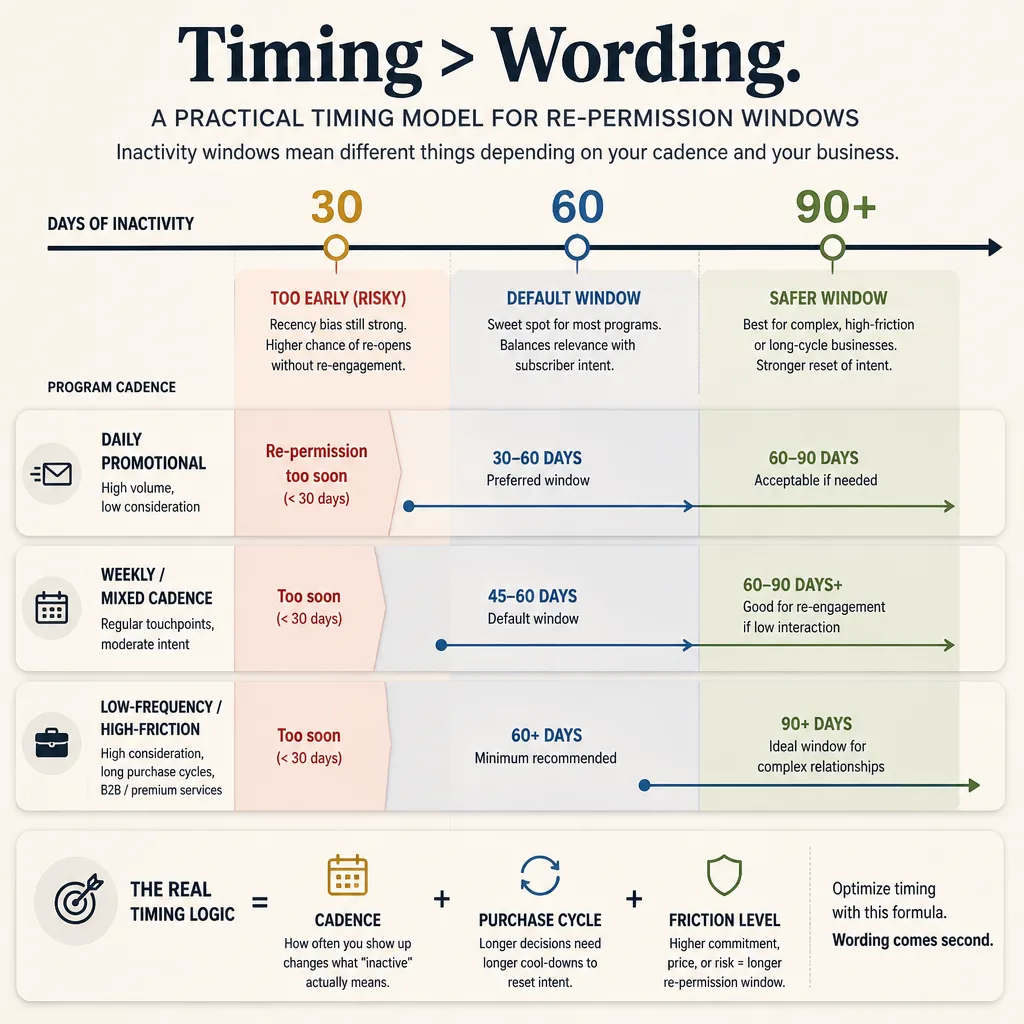
Copy matters, but timing matters more. The same message can feel courteous at 60 days and intrusive at 10. It can feel reasonable after a quiet lapse and reckless two days after a refund.
Why the same copy performs differently at 30, 60, and 90+ days
A re-permission email works best when it matches the subscriber’s likely mental state.
At 30 days, a daily or near-daily sender may already have enough data to spot meaningful disengagement. A monthly sender probably does not. Ask too early and the brand can seem erratic: “Why are they asking if I still want this? I barely hear from them.”
At 60 days, many weekly programs have enough behavioral history to make a careful decision. The contact has had enough chances to engage, but not so much time has passed that the brand feels unfamiliar.
At 90+ days, the ask is often safer for lower-frequency businesses, longer purchase cycles, or support-heavy products where silence does not automatically mean disinterest.
A practical timing model: short, standard, and long cool-downs
There is no universal provider rule for 30, 60, or 90 days. Treat these as operating ranges, not compliance mandates.
A practical model looks like this:
Short cool-down: ~30 days
Use only for high-frequency programs where the subscriber previously engaged and 30 days represents many missed opportunities.Standard cool-down: ~60 days
A sensible default for many weekly or mixed-frequency brands.Long cool-down: 90+ days
Better for low-frequency programs, high-consideration purchases, B2B, education, premium services, or any business where engagement naturally happens over longer intervals.
SparkPost’s older but still directionally useful hygiene guidance supports cadence-sensitive windows: roughly 30 days for daily senders, 60 for weekly, 90 for biweekly, and 180 for monthly.[^5] That is not a re-permission rule, but it is a useful reminder that timing should follow cadence, not habit.
How product cadence changes the waiting period
A flash-sale brand sending daily promotions can interpret 30 quiet days very differently from a SaaS company sending one newsletter every two weeks.
You also have to factor in purchase cycle and friction level. A skincare brand might ask sooner than a high-ticket furniture retailer. A support-heavy software product should usually wait longer, because silence may reflect evaluation rather than disengagement.
Use signals, not calendar rules alone
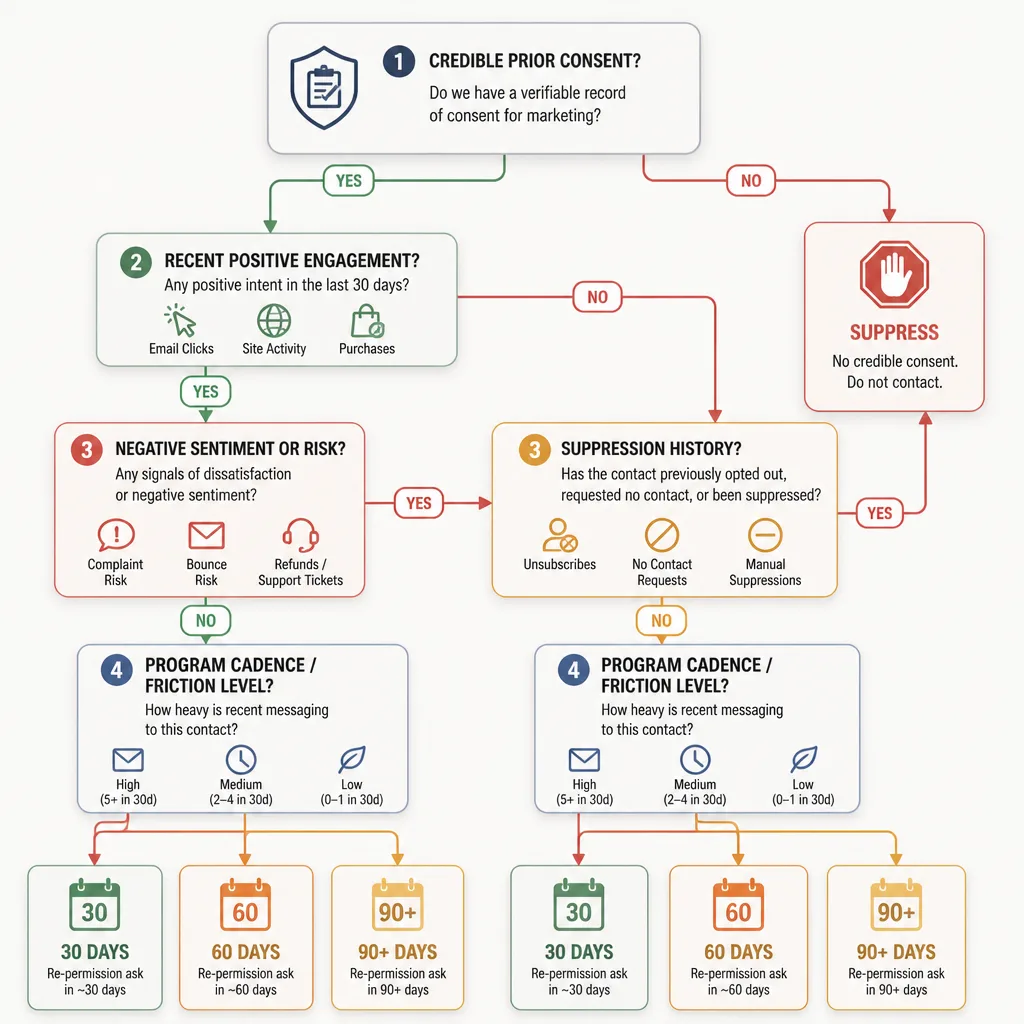
Calendar age is a starting point. It should not be the whole policy.
Engagement signals: clicks, site activity, purchase recency
Use multiple signals together:
- recent clicks
- recent site sessions
- recent purchases
- product usage
- replies
- preference-center visits
Opens alone are weaker than they used to be. Gmail does not track open rates itself, and mailbox privacy features make open-based logic less reliable.[^1] Multi-signal logic is safer.
Risk signals: complaints, unsubscribes, bounces, zero-engagement streaks
Some signals should sharply reduce your willingness to send:
- prior spam complaint
- prior unsubscribe
- hard bounce history
- repeated zero-engagement over a long window
- repeated suppression events
- suspicious import source or incomplete consent records
SparkPost’s suppression guidance is blunt for good reason: continuing to send to invalid or unwilling recipients damages sender reputation, and suppression lists exist to stop that automatically.[^7]
Customer sentiment signals: support tickets, refunds, chargebacks, NPS or CSAT patterns
This is where strong CRM teams outperform generic email playbooks.
If a customer recently asked for a refund, opened an unresolved support ticket, issued a chargeback, or gave sharply negative feedback, do not treat them like a normal inactive subscriber. Even if you technically can send, it is often the wrong moment.
This is more practitioner judgment than provider rule, but it is still sound judgment. Negative service events increase the odds that the next marketing email will feel tone-deaf.
Operational rule: who should be excluded automatically
Build a hard exclusion layer for:
- prior unsubscribes
- prior spam complainers
- hard bounces
- invalid addresses
- unresolved refund or chargeback cases
- recently canceled accounts in sensitive categories
- contacts with missing or unreliable consent history
Previously unsubscribed contacts should not get a re-permission email. If they want back in, they should re-opt in through a fresh form, checkout flow, or preference center.
A simple framework for choosing 30, 60, 90, or suppress
A useful decision rule is:
Valid prior consent + some recent positive signal + no negative sentiment + no suppression history = possible narrow re-permission test
If any of those conditions break, extend the cool-down or suppress.
30 days: only for high-frequency programs with prior engagement
Use 30 days only when the contact used to engage and your send cadence is high enough that 30 days is meaningful. For example, a daily deals list where a subscriber clicked regularly last month, then stopped.
Do not use 30 days as a blanket win-back trigger.
60 days: the default middle ground for many brands
For many ecommerce and content programs, 60 days is the most practical default. It gives enough space for natural disengagement to become visible without rushing into a risky ask.
If you can implement only one broad rule, this is often the least bad option.
90+ days: safer for low-frequency or higher-friction businesses
If your program sends less often, or customer relationships are more complex, wait longer. A B2B software brand, premium service provider, or high-ticket retailer will usually be better served by a longer cool-down.
Suppress instead of asking: the no-second-chance segment
Some contacts are not re-permission candidates at all.
That group includes:
- spam complainers
- unsubscribers
- hard bounces
- very old imported contacts with weak consent records
- long-term zero-engagers with no positive business signal
- customers coming off a negative support or refund event
This is where list value and list safety diverge. Chasing these names often creates more long-term cost than short-term recovery.
Copy that lowers pressure lowers complaints
Low-pressure copy is not just a style preference. It is risk control.
What non-coercive re-permission copy does differently
Good re-permission copy is:
- short
- plain
- optional
- easy to decline
- specific about what the subscriber will receive
It should not sound like a hostage negotiation. It should sound like a polite check-in.
Gmail requires one-click unsubscribe for subscribed marketing messages from high-volume senders, and Yahoo recommends both visible unsubscribe and list-unsubscribe support.[^8][^2] The lesson is straightforward: easy exits are table stakes.
Phrases that create pressure, guilt, or confusion
Avoid lines like:
- “Don’t miss out forever”
- “You need to act now to stay on the list”
- “We noticed you haven’t been supporting us”
- “Click here so we know you still care”
- “If you do nothing, important updates may stop”
These phrases create pressure or ambiguity. They may lift clicks a little, but often from the wrong people.
Template examples: soft check-in, preferences-first ask, final sunset notice
Soft check-in
Subject: Still want these emails?
Hi {{first_name}},
We only want to email people who still want to hear from us. If you’d like to stay subscribed, you can confirm here. If not, no action is needed, and you can unsubscribe below at any time.
Why it works: short, calm, and free of guilt.
Preferences-first ask
Subject: Update what you hear from us
Hi {{first_name}},
If you’d like fewer emails or only certain topics, you can update your preferences here. If you’d rather stop hearing from us, you can unsubscribe here.
Why it works: it offers reduction before removal, which is often better than a forced yes-or-no choice.
Final sunset notice
Subject: We’re pausing emails unless you opt in
Hi {{first_name}},
Since it’s been a while, we’re going to stop sending marketing emails unless you confirm you’d like to keep receiving them. You can stay subscribed here, update preferences here, or unsubscribe here.
Why it works: clear consequence, no threat, no manipulation.
Usually one ask, or at most one ask plus a sunset notice, is enough.
Why imports and list-switching create hidden deliverability debt
Moving data does not reset history.
Consent does not become cleaner when moved to a new list or ESP
Importing contacts into a new platform does not improve consent quality. Klaviyo’s import guidance makes clear that imports still depend on consent status, and imported uploads do not trigger double opt-in automatically.[^9]
A weak list imported into a clean-looking account is still a weak list.
How bypassing suppressions creates reputation damage that outlasts one campaign
This is one of the most expensive mistakes teams make during migrations.
SparkPost says bringing over your old suppression list is “extremely important.” Otherwise, you risk resending to typo addresses, unsubscribes, and prior complainers, which can damage reputation and even get an account suspended.[^10] Its suppression documentation also explains that spam complaints, unsubscribes, and hard bounces are exactly the events suppression lists are designed to block.[^7]
That is why list-switching creates hidden deliverability debt. The damage may not show up on day one, but the highest-risk addresses are often reactivated first.
What to migrate safely: consent records, suppression history, engagement context
A safe migration carries over more than email addresses. You need:
- original consent source
- signup date
- consent type
- unsubscribe history
- complaint history, where available
- bounce history
- engagement recency
- purchase and support context
If you cannot trust that record, do not trust the send.
How to operationalize this into a policy
The goal is to make re-permission rare, consistent, and low-drama.
Build a decision tree instead of one-off exceptions
A simple policy works better than constant debate. For example:
- Suppressed before? Never email again unless the person newly opts in through a fresh consent path.
- Negative sentiment event in the last 30–90 days? Delay or suppress.
- No engagement, but prior consent is clear and the recent relationship is positive? Consider one narrow re-permission test.
- Consent unclear or imported without proof? Suppress.
That keeps support, retention, and deliverability teams aligned.
Define sunset windows by segment, not one universal number
Use different windows for:
- daily promotional programs
- weekly newsletters
- monthly editorial sends
- buyers vs. non-buyers
- high-ticket vs. low-ticket customers
- support-heavy vs. low-friction products
One universal number sounds tidy. Usually, it hides bad judgment.
Measure success beyond clicks
Do not evaluate re-permission on confirmation rate alone.
Judge it in this order:
- spam complaint rate
- unsubscribe rate
- confirmed opt-ins
- downstream clicks, purchases, or usage
- engagement quality over the next 30 to 90 days
A campaign that “saves” a few thousand names but spikes complaints is not a win. Gmail and Yahoo have already made clear what matters most.[^1][^2]
Conclusion
The safest re-permission campaign is usually the one sent late, narrowly, and politely.
That means no blanket 60-day rule, no emotional copy, and no rescue mission for bad data. Start with the harder question: is this subscriber merely inactive, or are they now risky? If the answer is risky, suppression is not giving up. It is protecting future deliverability.
The long-term win is not squeezing one more send out of stale contacts. It is keeping complaint rates low, preserving sender reputation, and building a list that still wants to hear from you. Strong consent collection, disciplined suppression, and calm copy usually outperform aggressive recovery tactics.
FAQ
What is the difference between re-engagement, re-subscribe, and re-permission?
Re-engagement targets subscribers you can still mail and tries to revive interest with content or offers. Re-subscribe asks someone to opt back in after a lapse or settings change. Re-permission is stricter: it asks for fresh confirmation when the original consent is weak, old, or strategically risky.
When should you send a re-permission email instead of suppressing a contact?
Only when prior consent is credible, the contact shows some recent positive signal, and there is no negative sentiment such as refunds, chargebacks, unresolved support issues, prior complaints, or unsubscribe history. If consent is unclear or the contact has a long zero-engagement streak, suppression is usually safer.
Is there a standard 30, 60, or 90 day rule for re-permission campaigns?
No. There is no universal provider rule. Treat 30, 60, and 90+ days as operational ranges rather than mandates. High-frequency programs may justify a shorter window for previously engaged contacts, while lower-frequency or higher-friction businesses usually need a longer cool-down.[^5]
Which signals should control re-permission timing?
Use multiple signals together: click activity, site activity, purchase recency, product usage, unsubscribe trend, bounce history, complaint history, support tickets, refunds, chargebacks, and recent customer satisfaction signals. Calendar age alone is too blunt.[^6][^7]
Should previously unsubscribed contacts ever get a re-permission email?
Not by email. Prior unsubscribes belong in a separate suppression class. If they want back in, they should re-opt in through a fresh form, preference center, checkout flow, or another clear consent path.[^7]
Why is open-rate-based inactivity a weak trigger now?
Because open data is less reliable than it used to be. Gmail does not verify third-party open-rate accuracy, and privacy protections can distort open tracking. That makes multi-signal logic safer than relying on opens alone.[^1]
How many re-permission emails are defensible?
Usually one, or at most one ask plus a final sunset notice. More attempts tend to increase complaint risk faster than they recover value.
What kind of copy reduces spam complaints in a re-permission email?
Short, plain, optional copy. Make the choice clear, keep the unsubscribe path obvious, avoid guilt or urgency, and do not imply consequences for saying no. That fits current mailbox-provider expectations around easy unsubscribing and low-friction exits.[^8][^2]
Why are imports and list switching risky for deliverability?
Because moving contacts to a new list or ESP does not erase poor consent history, prior complaints, bounces, or unsubscribes. If suppressions and consent records are not migrated correctly, you can resend to the highest-risk addresses and create long-term sender reputation damage.[^9][^10][^7]
What metrics should define success for a re-permission campaign?
Start with complaint rate, then unsubscribe rate, confirmed opt-ins, downstream clicks, purchase or usage quality, and engagement over the next 30 to 90 days. A campaign that recovers some names but raises complaints can still be a net loss.[^1][^2]