If you run a small online business, you’ve probably seen the pattern already: customers mention finding you through ChatGPT, Perplexity, or Google AI Overviews, but your analytics barely reflects it.
That does not mean AI visibility is irrelevant. It usually means you’re trying to measure it with the wrong model. Discovery through AI often behaves less like paid search and more like PR, word of mouth, or dark social. It shapes awareness first, then the person returns later through branded search, direct traffic, or another path that hides the original source.
So the useful shift is simple: stop treating AI as a clean last-click channel. Treat it as an influence system.
For most small businesses, that means using a lightweight measurement stack built around four practical signals:
- brand-search lift
- query coverage
- assisted conversions
- CRM-based lead evidence
This won’t give you perfect attribution. It will give you something more useful: a reliable enough view to decide whether AI visibility is starting to matter commercially.
Why AI visibility is hard to measure
The attribution gap
Traditional analytics works best when traffic sources pass through clearly. Paid ads usually do. Email often does. Organic search often does.
AI platforms are messier.
Someone might see your brand in ChatGPT, click a citation, open an in-app browser, leave, and come back later by searching your brand in Google. By the time that second visit reaches Google Analytics 4, the original touchpoint may be gone. The same problem can happen with Perplexity and other assistants. Some visits show up cleanly. Some don’t. Some end up bucketed as direct or unattributed.
That makes last-click reporting incomplete by default.
Why AI influence often hides inside direct and organic traffic
It’s easy to assume hidden AI traffic would only inflate direct traffic. Sometimes it does. But organic traffic can hide it too.
A common path looks like this:
- A person discovers you in an AI answer.
- They don’t click.
- Later, they search your brand or product in Google.
- They convert on that later visit.
In GA4, that may appear as branded organic search or direct traffic, not AI. If you only look for obvious referrals from AI domains, you’ll almost certainly undercount the impact.
The right mental model: measure influence, not just clicks
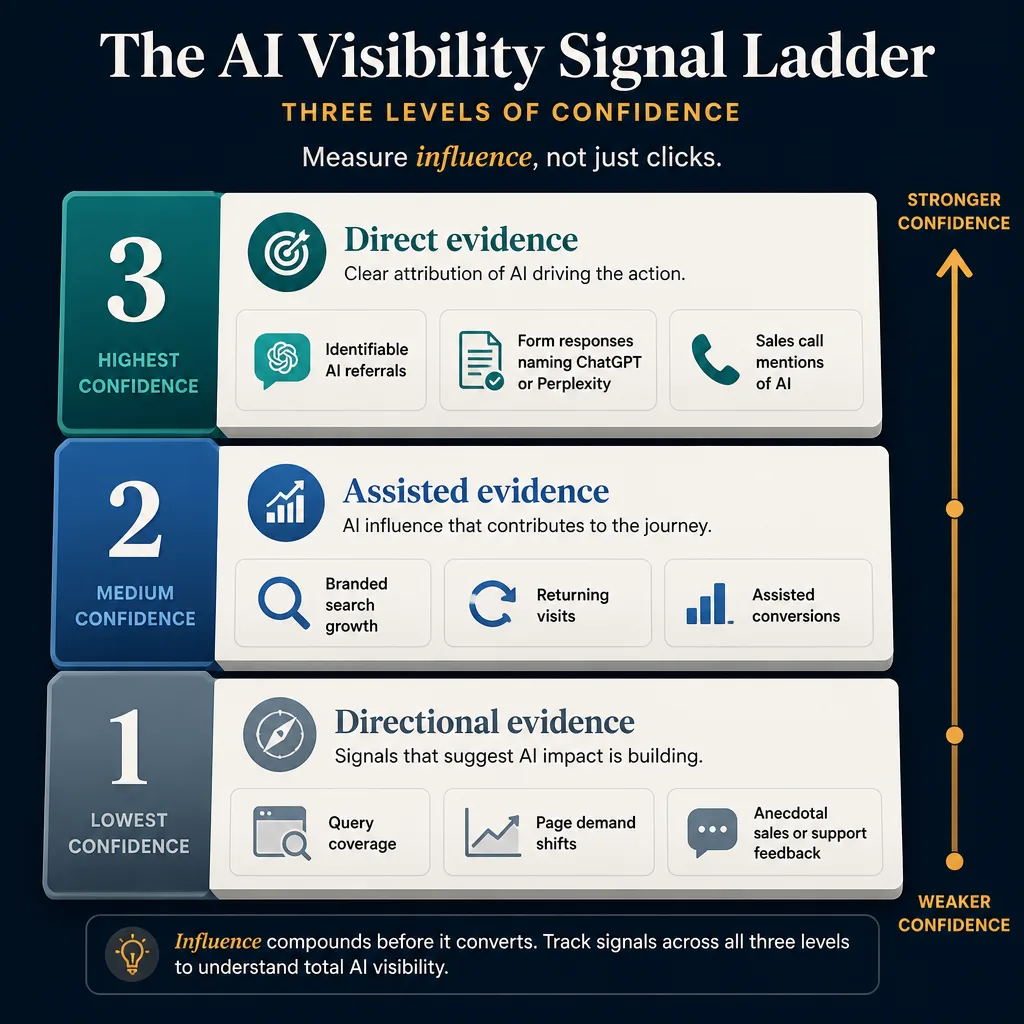
For most small businesses, AI visibility should be measured the way you’d measure any fuzzy but important awareness source: by combining signals and giving each one an appropriate level of trust.
A useful framework is the AI Visibility Signal Ladder:
- Level 1: Direct evidence — clear AI referrals, form responses like “found you on ChatGPT,” sales-call mentions
- Level 2: Assisted evidence — branded search growth, returning visits, assisted conversions from relevant pages
- Level 3: Directional evidence — query coverage, demand shifts, anecdotal feedback from sales or support
The point is not to treat every signal equally. The point is to avoid false certainty.
What you can track directly and what you can only estimate
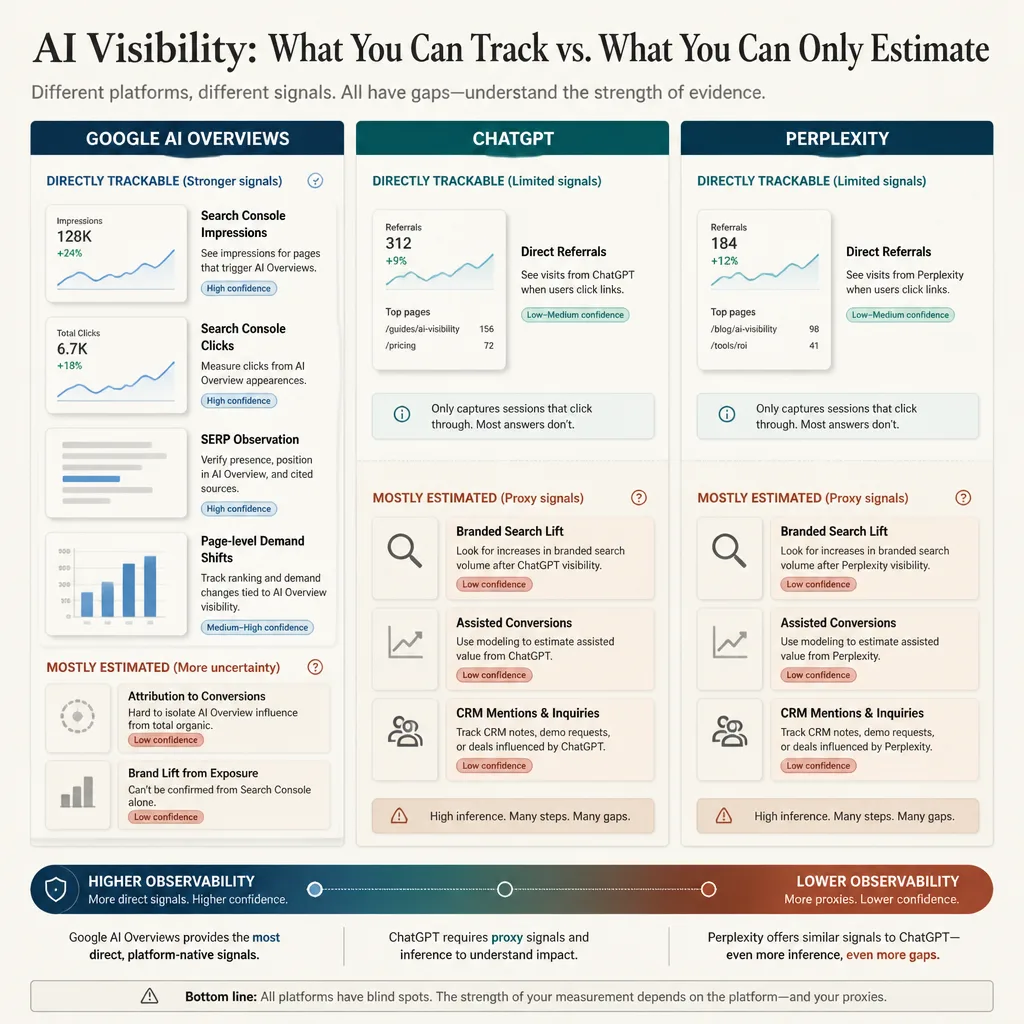
Google AI Overviews: somewhat observable
Google AI Overviews are easier to study than closed AI tools because they sit inside the broader Google search ecosystem.
You still usually won’t get a dedicated “AI Overviews traffic” report in Google Search Console. But you can often spot effects indirectly through:
- changes in impressions and clicks for affected queries
- page-level demand shifts
- manual SERP checks for important prompts
- third-party SERP tools such as Semrush or Ahrefs
That is still partial visibility, not clean attribution. But it’s more observable than most standalone AI assistants.
ChatGPT and Perplexity: direct data is limited
ChatGPT and Perplexity can send traffic. Sometimes those visits appear in analytics with recognizable referral data. Sometimes they don’t.
This is where teams often overreact. They see tiny visible referral numbers and conclude there is no meaningful impact.
A more honest interpretation is this: direct measurement is incomplete, so you need to rely more on assisted and directional signals.
A simple confidence model
If you need one rule, use this:
- Direct signals tell you AI influence definitely happened.
- Assisted signals suggest AI may be contributing.
- Directional signals show discoverability may be improving before revenue is obvious.
That framing helps you report results without pretending to know more than the data allows.
The four proxies that matter most
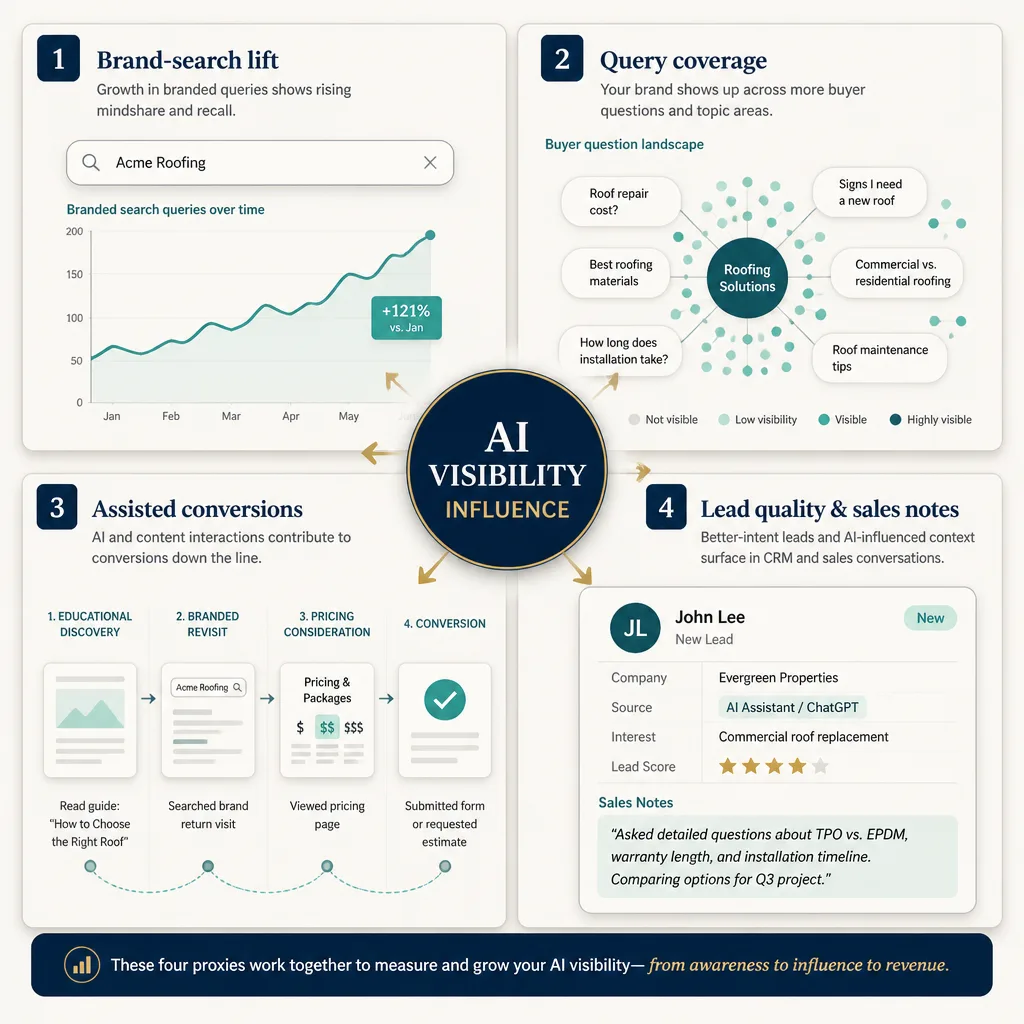
Brand-search lift
For many small businesses, branded search is the strongest practical proxy.
If someone sees your business in an AI answer but doesn’t click, the next move is often a Google search for your brand, founder, product, or a modifier like “pricing,” “reviews,” or “demo.” You can monitor that in the Search Console Performance report.
Define a fixed branded query set up front:
- brand name
- common misspellings
- founder name, if relevant
- product names
- high-intent modifiers like “pricing,” “reviews,” “demo,” or “alternatives”
A realistic example: a small service business sees almost no visible ChatGPT referrals in GA4, but over six weeks it notices rising branded impressions, more direct visits to service pages, and several calls where prospects say, “I found you through ChatGPT.” No single metric proves causation. Together, they form a credible pattern.
The limitation is obvious. Branded search is influenced by email, social, PR, podcasts, paid campaigns, and seasonality. Treat it as directional unless it lines up with other signals.
Query coverage
This is an early signal, and many teams overlook it.
The real question isn’t just “Did AI send traffic?” It’s “Are we becoming more visible for the questions buyers ask?”
Build a fixed list of topic clusters tied to likely prompts, such as:
- “best [software category] for [use case]”
- “[problem] alternatives”
- “how to solve [pain point]”
- “[tool A] vs [tool B]”
- “[service] for [industry]”
Then track those clusters in Search Console. Watch for growth in impressions, clicks, and the number of pages entering visibility.
For a SaaS company, this might mean publishing comparison pages and use-case FAQs. Search Console may show non-branded query growth on those topics before demo requests increase. That matters because visibility usually shows up before revenue does.
Assisted conversions
AI often introduces the brand early. The conversion happens later.
In GA4, that means looking beyond source/medium and into path relationships. Use GA4 attribution and path reports to see whether AI-relevant landing pages appear in conversion journeys.
A practical setup:
- create a page group for AI-relevant pages
- compare new vs. returning users on those pages
- review key event rates
- inspect assisted paths for visitors who first landed on educational or comparison content
A typical pattern might look like this:
- Day 1: user lands on a comparison page
- Day 4: returns via branded search
- Day 8: visits the pricing page directly and converts
GA4 will not prove that ChatGPT caused the first visit. But if those pages are showing up more often in successful paths, that is commercially meaningful.
Lead quality and sales notes
This is one of the most useful signals, especially for smaller businesses.
Add a simple “How did you hear about us?” field to your CRM or lead form. Keep the options short:
- Google search
- ChatGPT
- Perplexity
- Google AI Overviews
- referral
- social
- YouTube
- podcast
- friend or colleague
- not sure
Then add a free-text note field for exact wording.
If you take phone leads, train staff to ask a short version: “Did you find us through Google, ChatGPT, Perplexity, a referral, or somewhere else?”
This matters because explicit self-reports can confirm what analytics misses. If three qualified leads in a month independently mention ChatGPT, that is strong evidence even if GA4 shows them as direct.
A practical measurement stack
GA4
In GA4, keep the setup narrow.
Create comparisons or views for:
- branded organic traffic
- direct traffic to high-intent pages
- sessions landing on AI-relevant pages
- new vs. returning users for those pages
- assisted conversions involving those pages
If your traffic is small, don’t analyze the whole site. Focus on an AI-relevant page set instead: comparison pages, category pages, solution pages, and educational pages tied to buyer questions.
Search Console
In Search Console, save filters for:
- your branded query set
- target non-branded topic clusters
- AI-relevant landing pages
- device and country segments, if volume is uneven
Keep the taxonomy stable for at least 30 to 90 days. If you keep changing your query groups, the trend data stops being useful.
CRM tagging
Keep intake simple enough that people actually complete it.
A good rule is:
- one required source field
- one optional notes field
Define what counts as an AI-influenced lead before rollout:
- explicit self-report on a form
- explicit mention in a sales note
- call transcript or intake note naming an AI platform
Do not tag leads based on hunches.
Optional additions
A spreadsheet is enough for most small teams.
Track weekly:
- branded impressions
- branded clicks
- topic-cluster query coverage
- sessions to AI-relevant pages
- direct visits to commercial pages
- assisted conversions
- AI-tagged leads
- lead quality notes
- annotations for campaigns, launches, PR, or promotions
You can also manually test a small set of prompts in AI tools and Google to see whether your brand appears. That isn’t rigorous ranking data, but it can help validate early visibility.
A good-enough dashboard
Your dashboard does not need to be sophisticated. It needs to answer one question:
Is AI-driven discovery becoming more plausible and more commercially meaningful?
A useful dashboard usually includes five sections:
- Direct evidence
- Branded demand
- Topic visibility
- Conversion influence
- Lead quality
At minimum, include:
- identifiable AI referrals in GA4, if any
- leads explicitly tagged as ChatGPT, Perplexity, or Google AI Overviews
- branded impressions and clicks in Search Console
- query coverage for priority topic clusters
- organic sessions to AI-relevant landing pages
- direct sessions to high-intent pages
- assisted conversions involving AI-relevant pages
- lead-to-opportunity or lead-to-sale rate for AI-tagged leads
The key is how you read it. Look for overlap, not single-metric wins.
A convincing pattern looks like this:
- topic visibility rises
- branded search increases
- more people return to commercial pages
- CRM mentions of AI tools increase
- lead quality stays acceptable
That is much more credible than saying, “ChatGPT traffic is up 20%,” when the underlying sample is six visits.
A 30-day baseline plan
Week 1: define the pages, queries, and conversions that matter
Choose a narrow set of pages and query clusters tied to buyer intent.
This is where many teams go wrong. They track broad informational visibility instead of the topics and pages that can actually influence pipeline.
Week 2: set up tracking and CRM fields
Build your GA4 comparisons, save Search Console filters, and add CRM source fields.
If needed, start with a shared spreadsheet before building a full dashboard.
Week 3: record baseline data and annotate distortions
Capture your starting metrics and annotate anything that could distort interpretation:
- email campaigns
- branded paid search
- launches
- PR coverage
- webinars
- affiliate pushes
Without annotations, normal demand shifts can easily be mistaken for AI influence.
Week 4: review early patterns
At the end of 30 days, don’t try to prove ROI.
Use the first month to create a baseline. For many small businesses, useful directional insight appears over 60 to 90 days, not four weeks. Monthly reporting is usually more reliable than weekly reporting because low-volume data is noisy.
Where this approach breaks down
Low-volume sites
If your site has low traffic or very few leads, weekly analysis can become fiction. In that case, widen the time window, group queries more broadly, and rely more heavily on explicit lead-source data.
Branded campaigns can distort the signal
If branded paid search, PR, podcasts, or social campaigns are running at the same time, branded search lift becomes much harder to interpret. The signal may still be real, but the AI-specific conclusion becomes weaker.
Correlation is not proof
This is the discipline most teams need.
- Correlation: branded search rose after AI-focused content launched
- Plausible influence: branded search rose, query coverage improved, and leads began mentioning ChatGPT
- Proof: much harder, usually requiring cleaner attribution or controlled testing
For most small businesses, you won’t get proof. But you can often get enough evidence to make a better decision.
What “good enough” actually looks like
The goal is not perfect attribution. The goal is better judgment.
A useful system helps you answer practical questions:
- Should we keep investing in content that is likely to surface in AI answers?
- Are the right pages showing up around buyer questions?
- Is that visibility leading to qualified demand?
- Are multiple signals moving together?
Your measurement system is good enough when:
- your page set and query set remain stable
- your dashboard shows trends over time
- your CRM consistently captures explicit AI mentions
- you can separate direct, assisted, and directional evidence
- you can explain findings without overstating certainty
That is the real standard.
Conclusion
AI visibility is difficult to measure for the same reason it matters: it often shapes discovery before analytics can capture it cleanly.
For small businesses, the practical answer is not to wait for perfect referral data. It’s to build a lightweight signal stack. Track what you can directly, use brand-search lift and query coverage as proxies, study assisted conversions in GA4, and capture explicit AI mentions in your CRM.
No single metric will prove impact. But when multiple signals line up over time, the picture becomes clear enough to guide investment.
That’s what good measurement is for: not settling every attribution debate, but helping you make the next decision with more confidence.
FAQ
Why is AI visibility hard to measure?
Because AI platforms often influence discovery without passing clean referral data into analytics. A person may first encounter your brand in ChatGPT, Perplexity, or Google AI Overviews, then return later through branded search, direct traffic, or another session that hides the original source.
Can you track ChatGPT and Perplexity traffic directly in GA4?
Sometimes, but not reliably. Some visits appear with identifiable referrals, while others show up as direct, organic, or unattributed traffic depending on app, browser, and click behavior. That’s why most small businesses need proxy metrics, not direct attribution alone.
Is Google AI Overviews easier to measure than ChatGPT or Perplexity?
Partially. Because AI Overviews sit within Google’s search ecosystem, Search Console and SERP observation can reveal changes in impressions, clicks, and query behavior. But most sites still do not get a dedicated AI Overviews report, so the measurement is still indirect.
What are the best proxy metrics for AI visibility?
For most small businesses, the most useful proxies are brand-search lift, query coverage for relevant topics, assisted conversions from key landing pages, and CRM or sales-note mentions where leads explicitly say they found you through an AI tool.
Does branded search growth prove AI is working?
No. Branded search lift is a directional signal, not proof. It becomes more persuasive when it lines up with other evidence, such as increased topic coverage, more conversions from relevant pages, and explicit mentions in forms or sales calls.
What should a small business include in an AI visibility dashboard?
A practical dashboard should include any direct AI referrals you can detect, branded query trends in Search Console, topic-cluster query coverage, organic and direct sessions to relevant landing pages, assisted conversions, AI-tagged leads in your CRM, and the quality of those leads.
How should leads be tagged in a CRM to measure AI influence?
Keep it simple. Add a short “How did you hear about us?” field with options such as Google search, ChatGPT, Perplexity, Google AI Overviews, referral, social, YouTube, podcast, and not sure. Pair it with a free-text note field so prospects or sales reps can capture the exact wording.
How long does it take before AI visibility measurement becomes useful?
A 30-day setup period is enough to create a baseline, but many small businesses need 60 to 90 days before patterns become directionally reliable. Low-traffic sites usually need longer windows and should rely more on grouped trends and qualitative lead-source data.