How to Recruit Your First 25 Affiliates: A Practical Outreach System, Landing Page Template, and Tracking Stack
If you have launched an affiliate program—or are about to—you have probably run into the same problem most early teams face: the program exists, but no meaningful partner activity follows. You do not need hundreds of signups. You need a small group of relevant affiliates who understand your offer, reach the right audience, and will actually promote it.
Learning how to recruit affiliates is only part of the job. The other part is activation: giving partners a reason to join, a clear path to launch, and reliable tracking once they send traffic.
This guide walks through a simple system you can run without a full partnerships team. It covers where to find your first partners, how to prioritize them, what to say in outreach, what assets to prepare, how to structure your affiliate landing page, and how to set up a basic tracking stack with affiliate links and UTMs.[^1]
Recruit for Activity, Not Signups
The first 25 affiliates matter because they reveal what your program really is.
A large inactive program does not teach you much. A small active one shows which audiences respond, which messages convert, what objections come up, and which partner types are worth pursuing next.
Why the first 25 matter
Early affiliate growth is usually not a scale problem. It is a fit and activation problem.
If 100 affiliates sign up and none send qualified traffic, you do not have a partner channel. You have a signup list. If 5 affiliates consistently drive strong traffic, you have something you can improve.
The goal of your first push
Think of your early affiliate effort as a simple operating system:
- Recruit likely-fit partners
- Equip them with useful assets
- Onboard them quickly
- Track what happens
- Improve based on activation, not vanity metrics
Bottom Line: Your first affiliate program should help you learn who can actually sell, not just who will sign up.
Use an Activation Funnel, Not a Signup Goal
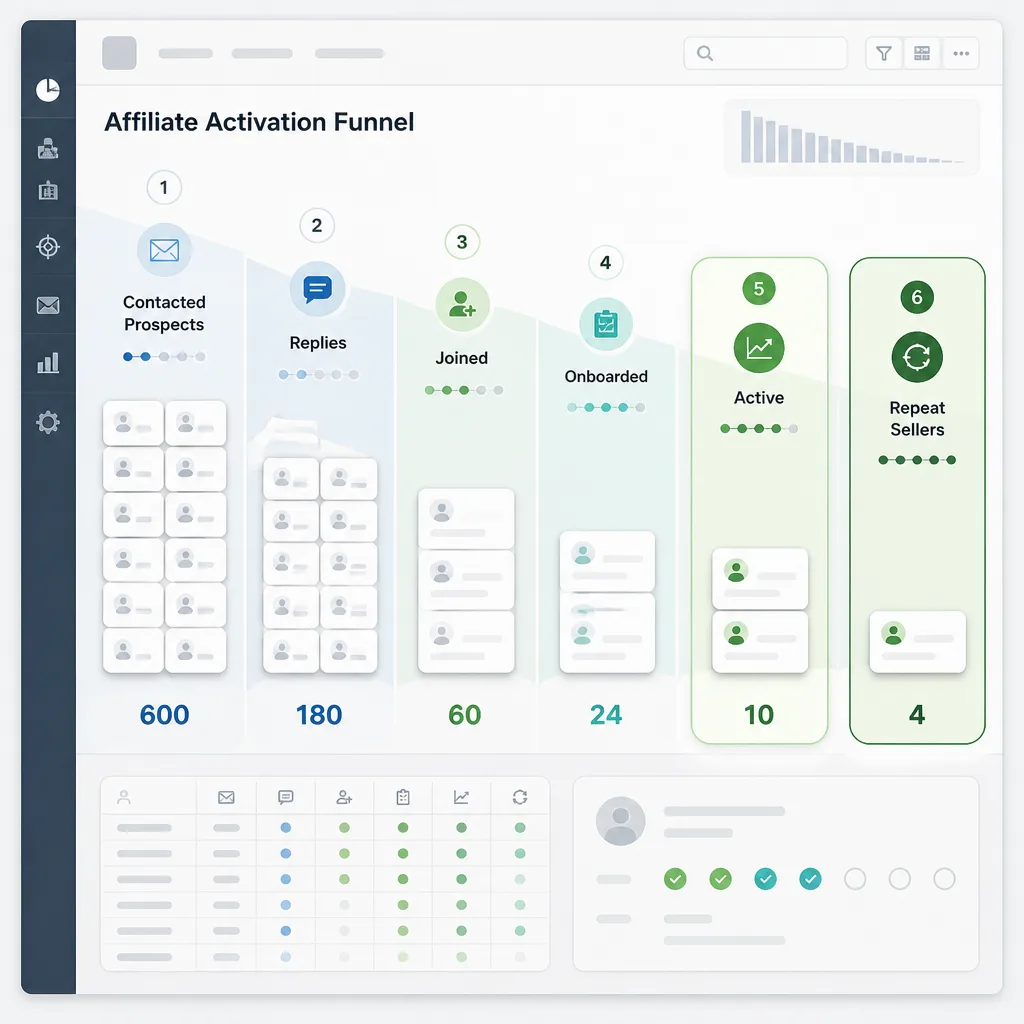
Many teams treat affiliate recruitment as the goal. It is not. Recruitment gets someone into the program. Activation gets them to publish, email, share, or launch.
A realistic early benchmark
A practical target looks like this:
The 25-Affiliate Activation Funnel
| Stage | What It Means | Healthy Early Benchmark |
|---|---|---|
| Contacted | You reached a relevant prospect | 50–75 |
| Replied | They showed interest | 15–25 |
| Joined | They signed up or were approved | 10–15 |
| Onboarded | They received assets and next steps | 10 |
| Active | They launched at least one campaign | 5 |
| Repeat seller | They drove ongoing sales | 2–3 |
This keeps the focus on output, not volume.
Decision Rule: If too few affiliates become active, improve partner fit and onboarding before increasing outreach.
Use the 4-Source Model to Find Your First Partners
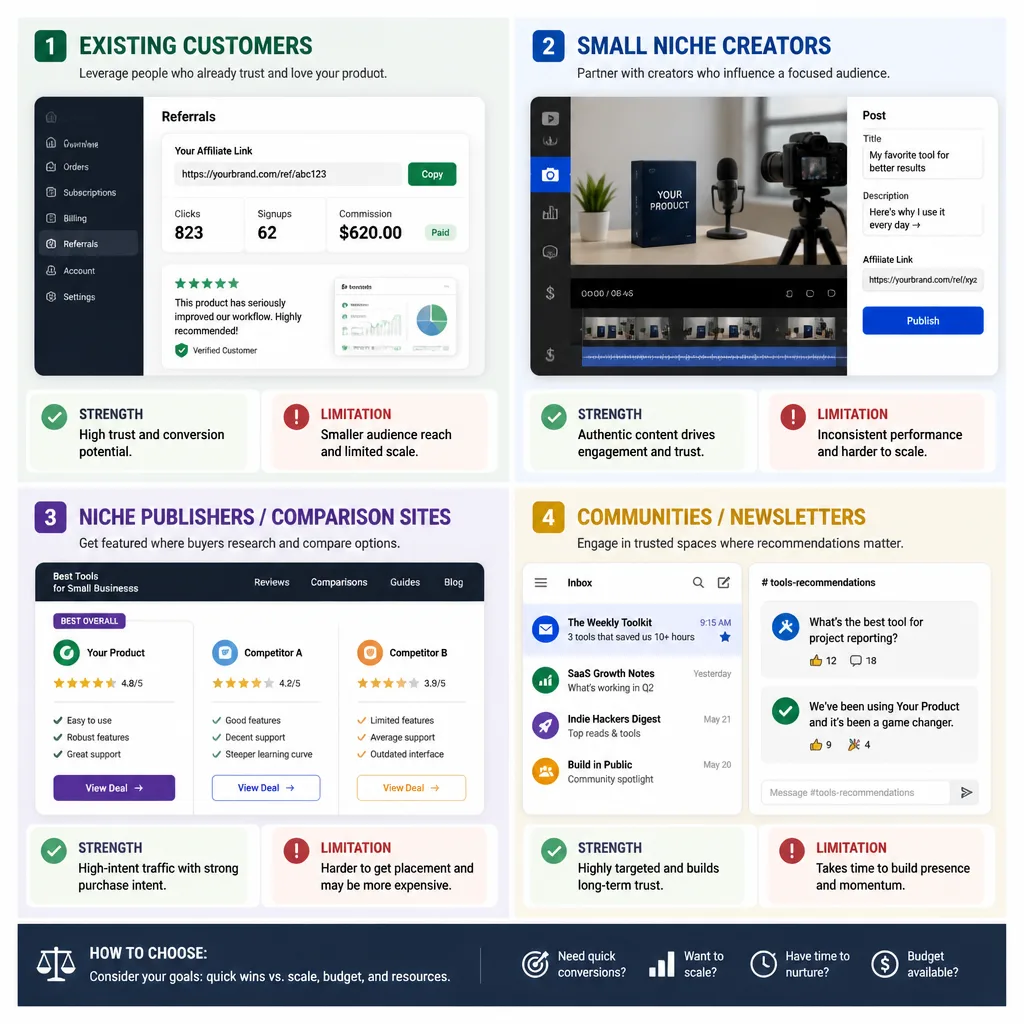
Broad affiliate marketplaces can help later. Your first 25 usually come from relevance, not reach.
Source 1: Existing customers
Customers often make the best early affiliates because they already know the product, trust the outcome, and can speak from experience.
Example: A SaaS customer posts on LinkedIn that your product saves their team several hours a week. If they also consult for the same kind of buyer you target, they may be a strong affiliate candidate. The pitch is not “we have a program.” It is “you already understand the value, and your audience likely has the same problem.”
Source 2: Small niche creators
Smaller creators often outperform bigger ones when audience fit is strong. A newsletter with 3,000 engaged subscribers can beat a social account with 100,000 broad followers.
Look for creators who publish tutorials, practical breakdowns, use cases, or tool recommendations.
Source 3: Niche publishers and comparison sites
These partners can bring high-intent traffic because they rank for searches like “best tools for X” or “Y vs Z.” That makes them especially useful for SaaS and considered ecommerce purchases.
The tradeoff is speed. Editorial partners often need more context, proof, and lead time.
Source 4: Communities and newsletters
Operators of niche newsletters, private groups, and communities can test offers quickly when the fit is clear. In some cases this looks like a standard affiliate relationship. In others, it works better as a co-branded campaign or partner offer.
The 4-Source Recruitment Model
| Source | Best For | Why They Convert | Outreach Angle | Limitation |
|---|---|---|---|---|
| Existing customers | Fast early wins | They know the product and trust the result | Reference their experience | Small pool |
| Small creators | Niche trust | Strong audience alignment | Reference a specific post or use case | Limited reach |
| Niche publishers | High-intent traffic | Visitors are closer to a decision | Show fit for a guide, comparison, or roundup | Slower process |
| Communities/newsletters | Concentrated audience access | Can test relevant offers quickly | Offer a clear angle or exclusive value | Promotion rules may limit access |
Key Insight: Smaller niche affiliates often outperform bigger names because trust and intent are stronger.
Prioritize the Right Prospects First
Not every possible affiliate deserves outreach.
What good-fit prospects look like
Strong prospects usually show a few patterns:
- They serve the same customer type you want
- They talk about adjacent problems your product solves
- They recommend tools or workflows, not just entertainment
- Their audience responds to practical content
Red flags to watch for
Be cautious with:
- Coupon-only or cashback-focused partners
- Broad traffic sources with weak trust
- Generic accounts with no clear niche
- Prospects focused only on commission rates
Coupon and cashback affiliates can matter later, but they are often a weak fit for your first 25 if your goal is learning and qualified demand.
A lightweight scoring system
| Criterion | What to Look For | Score Range |
|---|---|---|
| Audience fit | Same buyer, same problem space | 1–5 |
| Trust level | Strong engagement, niche credibility | 1–5 |
| Promotion style | Tutorials, guides, recommendations | 1–5 |
| Intent quality | Likely to send relevant traffic | 1–5 |
| Ease of contact | Reachable through a clear channel | 1–5 |
Use a 25-point score:
- 18–25: high priority
- 13–17: medium priority
- Below 13: low priority
Decision Rule: If it is not clear who in their audience would want your product, they are probably not a priority prospect.
Run Outreach From a Spreadsheet
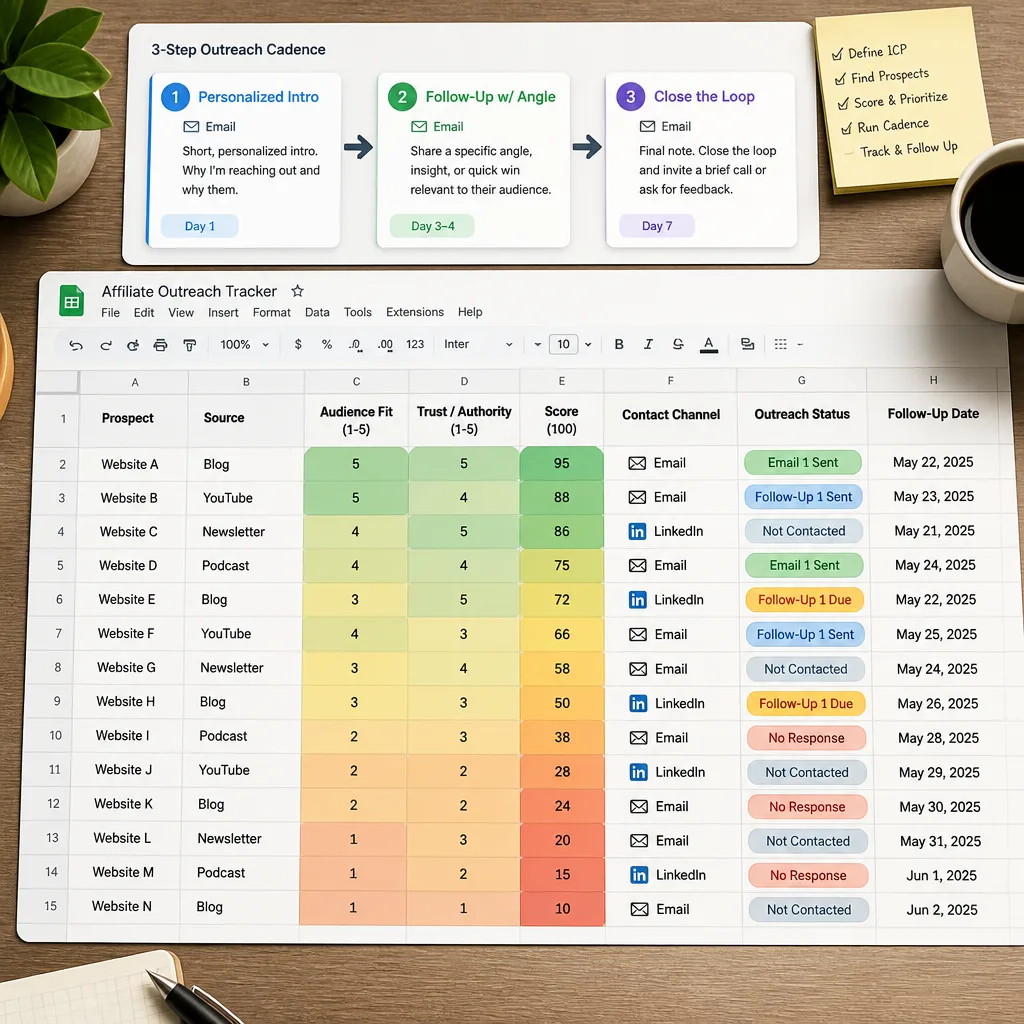
You do not need a CRM to recruit your first affiliates. A clean spreadsheet is enough.
Start with 50 to 75 prospects
That gives you room for non-replies, weak fits, and slow responses without forcing mass outreach.
Track the minimum useful fields
Include:
- Prospect name
- Company, site, or account
- Source category
- Audience type
- Contact name
- Contact channel
- Relevance angle
- Trust notes
- Score
- Outreach status
- First contact date
- Follow-up date
- Joined status
- Onboarded status
- First campaign date
- First conversion date
Use a simple 3-touch cadence
- Touch 1: Personalized intro with a clear fit angle
- Touch 2: Short follow-up with one suggested use case or asset
- Touch 3: Brief close-the-loop note
Keep it personal. Relevance matters more than automation.
Common Mistake: Sending a generic “join our affiliate program” blast. That gives the prospect no real reason to care.
Outreach Templates That Sound Human
The goal of outreach is to show fit, not force a signup.
Customer affiliate pitch
Subject: Quick idea based on your experience with [Product]
Hi [Name],
I saw your note about using [Product] for [specific result or use case]. Since you already know how it helps with [problem], I thought you might be a strong fit for our affiliate program.
A number of people in your audience may care about [specific outcome]. If helpful, I can send over a partner link, a suggested landing page, and a simple promo angle based on the result you already saw.
Would you like me to send details?
Creator or publisher pitch
Subject: Possible fit for your audience covering [topic]
Hi [Name],
I came across your [post, video, or newsletter] on [specific topic] and thought there might be a strong fit with what you cover for [audience type].
We help [target audience] solve [specific problem]. For your content, a natural angle might be [tutorial, use case, or comparison]. If useful, I can send a short partner brief with commission details, example copy, and the landing page we would recommend first.
Open to me sending that over?
Follow-up message
Hi [Name],
Just following up in case this is relevant. I think the strongest angle for your audience would be [specific angle], especially since you already cover [related topic].
If helpful, I can send:
- a sample promo message
- the best-fit landing page
- tracking instructions
- partner terms
No pressure if the timing is off.
What to personalize
Personalize these four things:
- A specific post, article, or comment
- The audience they serve
- The exact problem your product solves for that audience
- One promotion format that matches their style
Example: If a creator teaches ecommerce retention, do not say “our product is great.” Say “your audience already thinks about repeat purchase and lifecycle messaging, so this use case is likely the strongest first angle.”
Give Affiliates What They Need to Launch
Affiliates often fail for a simple reason: the program asks them to do too much work.
Make the basics clear
At minimum, explain:
- Commission structure
- Cookie duration
- Payout threshold
- Payout timing
- Approval criteria
- Any prohibited traffic sources
- Support contact
Build a focused starter pack
Affiliate Starter Pack Checklist
- Affiliate link
- UTM guidance
- Best landing page to use first
- 2–3 headline variations
- Short and long swipe copy
- Images or banners if relevant
- Product benefits by audience type
- FAQs
- Social proof snippets
- Objection handling
- One recommended first campaign idea
A compact starter pack is better than a folder full of unused files.
Decision Rule: If you cannot give a new affiliate one recommended angle and one relevant landing page within 5 minutes, your onboarding materials are not ready.
Build a Simple Affiliate Landing Page
Your affiliate landing page should recruit and qualify at the same time.
What it should do
A good page answers five questions quickly:
- Is this relevant to my audience?
- Will this offer convert?
- How do I get paid?
- What support will I get?
- Can I trust the tracking?
Suggested structure
- Headline
- Partner value proposition
- Who the product is for
- Why it converts
- Commission and payout details
- Social proof
- Promotional fit examples
- FAQs
- Signup or application CTA
Example headline
Promote the platform helping ecommerce brands recover more revenue—and earn recurring commission for every qualified referral
What to include
Explain:
- Who the product is for
- What problem it solves
- Why that problem matters
- Why the offer tends to convert
- Commission details and partner benefits
- Proof points, objections, and FAQs
Bottom Line: A strong affiliate landing page reduces uncertainty. It helps good-fit partners decide quickly and filters out weak-fit ones.
Use a 7-Day Onboarding Sequence
Recruitment gets the yes. Onboarding gets the first campaign live.
Day 0: Welcome email
Include:
- Welcome note
- Affiliate link
- Dashboard or login instructions
- Best landing page
- Best first promotional angle
- Support contact
Day 1 to 3: Recommend one angle
Give one clear recommendation based on affiliate type.
- For a customer advocate: share the workflow result you got
- For a blogger: use a comparison or roundup angle
- For a creator: lead with a tutorial use case
Day 4 to 5: Resend the essentials
Send the key assets and tracking instructions again. Do not overwhelm them with everything.
Day 7: Personal check-in
Ask a direct question:
- Do you need a custom angle?
- Do you want a better landing page match?
- Do you need example copy?
That often prompts the first real reply.
Set Up a Reliable Tracking Stack
Your affiliate setup does not need to be complicated. It does need to be trustworthy.
Track these from day one
- Affiliate identifier
- Destination page
- UTM parameters
- Click activity
- Conversion events
- Payout basis
- Manual adjustments or exceptions
Use a simple UTM naming structure
For example:
utm_source=affiliate&utm_medium=partner&utm_campaign=creatorname_offername
This makes affiliate traffic easier to analyze in your analytics platform.[^2]
Know what each piece does
Affiliate links and UTMs serve different purposes:
- Affiliate link: credits the conversion to the partner
- UTM tags: explain source and campaign behavior in analytics
- Landing page: maintains message match
- Analytics and events: show what visitors did after the click
When a spreadsheet is enough
| Layer | Minimum Setup | Why It Matters |
|---|---|---|
| Affiliate link generation | Unique partner links | Attributes referral conversions |
| UTM tagging | Standard naming convention | Analyzes traffic behavior |
| Analytics | GA4 or similar | Measures sessions and events[^1] |
| Conversion events | Trial, lead, sale, purchase | Verifies traffic quality |
| Payout records | Spreadsheet or tool ledger | Prevents disputes |
A spreadsheet is fine when you have a small number of partners, simple payouts, and low operational complexity. Move to affiliate software when partner volume grows, disputes increase, or you need self-serve dashboards and stronger controls.
When a Managed Traffic Partner Makes Sense
This is not the first step. It is a later one.
Why scaling can become difficult
Some affiliates are strong at messaging and audience trust but weak at paid acquisition or traffic operations. They may have a converting angle but no way to scale beyond their owned audience.
Where a managed traffic partner fits
A managed traffic partner can help when:
- the offer already converts
- the affiliate has a proven angle
- tracking is clean
- the team wants to test more qualified click volume
Scenario: A niche publisher has a comparison page and an email segment that converts well, but they cannot scale traffic beyond their existing audience. At that point, a managed traffic partner like Traffics.io can help test qualified click acquisition without requiring the affiliate or advertiser to build a media-buying operation from scratch.
Decision Rule: Do not scale traffic until the message, landing page, and attribution path already work. Scale amplifies what is there—good or bad.
Common Mistakes That Hurt Early Affiliate Recruitment
Recruiting for volume instead of fit
Fix: Score prospects and focus outreach on aligned audiences.
Leading with commission
Fix: Start with audience relevance. Talk economics after interest is established.
Giving affiliates no clear angle
Fix: Provide one recommended campaign idea and a focused starter pack.
Ignoring onboarding
Fix: Run a 7-day sequence and follow up personally.
Trusting weak tracking
Fix: Test links, verify conversion events, standardize UTMs, and reconcile payouts regularly.
Bottom Line: Most early affiliate problems are operational. Better fit, cleaner onboarding, and reliable tracking usually matter more than raising commission.
A 30-Day Plan to Recruit Your First 25 Affiliates
-
Week 1: Define the offer, assets, landing page, and tracking
Set commission and terms, build the starter pack, publish the affiliate page, choose spreadsheet or software, and test tracking end to end. -
Week 2: Build your prospect list and start outreach
Use the 4-source model to build a list of 50 to 75 prospects, score them, and begin personalized outreach. -
Week 3: Follow up, onboard responders, and activate first partners
Approve strong applicants, send onboarding, answer objections, and help the first partners launch. -
Week 4: Review results and refine the system
Review who replied, joined, and activated. Improve outreach copy, landing pages, and assets based on what actually worked.
Key Takeaways
The fastest way to recruit your first affiliates is not to cast the widest net. It is to build a focused system around partner fit, fast activation, and reliable tracking.
Start with existing customers, niche creators, relevant publishers, and trusted community operators. Prioritize fit over volume. Keep outreach personal. Give affiliates a small set of useful assets instead of an overwhelming library. Then track performance cleanly enough to trust what you learn.
Do that well, and your first 25 affiliates become more than names in a dashboard. They become the foundation of a partner channel that can actually grow.
FAQ
How do you recruit your first affiliates without a partnerships team?
Start with a focused system instead of broad outreach. Build a list of 50 to 75 prospects from four sources: existing customers, niche creators, publishers, and communities or newsletters. Score them for audience fit, trust, promotion style, intent quality, and ease of contact. Then run a simple 3-touch outreach cadence from a spreadsheet and focus on activating the best-fit partners.
Where should I look first when trying to recruit affiliates?
Start with people who already have trust with the audience you want to reach. Existing customers are often the best early source because they understand the product and can speak credibly about it. After that, prioritize small niche creators, relevant bloggers or comparison sites, and operators of newsletters or communities with clear audience overlap.
What is a realistic goal for an early affiliate program?
A practical benchmark is 25 recruited affiliates, 10 onboarded, 5 active, and 2 to 3 producing repeat sales. That keeps the focus on activation and output rather than vanity signup numbers.
How many affiliate prospects should I contact to recruit the first 25?
A reasonable starting range is 50 to 75 prospects. Not every prospect will reply, join, or become active. A smaller, well-prioritized list usually performs better than mass outreach to weak-fit affiliates.
What should an affiliate outreach message include?
A strong outreach message explains why the prospect is a fit. Reference a specific piece of content, audience problem, or use case. Keep the message short, show relevance first, and mention the program only after you establish alignment.
What do affiliates need before they can start promoting?
They need clear program terms and a compact starter pack. That includes commission details, cookie window, payout timing, affiliate links, UTM guidance, recommended landing pages, swipe copy, images if needed, product angles, FAQs, social proof, and objection handling.
What should an affiliate landing page include?
An affiliate landing page should explain what the product is, who it is for, why it converts, what the commission and payout terms are, what support the partner receives, and how to apply or join. It should also include social proof, promotional examples, objections, and FAQs.
What is the minimum viable affiliate tracking setup?
At minimum, track the affiliate identifier, destination landing page, UTM parameters, click activity, conversion events, and payout basis. Affiliate links handle attribution, while UTMs help you analyze traffic behavior in analytics tools.
When is a spreadsheet enough for affiliate tracking and management?
A spreadsheet is enough when you have a small number of partners, a simple offer, and limited payout complexity. Consider affiliate software when partner count grows, disputes increase, payouts become frequent, or you need stronger automation and controls.
When does it make sense to use a managed traffic partner like Traffics.io?
Only after the fundamentals are working. If an affiliate has a proven message, a converting landing page, and reliable tracking but cannot scale qualified click volume on their own, a managed traffic partner such as Traffics.io can help test broader acquisition. It should support scale, not compensate for weak fundamentals.