Re-Engaging an Unsubscribed Client Without Breaking Compliance: 7 Safer Channels
An email unsubscribe creates a specific kind of tension. At minimum, the client has said, “Don’t send me this type of email.” But businesses may still need to communicate about billing problems, account access, security alerts, contracts, or service continuity.
That is where teams get into trouble. Someone in sales, customer success, or marketing asks: If we can’t email them, can we reach out another way?
Usually, that is the wrong question.
The better question is: what communication need, if any, still survives the unsubscribe, and what is the least intrusive way to handle it? Under rules like CAN-SPAM, GDPR, and CASL, the real issue is not finding a loophole. It is separating service communication from promotional outreach, choosing a channel that fits the context, and making renewed consent explicit and easy to prove.[^1][^2][^3]
This article is a practical playbook, not legal advice. The goal is to reduce complaint risk, preserve trust, and create a cleaner internal workflow after an opt-out.
The real goal is not to bypass an unsubscribe
If someone unsubscribed from your newsletter, that does not automatically ban every future message. A billing failure notice or security alert is not the same as a reactivation campaign.[^1]
The more common mistake is treating the unsubscribe as something to work around. Teams switch channels, change sender names, or send a “quick check-in” that is obviously a sales nudge.
That is what creates complaints.
The safest path is not simply switching channels. It is respecting the opt-out, changing the communication context before changing the channel, and asking for renewed permission instead of forcing attention.
First, identify what kind of communication this is
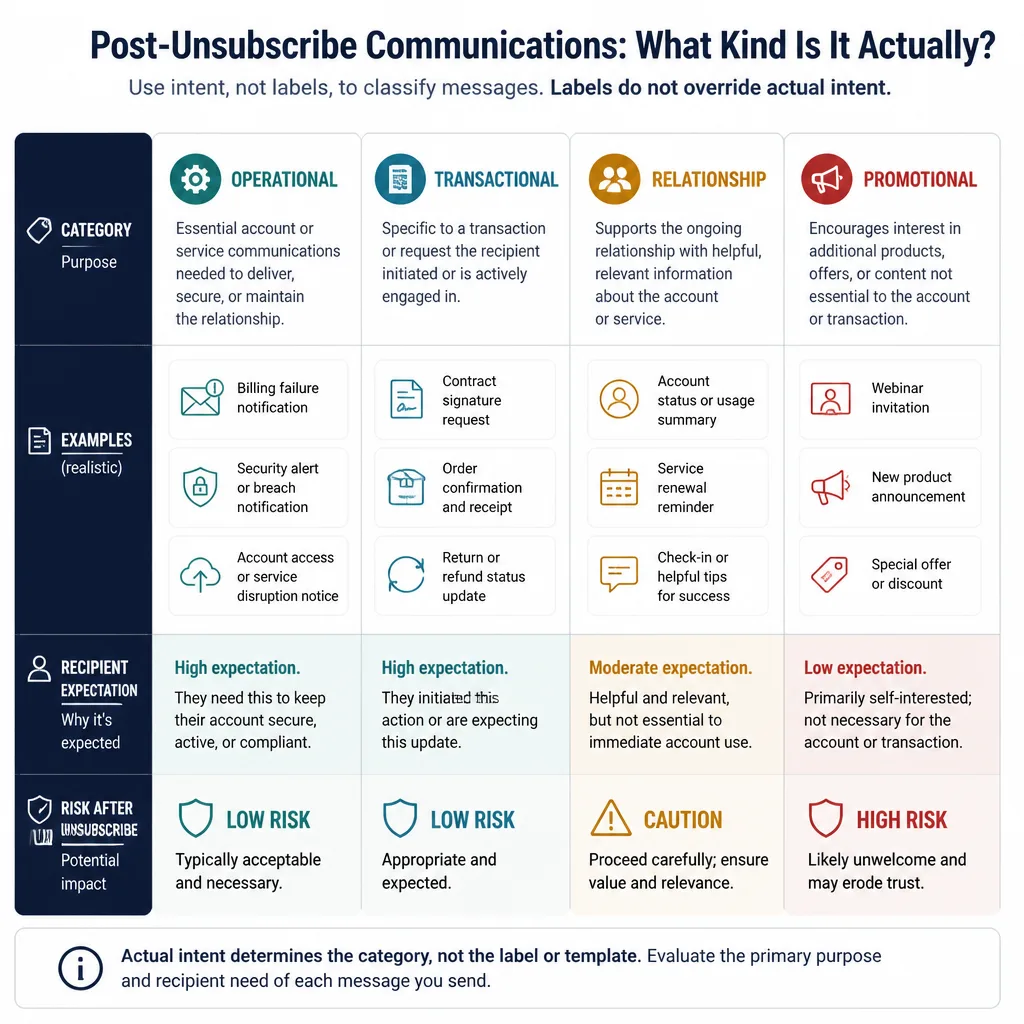
Before picking a channel, classify the message.
Operational, transactional, relationship, or promotional?
This matters more than most teams realize.
A message is easier to justify when it is tied to something the client actively needs right now, such as:
- account access problems
- billing failures
- service interruptions
- security alerts
- contract execution
- delivery or implementation steps
That is different from:
- “we miss you” campaigns
- webinar invites
- product announcements
- upsell outreach
- feature promotion
- “just checking in” notes meant to restart a pipeline
Under FTC CAN-SPAM guidance, transactional or relationship content is treated differently from commercial email.[^1] Under GDPR- and ePrivacy-related frameworks, lawful basis, purpose limitation, and reasonable expectation matter heavily.[^2] Under CASL, message category matters too, and Canada is often stricter than U.S. teams expect.[^3]
Why this matters more than the channel
A phone call can be appropriate or inappropriate.
So can LinkedIn. So can SMS. So can an in-app message.
What changes the risk is not just the medium. It is the purpose, the recipient’s expectation, and whether the message is genuinely necessary.
An in-app alert that says, “Your payment method failed; update billing to avoid service interruption,” is usually easier to justify than a LinkedIn message saying, “Saw you unsubscribed, but wanted to share a new offer.”
Same business. Same contact. Very different risk.
Where teams get into trouble
This is the common failure mode.
A customer success manager says, “It’s not marketing, it’s relationship management.”
An account executive says, “This is one-to-one, not a campaign.”
A marketer says, “We’re just asking them to update preferences.”
Maybe. But labels matter less than substance.
If the real purpose is reactivation, upsell, or renewed attention, recipients will feel that immediately. Regulators and complaint reviewers often will too.
The post-unsubscribe decision framework: should you reach out at all?
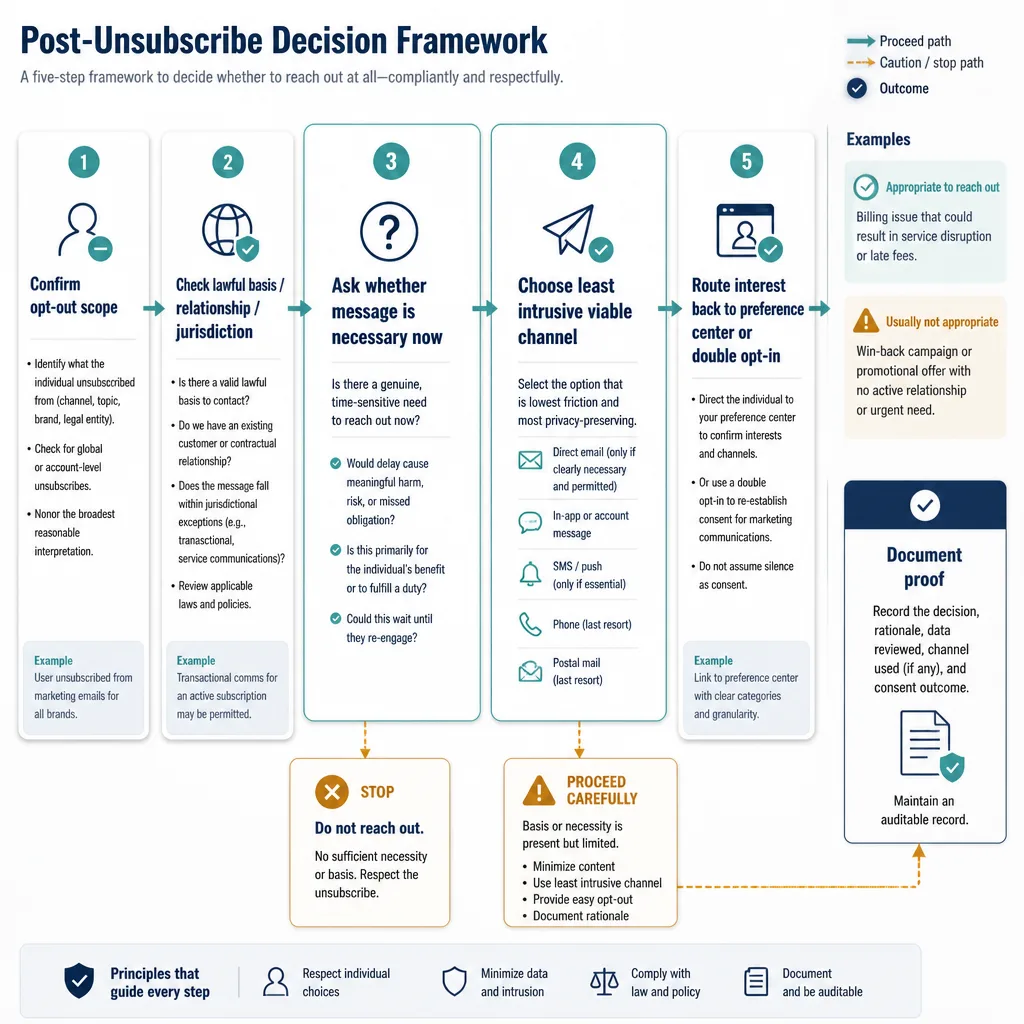
A useful mental model is:
Purpose -> Permission -> Proportionality -> Proof
Simple, but effective.
Step 1: Confirm the opt-out scope
Start with the basics.
Did the person unsubscribe from:
- one newsletter
- all marketing email
- all email from your brand
- SMS too
- specific sales outreach
- a broader communication preference set
Many teams get this wrong because their systems flatten everything into one field. That creates unnecessary silence in some cases and accidental overreach in others.
If your CRM, support platform, and marketing tool each store different suppression data, stop and fix that first.
Step 2: Check lawful basis, customer relationship, and jurisdiction
A prior customer relationship may support some operational contact. It does not erase opt-out expectations for promotional contact.
This becomes more important across borders. U.S. CAN-SPAM, EU privacy rules, Canadian CASL, and telecom rules for calls or SMS do not line up neatly.[^1][^2][^3][^4]
If you are considering phone or SMS, you may also trigger rules such as the FTC Telemarketing Sales Rule or FCC/TCPA-related requirements.[^4][^5]
Step 3: Ask whether the message is necessary now
This is the discipline most teams skip.
Ask:
- Does the client need this information to use, secure, pay for, or continue the service?
- Is there an active account dependency?
- Is delay harmful?
- Or do you simply want their attention back?
If the message is not necessary now, the safest move may be not to reach out.
Step 4: Choose the least intrusive viable channel
If the client is an active user, an authenticated product surface is often cleaner than an outbound interruption channel.
That is why in-app notifications and portal messages are often lower-risk in practice. This is not a universal legal ranking, just a practical one based on context and user expectation.
Step 5: Route any interest back to preferences or double opt-in
If the person wants broader updates again, do not treat the outreach itself as implied re-consent.
Send them to a preference center or a clean resubscribe flow. In higher-risk situations, use double opt-in so the renewed permission is explicit and documented.[^6][^7][^8]
7 safer channels for re-engaging an unsubscribed client
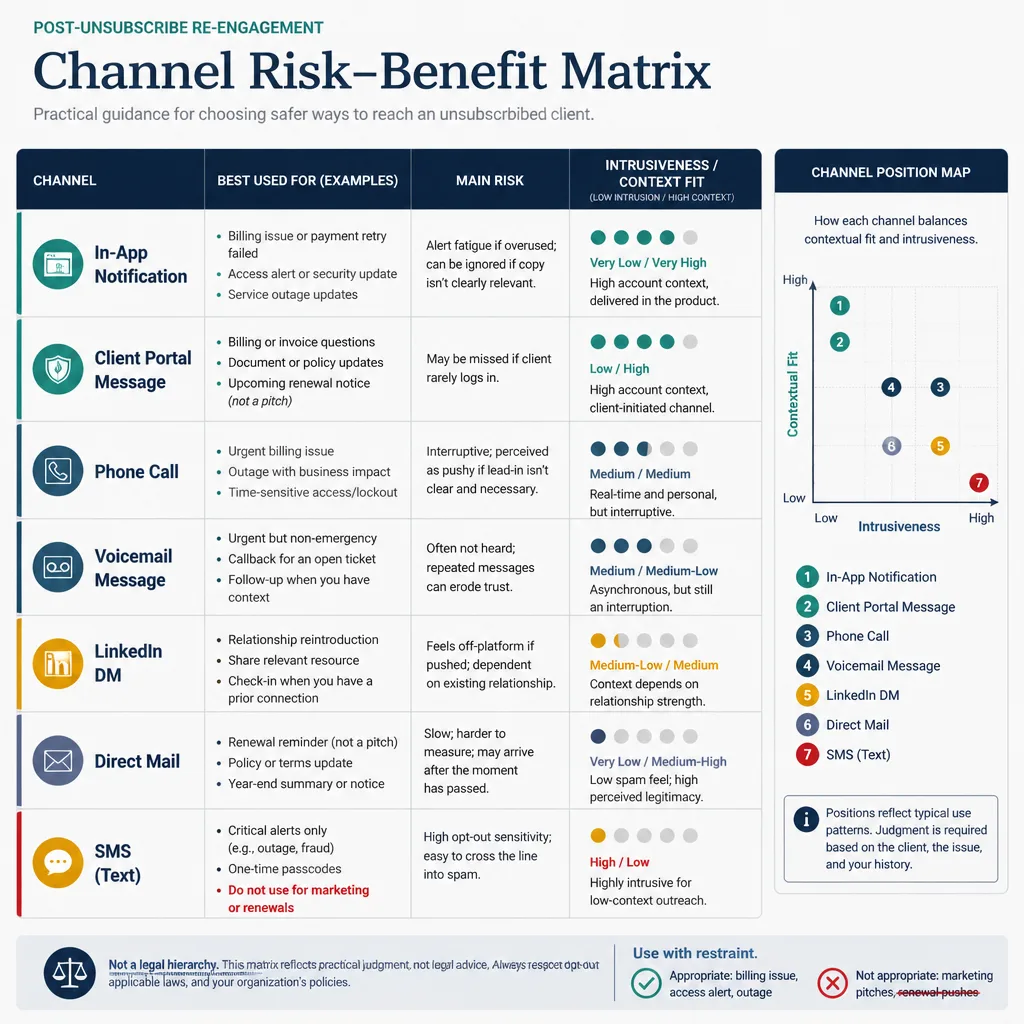
There is no regulator-issued ranking of “safest channels.” What follows is practical risk judgment, not a legal hierarchy.
1. Phone call: best for urgency or account continuity
A phone call is most defensible when the issue is time-sensitive and account-specific.
Good fit:
- account access failure
- implementation blockage
- payment issues affecting service
- contract action needed today
What it should sound like:
“Hi Sarah, this is Mark from Acme. You previously opted out of marketing emails, so I’m not calling about promotions. I’m reaching out because your team’s account access is blocked after a billing error, and I wanted to make sure the right person sees it.”
What it should not become:
- a product pitch
- a renewal upsell
- “while I have you” sales exploration
There is still risk. Calls can feel high-pressure, and telemarketing rules may apply depending on jurisdiction and purpose.[^4][^5]
2. Voicemail: useful when brevity and low pressure matter
Voicemail works when a live call would feel intrusive but the issue is still worth flagging.
A good voicemail is short, specific, and easy to ignore if irrelevant.
Example:
“Hi Sarah, Mark from Acme. This is only about your active account. We noticed a login issue affecting access for your team. If useful, call me back at this number or sign in to the client portal to review it.”
One concise message is very different from a sequence of repeated calls.
3. LinkedIn direct message: only for real existing relationships
LinkedIn is not automatically safer than email.
It can work when:
- there is a real pre-existing relationship
- the contact already interacts there
- the message would not feel surprising
- the purpose is narrow and non-promotional
Timing matters. A LinkedIn DM sent right after an unsubscribe can look evasive, even if the wording is polite.
Example:
“Hi Sarah — noting you opted out of marketing emails, so I’m not following up with a campaign. I wanted to flag one account-related item that may affect your team’s access. If helpful, I can point you to the right portal page, or you can update your communication preferences here.”
4. In-app notification: often the cleanest option for active users
For SaaS and subscription products, this is often the strongest option.
Why? Because it stays inside the service context. You are not pushing into a personal inbox or social platform. You are communicating where the user already expects account information.
Strong use cases:
- billing issues
- expiring credentials
- security prompts
- workspace configuration problems
- preference updates
A useful in-app notice might say:
“Your billing profile needs attention to avoid service interruption. Review account settings or update the types of notifications you want to receive.”
The caution: product teams should not use in-app notices to sneak in promotional recovery campaigns just because email is suppressed.
5. Client portal message: strong for account-specific operational updates
Portal messages work especially well for B2B services, agencies, consultancies, and platforms with authenticated client workspaces.
Best for:
- invoices
- approvals
- compliance documents
- account tasks
- service deliverables
If the client logs in regularly, portal messaging is hard to beat because it is both contextual and auditable.
Its weakness is visibility. If the account is dormant and urgency is high, a portal message alone may not be enough.
6. Direct mail: slower, but sometimes the least spam-like option
Direct mail is underused because it is slower and more expensive. But for a small number of high-value accounts, it can be the least spam-like option.
This works best when:
- the relationship is established
- the matter is serious but not urgent
- the note is respectful and plain
- the goal is clarity, not pressure
Example:
“We’re writing only about your active account and not to restart marketing communication. If you want to choose what operational or product-related updates you receive, you can update your preferences at…”
Direct mail can feel more deliberate and less intrusive than repeated digital touches. It can also feel creepy if the relationship is thin. Judgment matters.
7. SMS: only with existing consent or a clearly valid service basis
SMS belongs on this list only with heavy qualification.
In many contexts, SMS is higher-risk, not lower-risk. Consent expectations are often stricter, and telecom rules can apply.[^4][^5]
Appropriate narrow use:
- appointment changes
- urgent service outage updates
- security verification
- account-critical alerts
Poor use:
- reactivation
- offers
- “we haven’t heard from you”
- asking them to resubscribe to marketing
If you do not have clear prior consent for SMS, or a strong service-related basis that counsel would be comfortable defending, do not improvise here.
What to say without sounding like a workaround
Tone matters almost as much as channel choice.
A low-pressure re-engagement script
A good pattern is:
- acknowledge the existing preference
- state the narrow reason for contact
- avoid promotional language
- offer one voluntary next step
That can sound like:
“You previously opted out of marketing emails, and we’re respecting that. I’m reaching out only because there’s an active account issue that may need your attention. If you want to choose what communications you receive going forward, you can update your preferences here.”
How to acknowledge preferences respectfully
Do not argue with the unsubscribe.
Do not imply it was a mistake.
Do not say:
- “we noticed you unsubscribed by accident”
- “just wanted to sneak this through”
- “I know you opted out, but…”
- “required” unless it truly is
A respectful version is calm and matter-of-fact.
How to invite a preference update instead of pushing a sale
A preference invitation works when it feels optional.
Phone:
“If you’d rather get only billing and security notices, we can help you set that up.”
LinkedIn:
“If useful, I can send the preference page so you can choose which account updates you still want.”
Portal:
“Manage communication preferences: billing, security, product notices, and marketing.”
Direct mail:
“If you’d like to continue receiving only essential account-related updates, you can update those preferences here.”
What is missing matters too: no offer, no discount, no manufactured urgency.
How to route the client back into a compliant opt-in flow
This is where good intentions often fail operationally.
Preference center versus full resubscribe
Use a preference center when the person may still want some categories of communication but not others.
Useful categories include:
- billing notices
- security alerts
- account access
- service announcements
- product updates
- newsletters
- event invites
- sales follow-up
That kind of granularity reduces future conflict.
Use a full resubscribe flow when they are rejoining broader marketing communication.
When double opt-in is worth the extra friction
Double opt-in lowers conversion rates, but it improves proof quality.
It is often worth using when:
- the contact was previously unsubscribed
- the jurisdiction is stricter
- complaint risk is high
- your team has messy historical consent data
Platforms like HubSpot, Mailchimp, and Klaviyo all emphasize consent tracking, suppression management, and clear preference controls.[^6][^7][^8]
What records you need to store
At minimum, keep:
- channel-specific consent status
- suppression status
- source of consent
- timestamp
- preference history
- the form or disclosure shown at capture
- IP or device data where relevant
- an internal note explaining any service-contact exception
If a complaint arrives six months later, “we thought it was fine” is not a recordkeeping system.
Common failure cases that create risk fast
Using a different sender or domain to dodge the unsubscribe
This is one of the clearest signs of bad faith.
Even if someone internally can invent a technical justification, recipients will read it as evasion.
Sending a “just checking in” email that is really marketing
If the real purpose is pipeline revival, call it that internally and suppress it.
Fuzzy language does not make promotional intent disappear.
Contacting across channels too frequently
One email, then LinkedIn, then a call, then SMS in two days is not persistence. It is pressure.
Even if each touch is individually arguable, the overall pattern can create a strong complaint narrative.
Letting sales, support, and marketing keep separate consent records
This is less dramatic, but often more dangerous.
A support rep messages from one system, a salesperson calls from another, and marketing still has the contact in a stale segment. That is how “we respected the opt-out” turns into a screenshot thread.
When to involve legal or privacy counsel
Not every unsubscribe issue needs formal review.
But bring in counsel when you have:
Cross-border contacts
Different jurisdictions can materially change the answer.
High-volume reactivation campaigns
If this is becoming a program rather than a one-off, the compliance bar rises.
Sensitive sectors or regulated data
Health, finance, education, and similar sectors deserve more caution.
Unclear distinction between service and promotion
This is the biggest trigger. If reasonable people on your team disagree about whether the message is operational, pause and get review.
Conclusion
The safest way to re-engage an unsubscribed client is not to hunt for another channel. It is to apply better judgment.
Classify the message honestly. Use the least intrusive channel that fits a legitimate need. Keep the outreach narrow, respectful, and non-promotional. Then move any renewed interest into a clear preference center or explicit resubscribe flow.
That does more than reduce compliance risk. It protects the relationship.
A useful rule of thumb: use another channel only to restore clarity and choice, not to override a no.
FAQ
Can you contact a client after they unsubscribe from email?
Sometimes, yes. It depends on what they unsubscribed from, why you need to contact them, which channel you want to use, and which laws apply. A marketing unsubscribe does not automatically block every operational or account-related message, but it should not be treated as permission to keep promoting through another channel.
What is the safest way to re-engage an unsubscribed client?
Start by classifying the message correctly. If it is truly operational, use the least intrusive channel that fits the situation, such as an in-app notice or client portal message for active users. If the client shows interest again, route them to a preference center or explicit resubscribe flow instead of trying to win them back through repeated outreach.
Is LinkedIn safer than email after an unsubscribe?
Not automatically. LinkedIn can feel lower-friction in an existing professional relationship, but it can also look like a workaround if used right after an email opt-out. Safety depends on context, purpose, recipient expectations, and whether the outreach is genuinely non-promotional.
Can customer success or account managers still reach out after a newsletter unsubscribe?
They may be able to for legitimate account, service, billing, access, or security matters. But relabeling a promotional check-in, upsell, or reactivation message as customer success does not make it safer. The substance of the message matters more than the team sending it.
What counts as transactional or service communication versus marketing?
Service communication usually relates to something the client actively needs, such as billing issues, contract logistics, service interruptions, security alerts, or account access. Marketing includes reactivation nudges, offers, product promotion, event invites, and messages mainly intended to generate interest or revenue.
Can you send SMS after someone unsubscribes from email?
Only in narrow cases. SMS often has stricter consent expectations and may also trigger telecom or telemarketing rules depending on jurisdiction. It is generally a poor choice for promotional recovery and should be used only when there is clear consent or a strong service-related basis.
What should a post-unsubscribe re-engagement message say?
It should acknowledge the person’s preference, explain the narrow reason for contact, avoid promotional language, and offer a simple way to manage preferences. The tone should feel respectful and optional, not like an attempt to reverse the unsubscribe.
Should you use a preference center or a full resubscribe form?
Use a preference center when the client may still want some categories of communication, such as billing or product notices, but not general marketing. Use a full resubscribe or double opt-in flow when you need clearer proof of renewed consent, especially for higher-risk jurisdictions or complaint-sensitive programs.
What records should teams keep after an unsubscribe or re-consent event?
Store channel-specific consent status, suppression status, source, timestamp, preference history, and, where possible, the exact form or disclosure used at capture. If a service-related exception applies, document why the contact was necessary and which channel was used.
When should legal or privacy counsel review post-unsubscribe outreach?
Bring in counsel when you are dealing with cross-border contacts, high-volume reactivation campaigns, sensitive sectors, SMS or phone outreach, or unclear boundaries between service communication and marketing. Ambiguity is usually the trigger for review.