B2B Sales Process for Startups: A Cashflow-First Playbook
Many startups think they have a sales problem when they really have a cash conversion problem.
The CRM looks busy. Calls are happening. Proposals are out. A few prospects have even said yes in principle. But payroll does not care about “strong interest.” It cares about money arriving.
That is why a useful B2B sales process for startups should be designed backward from payment, not forward from lead volume. The point is not to create more stages or more activity. It is to move the right deals from first contact to invoice to cash with as little friction as possible.
If you are founder-led, understaffed, or operating under real cash pressure, this matters even more. The best sales process is usually the simplest one that qualifies hard, sells a narrow first engagement, and treats billing, handoff, and collection as part of the sale.
Why startup sales should be built around time-to-cash
A pipeline is not the same as liquidity.
That sounds obvious, but founders miss it all the time. A $200,000 pipeline full of vague enterprise conversations, custom proposals, and “circle back next quarter” deals may be less valuable than $20,000 in tightly scoped work that gets invoiced this month.
The real issue is the lag between “this looks promising” and “cash is in the bank.” Deals usually slow down in familiar places:
- extra discovery calls
- custom scoping
- procurement review
- legal redlines
- vendor setup
- delayed invoicing
- messy onboarding
This is why “closed won” can be a misleading milestone for an early-stage company. Signed paperwork does not always mean immediate revenue. If delivery starts before billing is sorted, or if the client pays on long terms after work begins, the startup is still financing the deal.
A simple mental model helps:
Target accounts that can buy, qualify aggressively, sell a narrow scope, invoice early, and hand off cleanly.
It is not sophisticated. It is practical. For startups, practical usually wins.
Start with a tight ICP, not a broad market
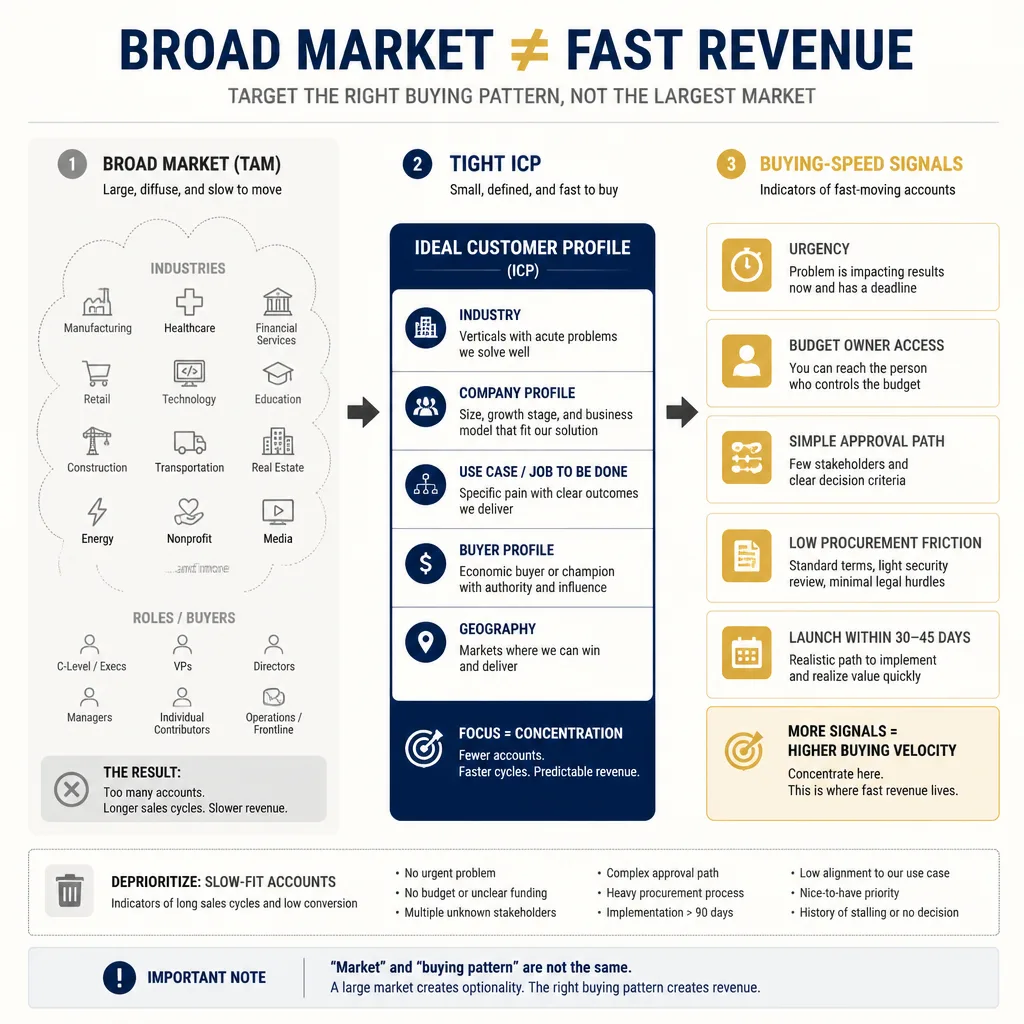
Early-stage teams often chase the wrong opportunities. They hear “big market” and take it to mean “talk to everyone.”
That usually leads to slower sales cycles and weaker pipeline quality.
A useful ICP is not just industry, company size, and job title. It should reflect who can buy quickly and implement without drama. In practice, that often means looking for:
- a painful problem that already costs money or time
- a buyer close to budget authority
- a simple approval path
- low security, legal, or procurement friction
- a realistic chance to launch within 30 to 45 days
What a useful ICP looks like
A better ICP sounds like this:
“Series A SaaS companies with 10–50 employees, founder or head of growth as buyer, clear acquisition bottleneck, no heavy procurement, and willingness to start with a fixed-scope sprint.”
That is far more useful than:
“B2B software companies.”
The second is a market. The first is a buying pattern.
Signals that a prospect can buy quickly
You are looking for signs of movement, not just fit.
Strong signals include a clear business problem, a cost of delay the buyer can explain, direct access to the budget owner, and an implementation window that exists now rather than someday. A team saying, “We need this fixed before next quarter’s launch, and I own the budget,” is very different from one saying, “We’re exploring options.”
A smaller client with a live need is often better than a larger logo with five approval layers.
Accounts to deprioritize fast
Some prospects consume time without producing near-term revenue:
- no internal owner
- no timeline
- heavy customization requests before commitment
- unclear success criteria
- enterprise procurement for a small initial deal
- lots of curiosity, little buying behavior
This is where more top-of-funnel is not the answer. If you invest in lead generation later, services like Traffics.io are most useful once your ICP and conversion path are already clear. More traffic into a weak qualification process just creates more expensive confusion.
Qualify fast: the goal is fewer bad deals
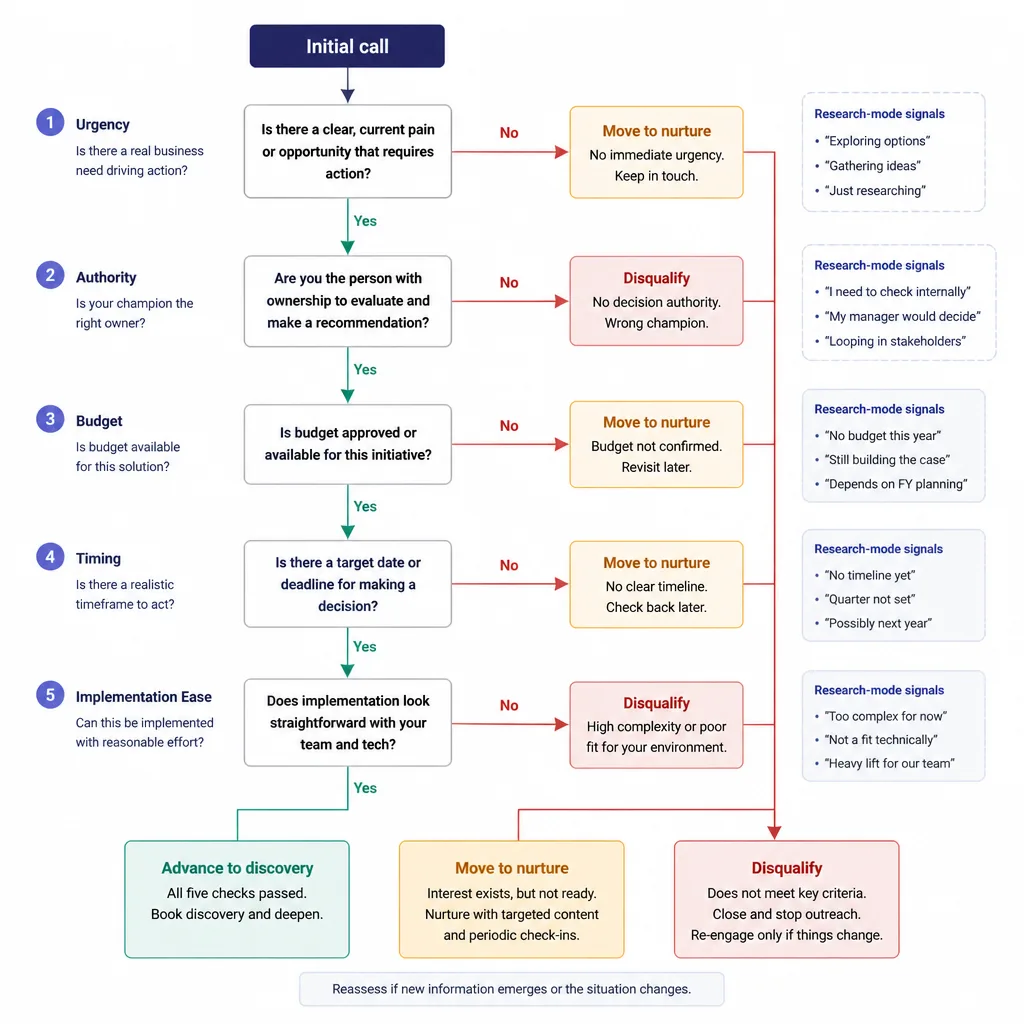
Founders often overvalue discovery because it feels productive. But a startup does not need more calls. It needs fewer weak opportunities taking up attention.
A lightweight qualification framework is enough. You do not need enterprise jargon. You need five checks:
- urgency
- authority
- budget
- timing
- implementation ease
Questions that reveal real buying intent
Ask direct questions early.
Urgency
- Why now?
- What happens if this is not solved this quarter?
- What changed recently?
Authority
- Who owns this problem internally?
- Who can approve spend?
- Who could slow this down?
Budget
- Is budget already allocated?
- Is this competing with other priorities?
- Would a smaller starter engagement fit an existing discretionary budget?
Timing
- When do you need results, not just kickoff?
- What internal deadline is driving action?
Implementation ease
- What teams need to be involved?
- Will legal, security, or procurement review this?
- Can this start with a narrower scope?
You are not interrogating the buyer. You are testing whether this can become cash on a startup timeline.
How to spot research-mode prospects
Research-mode prospects are not bad leads. They are just not active opportunities.
They usually want ideas without committing to a buying process. They ask smart questions, request recommendations, and sound engaged, but avoid specifics around budget, ownership, or next steps. Their language stays broad: “We’re looking into this,” “We’re gathering options,” “We want to learn what’s possible.”
Treat that as a separate category. Nurture lightly or close it out until a real trigger appears.
When to walk away
Indefinite nurturing feels polite. Often, it is just pipeline inflation.
If there is no clear problem owner, no practical timeline, and no buying path, step back. That time is usually better spent on active deals or improving the offer.
Sell a narrow starter offer before the big engagement
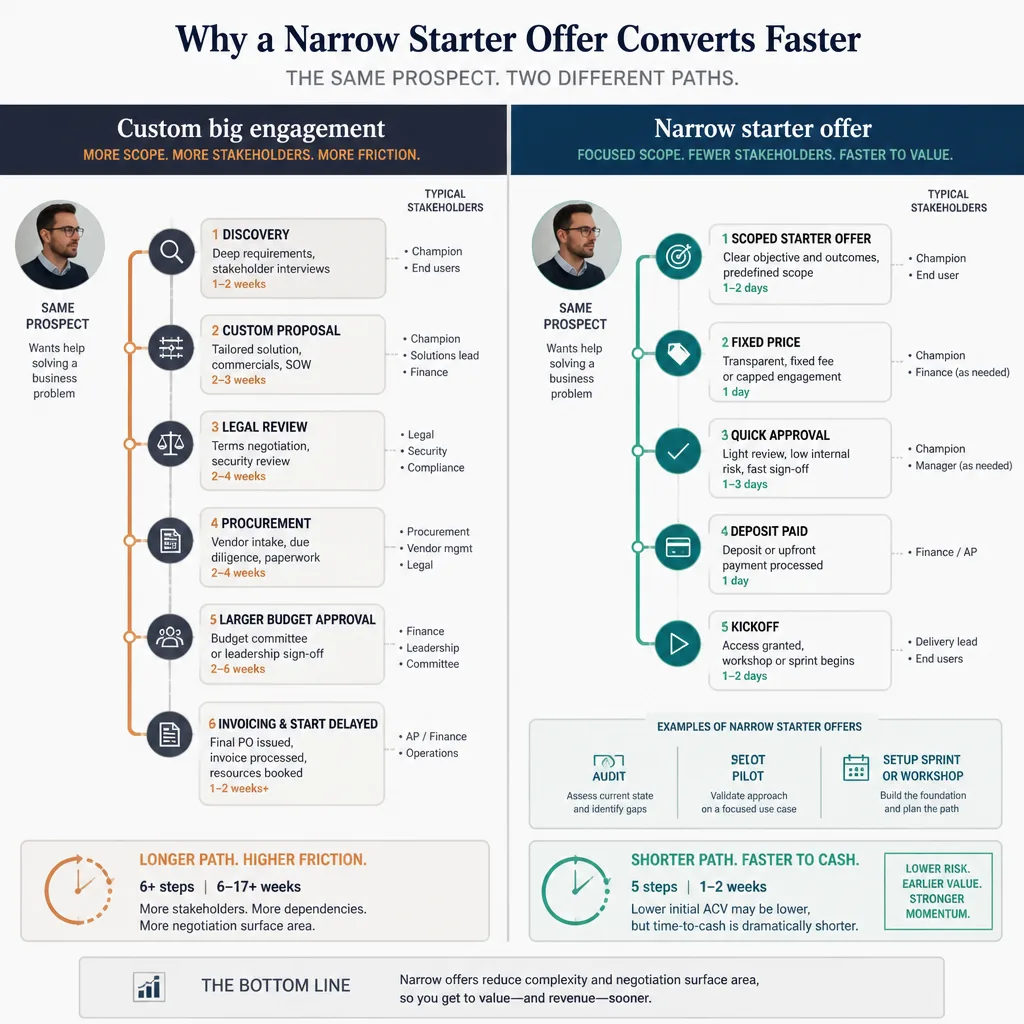
This is where many startups lose momentum. They jump straight to a large custom retainer, broad rollout, or open-ended consulting package.
That sounds valuable. It also creates friction.
A starter offer works because it lowers organizational risk. It gives the buyer a smaller decision to make, a smaller budget to approve, and a faster path to visible progress.
Why starter offers speed things up
A paid audit, setup sprint, pilot, or limited implementation is easier to approve than a six-month custom engagement. It often avoids deeper procurement review, reduces negotiation surface area, and helps the buyer justify action internally.
For the seller, it also tests whether the client is serious.
What makes a strong starter offer
A strong starter offer has:
- one clear problem
- narrow scope
- fixed deliverables
- short timeline
- explicit price
- a natural path to a larger engagement if it works
A weak starter offer is vague, over-customized, underpriced, or disconnected from the larger outcome.
Examples
- Agency: a two-week landing page and tracking audit with prioritized fixes
- SaaS with services layer: a paid onboarding sprint for one team, not the whole org
- Consultancy: a fixed-fee diagnostic workshop with a 30-day action plan
- Hybrid productized service: a pilot campaign for one channel before a broader retainer
The tradeoff is real: starter offers may reduce initial deal size. But early-stage teams usually benefit more from speed, proof, and faster cash than from chasing maximum ACV too early.
A cashflow-first sales pipeline
A stage should exist only if it changes what you do next or how you forecast. Otherwise it is CRM theater.
Stage 1: New lead
Purpose: Triage.
Exit criteria: Basic ICP fit is confirmed, the contact is relevant, and there is a credible reason to pursue.
Stage 2: Qualified opportunity
Purpose: Confirm this is more than interest.
Exit criteria: Urgency, likely buyer, rough budget reality, and plausible timing are all present.
Stage 3: Discovery completed
Purpose: Understand the problem well enough to recommend a specific next step.
Exit criteria: Problem, desired outcome, decision process, risks, and implementation constraints are clear.
Stage 4: Starter offer proposed
Purpose: Move from discussion to a concrete commercial path.
Exit criteria: A scoped offer with price, deliverables, and timeline has been shared and discussed with the actual buyer.
Stage 5: Verbal agreement
Purpose: Confirm commercial intent.
Exit criteria: The buyer has explicitly said yes to the offer direction.
This is progress. It is not bankable revenue.
Stage 6: Contract and billing agreed
Purpose: Remove execution friction before work starts.
Exit criteria: Redlines are resolved, billing entity is confirmed, AP contact is known, PO or vendor setup issues are handled, and payment terms are agreed.
Stage 7: Deposit or first invoice paid
Purpose: Confirm real conversion.
Exit criteria: Funds are received.
For a cash-constrained startup, this is the milestone that matters most.
Stage 8: Handoff to delivery or onboarding
Purpose: Protect delivery quality and future collection.
Exit criteria: Kickoff is scheduled, the delivery owner has full context, scope is confirmed, and dependencies are documented.
If your CRM marks a deal as won before payment, consider adding a separate paid stage or at least a cash-received field that affects forecasting.
How to shorten time-to-cash after the yes
A lot of startup sales pain happens after the yes.
Use deposits to test seriousness and fund delivery
Deposits do two things: improve liquidity and filter out weak commitment.
If a client agrees enthusiastically but resists any upfront payment on a service-heavy project, that is useful information. Not every buyer will accept deposits, especially larger companies, but many will for fixed-scope work.
Prefer milestone billing over end-loaded terms
If your team does meaningful work before the final outcome is delivered, end-loaded billing creates unnecessary strain.
A better structure might be:
- 50% upfront, 50% on delivery
- one-third upfront, one-third at midpoint, one-third at completion
- monthly billing tied to clearly defined phases
That is often safer than waiting until the end and then starting a net-30 clock.
Reduce procurement drag with simpler scopes and agreements
Smaller first engagements often move through internal systems faster. A tightly defined pilot is easier to approve than a broad transformation project.
This is another hidden advantage of starter offers: they are easier not just to sell, but to process.
Get billing and legal details early
Do not wait until signature to ask:
- What is the legal entity name?
- Who receives invoices?
- Does AP need vendor setup?
- Is a purchase order required?
- Are there tax or VAT details to collect?
- What payment method will be used?
Many deals do not stall because the buyer changed their mind. They stall because nobody handled the boring details soon enough.
The handoff is part of the sale
A messy handoff delays delivery. Delayed delivery delays value. Delayed value often delays final invoices, approvals, and expansion.
That makes handoff a sales issue, not just an operations issue.
Why messy handoffs create payment delays
A familiar failure pattern looks like this: sales promises a quick launch, delivery starts, then discovers missing access, undefined scope, extra stakeholders, or expectations the client thought were included. The work slows, the relationship gets tense, and the billing timeline drifts.
What sales should capture before handoff
At minimum, sales should document:
- the exact problem being solved
- promised outcomes
- scope and exclusions
- stakeholders and decision-makers
- timeline assumptions
- client dependencies
- pricing and billing schedule
- what success looks like to the client
How to align expectations
A clean handoff means the delivery team is not guessing what was sold, and the client is not discovering surprises after kickoff.
That protects margin, trust, and collection.
Metrics that matter
Most sales dashboards are too busy. For startups, a short list is better.
Track the metrics that connect activity to cash:
- Lead-to-qualified rate: Are you attracting the right opportunities?
- Qualified-to-proposal rate: Are qualified deals actually worth advancing?
- Proposal-to-paid rate: Better than proposal-to-close if deals often stall after yes
- Median days from first call to invoice: Where is process drag happening?
- Median days from invoice to cash: Is the problem sales friction or collections friction?
- Average upfront cash collected per new deal: How much does each sale improve liquidity right away?
Lead volume without these numbers can be actively misleading.
Common founder mistakes
Treating every lead like a strategic account
Not every prospect deserves deep founder attention. Some are interesting but slow, political, or structurally poor fits.
Writing custom proposals too early
Custom proposals feel responsive. They also expand negotiation and delay decisions. Most startups do better with tighter, repeatable starter offers.
Skipping payment discussions until the end
This creates avoidable surprises right when momentum matters most.
Marking deals as won before money arrives
Signed is better than verbal. Paid is better than signed.
Letting delivery teams discover missing details after the sale
This is where margin leaks and payment delays often begin.
Conclusion
A good startup sales process is not complicated. It is disciplined.
It starts with a tight ICP, qualifies hard, uses a narrow starter offer, and separates real progress from hopeful activity. Most importantly, it does not treat the contract as the finish line. It treats payment, handoff, and delivery readiness as part of selling.
If you remember one thing, make it this: build your sales process backward from cash receipt, not forward from lead volume.
That shift changes who you target, what you sell first, how you forecast, and how quickly new business actually improves your cash position.
FAQ
What is a good B2B sales process for a startup?
A good startup sales process is simple, disciplined, and built around time-to-cash. It should help the team target the right ICP, qualify weak-fit leads out quickly, sell a narrow starter offer, agree billing terms early, and track deals through payment rather than stopping at signed contracts.
Why should startups build sales processes around cash flow instead of pipeline volume?
Because pipeline activity does not pay payroll. Startups often mistake meetings, proposals, and verbal yeses for progress, but the real constraint is how quickly deals turn into collected cash. A cashflow-first process reduces delays between lead, agreement, invoicing, and payment.
How do startups shorten B2B sales cycles?
They shorten cycles by tightening their ICP, qualifying for urgency and authority early, avoiding oversized custom proposals, leading with a smaller starter offer, simplifying contracts, and discussing billing terms before final approval.
What stages should a startup sales pipeline have?
A practical version uses these stages: New lead, Qualified opportunity, Discovery completed, Starter offer proposed, Verbal agreement, Contract and billing agreed, Deposit or first invoice paid, and Handoff to delivery or onboarding.
Should a startup mark a deal as won when the contract is signed?
Usually not. For cash-constrained startups, signed is not the same as paid. It is often better to separate verbal agreement, contract complete, invoice sent, and cash received so forecasting reflects actual liquidity rather than optimism.
What is a starter offer in B2B sales?
A starter offer is a narrow, well-scoped first engagement designed to reduce buying friction. Examples include a paid audit, pilot, setup sprint, workshop, or limited-scope implementation. The goal is to make the first yes easier while creating a natural path to a larger engagement.
How can startups get paid faster by B2B clients?
They can get paid faster by using deposits where possible, preferring milestone billing over end-loaded invoicing, collecting billing and legal details before final approval, reducing procurement drag with simpler scopes, and sending invoices as soon as the triggering milestone is reached.
What qualification questions matter most for early-stage B2B sales?
The most useful questions focus on urgency, authority, budget, timing, and implementation ease. Ask why the problem matters now, who owns the decision, whether budget exists, what deadline is driving action, and what operational or procurement blockers could delay a start.
How do you spot a prospect in research mode?
Research-mode prospects often show curiosity without commitment. They ask for ideas but avoid discussing budget, timing, ownership, or next steps. If there is no clear trigger event or buying path, they likely belong in nurture rather than in an active opportunity stage.
What sales metrics matter most in a cashflow-first startup process?
The most useful metrics are lead-to-qualified rate, qualified-to-proposal rate, proposal-to-paid rate, median days from first call to invoice, median days from invoice to cash, and average upfront cash collected per new deal. These connect sales activity to real cash outcomes.